What Is a PCV Valve? Purpose, Function, Location, Hose & More
The PCV valve is a small engine component that plays an important role in controlling crankcase pressure, reducing harmful emissions, and keeping oil vapor and combustion gases from building up inside the engine. Although the part itself may be inexpensive and simple, a faulty PCV system can contribute to rough idle, oil leaks, increased oil consumption, sludge buildup, vacuum leaks, and other drivability problems.
A PCV valve is part of the Positive Crankcase Ventilation system. It routes blow-by gases and oil vapors from the engine crankcase back into the intake system so they can be burned instead of being released into the atmosphere or accumulating inside the engine.
If you are learning what is a PCV valve, it helps to understand that the valve does not work by itself. The complete PCV system may include a PCV valve, ventilation hoses, fresh-air hose, valve-cover ports, intake-manifold connections, oil separators, and sometimes electronically controlled components.
Modern vehicles also do not all use the same PCV design. Some have a traditional replaceable valve that can be removed in a few minutes. Others integrate the PCV valve or pressure-regulating diaphragm into a valve cover, oil separator, or intake assembly. On those engines, servicing the PCV system can involve replacing a much larger component.
This pillar guide explains what PCV stands for, what the PCV valve does, how it works, where it is located, what a PCV valve hose is, where the hoses connect, common symptoms of failure, and how to inspect and maintain the system.
What Is a PCV Valve?
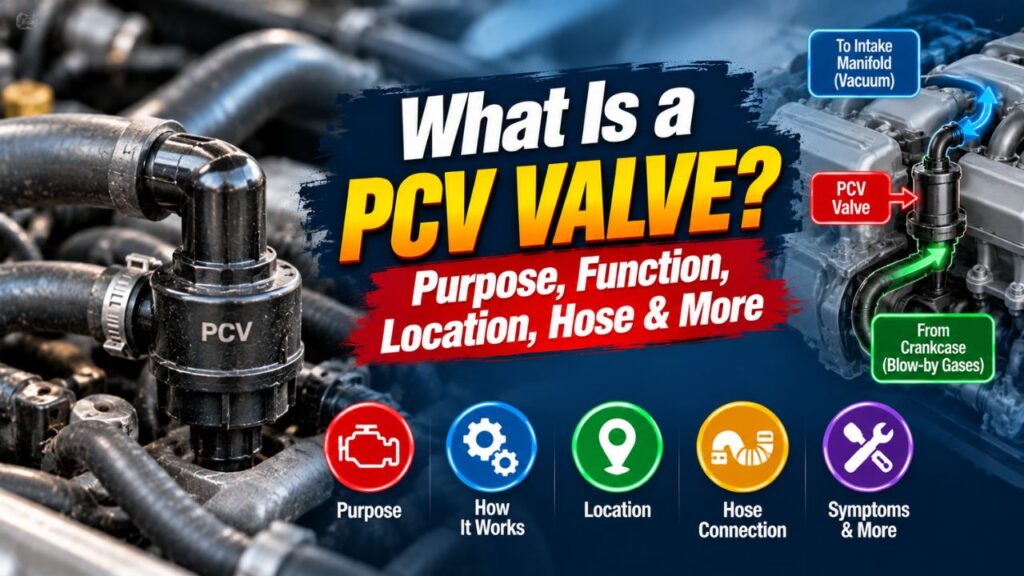
A PCV valve, or Positive Crankcase Ventilation valve, is a component in the engine’s crankcase ventilation system that controls the flow of crankcase gases into the intake system.
During normal engine operation, a small amount of combustion gas can escape past the piston rings and enter the crankcase. This is called blow-by.
Blow-by gases can contain:
- Unburned fuel vapors
- Combustion gases
- Moisture
- Oil vapor
- Combustion byproducts
If these gases were allowed to remain inside the crankcase, they could increase pressure and contribute to oil contamination and sludge.
The PCV system continuously removes these gases and sends them back into the engine intake, where they are burned during normal combustion.
What Does PCV Valve Stand For?
PCV stands for Positive Crankcase Ventilation.
Breaking the term down:
- Positive means the system actively uses intake vacuum or controlled pressure differences to move gases.
- Crankcase refers to the lower portion of the engine where the crankshaft and engine oil are located.
- Ventilation means gases and vapors are removed and replaced with cleaner incoming air.
Older engines often used simple crankcase vents that released vapors directly into the atmosphere.
The PCV system provides a cleaner and more controlled method.
What Does a PCV Valve Do?
The basic answer to what does a PCV valve do is that it controls how much crankcase vapor enters the engine intake.
The valve has several important functions.
Removes Blow-By Gases
Some combustion pressure gets past the piston rings even in a healthy engine.
The PCV system removes those gases before they accumulate inside the crankcase.
Helps Control Crankcase Pressure
Without proper ventilation, pressure can build inside the engine.
Excessive crankcase pressure can contribute to:
- Oil leaks
- Oil being pushed past seals
- Dipstick movement
- Gasket leakage
- Increased oil consumption
The PCV system helps maintain controlled crankcase pressure.
Reduces Emissions
Instead of allowing hydrocarbon-rich crankcase vapors to escape directly into the atmosphere, the PCV system routes them back into the combustion process.
This helps reduce emissions.
Helps Reduce Sludge Formation
Blow-by gases can contain moisture and combustion contaminants.
Removing these vapors helps limit the amount of contamination remaining in the crankcase.
This can contribute to cleaner engine oil and reduced sludge formation when combined with proper oil-change intervals.
Controls Airflow Into the Intake
The PCV valve does not normally remain completely open at all times.
It meters airflow based on engine operating conditions.
This prevents excessive airflow from acting like a major vacuum leak.
What Is the Purpose of a PCV Valve?
The purpose of a PCV valve is to regulate crankcase ventilation while maintaining proper engine operation.
The complete PCV system is intended to:
- Vent the crankcase
- Reduce pressure buildup
- Recycle hydrocarbon vapors
- Prevent excessive oil vapor from entering the intake
- Limit unmetered airflow
- Improve emissions control
A well-functioning PCV system creates a controlled flow path through the engine.
Fresh filtered air usually enters one side of the crankcase, while crankcase gases exit through the PCV side and move toward the intake manifold.
Why Does an Engine Need Crankcase Ventilation?
Every piston engine produces some blow-by.
The piston rings provide a seal between the combustion chamber and cylinder wall, but that seal is not absolutely perfect.
A small quantity of combustion gas escapes into the crankcase.
Without ventilation, those gases would accumulate.
Possible results include:
- Increased internal pressure
- Oil contamination
- Moisture buildup
- Sludge
- Gasket leaks
- Seal leaks
The PCV system provides a continuous method for managing those gases.
How Does a PCV Valve Work?
To understand how does a PCV valve work, consider how intake-manifold vacuum changes with engine load.
A traditional PCV valve commonly contains:
- Spring
- Plunger
- Pintle
- Internal passage
The valve changes its effective opening depending on pressure differences between the crankcase and intake manifold.
At Idle
When the engine is idling, intake manifold vacuum is high.
If the PCV passage were completely open, too much air could be drawn through the crankcase and into the intake.
The valve therefore restricts flow.
A controlled amount of crankcase vapor still enters the intake manifold.
During Normal Cruising
Under light or moderate load, intake vacuum remains present but is generally lower than at idle.
The PCV valve opens farther and allows more crankcase gases to flow.
This matches the increased amount of blow-by created by the engine.
Under Heavy Acceleration
During wide-open throttle or heavy engine load, manifold vacuum becomes much lower.
The pressure difference across the PCV valve changes.
Ventilation flow can be reduced or redirected depending on the system design.
Some crankcase gases may move through a breather connection toward the intake tract upstream of the throttle.
During a Backfire
Traditional PCV valves can help protect the crankcase if pressure suddenly travels backward through the intake.
The valve may move toward a closed position, helping prevent a flame or pressure pulse from traveling directly into the crankcase.
Modern engines may use different PCV architectures, so this behavior is not identical on every vehicle.
What Is Blow-By?
Blow-by is combustion gas that escapes past the piston rings and enters the crankcase.
Even a healthy engine produces some blow-by.
The amount can increase with:
- Engine wear
- Worn piston rings
- Cylinder wear
- High engine load
- High combustion pressure
Excessive blow-by can overwhelm the PCV system.
That may cause:
- Crankcase pressure
- Oil leaks
- Oil vapor in the intake
- Increased oil consumption
A new PCV valve cannot repair worn piston rings or severe internal engine wear.
How Does Air Flow Through the PCV System?
A typical PCV system has two main airflow paths.
Fresh-Air Side
Filtered air enters the crankcase through:
- Valve-cover breather
- Fresh-air hose
- Intake duct connection
This air usually comes from the engine intake after the air filter.
Vapor Outlet Side
Crankcase vapors leave through the PCV valve or pressure regulator.
They then move toward:
- Intake manifold
- Intake plenum
- Turbocharger inlet on certain systems
The engine burns those vapors along with the normal air-fuel mixture.
The exact routing varies by vehicle.
What Is a PCV Valve Hose?
A PCV valve hose is a vacuum or ventilation hose that carries crankcase gases between the PCV system and the intake system.
Depending on the vehicle, there may be several hoses associated with crankcase ventilation.
A traditional setup might use:
- PCV valve hose
- Fresh-air breather hose
More complicated systems may have:
- Multiple molded hoses
- Check valves
- Oil separator connections
- Turbocharger inlet hoses
- Intake manifold ports
PCV hoses must remain airtight and resistant to oil vapor.
What Is the PCV Valve Hose Made Of?
PCV hoses are normally constructed from materials designed to handle:
- Engine heat
- Oil vapor
- Vacuum
- Hydrocarbons
They may be:
- Molded rubber
- Reinforced rubber
- Engineered plastic
- Combination plastic/rubber assemblies
Using ordinary hose that is not rated for oil vapor and engine vacuum can lead to early failure.
Where Does the PCV Valve Hose Connect To?
If you are wondering where does the PCV valve hose connect to, a traditional PCV hose usually connects the PCV valve or crankcase port to an intake manifold vacuum source.
A typical layout is:
Crankcase/valve cover → PCV valve → PCV hose → Intake manifold
The fresh-air side may follow a different route:
Air intake duct → Breather hose → Valve cover/crankcase
The exact connection depends on the engine.
Intake Manifold Connection
Many traditional systems connect the PCV hose directly to the intake manifold.
Manifold vacuum pulls crankcase gases through the system.
Intake Tube Connection
A fresh-air hose commonly connects between the valve cover and the intake tube.
This supplies filtered air to the crankcase.
Turbocharged Engine Connections
Turbocharged engines can require more complicated PCV routing because intake pressure changes dramatically between vacuum and boost conditions.
They may use:
- Check valves
- Oil separators
- Multiple ventilation passages
- Turbo inlet connections
These systems are designed to prevent boost pressure from pressurizing the crankcase.
Where Is the PCV Valve Located?
The answer to where is the PCV valve located depends on the engine design.
Common locations include:
- Valve cover
- Rubber grommet in the valve cover
- Intake manifold
- Rear of the engine
- Oil separator housing
- Crankcase breather assembly
- Integrated valve-cover assembly
On older engines, the PCV valve may be very easy to identify.
It often looks like a small metal or plastic valve inserted into a rubber grommet in the valve cover.
A vacuum hose attaches to the other end.
PCV Valve Location on Modern Engines
Modern engines can make PCV identification more difficult.
The PCV valve may be integrated into:
- Valve cover
- Crankcase vent module
- Oil separator
- Intake manifold
Some vehicles do not have a small replaceable valve at all.
Instead, a diaphragm or calibrated passage performs the pressure-regulating function.
This means searching for a traditional removable PCV valve may lead nowhere even though the engine has a complete PCV system.
Where Is the PCV Valve Located on a V6 or V8?
On V-type engines, the valve may be located on either valve cover.
One side may contain the metered PCV outlet while the opposite cover provides the fresh-air breather connection.
The exact position depends on:
- Engine family
- Model year
- Intake design
Always use vehicle-specific service information to confirm.
Where Is the PCV Valve Located on a Four-Cylinder Engine?
Common locations include:
- Top of the valve cover
- Rear side of the valve cover
- Intake manifold area
- Built into the valve cover
Transverse engine layouts can make the valve difficult to see from the front of the vehicle.
What Does a PCV Valve Look Like?
Traditional PCV valves are usually small.
They may be:
- Metal
- Plastic
- Straight
- 90-degree shaped
They often have:
- Hose connection on one end
- Grommet connection or threads on the other
Integrated PCV systems may not look like a valve at all.
They can appear as:
- Round diaphragm covers
- Molded plastic housings
- Internal passages built into the valve cover
What Is a PCV Breather Hose?
The breather hose usually carries filtered fresh air into the crankcase.
It commonly connects the valve cover to the intake duct upstream of the throttle body.
During normal operation:
- Filtered air enters through the breather side.
- Air moves through the crankcase.
- Blow-by gases mix with that air.
- The gases exit through the PCV side.
- They enter the intake manifold and are burned.
This creates continuous ventilation.
PCV Valve vs. PCV Hose
The PCV valve and PCV hose are related but not the same component.
| Component | Main Function |
| PCV valve | Controls crankcase vapor flow |
| PCV hose | Carries vapors between components |
| Breather hose | Supplies fresh filtered air to crankcase |
| Oil separator | Reduces liquid oil entering intake |
A bad hose can create symptoms even when the PCV valve itself is functioning correctly.
What Is an Oil Separator in a PCV System?
Crankcase gases contain oil mist.
Engines often use an oil separator or baffling system to remove some oil droplets before the gases enter the intake.
The separated oil can drain back into the engine.
This helps reduce:
- Oil consumption
- Intake deposits
- Oil contamination in the intake system
Some engines integrate the oil separator directly into the valve cover.
What Happens If the PCV Valve Fails?
A PCV valve can fail in several ways.
It may become:
- Stuck open
- Stuck closed
- Restricted
- Broken internally
- Contaminated by sludge
Each failure mode can produce different symptoms.
Symptoms of a PCV Valve Stuck Open
A valve that allows too much airflow can behave like a vacuum leak.
Possible symptoms include:
- Rough idle
- High idle
- Lean mixture
- Misfire
- Check engine light
- Whistling noise
- Increased oil consumption
The engine computer may detect fuel-trim problems because extra air is entering the intake.
Symptoms of a PCV Valve Stuck Closed
A closed or blocked valve prevents crankcase gases from venting properly.
Possible symptoms include:
- Oil leaks
- Crankcase pressure
- Oil pushed past seals
- Sludge
- Moisture contamination
- Dipstick movement
- Oil around gaskets
Severe pressure buildup can worsen existing gasket and seal weaknesses.
Common Bad PCV Valve Symptoms
Possible symptoms include:
- Rough idle
- Engine hesitation
- Vacuum leak
- High idle
- Oil leaks
- Increased oil consumption
- Whistling or hissing
- Check engine light
- Sludge buildup
- Excess oil in intake
- Poor fuel trims
None of these symptoms alone proves the PCV valve is bad.
Other engine problems can cause similar symptoms.
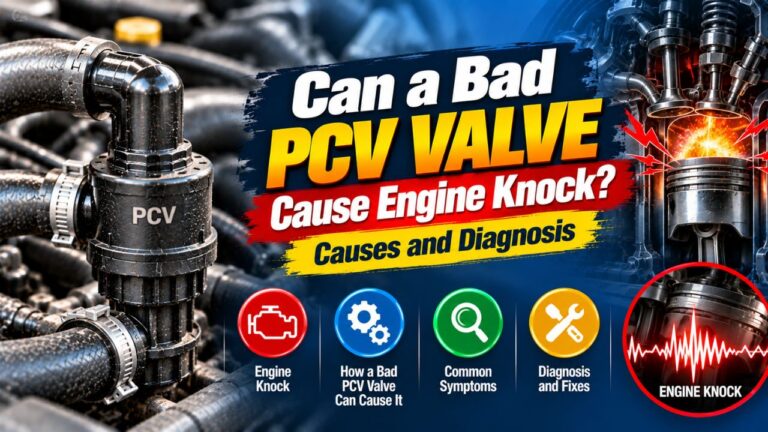
Can a Bad PCV Valve Cause Rough Idle?
Yes.
A PCV valve stuck too far open or a cracked PCV hose can introduce excess air into the intake manifold.
That can create a vacuum leak.
Possible results include:
- Unstable idle
- Lean fuel mixture
- Misfire
- Higher-than-normal idle
Modern engine computers may compensate to some extent by adding fuel.
If the vacuum leak becomes too large, fuel-trim trouble codes may appear.
Can a Bad PCV Valve Cause an Oil Leak?
Yes.
If the PCV system cannot relieve crankcase pressure effectively, pressure can build inside the engine.
That pressure can push oil through:
- Valve cover gaskets
- Crankshaft seals
- Camshaft seals
- Other weak sealing areas
Replacing a leaking gasket without correcting a blocked PCV system can sometimes result in another leak.
Can a Bad PCV Valve Cause Oil Consumption?
Yes, depending on the failure.
A PCV system pulling excessive oil mist into the intake can increase oil consumption.
Possible causes include:
- Failed PCV valve
- Torn diaphragm
- Failed oil separator
- Incorrect PCV flow
- Excessive engine blow-by
Oil consumption should not automatically be blamed on the PCV valve because worn piston rings, valve guides, turbocharger problems, and external leaks can produce similar results.
Can a Bad PCV Valve Cause Smoke?
It can.
If excessive oil enters the intake through the PCV system, the engine may burn that oil.
That can contribute to blue or bluish exhaust smoke.
However, smoke can also result from:
- Piston ring wear
- Valve stem seals
- Turbocharger seals
- Internal engine damage
A complete diagnosis is important.
Can a Bad PCV Valve Cause a Check Engine Light?
Yes.
A PCV fault can affect the air-fuel mixture and trigger diagnostic trouble codes.
Possible code categories include:
- Lean condition
- Idle control
- Misfire
- Crankcase ventilation system performance
Some modern vehicles also directly monitor crankcase ventilation.
The exact codes vary by vehicle.
Can a PCV Valve Cause a Vacuum Leak?
Yes.
A PCV valve stuck open, cracked hose, broken fitting, or torn diaphragm can allow too much air into the intake.
That creates a vacuum leak.
Common signs include:
- Hissing
- Whistling
- Rough idle
- Lean trouble codes
- High fuel trim values
Can a PCV Valve Cause a Whistling Noise?
Yes.
A damaged diaphragm or restricted PCV passage can sometimes create a high-pitched whistle.
Whistling can change when:
- Oil cap is loosened
- Dipstick is removed
- Engine RPM changes
This can provide a diagnostic clue that crankcase vacuum is abnormal.
What Happens If the PCV Hose Is Cracked?
A cracked PCV hose can cause:
- Vacuum leak
- Rough idle
- Lean mixture
- Oil vapor leakage
- Check engine light
- Dirt entering the ventilation system
Molded plastic hoses can become brittle with age and engine heat.
Inspect the complete hose rather than only the visible ends.
Can You Drive With a Bad PCV Valve?
A mildly failing PCV system may not immediately prevent the vehicle from driving.
However, continuing to ignore the problem can contribute to:
- Oil leaks
- Sludge
- Poor idle
- Increased emissions
- Oil consumption
- Seal damage
If the vehicle develops severe oil leakage, heavy smoke, significant drivability problems, or abnormal crankcase pressure, repair should not be delayed.
How Do You Test a PCV Valve?
Testing depends on the system design.
Older replaceable valves can sometimes be checked with simple methods.
Modern integrated systems often require more detailed diagnosis.
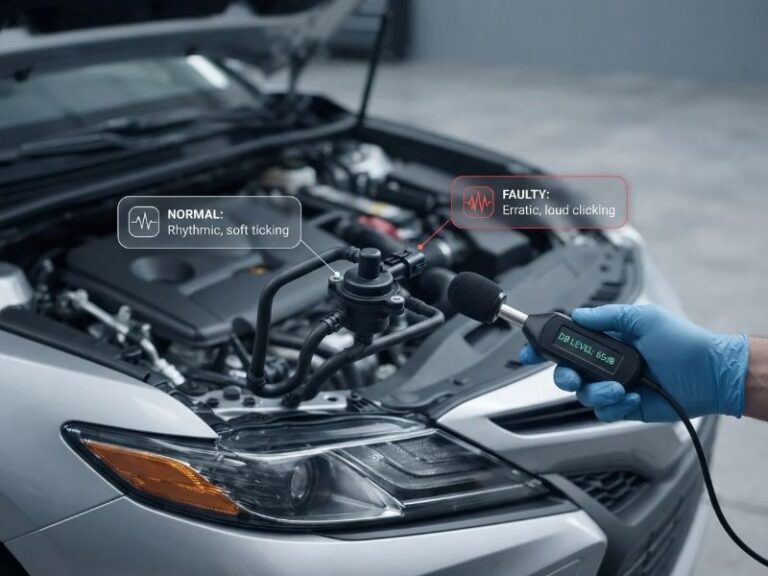
Listen for Internal Movement
Some traditional PCV valves make a rattling sound when removed and shaken.
However, a valve that rattles is not automatically good, and a valve that does not rattle is not automatically bad.
Different designs behave differently.
Check for Vacuum
With the engine idling, a traditional PCV hose may show intake vacuum.
A technician can verify whether airflow and pressure are within specification.
Inspect Fuel Trims
A scan tool can reveal whether the engine is compensating for excessive unmetered air.
High positive fuel trims may indicate a vacuum leak.
Measure Crankcase Pressure
A more accurate diagnostic approach is measuring crankcase pressure or vacuum.
Excessive positive pressure may indicate restricted ventilation or severe blow-by.
Excessive crankcase vacuum may indicate a PCV valve or diaphragm allowing too much flow.
Can You Test a PCV Valve by Removing the Oil Cap?
The behavior of the oil filler cap can sometimes provide clues, but it is not a universal test.
A properly operating engine may have a small amount of crankcase vacuum.
Extremely strong suction at the cap may indicate an abnormal PCV condition on some engines.
Pressure pushing outward may suggest restricted ventilation or excessive blow-by.
Vehicle-specific specifications are more reliable than interpreting the oil cap alone.
How Often Should a PCV Valve Be Replaced?
There is no universal replacement interval.
Some manufacturers provide a scheduled maintenance interval.
Others recommend inspection or replacement only when symptoms appear.
Modern integrated PCV systems may not have a separately replaceable valve.
Factors affecting PCV life include:
- Engine operating temperature
- Oil-change history
- Sludge
- Driving conditions
- Component design
Follow the maintenance schedule for the vehicle.
How Much Does a PCV Valve Cost?
A traditional standalone PCV valve is usually an inexpensive component.
However, costs vary greatly when the PCV system is integrated into:
- Valve cover
- Oil separator
- Intake manifold
- Crankcase vent assembly
In those cases, the complete assembly and labor may be significantly more expensive.
How Hard Is It to Replace a PCV Valve?
Difficulty ranges from extremely easy to fairly involved.
A traditional valve may require:
- Remove hose.
- Pull valve from grommet.
- Install replacement valve.
- Reconnect hose.
An integrated system may require removal of:
- Valve cover
- Intake components
- Turbocharger plumbing
- Engine covers
Always confirm the procedure before buying parts.
How to Replace a Traditional PCV Valve
A general replacement process is:
- Allow the engine to cool.
- Locate the PCV valve.
- Inspect hose routing.
- Remove the hose carefully.
- Remove the valve from its grommet or threaded port.
- Inspect the grommet and hose.
- Install the correct replacement valve.
- Reconnect the hose.
- Start the engine and check for leaks or abnormal idle.
Vehicle-specific procedures may differ.
Should You Replace the PCV Hose Too?
Replace the hose if it is:
- Cracked
- Hardened
- Swollen
- Collapsed
- Oil-soaked
- Brittle
- Leaking
A new PCV valve connected to a leaking old hose may not correct the system problem.
Can You Clean a PCV Valve Instead of Replacing It?
Older metal PCV valves were sometimes cleaned, but replacement is generally preferable when a replaceable valve is inexpensive.
Cleaning does not guarantee the internal spring and metering components remain within specification.
Integrated PCV assemblies should be serviced according to manufacturer procedures.
Do not spray random solvents into diaphragms or plastic PCV components without verifying compatibility.
What Happens If You Remove the PCV Valve Completely?
Removing the PCV system is generally not appropriate for a street vehicle designed to use it.
Possible consequences include:
- Increased emissions
- Crankcase pressure problems
- Oil leaks
- Unmetered air
- Engine calibration issues
- Legal emissions compliance problems
The engine management system is typically designed around a functioning crankcase ventilation system.
PCV Valve vs. EGR Valve
The PCV valve and EGR valve serve different purposes.
| Component | Primary Purpose |
| PCV valve | Controls crankcase vapor ventilation |
| EGR valve | Routes some exhaust gas back into the intake to reduce certain emissions |
The PCV system handles gases from the crankcase.
The EGR system handles gases from the exhaust.
They should not be confused.
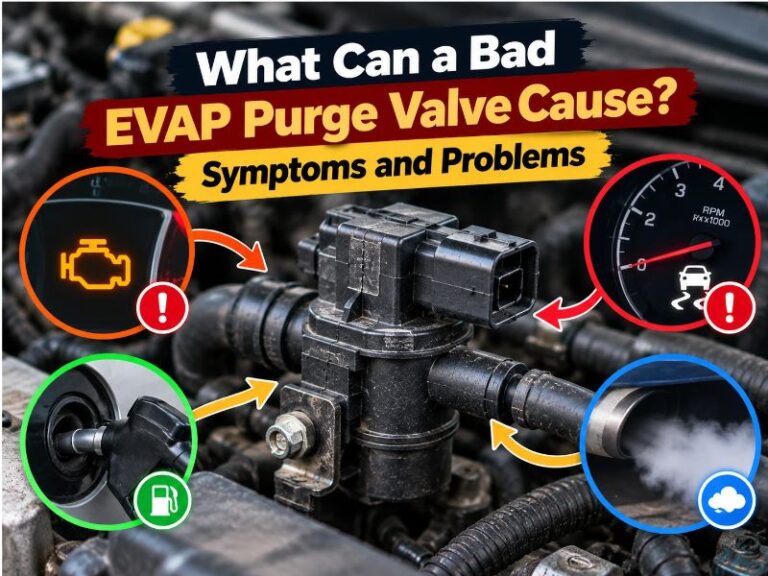
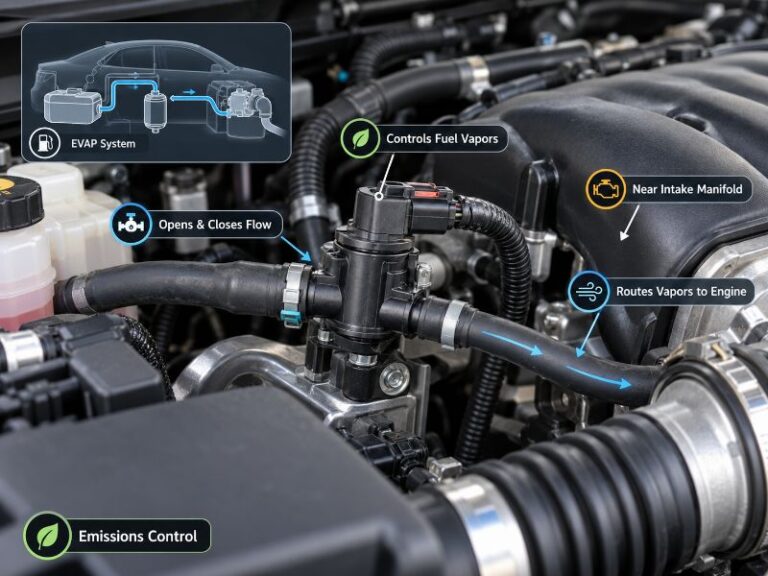
PCV Valve vs. EVAP System
These systems also control different vapors.
PCV System
Handles:
- Crankcase gases
- Blow-by
- Oil vapor
EVAP System
Handles:
- Gasoline vapor from the fuel tank
- Fuel-system vapor storage
- Purge into the engine
Both reduce hydrocarbon emissions but operate in different parts of the vehicle.
PCV Valve on Turbocharged Engines
Turbocharged engines require careful crankcase pressure management.
Under boost, the intake manifold may be pressurized instead of under vacuum.
The PCV system must prevent that boost pressure from entering the crankcase.
It may use:
- Check valves
- Pressure-regulating valves
- Oil separators
- Multiple flow paths
Under vacuum, crankcase vapors may flow toward the intake manifold.
Under boost, the system may route vapors toward the turbocharger inlet instead.
A faulty check valve can contribute to excessive crankcase pressure.
PCV Systems and Oil Catch Cans
An aftermarket oil catch can is designed to capture some oil mist from crankcase vapors before those vapors enter the intake.
A catch can is not normally a replacement for a properly functioning PCV system.
Improper catch-can installation can create:
- Restricted ventilation
- Vacuum leaks
- Freezing problems in cold climates
- Crankcase pressure
Any modification should preserve the intended PCV airflow and emissions function.
Can PCV Problems Cause Intake Carbon Deposits?
PCV vapors contain oil mist.
On certain engines, especially gasoline direct-injection engines, oil vapor entering the intake can contribute to deposits on intake valves because fuel does not wash across those valves in the same way it does in port-injected engines.
The PCV system is only one contributor.
Engine design, oil consumption, driving conditions, and EGR systems can also affect deposits.
Common PCV Valve Problems
PCV systems commonly fail because of:
Sludge
Poor oil maintenance can allow deposits to block small passages.
Torn Diaphragm
Integrated PCV regulators often contain rubber diaphragms that can rupture.
Cracked Hoses
Heat and age can cause hoses to become brittle.
Broken Plastic Fittings
Modern molded PCV lines can crack during removal or from age.
Failed Check Valve
Turbocharged systems often depend on check valves to control flow direction.
Excessive Blow-By
A healthy PCV system may be overwhelmed by severe engine wear.
How to Prevent PCV System Problems
Basic engine maintenance helps protect the PCV system.
Change Engine Oil on Schedule
Fresh oil helps reduce sludge and deposits.
Use the oil type and viscosity specified for the engine.
Inspect Hoses
Look for:
- Cracks
- Collapsed sections
- Oil saturation
- Loose connections
Address Oil Leaks
Repeated gasket leakage may indicate abnormal crankcase pressure.
Use Correct Replacement Parts
PCV valves are often calibrated for a specific engine.
An incorrect valve may flow too much or too little air.
Do not choose a replacement simply because it physically fits.
Common Mistakes When Diagnosing a PCV System
Assuming Every Engine Has a Removable PCV Valve
Many modern engines integrate the valve into another component.
Replacing the Valve Without Checking the Hose
A vacuum leak may remain if the hose is cracked.
Using a Universal Valve
PCV flow characteristics matter.
Use the correct application-specific part.
Ignoring Excessive Engine Blow-By
Repeated PCV problems can indicate internal engine wear.
Assuming Oil in the Intake Always Means PCV Failure
A light oil film can be normal in some intake systems.
Excessive oil may also come from turbocharger or engine wear.
FAQs About What Is a PCV Valve
What does PCV valve stand for?
PCV stands for Positive Crankcase Ventilation.
The valve is part of a system that removes crankcase gases and routes them back into the engine intake.
What does a PCV valve do?
It regulates the flow of blow-by gases and oil vapor from the crankcase into the intake system.
This helps control crankcase pressure, emissions, and contamination.
How does a PCV valve work?
A traditional PCV valve responds to intake-manifold vacuum and pressure differences.
It meters airflow so the engine can ventilate the crankcase without creating an excessive vacuum leak.
What is the purpose of a PCV valve?
Its purpose is to ventilate the crankcase, control internal pressure, reduce hydrocarbon emissions, and route blow-by gases back into the combustion process.
What is a PCV valve hose?
It is a hose that carries crankcase vapors between the PCV system and the engine intake.
A separate breather hose may provide fresh filtered air to the crankcase.
Where is the PCV valve located?
Common locations include the valve cover, intake manifold, crankcase vent housing, or oil separator.
On many modern engines, the PCV valve is integrated into the valve cover.
Where does the PCV valve hose connect to?
A traditional PCV hose commonly connects the PCV valve or crankcase outlet to an intake-manifold vacuum port.
The fresh-air breather hose often connects the valve cover to the intake duct.
Can a bad PCV valve cause rough idle?
Yes.
A stuck-open valve, cracked hose, or torn PCV diaphragm can act like a vacuum leak and cause rough idle, lean operation, or misfires.
Conclusion
The overall answer to what is a PCV valve is that it is the flow-control component of the engine’s Positive Crankcase Ventilation system. Its job is to remove blow-by gases and oil vapor from the crankcase, regulate how those gases enter the intake, reduce harmful emissions, and help prevent excessive pressure from building inside the engine.
Understanding what does a PCV valve do and how does a PCV valve work also makes many related engine symptoms easier to diagnose. A stuck-open valve can behave like a vacuum leak and cause rough idle or lean operation, while a blocked system can increase crankcase pressure and contribute to oil leaks, sludge, and seal problems.
The exact PCV valve location and hose routing depend on the engine. Older vehicles often use a small removable valve in the valve cover, while modern engines may integrate the PCV valve, diaphragm, and oil separator into a larger valve-cover or crankcase ventilation assembly. A PCV valve hose typically connects the crankcase ventilation outlet to the intake manifold, while another hose supplies filtered fresh air from the intake system.
The practical takeaway is to treat the PCV system as a complete ventilation system rather than focusing only on the small valve. Inspect the valve, hoses, fittings, oil separator, and crankcase pressure together. When the system is working correctly, it quietly helps the engine stay cleaner, reduces emissions, controls internal pressure, and supports reliable operation.