What Can a Bad EVAP Purge Valve Cause? Symptoms and Problems
A bad EVAP purge valve can cause rough idle, hard starting, stalling, engine misfires, poor fuel economy, hesitation, unusual RPM behavior, EVAP trouble codes, and a Check Engine Light. The exact symptoms depend heavily on whether the valve is stuck open, stuck closed, leaking internally, or failing electrically.
The purge valve is part of the vehicle’s Evaporative Emission Control System (EVAP). Its job is to control when stored fuel vapors from the charcoal canister enter the engine’s intake manifold to be burned. When the valve operates correctly, the Engine Control Module (ECM) opens it under appropriate conditions and carefully controls vapor flow.
Problems begin when vapor or outside air enters the intake when it should not, or when the valve fails to flow vapor when commanded. A purge valve stuck open can act much like a vacuum leak, particularly at idle, while a valve that remains closed can interfere with EVAP operation and trigger emissions-related diagnostic codes.
If you are trying to understand what can a bad EVAP purge valve cause, this guide explains the major symptoms, why they happen, whether a purge valve can cause misfires, stalling, no-start conditions, rev hang, poor gas mileage, and what typically causes the valve itself to fail.
What Can a Bad EVAP Purge Valve Cause?
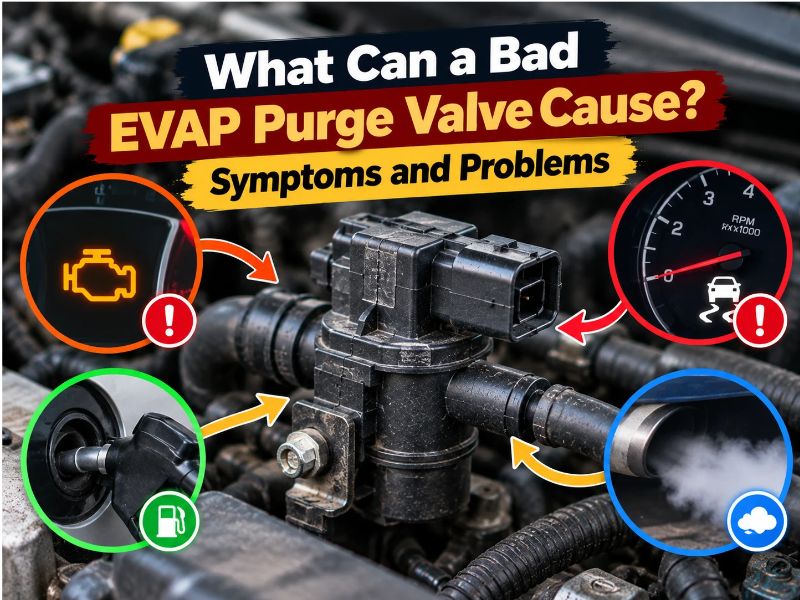
A faulty EVAP purge valve can affect both the emissions system and engine operation because the valve connects the EVAP vapor circuit to the engine’s intake.
The most common consequences include a Check Engine Light, rough or unstable idle, difficult starting after refueling, occasional stalling, lean or rich air-fuel conditions, fuel odors, reduced fuel economy, and failed EVAP emissions tests.
The severity depends on how the valve fails.
A purge valve stuck open is generally more likely to produce noticeable drivability problems because it can allow uncontrolled vapor or air into the intake manifold. At idle, where airflow through the engine is relatively low, even a small uncontrolled flow can significantly affect the air-fuel mixture.
A purge valve stuck closed, on the other hand, usually causes fewer immediate drivability problems. Instead, fuel vapors cannot be purged from the charcoal canister as intended, which can lead to EVAP system trouble codes and emissions problems.
An intermittent valve may be more confusing because symptoms can appear and disappear.
The engine may run normally one day and idle poorly the next, especially after the fuel tank has been filled.
What Does the EVAP Purge Valve Actually Do?
To understand the symptoms, it helps to know what the valve controls.
Gasoline naturally produces vapor inside the fuel tank. Modern vehicles are designed to prevent those hydrocarbon vapors from simply escaping into the atmosphere.
The EVAP system temporarily stores the vapors inside a charcoal canister. Activated charcoal inside the canister absorbs the fuel vapor.
Later, when engine conditions are suitable, the ECM commands the purge solenoid valve to open.
Intake manifold vacuum then draws the stored vapors through the purge line and into the engine, where they are burned during normal combustion.
The ECM does not normally keep the purge valve fully open all the time. Purge flow is carefully controlled according to factors such as engine temperature, engine load, RPM, fuel conditions, and emissions strategy.
When the purge valve can no longer control that flow accurately, the ECM may have difficulty maintaining the intended air-fuel ratio.
Stuck Open vs. Stuck Closed Purge Valve
The position in which the valve fails has a major effect on symptoms.
| Purge Valve Problem | What Happens | Common Result |
| Stuck open | Intake can continuously draw vapor or air through EVAP system | Rough idle, hard start, lean mixture, stalling |
| Leaking when closed | Small uncontrolled flow reaches intake | Intermittent rough idle, fuel-trim problems |
| Stuck closed | Fuel vapor cannot purge normally | EVAP codes, emissions problems |
| Electrical failure | ECM cannot control valve correctly | Check Engine Light, incorrect purge operation |
| Intermittent sticking | Valve works only sometimes | Symptoms appear and disappear |
A valve does not need to be completely stuck to cause trouble. Even a small internal leak can matter because the valve is supposed to seal when the ECM commands it closed.
Can a Bad EVAP Purge Valve Cause Rough Idle?
Yes. A bad EVAP purge valve can cause rough idle, particularly when the valve is stuck open or leaking.
Idle is one of the operating conditions where uncontrolled purge flow is most noticeable.
When the engine is idling, the throttle is nearly closed and the engine is consuming relatively little air. If a faulty purge valve allows an additional path into the intake manifold, the amount of unmetered airflow or vapor can represent a meaningful percentage of the engine’s total intake flow.
The ECM attempts to compensate using information from the oxygen sensors, mass airflow sensor, manifold pressure sensor, and fuel trims, depending on the vehicle.
If the disturbance is too large or inconsistent, idle quality can suffer.
You may notice the engine:
Shaking slightly, surging up and down, dropping below its normal idle speed, recovering repeatedly, or running rough immediately after startup.
A purge-related rough idle can sometimes become more noticeable after filling the fuel tank because there may be more fuel vapor available in the EVAP system.
However, rough idle has many possible causes. Dirty throttle bodies, ignition problems, intake vacuum leaks, faulty injectors, contaminated sensors, and compression problems can produce similar symptoms.
A rough idle alone does not prove the purge valve is bad.
Why a Stuck-Open Purge Valve Behaves Like a Vacuum Leak
When the purge valve should be closed, the intake manifold should not be pulling uncontrolled flow through the EVAP circuit.
If the valve remains open, manifold vacuum can draw through the purge hose toward the charcoal canister and fuel tank.
This can create an effect similar to an intake vacuum leak.
The engine may receive airflow that was not expected in the ECM’s normal calculation.
The oxygen sensors detect extra oxygen in the exhaust, and the ECM may respond by adding fuel.
This shows up as positive short-term or long-term fuel trim.
If the correction reaches the ECM’s limit, the engine may set a lean-condition trouble code.
Depending on the vehicle and size of the leak, you might see symptoms ranging from barely noticeable idle instability to severe stalling.
Can a Bad EVAP Purge Valve Cause Misfire?
Yes, a bad EVAP purge valve can cause misfire-like symptoms or actual combustion misfires, particularly when it significantly disturbs the mixture entering the engine.
A valve stuck open can allow too much air or vapor into the intake.
If the mixture becomes too lean, there may not be enough fuel relative to air for stable combustion. A cylinder may occasionally fail to burn the mixture properly.
That can register as a misfire.
The effect may be most obvious:
At idle, during startup, shortly after refueling, or during low-load driving.
Fuel vapor can complicate things further. Depending on the amount entering the engine, uncontrolled purge flow can create a mixture that is temporarily too rich rather than too lean.
So a failing purge valve can disturb combustion in either direction.
Can It Cause a P0300 Code?
Potentially.
P0300 indicates a random or multiple-cylinder misfire.
Because the purge valve feeds vapor into the intake rather than affecting just one specific cylinder, a major purge problem could contribute to misfires across multiple cylinders.
However, P0300 has many other possible causes, including ignition coils, spark plugs, injectors, low fuel pressure, intake leaks, timing issues, and mechanical engine problems.
A misfire code should therefore be diagnosed rather than automatically blamed on the purge valve.
Can a Purge Valve Cause a Single-Cylinder Misfire?
It is less typical.
Because purge flow normally enters a shared portion of the intake, a purge problem generally affects the engine more broadly.
Intake manifold design can sometimes distribute vapors unevenly, but a repeatable misfire isolated to one cylinder usually makes an ignition, injector, compression, or cylinder-specific intake problem more likely.
Can a Bad EVAP Purge Valve Cause Stalling?
Yes. A bad EVAP purge valve can cause stalling, especially if it is stuck open enough to severely disturb the mixture at idle.
The engine is most vulnerable to this problem when RPM is already low.
For example, the engine might stall:
Immediately after starting, while sitting at a traffic light, when shifting into Drive, while maneuvering slowly through a parking lot, or shortly after refueling.
Suppose the purge valve is stuck open.
When you release the accelerator and the throttle closes, intake manifold vacuum increases. That strong vacuum can pull significant flow through the faulty purge path.
The ECM then has to compensate quickly.
If the mixture becomes unstable faster than the control system can correct it, engine speed can fall below the point where combustion remains sustainable.
The engine stalls.
A mild leak may only cause a slightly rough idle. A larger purge leak can cause repeated stalling.
If your vehicle stalls in traffic, the issue deserves prompt diagnosis because sudden loss of engine power can create a safety concern.
Can a Bad EVAP Purge Valve Cause No Start?
Yes, but a complete no-start caused only by the purge valve is less common than hard starting.
A stuck-open purge valve can sometimes allow a large amount of fuel vapor into the intake after the vehicle has been shut off, particularly when the fuel tank contains a lot of vapor.
When you attempt to restart the engine, that extra vapor can create an excessively rich mixture.
The engine may:
Crank longer than normal, start and immediately stall, require a second attempt, or temporarily refuse to start until the excess vapor clears.
This pattern is particularly associated with hard starting after refueling.
Why Does It Happen After Filling the Tank?
Refueling changes vapor conditions inside the fuel tank.
If the purge valve does not seal correctly, fuel vapor can move into the intake manifold at a time when the ECM is not requesting purge.
When you start the engine, that stored vapor is immediately drawn into the cylinders.
The mixture may become too rich for clean ignition.
After several seconds of cranking—or after the engine sits for a while—the excess vapor may clear enough for the engine to start.
If your vehicle consistently has trouble starting immediately after buying gasoline but starts normally at other times, the purge valve is one component worth testing.
Can the Valve Cause a True Crank-No-Start?
It can contribute, but severe no-start conditions should not be diagnosed from the purge valve alone.
A vehicle that cranks normally but never starts can also have problems involving:
Fuel delivery, ignition, crankshaft position sensing, immobilizer systems, engine timing, compression, or electrical power.
Treat the purge valve as one possibility when other symptoms support it.
Can a Bad EVAP Purge Valve Cause Rev Hang?
Yes, a bad EVAP purge valve can potentially contribute to rev hang, although it is not one of the most common causes.
Rev hang means engine RPM remains elevated longer than expected after you release the accelerator or press the clutch in a manual-transmission vehicle.
Normally, closing the throttle reduces incoming air and allows RPM to fall.
If the purge valve creates an unintended airflow path into the intake, the engine may continue receiving additional air or vapor after the throttle closes.
This can slow the RPM drop.
The problem may resemble a small vacuum leak.
However, rev hang can also be normal to some extent because many modern engines intentionally control throttle closing for emissions, drivability, and transmission behavior.
Other causes can include:
A dirty or sticking throttle body, intake vacuum leaks, electronic throttle-control behavior, idle-control problems on older vehicles, or clutch-related driving conditions.
Therefore, rev hang by itself is weak evidence of a failed purge valve.
If rev hang occurs together with positive fuel trims, rough idle, EVAP codes, and difficult starting after refueling, the purge system becomes a stronger suspect.
Can a Bad EVAP Purge Valve Cause Bad Gas Mileage?
Yes. A bad EVAP purge valve can cause bad gas mileage, although the amount of fuel economy loss varies.
The purge system is designed to recycle fuel vapor rather than waste it, but the bigger fuel-economy concern comes from what happens when purge flow is no longer controlled correctly.
A stuck-open valve can disrupt the air-fuel mixture.
The ECM may compensate by adjusting injector pulse width.
If it repeatedly adds fuel because it interprets the condition as lean, fuel consumption can increase.
Poor combustion caused by an unstable mixture can also reduce engine efficiency.
You might notice:
Lower miles per gallon, more frequent trips to the gas station, unstable idle, or reduced responsiveness.
However, a purge valve is only one of many possible causes of poor fuel economy.
Tire pressure, driving style, cold weather, dragging brakes, dirty air filters, oxygen-sensor problems, fuel injector issues, engine temperature problems, and many other factors can reduce MPG.
If fuel economy drops suddenly and you also have EVAP symptoms, the purge valve deserves closer inspection.
Can a Bad Purge Valve Cause Hesitation or Poor Acceleration?
It can.
When the ECM is trying to compensate for unintended air or fuel vapor, throttle response may feel inconsistent.
The vehicle might hesitate briefly when you accelerate from a stop or transition from idle to light throttle.
Once engine speed and airflow increase, the purge leak may become a smaller percentage of total airflow, so the problem can feel less severe.
This is one reason a purge valve problem may be obvious at idle but almost disappear during highway driving.
Severe hesitation under heavy acceleration is less characteristic of a simple purge valve problem and should prompt investigation of ignition, fuel pressure, airflow measurement, and other engine systems.
Can a Bad Purge Valve Cause a Check Engine Light?
Yes. A Check Engine Light is one of the most common signs of EVAP purge system trouble.
The ECM monitors EVAP operation and may recognize that:
The purge valve does not respond electrically, purge flow occurs when it should not, commanded purge does not produce the expected pressure change, or the EVAP system cannot hold pressure or vacuum correctly.
Common EVAP-related diagnostic trouble codes can include faults involving purge flow, incorrect purge behavior, leaks, or purge-valve electrical circuits.
The exact code varies by vehicle.
A code should guide diagnosis rather than serve as automatic proof that the purge valve itself is defective.
For example, an EVAP flow code can also result from damaged hoses, vent-valve faults, wiring problems, a faulty pressure sensor, or charcoal-canister issues.
Can a Bad Purge Valve Cause Lean Codes?
Yes.
A valve stuck open can introduce unintended airflow into the intake and cause the oxygen sensors to detect a lean condition.
The ECM responds by adding fuel.
If fuel trim becomes excessively positive, the computer may eventually set system too lean trouble codes.
Lean codes are commonly associated with vacuum leaks, and a leaking purge valve effectively creates another possible vacuum path.
One useful diagnostic clue is what happens when the purge hose is temporarily isolated during proper troubleshooting.
If fuel trims improve significantly when unintended purge flow is eliminated, the purge circuit deserves further testing.
Can a Bad Purge Valve Cause Rich Running?
Yes, under some conditions.
Fuel vapor is combustible.
If a large amount of concentrated vapor enters the intake unexpectedly, especially after refueling or during hot soak, the mixture can temporarily become too rich.
Possible effects include:
Hard starting, strong fuel smell from the exhaust, unstable idle, temporary hesitation, or engine flooding-like behavior.
This is why a purge valve stuck open can sometimes create symptoms that appear contradictory.
Depending on operating conditions, it may act like an air leak at one moment and allow excessive fuel vapor into the engine at another.
Can a Bad EVAP Purge Valve Affect Fuel Trim?
Yes, and fuel trim data can be very helpful during diagnosis.
Short-term fuel trim (STFT) represents immediate fuel adjustments made by the ECM.
Long-term fuel trim (LTFT) represents corrections that the ECM has learned over a longer period.
With an unintended purge leak, positive fuel trims may become especially noticeable at idle.
As engine speed increases, the percentage effect of the leak may decrease.
A pattern where trims are high at idle but become more normal at higher RPM can suggest a vacuum-related problem.
The purge valve is one possible leak source among several.
Professional diagnosis often combines fuel-trim analysis with EVAP testing instead of replacing parts based solely on symptoms.
Can a Bad Purge Valve Cause Fuel Smell?
It can.
A failed EVAP component may allow fuel vapor to move where it should not.
You could notice gasoline odor around the vehicle, near the engine, or occasionally through the exhaust during a rich-start condition.
However, a strong raw gasoline smell should never automatically be assumed to come from the purge valve.
Liquid fuel leaks are more serious.
If you see wet gasoline, dripping fuel, or a persistent strong odor around the fuel tank or engine compartment, inspect the vehicle for an actual leak and avoid ignition sources.
What Causes EVAP Purge Valve to Go Bad?
Several factors can cause an EVAP purge valve to deteriorate.
The valve repeatedly opens and closes throughout thousands of driving cycles. Over time, its internal electrical coil, plunger, seals, or spring can wear.
Heat is another factor. Depending on the vehicle, the purge valve may be located in the engine compartment where it experiences repeated heating and cooling.
Fuel vapor can also leave deposits inside the valve.
Contamination becomes especially problematic if liquid fuel or charcoal particles enter areas designed primarily for vapor.
Normal Wear
The internal solenoid operates repeatedly over the life of the vehicle.
Eventually, mechanical or electrical wear can prevent the valve from opening or sealing consistently.
Carbon and Vapor Deposits
Residue from fuel vapor can accumulate inside the passage or around the valve seat.
A contaminated valve may begin sticking.
Charcoal Canister Contamination
If activated charcoal breaks apart inside a damaged canister, small particles may travel through EVAP lines.
These particles can interfere with purge-valve operation.
Electrical Failure
The valve is an electrically controlled solenoid.
Problems with the internal winding, connector, or wiring can prevent the ECM from operating it.
Heat and Age
Repeated thermal cycling can harden seals and weaken plastic components.
Fuel-System Overfilling
Repeatedly topping off the tank after the pump automatically stops can potentially allow liquid fuel to reach EVAP components that are designed mainly to handle vapor.
Over time, this may damage the charcoal canister and contribute to EVAP problems.
Stopping when the pump first shuts off is generally the better practice.
Can a Purge Valve Fail Without a Check Engine Light?
Yes.
A purge valve can begin leaking slightly before the ECM identifies a fault large enough to trigger the Check Engine Light.
You might initially notice:
Occasional rough idle, slightly longer cranking after refueling, inconsistent startup, or minor fuel-trim changes.
Intermittent failures can be especially difficult for onboard diagnostics to catch.
Eventually, if the fault becomes consistent or exceeds the monitoring threshold, an EVAP code may appear.
So the absence of a warning light does not completely rule out the valve.
Why Are Purge Valve Symptoms Often Worse After Refueling?
This is one of the more useful clues.
Refueling introduces major changes in fuel-tank vapor conditions.
The EVAP system has to manage those vapors.
If the purge valve is stuck open, those vapors may reach the intake when they should not.
The resulting mixture can be too rich during startup.
That is why a vehicle with a faulty purge valve may:
Start perfectly every morning, run normally during most driving, but crank for a long time immediately after filling the tank.
This symptom pattern is particularly useful when combined with EVAP trouble codes.
How Can You Tell If the Purge Valve Is Stuck Open?
A purge valve that is not being commanded open should normally restrict airflow according to its design.
One common diagnostic approach involves checking whether vacuum or airflow passes through the valve when it should be closed.
Technicians may also use:
A scan tool to command the valve, a vacuum pump, electrical resistance testing when specified, fuel-trim data, smoke testing, and EVAP pressure information.
The exact procedure depends on the vehicle because purge-valve design and electrical specifications vary.
Simply hearing the valve click does not prove that it seals properly.
A solenoid may move internally while still leaking through its valve seat.
Can You Keep Driving With a Bad EVAP Purge Valve?
A mild purge-valve problem may not immediately prevent the vehicle from moving, but continued driving depends on the severity of the symptoms.
If the vehicle only has an EVAP code and otherwise runs normally, the problem is generally less urgent than a brake, steering, or major engine failure.
However, do not ignore:
Repeated stalling, severe rough running, strong fuel odors, difficult starting in unsafe locations, or flashing Check Engine Light associated with active misfires.
A flashing Check Engine Light can indicate misfires severe enough to risk catalytic converter damage.
If stalling occurs unexpectedly in traffic, prompt repair is also advisable.
How Is a Bad Purge Valve Diagnosed?
Good diagnosis combines symptoms, trouble codes, live data, and direct testing.
A technician may begin by scanning the ECM for stored and pending codes.
Then the EVAP hoses and electrical connector can be inspected for obvious damage.
The purge valve may be commanded on and off with a scan tool while its behavior is monitored.
A sealing test can determine whether it leaks when closed.
A smoke machine may be used if a broader EVAP leak is suspected.
Fuel trims can help identify whether the purge system is affecting engine airflow.
This method is much more reliable than replacing the valve simply because the Check Engine Light mentions EVAP.
Should You Replace a Purge Valve Based Only on Symptoms?
Usually not.
Many purge-valve symptoms overlap with other engine problems.
For example, rough idle could come from:
A leaking intake gasket, PCV system fault, ignition misfire, dirty throttle body, injector problem, or other vacuum leak.
Hard starting can involve fuel pressure, ignition, battery condition, sensors, or injectors.
Poor gas mileage has dozens of potential causes.
Testing the purge valve before replacing it can prevent unnecessary parts replacement.
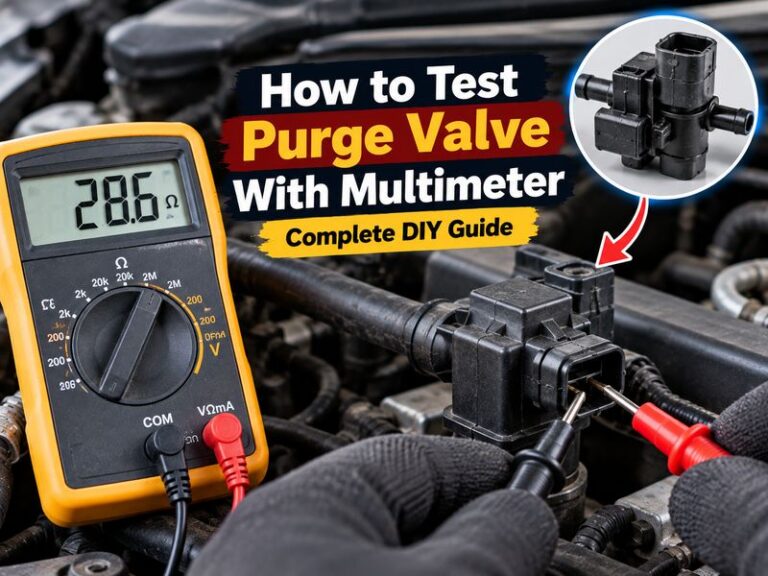
Fortunately, on many vehicles the purge valve is accessible enough that testing it is relatively straightforward.
What Happens If You Ignore a Bad EVAP Purge Valve?
A faulty valve may remain a minor emissions issue for some time, or symptoms may gradually worsen.
If it leaks increasingly, you may experience more noticeable rough idle, starting trouble, stalling, or fuel-trim problems.
Continued misfires can place additional stress on the catalytic converter.
A Check Engine Light also makes it harder to notice when a new engine fault appears because the warning is already illuminated.
In states that require emissions inspections, an active EVAP-related fault or illuminated malfunction indicator can also create inspection problems.
Addressing the fault early usually makes diagnosis easier.
FAQs About What Can a Bad EVAP Purge Valve Cause
Can a Bad EVAP Purge Valve Cause Misfire?
Yes. A leaking or stuck-open purge valve can disturb the air-fuel mixture enough to cause unstable combustion and misfires. Random or multiple-cylinder misfires are generally more plausible than a consistent single-cylinder misfire.
Can a Bad EVAP Purge Valve Cause Stalling?
Yes. If uncontrolled purge flow makes the mixture unstable at low RPM, the engine can stall, particularly at idle, immediately after startup, or after refueling.
Can a Bad EVAP Purge Valve Cause No Start?
A severely leaking purge valve can contribute to a crank-no-start condition, especially when excess fuel vapor creates an overly rich mixture. Hard starting after refueling is more common than a complete no-start.
Can a Bad EVAP Purge Valve Cause Rough Idle?
Yes. Rough idle is a common drivability symptom of a purge valve stuck open because the unwanted flow can act similarly to a vacuum leak and interfere with fuel control.
Can a Bad EVAP Purge Valve Cause Rev Hang?
It can contribute to rev hang if the valve allows unintended airflow into the intake after the throttle closes. However, electronic throttle programming and other vacuum leaks are also common causes.
Can a Bad EVAP Purge Valve Cause Bad Gas Mileage?
Yes. Incorrect purge flow can disrupt fuel trims and combustion efficiency, potentially reducing MPG. Fuel economy problems should still be diagnosed because many other faults can cause the same symptom.
What Causes EVAP Purge Valve to Go Bad?
Common causes include normal wear, heat, contaminated vapor passages, damaged internal seals, electrical solenoid failure, charcoal-canister debris, and EVAP contamination. Repeatedly overfilling the fuel tank can also contribute to problems within the EVAP system.
Can a Bad Purge Valve Cause Hard Starting After Getting Gas?
Yes. This is one of the more characteristic purge-valve symptoms. A valve stuck open can allow concentrated fuel vapor into the intake during refueling, temporarily creating an excessively rich mixture when the engine is restarted.
Conclusion
Understanding what can a bad EVAP purge valve cause comes down to understanding how the valve controls fuel vapor entering the engine. When the valve sticks open, leaks, stays closed, or fails electrically, it can interfere with both EVAP operation and engine air-fuel control.
A faulty valve can cause rough idle, misfires, stalling, hard starting or occasional no-start conditions, rev hang, poor gas mileage, lean or rich mixture problems, EVAP trouble codes, and a Check Engine Light. Hard starting immediately after refueling is an especially useful clue when combined with other EVAP symptoms.
The purge valve should not be replaced based on symptoms alone, however. Vacuum leaks, ignition faults, fuel-delivery problems, and other engine issues can look very similar. Checking trouble codes, fuel trims, valve sealing, electrical operation, and the rest of the EVAP system is the best way to confirm the cause before installing new parts.