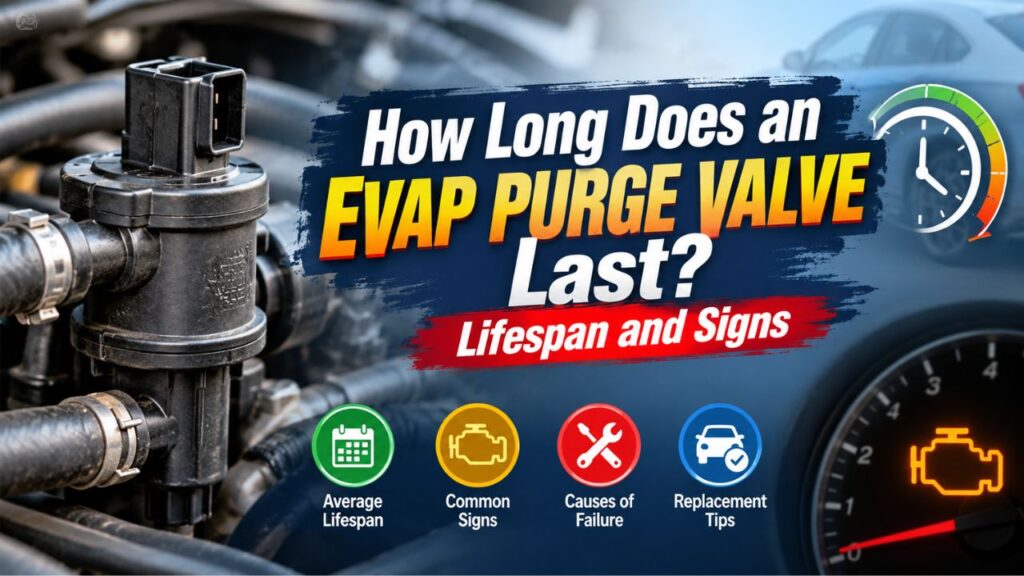
How Long Does an EVAP Purge Valve Last? Lifespan and Signs
An EVAP purge valve is a small emissions-control component, but it can have a noticeable effect on engine operation when it begins to fail. If you are wondering how long does an EVAP purge valve last, there is no universal mileage or replacement interval.
A purge valve can last well over 100,000 miles on some vehicles and may never need replacement during normal ownership. On another vehicle, the valve may fail much earlier because of heat, contamination, electrical problems, internal wear, or problems elsewhere in the evaporative emissions system.
Unlike engine oil, spark plugs, or some filters, the purge valve is generally not considered a routine maintenance item. It is normally replaced only when testing confirms that it is sticking, leaking, electrically faulty, or otherwise unable to control fuel vapors correctly.
This guide explains how long an EVAP purge valve typically lasts, why some fail early, the signs that yours may be wearing out, and when replacement actually makes sense.
How Long Does an EVAP Purge Valve Last?
An EVAP purge valve does not have a fixed service life. A properly functioning valve may last 100,000 miles or considerably longer, and some last for the life of the vehicle.
Manufacturers generally do not specify a routine mileage interval for replacing the purge valve.
The valve should normally remain in service until it develops a confirmed problem.
Its lifespan depends on several factors, including:
- Vehicle design
- Underhood temperature
- Driving conditions
- Fuel-vapor exposure
- Carbon or debris contamination
- Electrical solenoid wear
- Condition of the rest of the EVAP system
Mileage alone is therefore not a reliable way to determine whether a purge valve needs replacement.
A 150,000-mile purge valve that passes all tests may be perfectly usable, while a much newer valve that is stuck open may need immediate replacement.
What Is an EVAP Purge Valve?
The EVAP purge valve is part of the vehicle’s evaporative emissions control system.
Gasoline naturally produces vapors inside the fuel tank. Instead of allowing those hydrocarbons to escape directly into the atmosphere, the EVAP system captures them.
The charcoal canister temporarily stores the fuel vapors.
When engine operating conditions are appropriate, the engine control module commands the purge valve to open. Engine vacuum then draws the stored vapors from the charcoal canister into the intake, where they are burned during normal combustion.
The purge valve therefore acts as a controlled gateway between the EVAP system and the engine intake.
It may also be called:
- Canister purge valve
- EVAP purge solenoid
- Purge control valve
- Canister purge solenoid
These names often describe the same basic component.
Is the EVAP Purge Valve a Maintenance Item?
Normally, no.
There is usually no reason to replace a properly working purge valve simply because the vehicle has reached a certain mileage.
This is different from maintenance items that have predetermined replacement intervals.
A purge valve should generally be replaced when diagnosis shows that it:
- Sticks open
- Sticks closed
- Leaks when it should seal
- Fails electrically
- Does not respond correctly to commands
- Has physical damage
Replacing it based only on age or mileage can waste money and may not solve an EVAP-related problem.
Why Can a Purge Valve Last So Long?
A purge valve has a relatively simple job.
Inside a typical electronically controlled purge valve is an electromagnetic solenoid and a valve mechanism.
The engine computer controls the solenoid electrically. The valve repeatedly opens and closes or pulses during vehicle operation.
There are no routine consumable materials inside that require scheduled replacement.
As long as the internal seal, solenoid, wiring, and valve mechanism continue functioning correctly, the purge valve can operate for many years.
What Causes an EVAP Purge Valve to Wear Out?
Although a purge valve can last a long time, several conditions can eventually cause failure.
Internal Mechanical Wear
The valve opens and closes countless times throughout its life.
Eventually, internal components can wear or stop sealing properly.
A worn valve may begin leaking small amounts of vapor or vacuum even when commanded closed.
Carbon and Debris Contamination
Fuel vapors and contamination from the EVAP system can leave deposits inside the valve.
These deposits can interfere with movement and cause the valve to stick.
A valve that cannot completely close is commonly described as a purge valve stuck open.
Electrical Solenoid Failure
The purge valve is electrically controlled.
The internal solenoid winding can fail, preventing the valve from responding to commands.
Wiring problems, damaged connectors, or circuit faults can create similar symptoms.
This is why diagnostic testing is important before replacing the valve.
Heat Exposure
Depending on the vehicle, the purge valve may be located in a hot engine compartment.
Years of repeated heating and cooling can affect plastic housings, seals, electrical windings, and connectors.
Fuel Saturation
Problems elsewhere in the EVAP system can expose the purge valve to excessive fuel vapor or even liquid fuel.
For example, repeatedly overfilling the fuel tank can contribute to EVAP system problems by allowing liquid fuel to enter areas intended mainly for vapor.
This may damage the charcoal canister and can eventually affect purge-system operation.
Moisture and Corrosion
Electrical connectors and valve components may deteriorate from moisture exposure, road salt, or corrosion.
This is particularly relevant in regions where winter road salt is common.
Does Driving Style Affect Purge Valve Life?
Driving style is not usually the biggest factor in purge valve lifespan, but operating conditions can contribute.
Frequent short trips may result in different EVAP operating patterns compared with long highway trips.
Extreme temperatures can also affect components over time.
However, there is no practical driving technique that guarantees a purge valve will last a certain mileage.
Maintaining the vehicle properly and avoiding habits such as repeatedly topping off the fuel tank after the pump automatically shuts off are more useful.
Can an EVAP Purge Valve Fail at Low Mileage?
Yes.
Although many purge valves last a long time, early failure is possible.
A relatively new valve could fail because of:
- Manufacturing defect
- Electrical fault
- Contamination
- Damaged connector
- EVAP system problem
- Excessive fuel exposure
Therefore, low vehicle mileage does not rule out a faulty purge valve.
Diagnosis should be based on symptoms and testing rather than vehicle age alone.
Signs the EVAP Purge Valve May Be Reaching the End of Its Life
A worn or failed purge valve can produce several symptoms.
The exact symptoms depend greatly on whether the valve is stuck open, stuck closed, leaking, or electrically inoperative.
Check Engine Light
A check engine light is one of the most common reasons a purge valve problem is discovered.
The engine computer continuously monitors parts of the EVAP system.
If the expected flow or pressure changes do not occur, it may store a diagnostic trouble code.
Common EVAP-related codes can indicate purge-flow problems, but a trouble code does not automatically prove the purge valve itself is defective.
Hoses, wiring, the vent valve, charcoal canister, fuel cap, and other EVAP components can produce related codes.
Rough Idle
A purge valve stuck open can allow unwanted vapor and air into the intake at the wrong time.
This can interfere with the engine’s normal air-fuel mixture, especially at idle.
The engine may:
- Shake
- Idle unevenly
- Surge
- Run roughly after starting
A rough idle has many other possible causes, so proper diagnosis is necessary.
Hard Starting After Refueling
Difficulty starting immediately after filling the fuel tank is a particularly useful clue.
A purge valve stuck open may allow excessive fuel vapor into the intake after refueling.
This can temporarily make the mixture too rich and cause:
- Extended cranking
- Rough startup
- Stalling after starting
If hard starting happens mainly after refueling, the purge system deserves inspection.
Engine Stalling
A badly malfunctioning purge valve can sometimes contribute to stalling, particularly at idle or shortly after startup.
This generally occurs when incorrect vapor flow significantly disrupts the air-fuel mixture.
However, stalling has many possible causes, so the purge valve should not be replaced without testing.
Reduced Fuel Economy
A faulty purge valve may affect fuel economy if it disrupts normal fuel-vapor management or causes the engine control system to compensate for an incorrect mixture.
The difference may be small and difficult to notice.
Poor fuel economy by itself is not enough to diagnose a purge valve problem.
Fuel Smell
EVAP system faults can sometimes create a gasoline or fuel-vapor smell.
The purge valve is only one possible cause.
Cracked hoses, damaged fuel-system components, a saturated charcoal canister, or actual fuel leaks can produce similar odors.
A strong gasoline smell should be investigated promptly because an actual fuel leak is a safety concern.
Failed Emissions Test
A faulty purge valve can cause the check engine light to illuminate or prevent the EVAP system from completing its self-tests correctly.
That can contribute to emissions inspection failure where OBD readiness and fault codes are checked.
Stuck Open vs Stuck Closed Purge Valve Lifespan Failure
Purge valves do not always fail in the same position.
Understanding the difference can make the symptoms easier to recognize.
Purge Valve Stuck Open
A normally closed purge valve that becomes stuck open can allow continuous flow between the intake and EVAP system.
Possible symptoms include:
- Rough idle
- Hard starting after refueling
- Stalling
- Check engine light
- Mixture-related symptoms
A disconnected normally closed purge valve should generally not pass unrestricted air when it is unpowered, although exact testing procedures depend on the vehicle.
Purge Valve Stuck Closed
A purge valve stuck closed prevents stored fuel vapors from being properly drawn from the charcoal canister into the engine.
Possible results include:
- Check engine light
- Incorrect purge-flow codes
- EVAP system pressure problems
- Increased vapor accumulation in the canister
The engine may run relatively normally in some stuck-closed situations, making the problem less obvious to the driver.
Does a Clicking Purge Valve Mean It Is Wearing Out?
Not necessarily.
A purge valve commonly makes a clicking or ticking sound because the engine computer rapidly pulses the solenoid during operation.
Normal clicking can actually indicate that the solenoid is being commanded.
However, hearing a click does not prove that the valve is mechanically sealing correctly.
A purge valve can click normally while still leaking internally.
Likewise, an unusual loud or constant noise may warrant inspection if it appears alongside drivability symptoms or EVAP fault codes.
How Do You Know When a Purge Valve Needs Replacement?
The most reliable answer comes from testing rather than mileage.
A technician may evaluate:
- Diagnostic trouble codes
- Electrical resistance or circuit condition
- Commanded purge operation
- Vacuum retention
- Airflow through the valve
- Scan-tool data
- EVAP smoke testing
The valve should seal when it is supposed to be closed and allow controlled flow when commanded open.
If it fails those tests, replacement is appropriate.
Can You Test a Purge Valve at Home?
Some basic checks can be performed with simple tools, depending on the valve design.
A common preliminary test involves removing the valve and checking whether it passes air while unpowered.
Many purge valves are normally closed, meaning they should block airflow when no electrical power is applied.
Applying the correct electrical command should cause the valve to open.
However, vehicle designs vary, and applying incorrect voltage directly to electrical components can cause damage.
A multimeter can also help check the solenoid circuit, but resistance specifications vary between manufacturers.
For accurate diagnosis, use service information for the exact vehicle.
How Long Can You Drive With a Bad Purge Valve?
There is no universal safe mileage.
A purge valve problem usually does not cause the immediate braking or steering danger associated with certain mechanical failures, but it should still be repaired.
A faulty purge valve can lead to:
- Poor starting
- Rough running
- Stalling
- Increased emissions
- Fuel economy problems
- Additional EVAP faults
If the vehicle stalls, has severe drivability problems, smells strongly of gasoline, or appears to have an actual fuel leak, avoid continued driving until the cause is identified.
Can a Bad Purge Valve Damage the Engine?
A faulty purge valve usually causes drivability and emissions problems rather than immediate major internal engine damage.
However, a valve stuck open can significantly disturb the engine’s air-fuel mixture.
Leaving the problem unresolved can cause persistent poor running and may contribute to other problems depending on the severity and vehicle.
The more practical reason to repair it promptly is to restore proper engine operation and EVAP system control.
Should You Replace a Purge Valve Preventively?
Usually, no.
If the purge valve is functioning correctly and there are no diagnostic problems, preventive replacement provides little benefit.
Unlike a timing belt or some filters, the purge valve is not normally assigned a scheduled service interval.
Testing before replacement is particularly important because many EVAP problems can mimic purge-valve failure.
Replacing a good valve will not fix:
- Cracked EVAP hoses
- Bad vent valve
- Damaged charcoal canister
- Wiring faults
- Loose or damaged fuel cap
- Other vacuum leaks
How Much Does Vehicle Age Matter?
Age can increase the likelihood of purge valve failure because electrical components, plastic housings, seals, and connectors all deteriorate over time.
However, age is not a direct replacement trigger.
A 15-year-old purge valve that functions correctly can remain in service.
Likewise, a much newer valve may fail unexpectedly.
Condition matters more than age alone.
Can a New Purge Valve Fail Quickly?
Yes.
A replacement purge valve can fail prematurely if it is defective or if another EVAP problem contributed to the original failure.
For example, if the charcoal canister is saturated with liquid fuel, simply replacing the purge valve may not address the underlying condition.
If a newly installed valve fails again soon, the entire EVAP system should be evaluated rather than repeatedly replacing the same part.
OEM vs Aftermarket Purge Valve Lifespan
Both OEM and aftermarket purge valves can work correctly, but quality varies among replacement parts.
The most important factors are:
- Correct fit
- Correct electrical specifications
- Proper sealing
- Reliable solenoid operation
A poorly made valve may leak or fail prematurely even if it physically fits the vehicle.
When the purge valve is difficult to access or known to be sensitive on a particular application, using a high-quality replacement can reduce the chance of repeating the repair.
How to Help an EVAP Purge Valve Last Longer
There is no maintenance procedure specifically designed to extend purge-valve life dramatically, but good fuel-system habits can help protect the EVAP system.
Avoid repeatedly topping off the fuel tank after the gas pump automatically stops.
Overfilling can allow liquid gasoline to enter EVAP components designed primarily to handle vapor.
Also address EVAP-related warning lights rather than leaving them unresolved for years.
Damaged hoses, canister problems, or electrical faults can affect overall system operation.
FAQs About How Long Does an EVAP Purge Valve Last
How Many Miles Does an EVAP Purge Valve Last?
There is no fixed mileage.
Many purge valves can exceed 100,000 miles, while some fail considerably earlier. The valve is normally replaced based on condition and diagnostic testing rather than mileage.
Does an EVAP Purge Valve Need Regular Replacement?
No.
The purge valve is generally not a scheduled maintenance item. Replace it when it fails testing or produces a confirmed fault.
Can a Purge Valve Last the Life of the Car?
Yes.
Some purge valves continue operating correctly for the entire useful life of the vehicle.
Others eventually fail because of wear, contamination, heat, electrical problems, or EVAP system issues.
What Causes an EVAP Purge Valve to Go Bad?
Common causes include internal wear, carbon or debris contamination, electrical solenoid failure, corrosion, heat exposure, damaged seals, and problems elsewhere in the EVAP system.
How Do I Know My Purge Valve Is Going Bad?
Possible signs include a check engine light, rough idle, difficult starting after refueling, stalling, incorrect purge-flow codes, or EVAP-related drivability problems.
Testing is necessary because these symptoms can have other causes.
Can a Purge Valve Slowly Go Bad?
Yes.
A valve may initially leak only slightly or operate intermittently before becoming completely stuck or electrically inoperative.
Intermittent symptoms can make early failure difficult to diagnose.
Should I Replace the Purge Valve at 100,000 Miles?
Not automatically.
If a 100,000-mile purge valve passes testing and the EVAP system operates correctly, there is normally no reason to replace it solely because of mileage.
Is It Okay to Drive With a Bad Purge Valve?
A minor purge-valve fault may allow the vehicle to continue running, but repair should not be unnecessarily delayed.
If the vehicle stalls, becomes difficult to start, runs very poorly, or has a strong fuel smell, have it inspected promptly.
Conclusion
So, how long does an EVAP purge valve last? There is no fixed replacement interval. A purge valve can last more than 100,000 miles and may even remain functional for the life of the vehicle, while another may fail much sooner.
Mileage alone is not a good reason to replace it. The condition of the valve, EVAP system fault codes, airflow testing, electrical operation, and actual drivability symptoms are much more useful.
If your vehicle develops rough idle, difficult starting after refueling, EVAP trouble codes, stalling, or other purge-related symptoms, test the valve before replacing it. A correctly diagnosed repair is more reliable than replacing the EVAP purge valve simply because it has reached a certain age or mileage.