What Does a Bad Oxygen Sensor Do? Symptoms and Problems
An oxygen sensor is one of the main sensors your vehicle uses to monitor how efficiently the engine is burning fuel. It measures the amount of oxygen remaining in the exhaust and sends that information to the engine control module, or ECM/PCM. The computer then uses the signal from certain oxygen sensors to adjust the air-fuel mixture and monitor catalytic converter operation.
When an oxygen sensor starts giving inaccurate information, the engine computer may make fuel adjustments based on the wrong data. Depending on which sensor has failed and how it fails, the result can range from a simple check engine light to poor fuel economy, rough running, increased emissions, or catalytic converter problems.
A bad oxygen sensor can send incorrect exhaust-oxygen information to the engine computer, potentially causing the engine to run too rich or too lean, use more fuel, idle poorly, hesitate, produce higher emissions, or turn on the check engine light. A failed downstream sensor may mainly affect emissions monitoring rather than fuel control.
If you are asking what does a bad oxygen sensor do or what can a bad oxygen sensor cause, it is important to understand that not every oxygen sensor has exactly the same job. The sensor before the catalytic converter usually plays a major role in fuel control, while the sensor after the converter is commonly used to monitor catalyst efficiency. This difference can significantly affect the symptoms you experience.
What Does a Bad Oxygen Sensor Do?
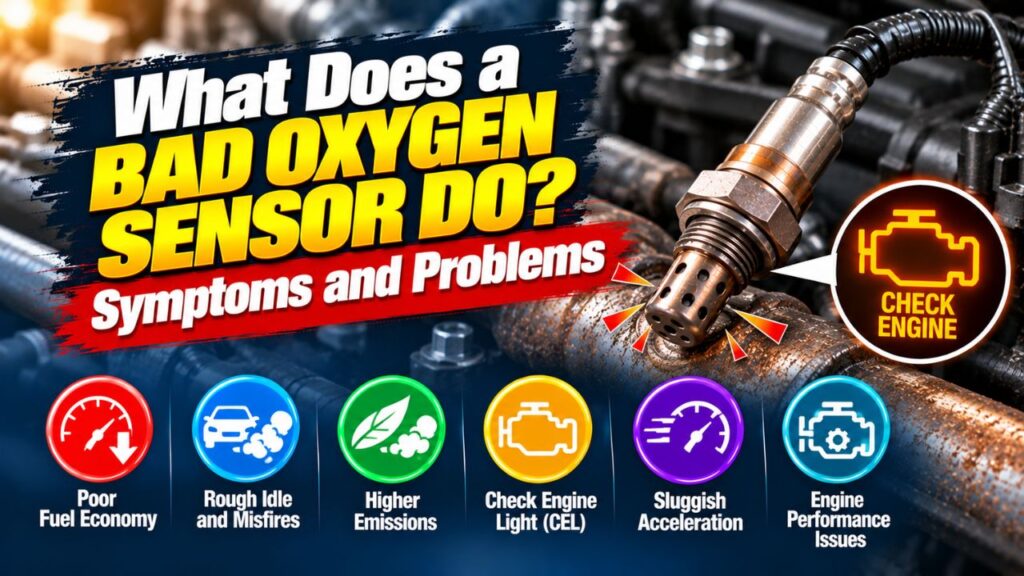
A bad oxygen sensor can provide an inaccurate, delayed, or completely missing signal about oxygen levels in the exhaust.
On sensors used for fuel control, the engine computer relies on that information to determine whether combustion is running relatively rich or lean and then adjusts fuel delivery accordingly.
If the information is wrong, the computer may add fuel when it should remove it or remove fuel when the engine actually needs more.
This can contribute to:
- Poor fuel economy
- Rough idle
- Hesitation
- Reduced performance
- Rich or lean operation
- Higher exhaust emissions
- Check engine light
- Catalytic converter stress
However, the exact effect depends heavily on whether the failed sensor is an upstream oxygen sensor or a downstream oxygen sensor.
What Is an Oxygen Sensor?
An oxygen sensor, often called an O2 sensor, is installed in the exhaust system.
Its job is to measure oxygen content in the exhaust gases.
A modern vehicle may have several oxygen sensors, especially if it uses:
- Multiple cylinder banks
- Multiple catalytic converters
- A V6 or V8 engine
The engine computer uses the sensor data to help manage fuel delivery and emissions.
Some newer vehicles use wideband air-fuel ratio sensors in the upstream position. These perform a similar overall function but provide more detailed air-fuel information than traditional narrowband oxygen sensors.
Upstream vs. Downstream Oxygen Sensors
Understanding sensor position is important because failure symptoms can differ significantly.
Upstream Oxygen Sensor
The upstream sensor is located before the catalytic converter.
It is commonly referred to as:
- Sensor 1
- Bank 1 Sensor 1
- Bank 2 Sensor 1
This sensor is especially important for fuel-trim control.
The computer uses its signal to make rapid adjustments to fuel delivery once the engine is operating under normal closed-loop conditions.
A failed upstream sensor is therefore more likely to affect:
- Fuel economy
- Air-fuel ratio
- Idle quality
- Engine performance
- Emissions
Downstream Oxygen Sensor
The downstream sensor is installed after the catalytic converter.
It may be identified as:
- Sensor 2
- Bank 1 Sensor 2
- Bank 2 Sensor 2
Its primary role on many vehicles is monitoring how effectively the catalytic converter is working.
A failed downstream sensor may illuminate the check engine light without causing an obvious change in drivability.
Some vehicle strategies can use downstream sensor information for additional corrections, but its main role is generally catalyst monitoring rather than primary fuel control.
What Can a Bad Oxygen Sensor Cause?
A faulty O2 sensor can cause several different problems, particularly if it is an upstream sensor involved in fuel management.
The engine may run richer or leaner than intended, which can affect fuel consumption, emissions, idle quality, and performance.
The severity varies.
Some vehicles continue to drive almost normally despite a failed sensor. Others develop noticeable hesitation, rough idle, or poor mileage.
Can a Bad Oxygen Sensor Cause Poor Fuel Economy?
Yes.
Poor fuel economy is one of the better-known effects of an inaccurate upstream oxygen sensor.
If the sensor incorrectly indicates that the mixture is too lean, the computer may add more fuel.
The engine can then operate richer than necessary.
You may notice that:
- Fuel mileage decreases
- You fill the tank more often
- Exhaust smells stronger
- Tailpipe emissions increase
A failed O2 sensor is not the only cause of reduced fuel economy, so fuel consumption alone should not be used as proof that the sensor is bad.
Can a Bad Oxygen Sensor Cause a Rich Mixture?
Yes.
If an upstream oxygen sensor falsely reports too much oxygen in the exhaust, the computer may interpret that as a lean condition.
The ECM may respond by adding fuel.
That can contribute to a rich air-fuel mixture.
Possible rich-running symptoms include:
- Poor fuel economy
- Strong fuel smell
- Dark exhaust deposits
- Rough running
- Spark plug fouling
- Higher emissions
A rich condition can also be caused by fuel injectors, fuel-pressure problems, airflow sensors, coolant-temperature sensors, or other faults.
Can a Bad Oxygen Sensor Cause a Lean Mixture?
It can.
If the oxygen sensor reports the mixture as richer than it really is, the engine computer may reduce fuel delivery too much.
That can contribute to lean operation.
Possible symptoms include rough idle, hesitation, or lack of power.
However, true lean conditions are also commonly caused by vacuum leaks, low fuel pressure, intake leaks, or unmetered air.
Can a Bad Oxygen Sensor Cause Rough Idle?
Yes, particularly if the faulty sensor causes incorrect fuel corrections.
An unstable air-fuel mixture can make combustion inconsistent at idle.
The vehicle may:
- Shake
- Stumble
- Surge
- Idle irregularly
- Occasionally stall
However, oxygen sensor problems are only one possible explanation for rough idle.
Spark plugs, ignition coils, vacuum leaks, PCV problems, injectors, throttle-body contamination, and low compression can create similar symptoms.
Can a Bad Oxygen Sensor Cause Engine Misfire?
A bad oxygen sensor can contribute to conditions that make misfires more likely, but it is usually not the first component to suspect for a single-cylinder misfire.
If incorrect oxygen-sensor information causes the engine to run significantly rich or lean, combustion can become unstable.
That may contribute to random or multiple-cylinder misfires.
However, a code such as P0301 or P0302 is more commonly investigated for:
- Spark plug problems
- Ignition coil failure
- Fuel injector problems
- Compression issues
- Vacuum leaks
The oxygen sensor may sometimes report the effects of a misfire rather than being the cause of it.
That distinction is important during diagnosis.
Can a Bad Oxygen Sensor Cause Hesitation?
Yes.
Incorrect fuel adjustments can cause hesitation during:
- Acceleration
- Light throttle
- Transition from idle
- Cruising
The driver may feel a brief flat spot or delayed response when pressing the accelerator.
Because hesitation can also come from ignition, fuel delivery, throttle, or transmission issues, additional testing is necessary before replacing an O2 sensor.
Can a Bad Oxygen Sensor Cause Loss of Power?
Yes, although significant power loss usually suggests the problem has become substantial or another issue is present as well.
If the engine runs too rich, combustion efficiency can fall.
If it runs too lean, the engine may hesitate or fail to produce normal power.
A severely restricted catalytic converter can also cause major power loss and may sometimes be related to long-term rich operation.
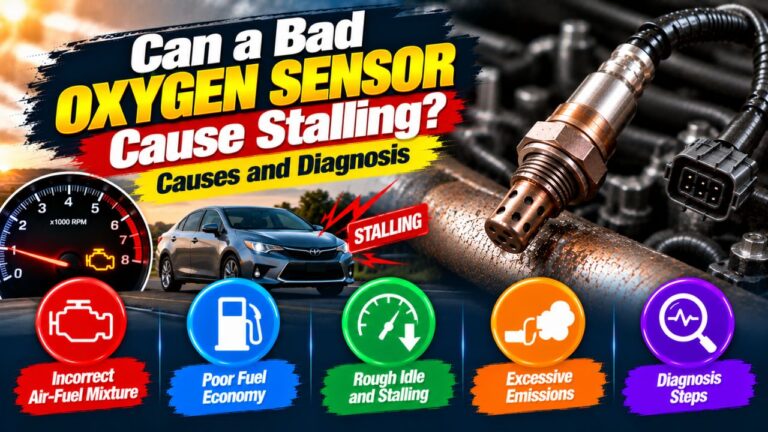
Can a Bad Oxygen Sensor Cause Stalling?
It can in some cases.
If fuel corrections become extreme enough, the engine may struggle to maintain a stable idle.
Stalling is more likely when the vehicle:
- Comes to a stop
- Returns to idle
- Is started while warm
- Experiences another fuel-control problem simultaneously
Still, stalling has many possible causes, and an oxygen sensor should not be blamed without proper diagnosis.
Can a Bad Oxygen Sensor Cause a Check Engine Light?
Yes.
A faulty oxygen sensor commonly causes the check engine light to illuminate.
Diagnostic trouble codes may indicate problems such as:
- Slow sensor response
- Heater circuit faults
- Sensor signal stuck rich or lean
- No sensor activity
- Sensor circuit voltage problems
Common OBD-II code families include P0130–P0167, although the exact meaning depends on the specific code.
A code mentioning an oxygen sensor does not always mean the sensor itself is defective.
The problem may instead involve:
- Wiring
- Connector damage
- Exhaust leaks
- Sensor heater power
- Ground circuit
- Fuel mixture problems
Proper diagnosis prevents unnecessary sensor replacement.
Oxygen Sensor Heater Failure
Modern oxygen sensors often contain an internal heater element.
The heater helps the sensor reach operating temperature quickly after startup.
If the heater fails, the sensor may take longer to begin working normally.
The engine computer may detect this and store a heater-related trouble code.
Possible causes include:
- Failed heater inside the sensor
- Blown fuse
- Damaged wiring
- Poor connector
- Power or ground problem
Replacing the sensor without checking the heater circuit can result in the same trouble code returning.
Can a Bad Oxygen Sensor Cause Black Smoke?
It can contribute to black exhaust smoke if the failure causes the engine to run excessively rich.
Black smoke generally indicates too much fuel relative to available air.
However, visible black smoke is a substantial symptom and can be caused by several other issues, such as:
- Leaking fuel injector
- Fuel-pressure problem
- Faulty airflow measurement
- Incorrect coolant-temperature information
Do not assume an oxygen sensor is responsible simply because the exhaust is dark.
Can a Bad Oxygen Sensor Cause a Fuel Smell?
Yes.
If a faulty sensor contributes to rich operation, the exhaust may contain more unburned or partially burned fuel.
You may notice a stronger exhaust or gasoline-like smell.
A strong raw-fuel smell can also indicate an actual fuel leak, which requires prompt attention.
Do not assume every fuel odor comes from rich combustion.
Can a Bad Oxygen Sensor Damage the Catalytic Converter?
A bad upstream oxygen sensor can indirectly contribute to catalytic converter damage if it causes the engine to operate excessively rich for an extended period.
The catalytic converter is designed to process exhaust pollutants.
Excess unburned fuel entering the converter can increase its internal temperature.
Long-term overheating can damage the catalyst material.
However, oxygen sensors are not the only reason catalytic converters fail.
Other causes include:
- Persistent engine misfires
- Oil burning
- Coolant entering the combustion chamber
- Physical damage
- Long-term rich operation from other faults
Fixing the underlying engine problem is essential before replacing a damaged catalytic converter.
Can a Bad Downstream O2 Sensor Damage the Engine?
Usually, a failed downstream oxygen sensor mainly creates an emissions-monitoring problem rather than directly damaging the engine.
The check engine light may illuminate, and the vehicle may fail an emissions inspection where applicable.
Because the downstream sensor typically has less influence on primary fuel control, engine performance may remain normal.
Vehicle strategies vary, however, so exact operation depends on the model.
Can a Bad O2 Sensor Cause the Catalytic Converter Code P0420?
A faulty oxygen sensor can sometimes contribute to misleading catalyst-monitoring information, but a P0420 catalyst efficiency code should not automatically be blamed on the sensor.
The engine computer compares upstream and downstream oxygen-sensor behavior to evaluate catalytic converter performance.
A P0420 can result from:
- Degraded catalytic converter
- Exhaust leaks
- Engine running problems
- Sensor faults
- Oil or coolant contamination
Diagnose the entire system before replacing either the converter or oxygen sensors.
Can a Bad Oxygen Sensor Affect Emissions?
Yes.
Oxygen sensors are a major part of emissions control.
Incorrect fuel control can increase pollutants such as:
- Hydrocarbons
- Carbon monoxide
- Oxides of nitrogen under certain conditions
A failed downstream sensor can also prevent the computer from accurately monitoring catalytic converter performance.
This is why oxygen sensor faults commonly trigger the check engine light even when the vehicle seems to drive normally.
Can a Bad Oxygen Sensor Cause Failed Emissions Testing?
Yes.
A vehicle may fail an emissions or inspection program because:
- The check engine light is on.
- Oxygen sensor readiness monitors are incomplete.
- O2 sensor codes are stored.
- Actual tailpipe emissions are too high.
Requirements vary by state.
Clearing trouble codes immediately before testing does not necessarily solve the problem because the vehicle’s readiness monitors may reset to “not ready.”
How Does an Oxygen Sensor Go Bad?
Oxygen sensors operate in a harsh environment.
They are constantly exposed to:
- High exhaust temperatures
- Combustion gases
- Moisture
- Deposits
Over time, the sensing element can become slower or less accurate.
Contamination can also shorten sensor life.
Possible contaminants include:
- Excess engine oil
- Coolant from an internal engine leak
- Silicone contamination
- Excessively rich exhaust
Physical problems such as damaged wiring or corroded connectors can create symptoms identical to a failed sensor.
Signs of a Bad Oxygen Sensor
A bad O2 sensor may cause no noticeable drivability symptoms beyond the check engine light.
When symptoms do occur, they may include poor fuel economy, rough idle, hesitation, unusual exhaust odor, or increased emissions.
The pattern depends heavily on which sensor failed.
A failed upstream sensor is generally more likely to affect drivability than a failed downstream sensor.
How Long Can You Drive With a Bad Oxygen Sensor?
A vehicle may still run with a faulty oxygen sensor, but continuing to drive indefinitely is not a good idea.
If the failed sensor is causing rich operation, prolonged driving can:
- Waste fuel
- Foul spark plugs
- Increase emissions
- Overheat the catalytic converter
If drivability remains normal and the problem involves only downstream catalyst monitoring, the immediate mechanical risk may be lower.
Even then, the fault should be diagnosed and repaired.
How to Tell If the Oxygen Sensor Is Actually Bad
Do not replace the sensor solely because a trouble code contains the words “oxygen sensor.”
A technician may use a scan tool to examine:
- Sensor voltage or current
- Sensor response speed
- Fuel trims
- Heater operation
- Short-term fuel correction
- Long-term fuel correction
The electrical wiring should also be inspected.
Exhaust leaks near the sensor can introduce outside oxygen and create misleading readings.
A sensor can therefore appear lean even though it is accurately reporting oxygen entering through an exhaust leak.
Fuel Trim and Oxygen Sensor Diagnosis
Fuel trim shows how the engine computer is correcting fuel delivery.
Positive fuel trim means the computer is adding fuel.
Negative fuel trim means it is reducing fuel.
Fuel-trim data can help distinguish between an actual mixture problem and a sensor problem.
For example, a lean oxygen sensor reading combined with other evidence of a genuine intake vacuum leak may mean the sensor is working correctly.
The sensor is reporting the problem rather than causing it.
Oxygen Sensor vs. Air-Fuel Ratio Sensor
Modern vehicles may use an air-fuel ratio sensor, sometimes called a wideband oxygen sensor, in place of a traditional upstream O2 sensor.
Both monitor exhaust oxygen, but a wideband sensor can measure mixture changes over a broader range.
They are not always interchangeable.
If your vehicle requires an air-fuel ratio sensor, install the correct part rather than a conventional O2 sensor that happens to look similar.
Should You Replace All Oxygen Sensors at Once?
Usually, no.
If one sensor fails, you generally replace the sensor that has been properly diagnosed as defective.
There is no rule requiring every oxygen sensor to be replaced at the same time.
However, on a high-mileage vehicle where multiple original sensors have become slow or degraded, additional sensors may require service eventually.
Diagnosis should guide replacement rather than automatically changing every sensor.
Should You Replace an Oxygen Sensor Just Because of Mileage?
Not necessarily.
Oxygen sensors do age, but replacement schedules vary by vehicle and sensor design.
Some manufacturers specify inspection or replacement intervals, while others recommend replacement only when a sensor fails.
If the vehicle has no symptoms, no trouble codes, and the sensors operate normally, mileage alone may not justify immediate replacement.
Follow the maintenance information for your exact vehicle.
What Happens If You Ignore a Bad Oxygen Sensor?
Ignoring a failed sensor can increase long-term costs if the sensor is affecting fuel control.
The engine may continue consuming excess fuel, producing higher emissions, and placing unnecessary stress on the catalytic converter.
There is another practical problem: once the check engine light is already illuminated for an O2 sensor fault, you may not immediately notice when a second unrelated fault occurs.
Repairing the original problem restores normal onboard monitoring.
Can Cleaning an Oxygen Sensor Fix It?
Usually, cleaning is not considered a reliable repair for a worn or contaminated oxygen sensor.
The sensing element is designed to operate directly in the exhaust stream, and its performance depends on precise materials and internal construction.
Attempting to clean it with solvents or abrasive tools can damage it.
If testing confirms that the sensor has failed, replacement is generally the proper repair.
More importantly, determine why the sensor failed if contamination from oil, coolant, or excessively rich operation is present.
Can a New Oxygen Sensor Improve Gas Mileage?
Yes, if the old upstream sensor was providing inaccurate information that caused excessive fuel consumption.
Replacing a genuinely faulty sensor can restore more accurate fuel control and improve mileage toward normal.
A new sensor will not create better-than-designed fuel economy when the existing sensor is already functioning correctly.
If poor mileage remains after replacement, other causes need to be investigated.
FAQs About What Does a Bad Oxygen Sensor Do
What can a bad oxygen sensor cause?
A bad oxygen sensor can contribute to poor fuel economy, rough idle, hesitation, rich or lean operation, higher emissions, check engine light, and catalytic converter stress.
The exact symptoms depend largely on whether the failed sensor is upstream or downstream.
Can a bad oxygen sensor cause rough idle?
Yes. An inaccurate upstream oxygen sensor can cause incorrect fuel adjustments that make combustion unstable at idle.
However, vacuum leaks, ignition problems, injectors, and other faults can cause the same symptom.
Can a bad oxygen sensor cause poor acceleration?
Yes. Incorrect air-fuel control can cause hesitation or reduced response during acceleration.
Significant power loss should also prompt inspection for other engine or exhaust problems.
Can a bad oxygen sensor cause high fuel consumption?
Yes. If the sensor causes the computer to add excessive fuel, fuel economy can decrease noticeably.
Can a bad oxygen sensor cause a misfire?
It can contribute to a mixture that causes misfires, particularly if the engine becomes excessively rich or lean.
However, a cylinder-specific misfire is more commonly caused by an ignition, injector, compression, or localized intake problem.
Can a bad oxygen sensor damage a catalytic converter?
Indirectly, yes. A faulty upstream sensor that causes sustained rich operation can allow excessive fuel into the exhaust and overheat the catalytic converter.
Will a bad downstream O2 sensor affect performance?
Often, a failed downstream sensor causes little or no noticeable performance change because its primary role is monitoring the catalytic converter.
The check engine light and emissions-monitoring functions can still be affected.
Can you drive with a bad oxygen sensor?
The vehicle may still drive, but the fault should be repaired. Continued operation with incorrect fuel control can increase fuel consumption, emissions, and the risk of catalytic converter damage.
Conclusion
The overall answer to what does a bad oxygen sensor do depends mainly on which sensor has failed. A faulty upstream oxygen sensor can give the engine computer inaccurate information about exhaust oxygen, leading to incorrect fuel adjustments. That can cause poor gas mileage, rough idle, hesitation, rich or lean operation, higher emissions, and in prolonged severe cases, additional stress on the catalytic converter.
A bad downstream sensor often has a different effect. Because it is primarily used to monitor catalytic converter performance, the vehicle may continue to run normally while the check engine light remains on and emissions monitoring is compromised.
So, what can a bad oxygen sensor cause? Potentially several drivability and emissions problems, but an O2 sensor code or symptom should not automatically lead to sensor replacement. Exhaust leaks, wiring faults, vacuum leaks, fuel-system problems, misfires, and other engine issues can make a healthy oxygen sensor report abnormal conditions. The best repair is to confirm that the sensor itself is defective, correct any underlying engine problem, and replace only the component that has actually failed.