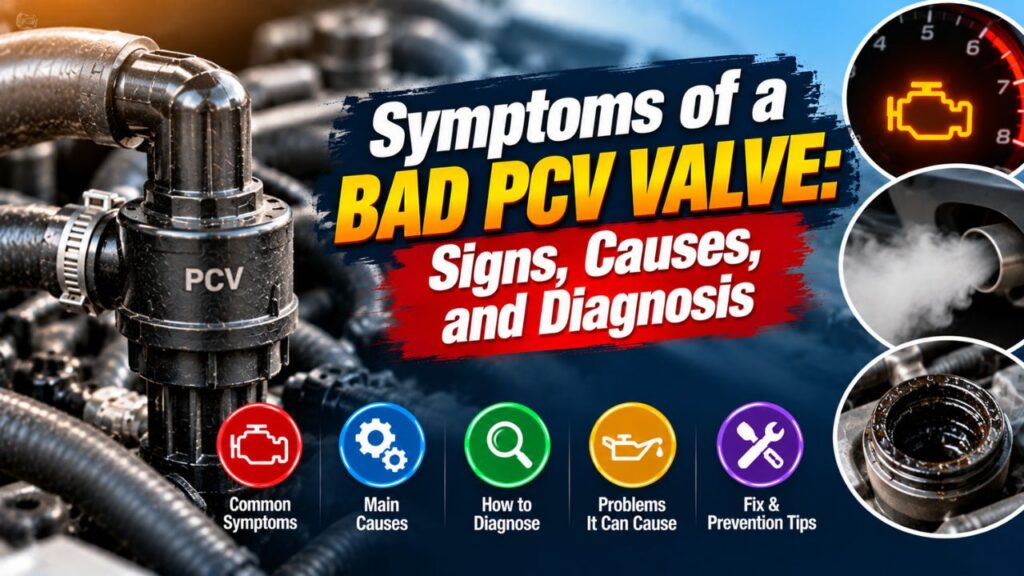
Symptoms of a Bad PCV Valve: Signs, Causes, and Diagnosis
Common symptoms of a bad PCV valve include rough idle, oil leaks, increased oil consumption, a check engine light, whistling noises, engine misfires, excessive crankcase pressure, and oil inside the intake system.
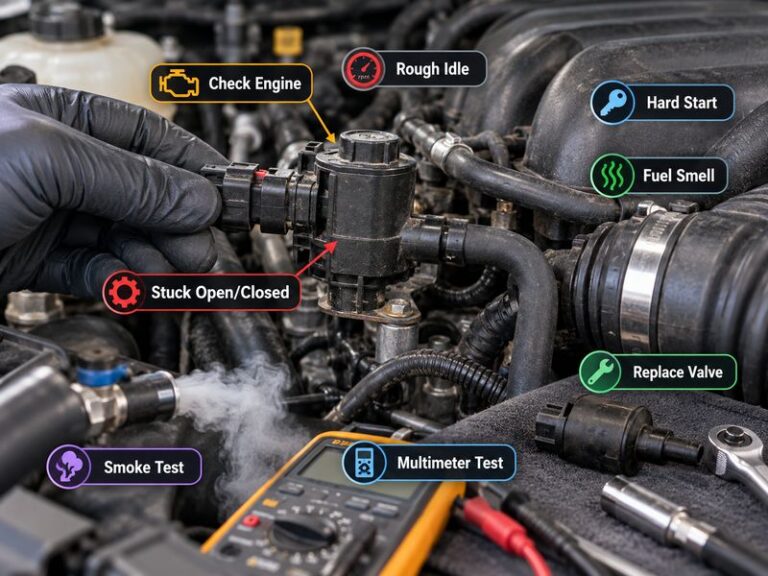
The symptoms of a bad PCV valve can vary because the valve can fail in more than one way. A PCV valve may become stuck open, stuck closed, clogged with sludge, or develop a problem in its connected hoses or diaphragm. Each failure changes crankcase airflow differently, so one vehicle may develop a vacuum leak and rough idle while another develops high crankcase pressure and oil leaks.
The positive crankcase ventilation (PCV) system is responsible for removing blow-by gases from inside the engine crankcase and routing them back into the intake so they can be burned. When that system stops working correctly, pressure, vacuum, fuel mixture, and oil control can all be affected.
If you are wondering what does a bad PCV valve do, what can a bad PCV valve cause, or how to tell if a PCV valve is bad, the key is to look at several symptoms together rather than relying on one sign. Some PCV failures are easy to diagnose, while others can resemble vacuum leaks, ignition problems, worn piston rings, or other engine faults.
What Are the Symptoms of a Bad PCV Valve?
The most common symptoms of a bad PCV valve include:
- Rough or unstable idle
- Check engine light
- Engine misfires
- Whistling or hissing noises
- Increased oil consumption
- Oil leaks
- Excessive pressure inside the crankcase
- Oil around seals or gaskets
- Oil inside the air intake
- Poor engine performance
- Lean or rich air-fuel mixture
- Sludge buildup
- Blue exhaust smoke in some cases
The exact symptoms depend heavily on whether the valve is stuck open or stuck closed.
A stuck-open PCV valve can act much like a vacuum leak.
A stuck-closed or clogged PCV valve can allow pressure to build inside the crankcase.
Understanding that difference makes diagnosis much easier.
What Does a PCV Valve Do?
The PCV valve is part of the engine’s crankcase ventilation system.
During combustion, a small amount of gas can escape past the piston rings and enter the crankcase. These gases are known as blow-by gases.
Blow-by may contain:
- Unburned fuel vapor
- Combustion gases
- Water vapor
- Oil mist
If these gases remained trapped inside the crankcase, they could increase pressure and contribute to oil contamination and sludge.
The PCV system routes these vapors back into the engine’s intake system so they can be burned during combustion.
The PCV valve helps regulate how much vapor flows based on engine operating conditions.
What Does a Bad PCV Valve Do to an Engine?
A bad PCV valve disrupts normal crankcase ventilation.
If too much air flows through the system, the engine may develop a vacuum leak and run lean.
If airflow becomes restricted, crankcase pressure can build.
This means a failing PCV system can affect:
- Engine idle
- Fuel mixture
- Oil seals
- Gaskets
- Oil consumption
- Intake cleanliness
- Emissions
- Engine performance
A failed PCV valve does not always cause immediate major engine damage, but ignoring the problem can lead to secondary issues.
Rough Idle Is a Common Bad PCV Valve Symptom
A rough idle is especially common when a PCV valve becomes stuck open or when a PCV hose develops a leak.
The PCV system connects to engine vacuum.
If too much unmetered air enters the intake manifold through the PCV system, the engine control module may struggle to maintain the correct air-fuel mixture.
You may notice:
- Shaking at idle
- Uneven engine speed
- RPM moving up and down
- Engine nearly stalling
- Idle improving when RPM increases
These symptoms can also come from other vacuum leaks, dirty throttle components, ignition faults, or fuel-system problems.
A Bad PCV Valve Can Cause a Check Engine Light
Yes. A failing PCV valve can trigger the check engine light.
The engine computer may detect problems such as:
- Lean air-fuel mixture
- Rich mixture
- Misfires
- Abnormal idle speed
- Fuel-trim problems
Diagnostic trouble codes associated with lean conditions or cylinder misfires may appear.
However, there usually is not a universal trouble code that automatically proves the PCV valve itself is bad.
The entire ventilation system should be inspected before replacing parts.
Can a Bad PCV Valve Cause Misfires?
Yes.
A stuck-open PCV valve or leaking PCV hose can introduce too much unmetered air into the intake.
This can make the air-fuel mixture too lean, particularly at idle.
A lean mixture may contribute to:
- Random misfires
- Cylinder-specific misfires
- Rough running
- Hesitation
Misfires have many other possible causes, including:
- Spark plugs
- Ignition coils
- Fuel injectors
- Vacuum leaks
- Low compression
A PCV problem should be considered alongside these possibilities rather than assumed automatically.
Whistling or Hissing Noise
A bad PCV system can create an unusual whistling, squealing, or hissing sound.
This often happens when:
- A PCV diaphragm tears
- A hose cracks
- Excessive vacuum passes through a restricted opening
- The valve becomes stuck in an abnormal position
The sound may be most noticeable at idle.
On some modern engines, the PCV system is built into the valve cover. A failed internal diaphragm may produce a strong whistle that changes when the oil cap is loosened.
Excessive Crankcase Pressure
A clogged or stuck-closed PCV valve can prevent blow-by gases from leaving the crankcase properly.
As pressure builds, the engine may begin forcing oil through weak sealing points.
Possible results include:
- Oil leaks
- Oil around valve-cover gaskets
- Oil near crankshaft seals
- Dipstick being pushed upward in severe cases
- Oil forced into other ventilation passages
Excessive crankcase pressure can also occur because of serious engine wear and excessive blow-by, so a clogged PCV valve is not the only possible cause.
Can a Bad PCV Valve Cause Oil Leaks?
Yes.
A restricted PCV system can increase pressure inside the crankcase.
That pressure may push oil past:
- Valve-cover gaskets
- Crankshaft seals
- Camshaft seals
- Oil-pan seals or gaskets
- Other engine sealing surfaces
Replacing a leaking gasket without correcting an underlying PCV restriction may allow the leak to return.
When an engine develops several oil leaks around the same time, checking crankcase ventilation is worthwhile.
Increased Oil Consumption
A faulty PCV system can contribute to increased oil consumption.
If the valve allows excessive vacuum through the crankcase ventilation system, oil mist or liquid oil may be pulled into the intake.
The engine can then burn that oil.
Possible signs include:
- Oil level dropping between changes
- Oil residue in intake tubing
- Oil around the throttle body
- Oil in the intake manifold
- Blue exhaust smoke in more severe cases
A small amount of oil vapor in a PCV system can be normal.
Large quantities of liquid oil are more concerning.
Can a Bad PCV Valve Cause Blue Smoke?
Yes, in some situations.
If a malfunctioning PCV system pulls excessive oil into the intake, the engine may burn the oil and produce blue or bluish exhaust smoke.
However, blue smoke can also indicate:
- Worn piston rings
- Valve-seal problems
- Turbocharger seal problems
- Cylinder wear
PCV failure should therefore be considered as one possible cause rather than the only explanation.
Oil in the Air Intake or Throttle Body
Some oil vapor is normal in many crankcase ventilation systems.
Excessive oil accumulation may indicate a problem.
A faulty PCV valve can allow too much oil mist to enter:
- Intake hose
- Throttle body
- Intake manifold
- Intercooler piping on some turbocharged engines
The amount that is considered normal varies considerably by engine design.
Heavy pooling of oil deserves further investigation.
Can a Bad PCV Valve Cause Poor Acceleration?
It can.
A major PCV vacuum leak can disturb the fuel mixture enough to cause:
- Hesitation
- Weak throttle response
- Rough acceleration
- Reduced power
A clogged system can also contribute indirectly to engine problems through pressure and oil contamination.
However, severe power loss usually warrants a broader diagnosis because many other faults can cause it.
Can a Bad PCV Valve Affect Fuel Economy?
Yes, particularly if it creates a vacuum leak or affects fuel trim.
When the engine computer detects an abnormal mixture, it may adjust fuel delivery to compensate.
Depending on the type of failure, fuel economy may decrease.
The difference may be small, and many other vehicle problems affect fuel consumption, so poor mileage alone is not a reliable PCV diagnosis.
What Happens When a PCV Valve Is Stuck Open?
A PCV valve stuck open can allow excessive airflow into the intake manifold.
This may effectively act like a vacuum leak.
Common stuck-open symptoms include:
- Rough idle
- High or unstable idle
- Lean mixture
- Check engine light
- Misfires
- Hissing noise
- Poor idle quality
The problem may be especially noticeable at idle because intake-manifold vacuum is high.
What Happens When a PCV Valve Is Stuck Closed?
A stuck-closed or clogged PCV valve prevents blow-by gases from escaping normally.
Possible symptoms include:
- High crankcase pressure
- Oil leaks
- Sludge buildup
- Oil forced past seals
- Increased oil contamination
- Moisture accumulation
- Oil around the air-cleaner or breather system
The engine may initially seem to run normally because a closed valve does not necessarily create the same obvious vacuum leak as a stuck-open valve.
That can allow the problem to go unnoticed.
Can a Bad PCV Valve Cause Engine Sludge?
Yes, a poorly functioning PCV system can contribute to sludge formation.
Blow-by gases contain moisture and combustion contaminants.
If crankcase ventilation is inadequate, those contaminants can remain in the engine oil.
Over time, especially with short-trip driving and neglected oil changes, this can promote:
- Sludge
- Varnish
- Deposits
Proper PCV operation helps remove moisture and vapors from the crankcase.
It does not replace regular engine-oil maintenance.
What Does a Bad PCV Valve Look Like?
A bad PCV valve does not always look visibly damaged.
It may appear completely normal from the outside.
Depending on the type of failure, you might notice:
- Thick oil sludge
- Carbon deposits
- Cracked plastic housing
- Damaged hose connection
- Oil contamination
- Broken internal parts
- Torn diaphragm on applicable designs
A visually clean PCV valve can still fail internally.
That is why appearance alone cannot confirm whether a PCV valve is good or bad.
Where Is the PCV Valve Located?
PCV valve location varies by engine.
Common locations include:
- Valve cover
- Cylinder head
- Intake manifold area
- Connected to a valve-cover hose
- Integrated directly into the valve cover
Older engines often have a small removable PCV valve connected by a rubber hose.
Many modern engines use a more complex integrated PCV assembly with diaphragms, passages, and oil separators built into the valve cover.
Always check the vehicle’s service information before assuming a particular component is the PCV valve.
How to Tell If a PCV Valve Is Bad
The best way to diagnose a PCV problem is to inspect the entire system rather than relying on a single test.
Look for Visible Damage
With the engine off, inspect:
- PCV valve
- Rubber hoses
- Plastic tubes
- Connectors
- Valve-cover fittings
Look for:
- Cracks
- Collapsed hoses
- Loose connections
- Oil saturation
- Broken fittings
A leaking hose can produce many of the same symptoms as a defective valve.
Check for Abnormal Vacuum
PCV systems normally have controlled vacuum flow.
Depending on engine design, abnormal vacuum at the oil-fill opening may suggest a failed PCV diaphragm or valve.
However, the amount of normal crankcase vacuum varies substantially between engines.
Do not use a generic vacuum expectation for every vehicle.
Inspect for Excessive Crankcase Pressure
Pressure coming strongly from the oil-fill opening can suggest poor ventilation or excessive engine blow-by.
Possible causes include:
- Blocked PCV valve
- Blocked hoses
- Internal PCV passage restriction
- Worn piston rings
Further diagnosis may be necessary to distinguish among them.
Does the PCV Valve Rattle Test Work?
Older spring-loaded PCV valves may make a rattling sound when removed and shaken.
A valve that does not rattle may be clogged.
However, the test has significant limitations.
A valve that rattles can still be worn or flow incorrectly.
Many modern PCV systems:
- Do not use a traditional rattling valve
- Use diaphragms
- Are integrated into the valve cover
Therefore, a rattle test should not be treated as definitive proof that a PCV valve is good.
Can You Test a PCV Valve by Removing the Oil Cap?
Loosening the oil-fill cap while the engine idles can sometimes reveal abnormal crankcase vacuum or pressure.
For example, an unusually strong vacuum that makes the cap very difficult to remove may suggest a PCV problem on certain engines.
However, some crankcase vacuum is normal.
The engine’s idle may also change when the oil cap is removed because you are opening the crankcase ventilation system.
Use this observation as a diagnostic clue, not a universal pass-or-fail test.
PCV Valve vs. PCV Hose Problems
Sometimes the valve itself is fine while the hose has failed.
PCV hoses can develop:
- Cracks
- Splits
- Collapse
- Sludge blockage
- Loose fittings
- Heat damage
A cracked PCV hose may introduce unmetered air and create lean-mixture symptoms.
A blocked hose can restrict crankcase ventilation and increase pressure.
Inspect the entire PCV circuit whenever a valve problem is suspected.
PCV Valve vs. Vacuum Leak
A stuck-open PCV valve can behave like a vacuum leak because it allows too much air into the intake.
Symptoms shared by both include:
- Rough idle
- Lean fuel trim
- Misfires
- Check engine light
- Hissing noise
Other possible vacuum-leak sources include:
- Intake manifold gasket
- Brake-booster hose
- Vacuum lines
- Throttle-body gasket
A smoke test is often useful for locating intake and PCV-system leaks.
Can a Bad PCV Valve Damage the Engine?
It can contribute to engine damage if ignored for a long time.
Possible long-term consequences include:
- Oil leaks
- Seal damage
- Sludge formation
- Excessive oil consumption
- Contaminated intake system
- Misfire-related catalytic-converter damage
- Poor lubrication due to oil contamination
The PCV valve itself is usually a relatively small component, but it controls an important engine ventilation function.
Correcting a fault early can prevent more expensive secondary problems.
Can a Bad PCV Valve Cause Catalytic Converter Problems?
Indirectly, yes.
If a PCV fault causes severe oil consumption or persistent misfires, oil or unburned fuel may enter the exhaust.
That can contaminate or overheat the catalytic converter.
A flashing check engine light associated with an active misfire should be taken seriously because continued driving can damage the catalyst.
How Often Should a PCV Valve Be Replaced?
There is no universal replacement interval.
Some manufacturers specify inspection or replacement at certain mileage intervals, while other modern systems are intended to be replaced only when a fault develops.
PCV life depends on:
- Engine design
- Oil-change history
- Driving conditions
- Heat
- Sludge formation
Check the maintenance schedule for your specific vehicle.
Do not replace an integrated valve cover merely because of a generic PCV mileage recommendation if the manufacturer does not specify it.
How Much Does It Cost to Replace a PCV Valve?
Cost varies dramatically by design.
A traditional stand-alone PCV valve can be inexpensive and quick to replace.
A modern integrated PCV system may require:
- New valve cover
- Intake components
- More labor
- Additional gaskets
The vehicle’s make, model, engine, labor rates, and component design determine the final cost.
Can You Drive With a Bad PCV Valve?
A vehicle may continue running with a faulty PCV valve, but ignoring the problem is not recommended.
A minor PCV fault might initially cause only a rough idle or warning light.
A severe restriction can create crankcase pressure and oil leaks, while a major vacuum leak can cause misfires and poor running.
If the vehicle has:
- Flashing check engine light
- Severe misfire
- Heavy oil leakage
- Heavy smoke
- Major loss of power
avoid unnecessary driving until the cause is diagnosed.
Common Mistakes When Diagnosing a Bad PCV Valve
Replacing the Valve Without Checking the Hoses
A cracked hose may be the actual problem.
Inspect the complete ventilation system.
Assuming a Rattling Valve Must Be Good
The rattle test is not conclusive.
A valve can move internally and still have incorrect flow.
Ignoring Oil Leaks
Multiple new oil leaks can indicate excessive crankcase pressure rather than several unrelated gasket failures.
Assuming All Oil in the Intake Means a Bad PCV Valve
Some oil vapor is normal in many engines.
The amount and engine design matter.
Ignoring Engine Wear
Severe blow-by caused by worn piston rings can overwhelm a correctly working PCV system.
Replacing the PCV valve alone will not repair internal engine wear.
FAQs About Symptoms of a Bad PCV Valve
What are the first symptoms of a bad PCV valve?
Early signs commonly include rough idle, hissing or whistling, a check engine light, unusual oil consumption, or new oil leaks.
The symptoms depend on whether the valve is stuck open or restricted.
What does a bad PCV valve do?
A bad PCV valve either allows too much airflow or prevents crankcase gases from escaping properly.
This can cause a vacuum leak, excessive crankcase pressure, oil leaks, fuel-mixture problems, and increased oil consumption.
What can a bad PCV valve cause?
A bad PCV valve can cause rough idle, misfires, oil leaks, excessive pressure, sludge, oil consumption, intake contamination, and potentially catalytic-converter problems if oil burning or misfires become severe.
What does a bad PCV valve look like?
It may look clogged with sludge, oily, cracked, or physically damaged.
However, many bad PCV valves look normal externally, so visual inspection alone is not enough.
How can I tell if my PCV valve is stuck open?
A stuck-open valve may cause symptoms similar to a vacuum leak, including rough idle, lean fuel mixture, misfires, hissing, and an abnormal amount of crankcase vacuum.
How can I tell if my PCV valve is clogged?
A clogged valve may cause excessive crankcase pressure, oil leaks, sludge, oil around seals, or pressure from the oil-fill opening.
Will a bad PCV valve trigger a check engine light?
It can.
A PCV fault may create lean fuel-trim or misfire conditions that trigger diagnostic trouble codes and illuminate the check engine light.
Can a bad PCV valve cause oil to burn?
Yes.
If the PCV system pulls excessive oil mist or liquid oil into the intake, that oil can enter the cylinders and burn, potentially causing increased oil consumption or blue exhaust smoke.
Conclusion
The overall verdict on the symptoms of a bad PCV valve is that there is no single sign that confirms every failure. A PCV valve stuck open commonly behaves like a vacuum leak and may cause rough idle, lean fuel mixture, misfires, whistling, and a check engine light. A clogged or stuck-closed valve is more likely to cause excessive crankcase pressure, oil leaks, sludge, and oil being forced through seals or ventilation passages.
A bad PCV valve may look dirty, clogged, oily, or damaged, but it can also look completely normal from the outside. That is why the best way to tell if a PCV valve is bad is to inspect the entire PCV system, including its hoses, connections, crankcase vacuum or pressure behavior, and relevant diagnostic trouble codes.
If the engine develops unexplained oil leaks, abnormal oil consumption, strong crankcase vacuum, excessive pressure, or persistent idle problems, the PCV system deserves inspection. Finding and correcting a PCV fault early can prevent a relatively inexpensive ventilation problem from contributing to oil leaks, intake contamination, sludge, or other more costly engine issues.