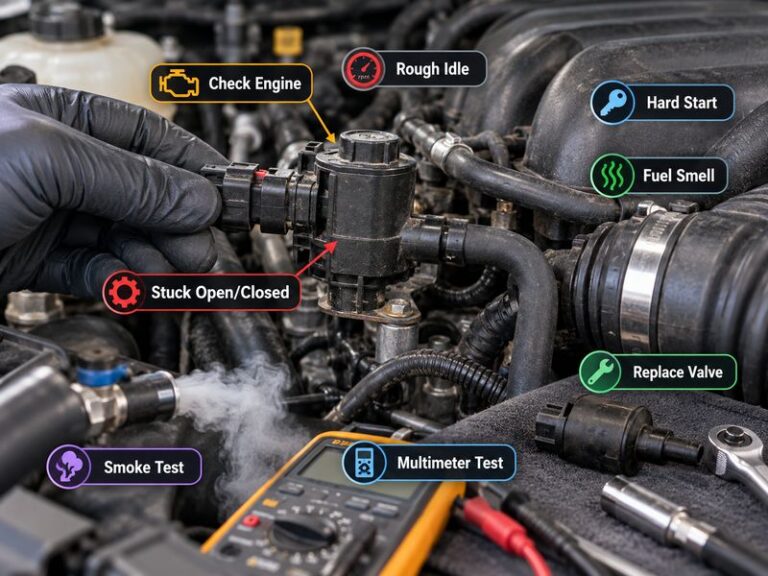
Can a PCV Valve Cause Rough Idle? Signs, Causes, and Fixes
A rough idle can make an otherwise normal-running vehicle shake, stumble, or feel as though the engine may stall while sitting at a stop. Many problems can cause these symptoms, but the positive crankcase ventilation system, commonly called the PCV system, is one possible source.
Yes, a bad PCV valve can cause rough idle. If the valve sticks open, leaks, or allows too much airflow into the intake manifold, it can act like a vacuum leak and make the air-fuel mixture too lean at idle. A stuck-closed or restricted PCV valve can cause different crankcase-pressure problems that may also affect engine operation.
Understanding can a PCV valve cause rough idle is especially useful because PCV-related symptoms can look similar to a vacuum leak, dirty throttle body, ignition problem, or fuel-delivery issue. The engine may run roughest at idle because manifold vacuum is high and even a relatively small amount of unmetered air can have a noticeable effect.
This guide focuses specifically on how the PCV valve can affect idle quality, which symptoms point toward a PCV problem, how to test the system, and when replacing the valve may solve the rough idle.
Can a PCV Valve Cause Rough Idle?

Yes. A faulty PCV valve can cause rough idle, particularly when it becomes stuck open or develops an internal leak.
The PCV system routes crankcase vapors back into the intake so they can be burned by the engine. The flow must be controlled.
If too much air is pulled through the PCV system at idle, the engine can receive air that the engine management system did not expect. This can create a lean air-fuel mixture, causing unstable combustion.
The result may include:
- Rough idle
- Engine shaking
- Idle speed that is too high
- Surging idle
- Stalling
- Lean diagnostic trouble codes
- Hissing or whistling noises
A PCV problem may be most noticeable when the engine is idling and improve somewhat as engine speed increases.
How the PCV Valve Affects Engine Idle
The PCV valve is part of the crankcase ventilation system.
During engine operation, a small amount of combustion gas escapes past the piston rings into the crankcase. This is called blow-by.
These gases can contain:
- Fuel vapor
- Moisture
- Combustion gases
- Oil vapor
Instead of allowing them to build up inside the engine, the PCV system routes the vapors back into the intake system.
The PCV valve controls how much vapor and airflow are allowed through.
At idle, intake manifold vacuum is relatively high. The PCV valve must restrict flow so the engine does not receive too much additional air.
If the valve fails to control that airflow properly, idle quality can suffer.
How a Stuck-Open PCV Valve Causes Rough Idle
A stuck-open PCV valve is one of the PCV failures most likely to cause rough idle.
When the valve remains too far open, intake manifold vacuum can pull excessive air through the crankcase ventilation system.
This behaves much like a vacuum leak.
The extra air may cause the mixture to become lean, particularly at idle.
A lean mixture may burn inconsistently, causing:
- Shaking
- Stumbling
- Surging
- Hesitation
- Occasional stalling
The engine computer may try to compensate by adding more fuel.
If the correction becomes large enough, it may store a lean-condition trouble code.
Can a PCV Valve Cause a High Idle?
Yes.
A PCV valve that allows excessive airflow can sometimes cause the engine to idle faster than normal.
The engine effectively receives additional air through the PCV circuit.
Possible symptoms include:
- Higher-than-normal RPM
- Idle speed that changes unexpectedly
- Engine speed that hangs before dropping
- Rough but elevated idle
However, a high idle can also come from other vacuum leaks, throttle-body problems, or electronic throttle-control issues.
PCV diagnosis should therefore include inspection of the complete hose and valve system.
Can a PCV Valve Make the Engine Idle Low?
It can contribute to unstable or unusually low idle in some situations.
If airflow through the PCV system is incorrect, the engine computer may struggle to maintain the desired idle speed.
The engine may:
- Drop below normal idle RPM
- Shake heavily
- Nearly stall
- Stall completely when stopping
A low idle by itself does not prove the PCV valve is bad.
Ignition, fuel, throttle, and vacuum problems can create very similar symptoms.
Can a Clogged PCV Valve Cause Rough Idle?
A clogged or stuck-closed PCV valve usually creates different problems than a stuck-open valve, but it can still contribute to poor engine operation.
If crankcase gases cannot escape normally, pressure can increase inside the engine.
Possible consequences include:
- Oil leaks
- Oil pushed past seals
- Sludge formation
- Increased oil contamination
- Crankcase pressure problems
A restricted system may also alter expected crankcase ventilation flow.
Depending on the engine design, this can contribute to poor idle or drivability symptoms.
However, when rough idle is the main symptom, an open PCV leak is often more directly suspicious than a completely blocked valve.
PCV Valve Rough Idle Symptoms
A faulty PCV valve rarely produces only one symptom.
When rough idle is PCV-related, you may also notice:
- Engine shaking at stoplights
- RPM fluctuation
- Whistling or hissing sound
- High idle
- Lean trouble codes
- Check engine light
- Increased oil consumption
- Oil around seals or gaskets
- Strong crankcase vacuum
- Engine behavior changing when the PCV hose is pinched
The exact symptom pattern depends on whether the valve is stuck open, restricted, leaking, or whether the problem is actually in a PCV hose or diaphragm.
Why Rough Idle May Be Worse When the Engine Is Warm
A PCV-related vacuum leak can sometimes become more noticeable after the engine warms up.
Several things change as the engine reaches operating temperature:
- Idle speed normally drops.
- Fuel enrichment used during cold starting decreases.
- Engine management enters normal closed-loop control.
- Rubber and plastic PCV components warm and change slightly.
A vacuum leak that is less noticeable during a rich cold start may become more obvious after warm-up.
If an engine idles reasonably when cold but becomes rough when warm, a PCV or vacuum leak is one possibility worth checking.
Why Rough Idle May Improve When You Accelerate
A PCV vacuum leak often has a greater effect at idle than at higher engine speeds.
At idle, total engine airflow is relatively low.
A small amount of extra air therefore represents a significant percentage of the total airflow entering the engine.
When you open the throttle and accelerate, the engine consumes much more air.
The same PCV leak becomes a smaller percentage of total airflow.
That is why an engine may:
- Idle badly
- Smooth out around 1,500–2,000 RPM
- Drive relatively normally under moderate throttle
This pattern can point toward a vacuum-related problem, including the PCV system.
Can a PCV Hose Cause Rough Idle?
Yes.
Sometimes the PCV valve itself is fine, but the PCV hose is cracked, loose, collapsed, or disconnected.
A damaged hose can allow unmetered air into the intake.
Common hose problems include:
- Cracks near fittings
- Split rubber elbows
- Loose connections
- Hardened hoses
- Collapsed sections
- Oil-softened rubber
- Broken plastic tubing
Because PCV hoses are often exposed to engine heat and oil vapor, they can deteriorate over time.
Always inspect the hose when checking the valve.
Can a PCV Diaphragm Cause Rough Idle?
Yes.
Many newer engines do not use a simple removable PCV valve.
Instead, the PCV system may use a diaphragm or pressure-regulating assembly built into:
- Valve cover
- Oil separator
- Breather assembly
- Intake system
If the diaphragm tears, it can create a substantial vacuum leak.
Possible symptoms include:
- Rough idle
- Whistling
- Excessive crankcase vacuum
- Lean codes
- Oil consumption
- Check engine light
On some engines, the PCV diaphragm is not serviced separately and the entire valve cover or separator assembly must be replaced.
What Does a Bad PCV Valve Sound Like at Idle?
A PCV problem can sometimes produce a noticeable sound.
Common noises include:
- Hissing
- Whistling
- Squealing
- Air-sucking noise
A torn diaphragm can create a particularly noticeable whistle.
However, similar noises can come from:
- Intake hoses
- Vacuum lines
- Brake-booster hose
- Intake manifold gasket
- Throttle-body gasket
Use the sound as a clue rather than a final diagnosis.
Can a Bad PCV Valve Cause a Misfire at Idle?
Yes.
If a PCV fault creates a significant lean condition, combustion can become unstable enough to cause misfires.
The engine computer may store codes such as:
- P0300 – Random or multiple-cylinder misfire
- P0301 – Cylinder 1 misfire
- P0302 – Cylinder 2 misfire
- Similar cylinder-specific codes
However, misfire codes are not automatically PCV codes.
Other common causes include:
- Spark plugs
- Ignition coils
- Fuel injectors
- Compression problems
- Intake leaks
A PCV-related vacuum leak is more likely to affect multiple cylinders or those closest to the leak, depending on intake design.
Can a Bad PCV Valve Cause Lean Codes?
Yes.
A PCV system that allows excessive unmetered air can cause the engine control module to detect a lean condition.
Possible trouble codes include:
- P0171 – System Too Lean, Bank 1
- P0174 – System Too Lean, Bank 2
These codes mean the engine computer has been adding fuel to compensate for a mixture it believes is too lean.
A leaking PCV valve or hose is one possible cause.
Other causes include:
- Intake manifold leaks
- Vacuum hose leaks
- Low fuel pressure
- Dirty or faulty mass airflow sensor
- Exhaust leaks affecting oxygen-sensor readings
Do not replace the PCV valve based on a lean code alone.
How to Check Whether the PCV Valve Is Causing Rough Idle
A few simple checks can help determine whether the PCV system deserves closer attention.
Inspect the PCV Valve and Hose
With the engine off, look for:
- Cracked hoses
- Loose fittings
- Broken connectors
- Oil-soaked rubber
- Collapsed tubing
- Damaged valve housing
Visible damage is a strong reason to repair the system.
Listen for Vacuum Noise
With the engine running, listen around the PCV valve and hose.
A pronounced hissing or whistling sound can indicate a leak.
Keep hands, clothing, and tools away from moving belts and fans.
Check for Changes When the PCV Flow Is Restricted
On some traditional PCV systems, a technician may temporarily restrict the PCV hose while monitoring idle quality.
If the rough idle immediately improves, excessive PCV airflow may be contributing to the problem.
However, do not permanently block the PCV system.
The engine needs proper crankcase ventilation.
Some modern electronically monitored systems also require more specialized diagnosis.
Does the PCV Valve Rattle Test Prove It Is Good?
No.
Older PCV valves often contain an internal plunger that may rattle when the valve is shaken.
A valve that does not rattle may be clogged.
However, a valve that does rattle is not automatically good.
It may still:
- Flow too much air
- Leak
- Have a weak internal spring
- Be incorrect for the engine
The rattle test is only a basic screening check for certain traditional valve designs.
It is not a complete diagnostic test.
Can You Clean a PCV Valve to Fix Rough Idle?
Some older metal PCV valves can sometimes be cleaned, but replacement is often more reliable because conventional PCV valves are generally inexpensive.
Modern PCV systems may include:
- Plastic valves
- Calibrated diaphragms
- Integrated oil separators
- Valve-cover assemblies
These components may not be designed for cleaning.
If a valve is worn, cracked, or internally damaged, cleaning will not restore the correct calibrated airflow.
Use the manufacturer’s recommended service procedure.
Will Replacing the PCV Valve Fix Rough Idle?
Yes, if the PCV valve or associated PCV leak is the actual cause.
Replacing a faulty valve can restore the correct crankcase ventilation flow and eliminate the unwanted vacuum leak.
The idle may then become smoother almost immediately.
However, replacing the PCV valve will not fix rough idle caused by:
- Bad spark plugs
- Ignition coil failure
- Dirty fuel injectors
- Intake gasket leaks
- Throttle-body problems
- Low compression
- Fuel-pressure problems
Diagnosis prevents unnecessary parts replacement.
How Quickly Should Idle Improve After PCV Replacement?
If excessive PCV airflow was directly causing the problem, the idle may improve as soon as the engine is restarted.
However, some vehicles may need time for fuel-trim corrections to return toward normal.
The engine computer continuously adjusts fuel delivery based on sensor feedback.
After a major vacuum leak is repaired, those learned corrections may take some driving to stabilize.
A scan tool can be useful for monitoring fuel trims before and after the repair.
Fuel Trim and PCV-Related Rough Idle
Fuel trim shows how much the engine computer is adjusting fuel delivery to maintain the desired air-fuel ratio.
A significant vacuum leak often produces positive fuel trims because the computer is adding fuel.
A PCV-related leak may show a useful pattern:
- High positive fuel trim at idle
- Lower correction at higher RPM
This happens because a fixed-size vacuum leak has a larger effect when total airflow is low.
Fuel-trim analysis is one of the more useful professional diagnostic methods for identifying vacuum-related rough idle.
Can a Bad PCV Valve Cause Stalling?
Yes.
If a PCV leak is large enough, the mixture may become unstable enough for the engine to stall.
Stalling may occur:
- Immediately after startup
- When coming to a stop
- When shifting into gear
- While idling with accessories on
A severe vacuum leak can make it difficult for the idle-control system to compensate.
Again, stalling has many possible causes, so PCV inspection should be part of a broader diagnosis if other symptoms are present.
Can a Bad PCV Valve Cause Engine Shaking?
Yes.
Rough combustion caused by an incorrect air-fuel mixture can make the engine shake.
The shaking may be felt through:
- Steering wheel
- Seat
- Floor
- Dashboard
However, engine mounts can make normal engine vibration feel worse, while ignition or fuel problems can produce the same shaking.
If the engine RPM itself is unstable or misfires are present, the problem is more likely combustion-related than simply a worn mount.
PCV Valve vs. General Vacuum Leak
A bad PCV valve is essentially one possible source of an intake vacuum leak.
| Problem | Rough Idle | Lean Codes | Hissing | Oil-Related Symptoms |
| PCV valve stuck open | Common | Possible | Possible | Possible |
| Cracked PCV hose | Common | Possible | Common | Sometimes |
| Torn PCV diaphragm | Common | Common | Often | Common |
| Intake gasket leak | Common | Common | Possible | Usually no |
| Other vacuum hose leak | Common | Possible | Common | Usually no |
Oil-related symptoms can make the PCV system more suspicious, but they are not required.
Should You Drive With a Bad PCV Valve and Rough Idle?
A mild PCV problem may not immediately prevent the vehicle from moving, but it should not be ignored.
A faulty PCV system can contribute to:
- Poor drivability
- Increased emissions
- Oil leaks
- Sludge
- Excessive oil consumption
- Lean operation
- Misfires
If the check engine light is flashing, the engine is stalling repeatedly, or the vehicle runs severely rough, driving should be minimized until the cause is diagnosed.
A flashing check engine light can indicate a misfire severe enough to damage the catalytic converter.
When Should You Replace the PCV Valve?
Replacement is reasonable when the valve:
- Is confirmed stuck
- Leaks excessive vacuum
- Is physically damaged
- Has failed a manufacturer-specified test
- Is due according to the vehicle’s maintenance recommendations
Some manufacturers do not specify a routine interval because the PCV component is intended to be inspected and replaced as needed.
Modern integrated PCV systems may require replacement of a larger assembly rather than a small standalone valve.
FAQs About Can a PCV Valve Cause Rough Idle
Can a PCV valve cause rough idle only when warm?
Yes. A PCV-related vacuum leak can become more noticeable after the engine warms and cold-start enrichment ends.
However, warm-only rough idle can also come from other vacuum, ignition, or fuel-control problems.
Can a stuck-open PCV valve cause rough idle?
Yes. A stuck-open PCV valve can allow excessive air into the intake manifold, creating a vacuum leak and lean mixture that makes the engine idle roughly.
Can a clogged PCV valve cause rough idle?
It can, although a completely restricted valve more commonly causes excessive crankcase pressure and oil-related problems.
A PCV valve that leaks too much air is usually more directly associated with rough idle.
Can a bad PCV valve cause high idle?
Yes. Excessive PCV airflow can behave like a vacuum leak and increase idle speed on some engines.
Can a bad PCV valve make the car stall?
Yes. A severe PCV vacuum leak can destabilize the air-fuel mixture enough to cause low idle or stalling.
Can a PCV valve cause a P0171 code?
Yes. A leaking PCV valve or hose can allow unmetered air into the engine and contribute to a P0171 lean code.
Other vacuum leaks and fuel-delivery problems can cause the same code.
How can I tell if my PCV valve is causing rough idle?
Look for PCV hose damage, hissing or whistling, excessive crankcase vacuum, lean fuel trims, or an idle that changes when PCV airflow is temporarily restricted during proper diagnosis.
Will replacing a PCV valve make the engine idle smoother?
It can if the valve is faulty and causing incorrect airflow.
If the rough idle remains after replacement, another ignition, fuel, vacuum, or mechanical problem should be investigated.
Conclusion
The answer to can a PCV valve cause rough idle is yes, especially when the valve sticks open, a PCV hose leaks, or a diaphragm failure allows too much unmetered air into the intake. At idle, engine airflow is relatively low and manifold vacuum is high, so even a modest PCV leak can significantly disturb the air-fuel mixture and cause shaking, surging, high idle, lean codes, misfires, or stalling.
The best approach is to inspect the entire PCV system rather than replacing the valve blindly. Check the valve, hoses, fittings, and any integrated diaphragm for leaks or damage, and compare the symptoms with fuel-trim or vacuum-leak evidence when possible.
If repairing the PCV system immediately restores a smooth idle, excessive crankcase ventilation airflow was likely the problem. If the engine remains rough, the next step is to investigate other causes such as ignition, fuel delivery, intake leaks, or compression rather than continuing to replace PCV components.