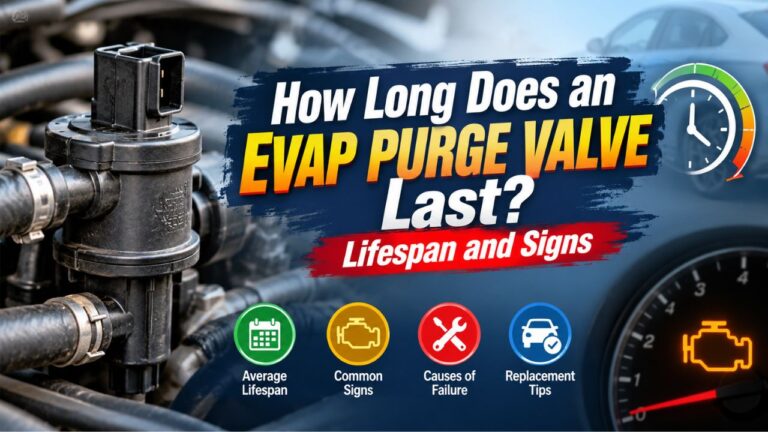
Bad Purge Valve Symptoms: Signs, Causes, Testing and Fixes
The most common bad purge valve symptoms are a check engine light, rough idle, hard starting after refueling, hesitation, occasional stalling, unusual fuel-vapor smells, reduced fuel economy, and EVAP-related trouble codes. A purge valve that is stuck open can allow fuel vapor and unwanted airflow into the intake when the engine is not expecting it. A valve stuck closed can prevent stored fuel vapor from leaving the charcoal canister correctly.
One of the strongest clues is an engine that becomes hard to start immediately after filling the gas tank. This often happens when a purge valve leaks while it should be closed and allows too much fuel vapor into the intake.
However, these symptoms do not automatically prove that the purge valve is bad. Vacuum leaks, damaged EVAP hoses, a faulty vent valve, wiring problems, and other engine faults can produce similar problems. Proper testing is important before replacing the valve.
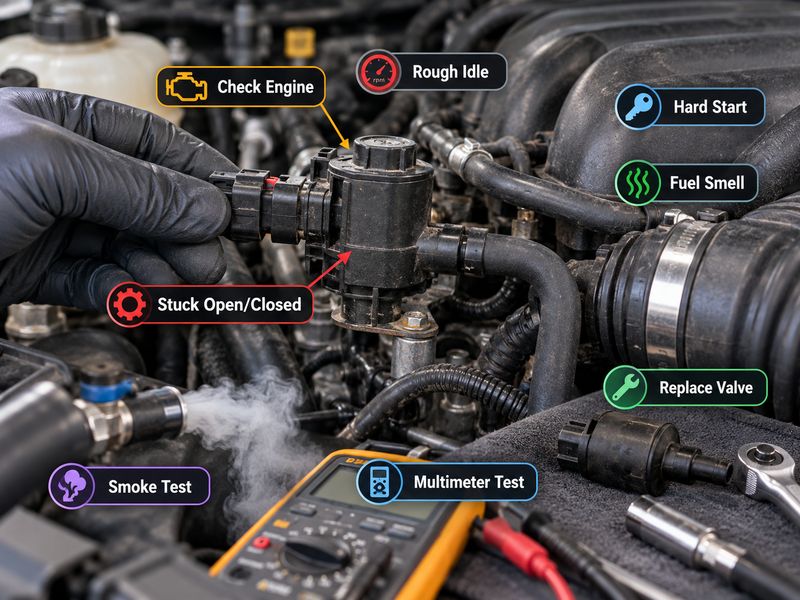
Bad Purge Valve Symptoms and What They Mean
Bad purge valve symptoms vary depending on how the valve fails.
A purge valve may become stuck open, stuck closed, partially restricted, mechanically leaky, or electrically defective. Each failure affects the EVAP system differently.
A stuck-open purge valve usually causes more noticeable drivability problems because intake vacuum can pull vapor or air through the EVAP system at the wrong time.
A stuck-closed purge valve may cause few obvious driving symptoms. The vehicle may seem normal while the check engine light comes on because the EVAP system cannot move stored vapors as expected.
Common symptoms include:
- Check engine light
- Rough or unstable idle
- Hard starting after refueling
- Hesitation during acceleration
- Occasional stalling
- Fuel-vapor odor
- Reduced fuel economy
- Abnormal fuel-trim readings
- Failed emissions testing
Some vehicles may have only one symptom, while others can show several at the same time.
What Is an EVAP Purge Valve?
The EVAP purge valve, also called a canister purge valve, purge solenoid, or EVAP purge solenoid, is part of the vehicle’s evaporative emissions system.
Gasoline naturally creates vapor inside the fuel tank. Instead of allowing those vapors to escape into the atmosphere, the EVAP system stores them inside a charcoal canister.
When engine conditions are appropriate, the engine control module commands the purge valve to open. Intake vacuum then pulls the stored vapors from the charcoal canister into the engine, where they are burned during normal combustion.
The purge valve therefore controls when and how much vapor enters the engine.
When the valve should be closed, it needs to seal properly. When the engine computer commands purge flow, it needs to open and respond correctly.
Once the valve stops doing either of those things, EVAP and engine-running problems can begin.
What Happens When a Canister Purge Valve Goes Bad?
What happens when a canister purge valve goes bad depends mainly on whether it fails open or closed.
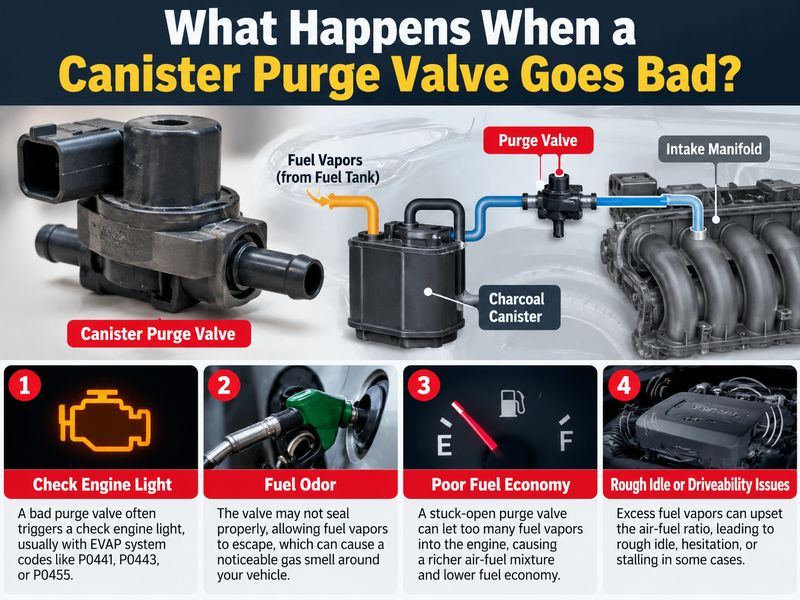
If the valve remains open, the engine may receive fuel vapor and additional airflow at the wrong time. This can disturb the air-fuel mixture, especially at idle and during startup.
If the valve remains closed, vapor stored in the charcoal canister cannot move into the intake as designed. The engine may continue running normally, but the vehicle’s onboard diagnostics can detect that expected purge flow is missing.
An electrical failure can also prevent the purge valve from responding to commands even if the mechanical valve itself is not physically stuck.
This is why a bad purge valve can create either obvious drivability problems or nothing more than a check engine light.
Check Engine Light
A check engine light is one of the most common EVAP purge valve symptoms.
The engine computer monitors purge flow and EVAP system behavior. If the system sees airflow when none should be present, cannot produce expected purge flow, or detects an electrical problem in the purge-valve circuit, it can store a diagnostic trouble code.
A purge-related trouble code is useful, but it does not automatically mean the purge valve needs replacement. You can read more about the replacement cost of evap purge valve.
Other possible causes include a damaged EVAP hose, faulty vent valve, wiring problem, charcoal canister issue, fuel tank pressure sensor problem, or leak elsewhere in the system.
The code should guide diagnosis rather than replace it.
Rough or Unstable Idle
A rough idle is one of the most recognizable canister purge valve symptoms, particularly when the purge valve is stuck open.
At idle, the engine is using a relatively small amount of air and fuel. Unexpected flow through the purge system can therefore have a noticeable effect.
The engine may shake, surge, fluctuate in RPM, or feel as though it is about to stall at a stoplight.
A leaking purge valve can sometimes behave similarly to a vacuum leak because intake manifold vacuum is pulling air through a passage that should be sealed.
The more severe the leak, the more noticeable the idle problem may become.
Hard Starting After Refueling
Hard starting after getting gas is one of the most useful clues when trying to determine how to tell if purge valve is bad.
When the fuel tank is filled, a large amount of fuel vapor can be displaced into the EVAP system.
If the purge valve is leaking or stuck open, some of that vapor can enter the intake manifold when it should not.
When you start the engine, the mixture may temporarily become too rich.
The engine may crank longer than usual, start and stall, run roughly for several seconds, or require a second attempt before it stays running.
If your vehicle normally starts fine but repeatedly struggles right after refueling, the purge valve should be tested.
Engine Stalling
A faulty purge valve can sometimes make the engine stall.
This tends to happen when a valve stuck open allows too much vapor or unintended airflow into the intake.
The engine computer can compensate for small mixture changes, but a larger unexpected flow may overwhelm those corrections, especially at idle.
Stalling may happen immediately after refueling, shortly after startup, while sitting at a stoplight, or while coming to a stop.
Because stalling has many possible causes, a purge valve should be confirmed with testing rather than replaced based on this symptom alone.
Can a Bad Purge Valve Cause Loss of Power?
Yes, a bad purge valve can cause loss of power, but the reduction is usually mild rather than dramatic.
A purge valve stuck open can disturb the air-fuel mixture and make the engine hesitate or respond sluggishly when you press the accelerator.
You might notice weak low-speed acceleration, a brief flat spot, or inconsistent throttle response.
However, severe power loss is less typical of a purge-valve problem.
If the engine can barely accelerate, misfires heavily under load, or cannot maintain highway speed, other problems such as fuel-delivery faults, ignition issues, airflow-sensor problems, or exhaust restrictions should also be investigated.
Hesitation During Acceleration
A leaking purge valve can sometimes cause hesitation when the vehicle begins accelerating from a stop.
At that moment, the engine computer is changing throttle position, fuel delivery, ignition timing, and airflow.
Unexpected fuel vapor entering through the purge system can briefly disturb the mixture.
The vehicle may pause or stumble before accelerating normally.
This symptom may be more noticeable after the engine is warm or shortly after refueling.
Because hesitation can come from many different systems, scan data and purge-valve testing are useful before replacing parts.
Poor Fuel Economy
A faulty purge valve can sometimes contribute to reduced fuel economy.
If the valve remains open when it should be closed, the engine control system may continually adjust fuel delivery to compensate for the unexpected vapor or airflow.
The change in fuel economy is usually not enormous.
A major drop in MPG should also prompt checks for tire pressure, misfires, oxygen-sensor problems, thermostat faults, dragging brakes, fuel injector issues, and other common causes.
Poor mileage becomes more meaningful as a purge-valve clue when it appears together with rough idle, hard starting after filling the tank, or EVAP trouble codes.
Fuel Smell or Fuel-Vapor Odor
A bad purge valve can sometimes be associated with an unusual gasoline-vapor smell.
The EVAP system is designed to contain fuel vapor, so incorrect vapor flow can contribute to noticeable odors.
However, a strong fuel smell should not automatically be blamed on the purge valve.
A cracked vapor hose, damaged charcoal canister, loose gas cap, damaged filler neck, or actual liquid-fuel leak can also create a gasoline odor.
If you smell strong raw gasoline, especially around the engine compartment or under the vehicle, inspect the vehicle for an actual fuel leak rather than assuming it is only an EVAP control issue.
Hard Starting When the Engine Is Warm
Some vehicles with a leaking purge valve may develop warm-start problems.
After the engine is shut off, vapor remains in the fuel and EVAP systems. If the purge valve fails to seal, some of that vapor can migrate into the intake.
When the warm engine is restarted, the mixture may be too rich for easy starting.
This can cause longer cranking or a short period of unstable running.
Warm-start difficulty becomes especially suspicious when it happens more frequently after refueling.
Abnormal Fuel Trim Readings
Fuel trim describes how much the engine computer is adjusting fuel delivery to maintain the correct mixture.
A leaking purge valve can alter those readings because the engine is receiving vapor or airflow the computer did not originally expect.
A technician may notice abnormal short-term fuel trim or long-term fuel trim, particularly at idle.
Fuel-trim data can help identify an unwanted flow path, but it cannot by itself prove that the purge valve is responsible.
Vacuum leaks, a dirty mass airflow sensor, low fuel pressure, injector problems, oxygen-sensor issues, and exhaust leaks can also influence fuel trims.
Failed Emissions Inspection
A vehicle with a bad purge valve may fail an emissions inspection even if it seems to drive normally.
The check engine light may remain on because of an EVAP-related code, or the EVAP readiness monitor may report incomplete or failed status.
If the code is cleared immediately before an emissions inspection, the vehicle may still not pass because the computer needs time and specific operating conditions to rerun its self-tests.
Replacing the faulty component should therefore be followed by verification that the EVAP monitor completes normally.
Symptoms of a Bad Purge Valve Solenoid
The phrases symptoms of bad purge valve solenoid, bad purge valve solenoid symptoms, and bad purge valve symptoms usually describe the same general problems.
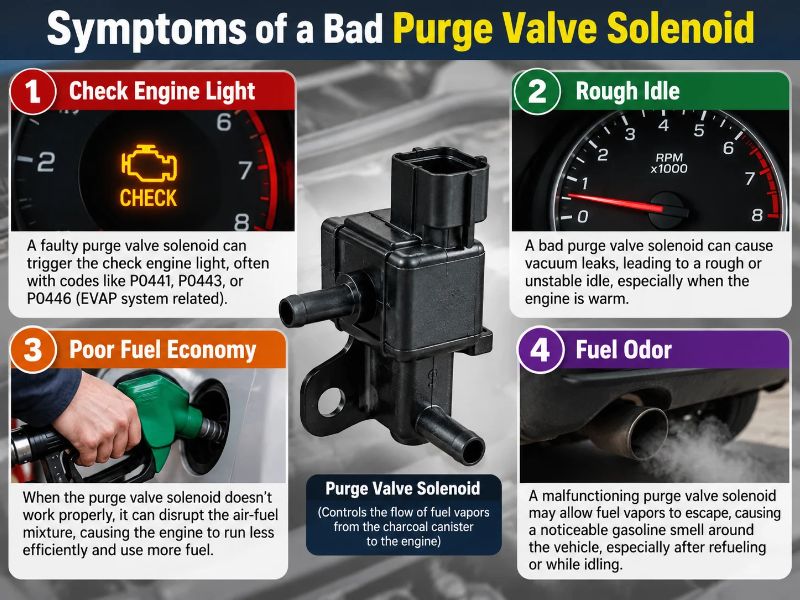
The purge valve is normally controlled by an electromagnetic solenoid.
When the engine computer sends a command, the solenoid moves the internal valve.
An electrical failure can occur because of a failed coil, damaged wiring, corrosion inside the connector, or a circuit fault.
In that situation, the engine may run almost normally because the valve remains closed, but the check engine light can appear when the computer detects that the solenoid is not responding.
A mechanically stuck valve, on the other hand, may create drivability problems even when the electrical circuit tests correctly.
Stuck-Open vs Stuck-Closed Purge Valve Symptoms
The difference between a stuck-open and stuck-closed valve explains many purge-valve symptoms.
Purge Valve Stuck Open
A purge valve stuck open tends to create more noticeable engine symptoms.
Because the valve is allowing flow when it should not, you may experience rough idle, hard starting after refueling, hesitation, stalling, fuel-trim changes, or mild loss of power.
The problem may be especially obvious after filling the fuel tank.
Purge Valve Stuck Closed
A purge valve stuck closed may produce little or no noticeable effect on how the engine runs.
Instead, the engine computer may detect that stored vapor is not flowing from the charcoal canister into the engine when commanded.
The result may simply be a check engine light, EVAP code, or failed emissions test.
Driving With Bad Purge Valve Symptoms
The severity of driving with bad purge valve symptoms depends on the type of failure.
A vehicle with a stuck-closed purge valve may continue to drive normally while displaying a check engine light.
A stuck-open valve can be more disruptive because it may cause rough idle, hesitation, difficult starting, or stalling.
In many cases, a bad purge valve will not immediately cause major engine damage. However, it should still be repaired.
A persistent check engine light also makes it harder to notice when another unrelated engine fault develops later.
If the vehicle begins stalling unexpectedly, has severe hesitation, or has a strong fuel smell, repair becomes more urgent.
Can You Drive With a Bad Purge Valve?
A vehicle with a bad purge valve is often still drivable for a short period if the engine runs normally and there is no strong fuel odor.
There is no universal safe mileage limit, though.
A valve that is only causing an EVAP warning light is very different from one that causes the engine to stall after every refueling stop.
If the vehicle is difficult to start, repeatedly stalls, or runs poorly enough to affect safe driving, do not postpone diagnosis.
How to Tell If Purge Valve Is Bad
Knowing how to tell if purge valve is bad requires checking both the valve and the rest of the EVAP system.
The first step is usually to scan the vehicle for diagnostic trouble codes and look at any stored freeze-frame information.
The next step is a visual inspection.
A technician or experienced DIYer should inspect the purge valve, electrical connector, vapor hoses, and nearby EVAP plumbing for obvious damage.
After that, the valve can be tested to determine whether it seals properly when closed and opens correctly when commanded.
How to Tell If EVAP Purge Valve Is Bad With a Scan Tool
A bidirectional scan tool can be particularly useful.
On vehicles that support active tests, the scan tool can command the purge valve to open or close while the technician watches engine behavior and EVAP sensor data.
If the computer commands the valve closed but airflow continues, the valve may be leaking.
If the computer commands the valve open and nothing changes, the valve may be stuck, blocked, electrically defective, or disconnected.
The exact test varies by manufacturer, so vehicle-specific service information is important.
Can You Test a Purge Valve by Blowing Through It?
On many normally closed purge valves, a simple airflow check can provide a useful clue.
With no electrical power applied, a normally closed valve should generally block airflow.
If air passes freely through a valve that should be closed, it may be stuck open or leaking internally.
However, this is only a basic check.
Not every purge valve uses exactly the same design, and a valve that appears to block airflow may still leak enough under vacuum to cause a problem.
A proper vacuum test is more informative.
Testing a Purge Valve With Vacuum
A hand vacuum pump can help determine whether the purge valve seals.
When the valve is supposed to be closed, it should generally hold vacuum.
If vacuum quickly leaks away through the valve, the internal seal may be faulty.
When the valve is correctly energized or commanded open, it should allow flow according to its design.
This test is particularly helpful because a purge valve can make a clicking sound and still leak.
Can a Purge Valve Click and Still Be Bad?
Yes.
A purge valve that clicks is not automatically good.
The clicking sound only shows that the solenoid or internal mechanism is moving.
The valve may still fail to close completely, leak internally, fail to open fully, or have restricted flow.
A mechanical sealing test is therefore useful even when the solenoid responds electrically.
This is a common reason a valve can pass a simple “click test” but still cause hard starting after refueling.
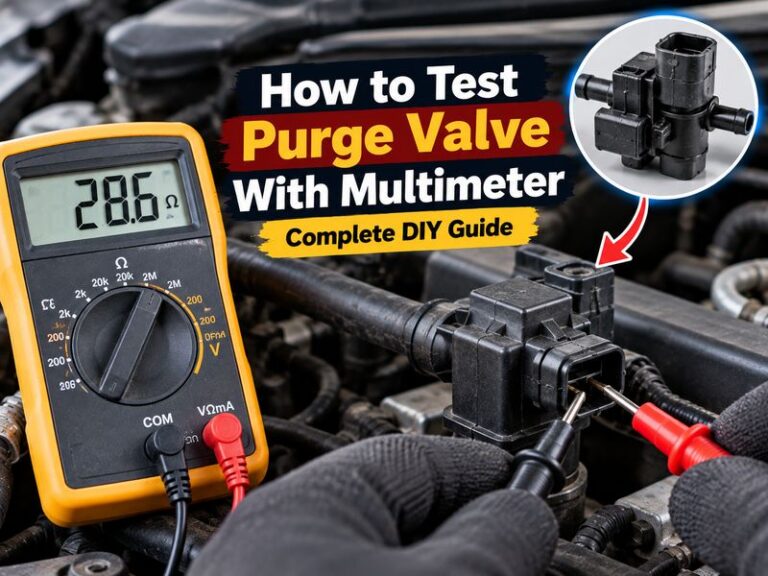
Can You Test a Purge Valve With a Multimeter?
A multimeter can help diagnose the electrical side of the purge solenoid.
You can use it to check the solenoid coil, electrical supply, wiring continuity, and related circuit problems when you have the correct vehicle-specific specifications.
The purge valve’s expected electrical resistance varies between designs.
Do not assume that a resistance value listed for one vehicle is correct for another.
Also remember that a purge valve can test electrically good but still be mechanically bad.
Electrical testing and sealing tests answer different questions.
Can a Good Purge Valve Still Trigger an EVAP Code?
Yes.
An EVAP code can be present even when the purge valve itself is functioning correctly.
Other possible causes include the vent valve, charcoal canister, vapor hoses, wiring, gas cap, fuel tank pressure sensor, and leaks elsewhere in the EVAP system.
This is why replacing a purge valve solely because a trouble code contains the word “purge” can lead to unnecessary repairs.
The entire fault description and system behavior need to be considered.
Bad Purge Valve vs Vacuum Leak
A purge valve stuck open can imitate some symptoms of a vacuum leak.
Both can cause rough idle, unstable fuel trims, hesitation, and a check engine light.
The difference is the source of the unwanted airflow.
With a conventional vacuum leak, air enters through a damaged hose, gasket, or intake component.
With a leaking purge valve, air or vapor enters through the EVAP purge circuit.
Temporarily isolating the purge circuit during diagnosis can help determine whether it is contributing to the problem.
Bad Purge Valve vs Bad Vent Valve
The purge valve and vent valve are not the same component.
The purge valve controls vapor movement from the charcoal canister toward the engine.
The EVAP vent valve allows controlled fresh air into the canister and helps seal the EVAP system during leak testing.
A bad vent valve is more likely to cause EVAP leak-test or refueling problems.
A purge valve stuck open is more likely to directly affect engine idle and starting because it connects the EVAP system to intake vacuum.
Both can set check engine codes.
Bad Purge Valve vs Bad Charcoal Canister
The charcoal canister stores fuel vapor, while the purge valve controls when that vapor is sent to the engine.
A damaged or fuel-saturated charcoal canister may cause fuel-vapor odors, EVAP codes, or refueling problems.
A bad purge valve more directly affects vapor flow between the canister and the intake.
These components can sometimes fail together.
For example, contamination from a deteriorating charcoal canister may interfere with the purge valve.
Repeatedly topping off the fuel tank after the pump automatically shuts off can also increase the chance of liquid fuel entering portions of the EVAP system designed mainly for vapor.
What Causes a Purge Valve to Go Bad?
Purge valves can fail simply because of age and repeated operation.
The solenoid may cycle thousands of times over the life of the vehicle.
Eventually, the internal valve, coil, or sealing surfaces can wear.
Heat from the engine compartment can also affect plastic housings and electrical components.
Contamination is another common contributor. Fuel residue, dirt, or charcoal particles can interfere with the internal sealing surface and prevent the valve from closing completely.
Damaged wiring or a corroded connector can create symptoms that appear identical to a failed purge valve even when the mechanical valve is still functional.
Can Overfilling the Gas Tank Cause Purge-Valve Problems?
Repeatedly topping off the tank after the fuel nozzle clicks off is not a good habit.
The EVAP system is designed primarily to handle fuel vapor.
Forcing additional gasoline into an already full tank can increase the chance that liquid fuel enters the vapor-control system or charcoal canister.
This does not mean that topping off once automatically ruins the purge valve.
However, regularly overfilling the tank can contribute to EVAP problems over time.
Stopping when the pump automatically shuts off is the better practice.
Can a Bad Purge Valve Damage the Engine?
A bad purge valve usually does not cause immediate catastrophic engine damage.
Most problems involve emissions control, starting, idle quality, and fuel-mixture management.
However, a valve that causes persistent mixture problems should not be ignored indefinitely.
Long-term poor running can lead to additional drivability problems, and leaving the check engine light illuminated makes it more difficult to recognize new faults.
Repairing the purge system restores the engine computer’s normal control over vapor flow.
How Is a Bad Purge Valve Fixed?
Once testing confirms that the valve itself is faulty, replacement is normally the preferred repair.
Purge valves are generally replaced rather than rebuilt.
On many vehicles, the job is fairly straightforward.
The valve may have one electrical connector, one or two vapor connections, and a mounting bolt or clip.
Other vehicles use a purge valve integrated into a larger hose or tube assembly, which can make replacement more involved.
After installation, all vapor lines and electrical connectors should be checked carefully to make sure they are fully seated.
Can You Replace an EVAP Purge Valve Yourself?
Yes, many average DIY owners can replace an EVAP purge valve if it is easily accessible.
The physical repair is often much easier than the diagnosis.
On a simple setup, you may only need to disconnect the electrical plug and vapor lines, remove a mounting fastener, install the replacement valve, and reconnect everything.
Older EVAP hose fittings can become brittle, so they should be handled carefully.
If the valve is difficult to access or you are not sure it is actually faulty, professional diagnosis may save money compared with replacing parts by trial and error.
Do You Need to Clear the Check Engine Light After Replacing the Purge Valve?
You can clear the stored trouble code with a scan tool after the repair.
In some cases, the check engine light may eventually turn off by itself once the computer completes enough successful tests.
However, clearing the light does not prove the repair worked.
The EVAP system normally needs certain fuel levels, temperatures, driving conditions, and vehicle-off periods before its monitor can run again.
If the same fault returns, further diagnosis is needed.
When Should a Mechanic Diagnose the EVAP System?
Professional diagnosis is worthwhile when the symptoms are unclear or the problem keeps returning.
A mechanic may use a scan tool, vacuum testing, electrical testing, or an EVAP smoke machine to determine exactly where the problem is.
Professional help is especially useful if the vehicle has multiple EVAP codes, a strong fuel smell, repeated stalling, difficult refueling, or a purge valve that appears to test normally even though the warning light keeps returning.
Accurate diagnosis becomes increasingly important when several EVAP components could create the same symptom.
FAQs About Bad Purge Valve Symptoms
What Are the Most Common Bad Purge Valve Symptoms?
The most common symptoms are a check engine light, rough idle, hard starting after refueling, hesitation, occasional stalling, EVAP trouble codes, and abnormal fuel-trim readings.
A stuck-open purge valve usually creates more noticeable engine symptoms than a stuck-closed valve.
How Do I Know If My EVAP Purge Valve Is Bad?
Look for a combination of symptoms and test results rather than relying on one code.
A valve that allows airflow when it should be closed, fails to hold vacuum, or does not respond properly to an electrical command may be defective.
Can a Bad Purge Valve Cause Loss of Power?
Yes. A purge valve stuck open can disturb the air-fuel mixture and cause mild hesitation or sluggish acceleration.
Severe power loss usually indicates that another engine problem may also be present.
Can a Bad Purge Valve Cause Rough Idle?
Yes. A leaking purge valve can create an unintended path into the intake manifold and make the engine idle unevenly.
It may feel similar to a vacuum leak.
Can a Bad Purge Valve Cause Hard Starting After Getting Gas?
Yes. This is one of the more characteristic purge-valve symptoms.
A leaking valve can allow excessive fuel vapor into the intake immediately after refueling, making the engine temporarily too rich to start easily.
Can a Bad Purge Valve Cause a Fuel Smell?
It can contribute to abnormal fuel-vapor behavior, but a strong gasoline smell can also indicate an EVAP hose leak, damaged canister, loose gas cap, or actual fuel leak.
A persistent strong odor should be inspected rather than assumed to be caused by the purge valve.
Can a Purge Valve Be Bad Without a Check Engine Light?
Yes. An intermittent or early mechanical failure may cause occasional starting or idle problems before the engine computer stores a fault that turns on the warning light.
Persistent failures are more likely to eventually trigger an EVAP code.
What Happens If You Keep Driving With a Bad Purge Valve?
The vehicle may continue to experience rough idle, hard starting, hesitation, increased emissions, or a persistent check engine light.
If the valve causes stalling or severe drivability problems, the repair should be addressed promptly.
Conclusion
The most important bad purge valve symptoms include a check engine light, rough idle, hard starting after refueling, hesitation, occasional stalling, fuel-vapor odor, abnormal fuel trims, and EVAP trouble codes.
A valve stuck open usually causes more noticeable engine-running problems because it allows unwanted vapor or airflow into the intake. A valve stuck closed may cause few drivability symptoms while still preventing the EVAP system from working correctly.
If you are trying to determine how to tell if an EVAP purge valve is bad, do not rely on one trouble code alone. Check whether the valve seals when it should be closed, responds correctly when commanded, and has a healthy electrical circuit. This helps distinguish a bad purge valve from problems involving the vent valve, charcoal canister, hoses, wiring, or another EVAP component.
Once the purge valve is confirmed faulty, replacement is normally straightforward. Proper diagnosis first is what prevents unnecessary repairs and ensures the actual EVAP problem gets fixed.