How Much Is an EVAP Purge Valve? Cost, Labor & DIY Guide
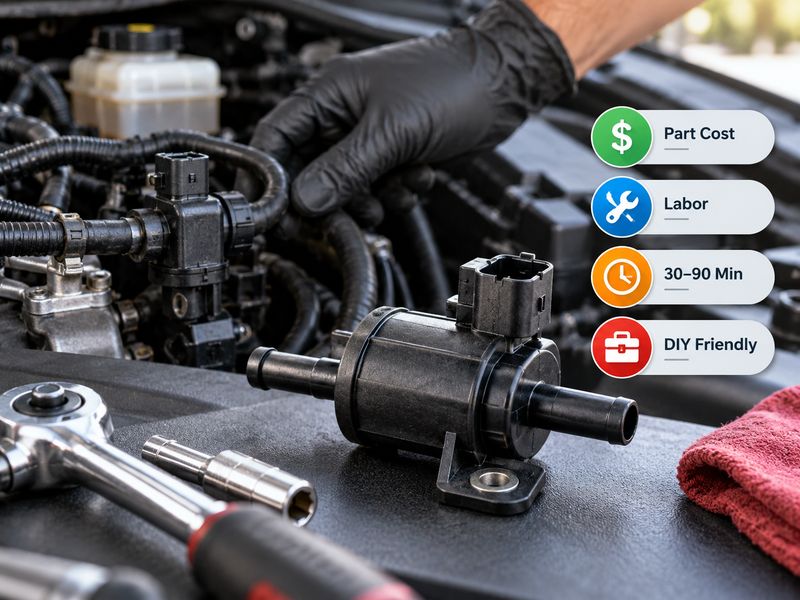
If you are wondering how much is an EVAP purge valve, the part alone commonly costs about $35 to $150, although some vehicle-specific or OEM assemblies can approach $200 or more. A professional replacement commonly ends up around $150 to $300, with some vehicles falling outside that range because of part prices, accessibility, diagnosis, and local labor rates. Current national estimates put the average purge-valve replacement at roughly 210–251, including parts and labor.
The actual replacement is often fairly quick. On an easy-to-access engine, an experienced technician may change the valve in well under an hour. The average DIY owner can also replace many purge valves with basic hand tools, but correctly diagnosing the EVAP problem is often harder than replacing the valve itself.
This guide covers the cost of the valve, mechanic labor charges, replacement time, DIY difficulty, and the factors that can make an EVAP purge valve repair cheaper or more expensive.
How Much Is an EVAP Purge Valve?
An EVAP purge valve by itself commonly costs around $35 to $150 for many mainstream vehicles.
However, the price varies considerably by vehicle.
Current retail listings show individual purge valves ranging from roughly the mid-$30s to nearly $190 depending on the application and brand.
A simple aftermarket purge solenoid may cost around:
- 35–70 for many common applications
- 70–150 for higher-priced or vehicle-specific valves
- 150–200 or more for certain assemblies or applications
OEM parts purchased through a dealer may cost more than comparable aftermarket components.
The purge valve is also called a:
- Canister purge valve
- EVAP purge valve
- Purge solenoid
- Canister purge solenoid
- Vapor canister purge valve
These names often refer to the same basic EVAP component, although the exact design varies between vehicles.
What Does an EVAP Purge Valve Do?
The purge valve is part of the vehicle’s evaporative emission control system, commonly called the EVAP system.
Gasoline produces fuel vapors inside the fuel tank. Instead of allowing those vapors to escape into the atmosphere, the EVAP system stores them in a charcoal canister.
When operating conditions are appropriate, the engine computer commands the purge valve to open.
The stored fuel vapors then travel into the engine’s intake system and are burned during normal combustion.
A properly functioning purge valve therefore needs to:
- Remain closed when commanded closed
- Open when commanded by the engine computer
- Control vapor flow correctly
- Seal properly when the EVAP system performs leak tests
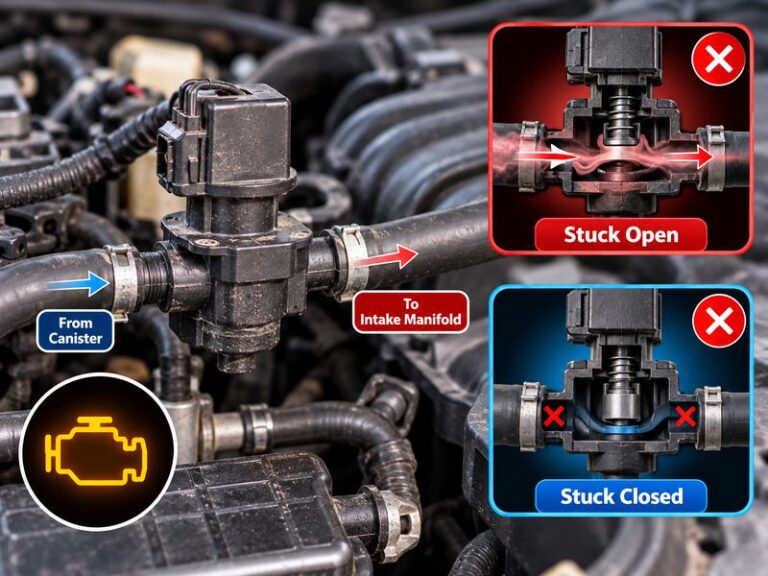
If the valve sticks open, sticks closed, leaks, or develops an electrical failure, the vehicle may set an EVAP-related trouble code.
How Much Does It Cost to Replace an EVAP Purge Valve?
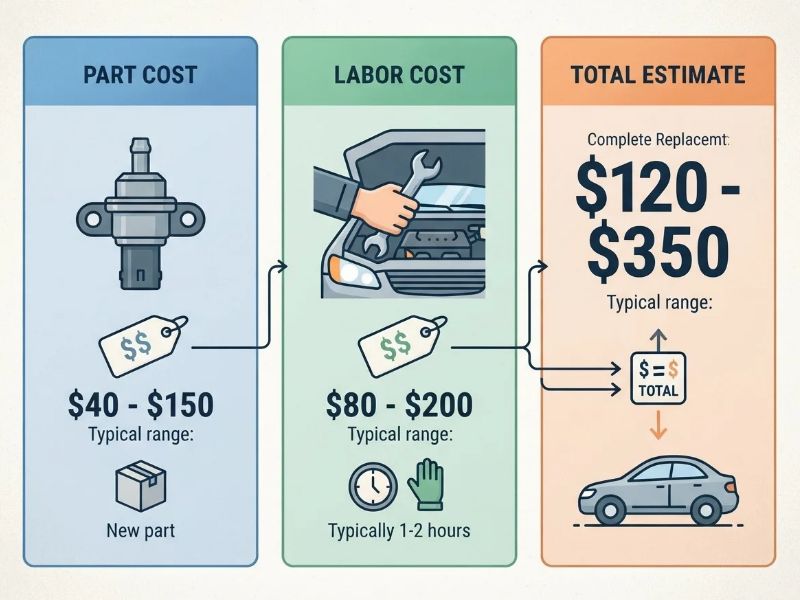
For many vehicles, how much does it cost to replace an EVAP purge valve comes down to three expenses:
- The replacement valve
- Labor
- Diagnosis, if required
A reasonable professional-repair budget for many mainstream vehicles is around $150 to $300.
Some straightforward repairs may cost less, while complicated or expensive applications can reach 350–400 or more.
A current national repair estimate places average purge-valve replacement at approximately 210–251, with about 146–156 attributed to parts and 65–95 to labor. Taxes, fees, location, and additional repairs are not included in that estimate.
Typical Cost Breakdown
For a straightforward repair, you might see something similar to:
Purge valve: 35–150
Labor: 60–150
Diagnostic testing: 0–150, depending on the shop and whether diagnosis is included
Estimated total: Approximately 150–300 for many vehicles
Do not treat these figures as a guaranteed quote. Vehicle-specific pricing can differ significantly.
Why Can EVAP Purge Valve Replacement Cost Vary So Much?
The purge valve itself is usually a relatively small component, but several factors influence the total repair cost.
Vehicle Make and Model
A common domestic or Japanese vehicle may use an inexpensive, widely available purge valve.
A luxury, performance, or less common vehicle may require a more expensive part.
Purge Valve Location
On some engines, the valve is right on top of the engine near the intake manifold.
A technician may be able to reach it immediately.
On other vehicles, access may require removing:
- Engine covers
- Air intake components
- Brackets
- Hoses
- Other surrounding components
More disassembly means more labor.
OEM vs Aftermarket Parts
An aftermarket valve may be significantly cheaper than an OEM replacement.
However, quality can vary.
A reputable OE-quality aftermarket part can be a reasonable choice for many vehicles, while some owners prefer the original manufacturer’s component.
Local Labor Rates
Repair shop labor prices vary substantially across the United States.
Dealerships and shops in high-cost metropolitan areas may charge more than independent shops in smaller cities.
Additional EVAP Problems
A diagnostic trouble code does not always mean the purge valve is the only problem.
The vehicle may also have:
- Cracked EVAP hose
- Loose or damaged gas cap
- Failed vent valve
- Damaged charcoal canister
- Wiring problem
- Electrical connector problem
- EVAP system leak
If additional diagnosis or repairs are needed, the total cost increases.
How Much Do Mechanics Charge to Replace an EVAP Purge Valve?
If you are asking how much do mechanics charge to replace an EVAP purge valve, the labor portion alone is often relatively modest because many purge valves are easy to reach.
A current national estimate puts typical purge-valve labor at approximately 65–95 for the replacement itself.
However, your bill may be higher if diagnosis is included.
For example, a mechanic may need to:
- Scan diagnostic trouble codes
- Test the purge valve electrically
- Check whether it holds vacuum
- Inspect EVAP hoses
- Perform a smoke test
- Verify purge commands with a scan tool
- Clear trouble codes
- Confirm proper operation after repair
That diagnostic work can add significantly more time than physically replacing the valve.
Independent Shop vs Dealership
An independent repair shop will often be less expensive than a dealership, although this is not guaranteed.
A dealership may provide advantages such as:
- Vehicle-specific factory diagnostic equipment
- OEM parts
- Factory service information
- Technicians familiar with brand-specific EVAP problems
For a straightforward purge-valve replacement, a competent independent mechanic can normally perform the repair without difficulty.
Does Diagnosis Cost Extra?
Sometimes.
If you arrive at a repair shop and simply request a purge-valve replacement, the shop may still recommend diagnosis before installing the part.
That is usually reasonable.
EVAP trouble codes can have multiple causes, and replacing a valve simply because an EVAP code is stored can waste money.
A diagnostic fee may cover:
- Code scanning
- Visual inspection
- Electrical testing
- Vacuum testing
- Smoke testing
Some shops apply part or all of the diagnostic charge toward the repair if you authorize the work.
Ask how the shop handles diagnostic fees before approving the repair.
How Long Does It Take to Replace an EVAP Purge Valve?
For many vehicles, how long does it take to replace an EVAP purge valve is approximately 20–60 minutes of actual repair time.
Some particularly accessible purge valves can be replaced even faster.
For example, factory labor information for certain GM vehicles lists the actual purge-solenoid replacement operation at approximately 0.2–0.3 labor hours, with additional diagnostic time when necessary.
However, other vehicles require more disassembly.
A practical general estimate is:
Easy-Access Purge Valve
Approximately 20–45 minutes
Moderate-Access Purge Valve
Approximately 30–60 minutes
Difficult-Access Purge Valve
Approximately 1–2 hours or occasionally longer
The time your car spends at a repair shop can obviously be longer than the actual wrench time because diagnosis, parts availability, technician scheduling, and post-repair testing also take time.
Why Can Diagnosis Take Longer Than Replacement?
The purge valve may take only a few minutes to remove, but confirming that it is actually defective can require more work.
An EVAP system includes several components that can cause similar trouble codes.
A technician may need to determine whether the problem comes from:
- Purge valve
- Vent valve
- Gas cap
- Charcoal canister
- Vacuum line
- Vapor line
- Electrical circuit
- Fuel tank pressure sensor
For this reason, a 30-minute component replacement could still involve an hour or more of total diagnostic and repair time.
Can the Average Person Change an EVAP Purge Valve?
Yes. On many vehicles, can the average person change an EVAP purge valve has a straightforward answer: a reasonably comfortable DIYer often can.
Many purge valves are among the easier engine-bay components to replace.
They commonly have:
- One electrical connector
- One or two vapor hoses
- One or two mounting bolts or clips
If the valve is mounted on top of the engine with clear access, replacement may require only basic hand tools.
However, being able to replace a part and being able to correctly diagnose the failed part are two different things.
How Difficult Is DIY EVAP Purge Valve Replacement?
For an easily accessible valve, the job is generally beginner-to-intermediate level.
The mechanical work may involve:
- Allowing the engine to cool.
- Locating the purge valve.
- Disconnecting the electrical connector.
- Releasing the EVAP hose fittings.
- Removing the valve mounting fastener.
- Installing the replacement valve.
- Reconnecting the hoses and wiring.
- Checking that everything is securely attached.
The exact sequence depends on the vehicle.
Some cars use brittle plastic vapor lines and quick-connect fittings that require more care.
What Tools Do You Need to Replace an EVAP Purge Valve?
Many simple purge-valve replacements require only a few tools.
Depending on the vehicle, you may need:
- Ratchet and socket set
- Screwdriver
- Pliers
- Small pick or connector-release tool
- Flashlight
- Scan tool for diagnosis and code clearing
Do not force plastic EVAP connectors.
Heat and age can make plastic fittings brittle, and breaking a vapor line can turn a cheap repair into a more expensive one.
How Do You Know the EVAP Purge Valve Is Actually Bad?
A check engine light alone does not confirm a defective purge valve.
Possible signs include:
- Check engine light
- Rough or unstable idle
- Difficult starting after refueling
- Engine hesitation
- Fuel odor in some cases
- Poor EVAP system test results
One particularly common failure is a valve that becomes stuck open.
That can allow fuel vapors or unwanted airflow to enter the intake when the engine computer does not expect it.
However, similar symptoms may be caused by other engine or EVAP problems.
Can an EVAP Code Mean Something Other Than the Purge Valve?
Absolutely.
This is one of the most important things to understand before spending money.
EVAP trouble codes can be triggered by:
- Loose gas cap
- Damaged gas cap seal
- Cracked vapor hose
- Bad vent solenoid
- Charcoal canister problem
- Fuel tank pressure sensor problem
- Electrical fault
- Purge valve failure
Even a trouble code mentioning purge flow does not automatically prove that the purge valve itself needs replacement.
Diagnosis matters.
Should You Replace the Purge Valve Yourself to Save Money?
DIY replacement can save a meaningful amount if the valve has already been correctly diagnosed.
For example, if the replacement part costs 50–100 and you can install it yourself, you may avoid most or all of the labor charge.
DIY makes the most sense when:
- The valve is easily accessible
- You have already confirmed the diagnosis
- You are comfortable disconnecting automotive electrical connectors
- The vapor lines are in good condition
- You have basic tools
Professional repair is more sensible when:
- The valve is difficult to reach
- EVAP diagnosis is uncertain
- Multiple trouble codes are present
- Plastic hoses are brittle
- Electrical testing is required
- The vehicle has repeated EVAP failures
Aftermarket vs OEM EVAP Purge Valve
Both can be reasonable choices.
Aftermarket Purge Valve
An aftermarket valve can reduce the cost considerably.
A good-quality aftermarket component may be perfectly suitable for an older daily driver.
Avoid choosing only by the lowest possible price. Poor valve calibration or premature failure can create another check engine light and repeat repair costs.
OEM Purge Valve
An OEM valve is made or supplied according to the original vehicle manufacturer’s specifications.
OEM parts are often more expensive but may provide greater confidence in:
- Fit
- Connector design
- Flow characteristics
- Vehicle compatibility
The best choice depends on vehicle age, budget, part availability, and how long you plan to keep the vehicle.
Do You Need to Clear the Check Engine Light After Replacement?
Sometimes the light can eventually turn off after the vehicle completes enough successful self-tests.
However, a scan tool can normally be used to clear the stored trouble code after the repair.
Clearing the code immediately does not prove the repair worked.
The EVAP monitor may need specific driving conditions before the engine computer tests the system again.
If the check engine light returns, further diagnosis is needed.
Can You Drive With a Bad EVAP Purge Valve?
A vehicle with a faulty purge valve may still drive, but the problem should not be ignored indefinitely.
Depending on how the valve fails, you may experience:
- Difficult starting
- Rough idle
- Poor drivability
- Check engine light
- Increased emissions
- Failed emissions inspection
A stuck-open purge valve can be particularly noticeable after filling the fuel tank because excessive fuel vapor can enter the intake.
If the engine runs poorly, stalls, or develops other serious symptoms, have the vehicle inspected rather than continuing to drive normally.
Can a Bad Purge Valve Damage the Engine?
A faulty purge valve usually does not immediately cause major mechanical engine damage.
However, a valve stuck open can disrupt the engine’s air-fuel mixture and contribute to poor running.
Ignoring EVAP faults can also hide other problems because the check engine light remains illuminated.
Fixing the problem allows the engine management system and emissions system to operate as intended.
Is an EVAP Purge Valve Expensive Compared With Other EVAP Repairs?
Usually not.
The purge valve is often one of the less expensive major EVAP components to replace.
A charcoal canister, complex vapor-line assembly, or difficult-to-access component can cost considerably more.
This is why proper diagnosis is valuable.
You do not want to replace several EVAP components unnecessarily while trying to solve one trouble code.
How to Avoid Paying Too Much for Purge Valve Replacement
The easiest way to control costs is to understand what the quote includes.
Ask whether the estimate includes:
- Diagnosis
- Replacement valve
- Labor
- Taxes
- Shop fees
- Code clearing
- Post-repair testing
If the quote is significantly higher than expected, ask why.
The vehicle may require an expensive OEM assembly or additional EVAP repairs that a simple national average does not account for.
Getting a second quote can be reasonable when the repair estimate is unusually high.
FAQs About How Much Is an EVAP Purge Valve
How Much Does an EVAP Purge Valve Cost by Itself?
For many vehicles, the valve itself costs roughly 35–150.
Certain OEM, luxury, or vehicle-specific assemblies may cost 150–200 or more.
How Much Does It Cost to Replace an EVAP Purge Valve at a Shop?
Many professional replacements fall around 150–300.
Current national estimates put the average at approximately 210–251, although the final price depends heavily on the vehicle and location.
How Much Do Mechanics Charge to Replace an EVAP Purge Valve?
For a straightforward repair, the labor portion may be around 65–100.
Diagnosis, difficult access, higher regional labor rates, or dealership pricing can increase the bill.
How Long Does It Take to Replace an EVAP Purge Valve?
Many purge valves can be replaced in approximately 20–60 minutes.
Difficult locations or additional diagnostic work can extend the overall repair to one or two hours or more.
Can the Average Person Change an EVAP Purge Valve?
Yes, on many vehicles.
If the valve is easily accessible, replacing it may require only disconnecting the electrical plug and vapor hoses, removing a fastener, and installing the new component.
Correct diagnosis is often the harder part.
Do I Need a Mechanic to Diagnose a Bad Purge Valve?
Not necessarily, but proper testing is strongly recommended before replacing the part.
A basic code scanner can identify EVAP trouble codes, but advanced diagnosis may require a smoke machine, scan-tool commands, electrical testing, or vacuum testing.
Is It Cheaper to Replace an EVAP Purge Valve Yourself?
Usually yes if the diagnosis is correct.
DIY replacement may reduce the total cost to roughly the price of the valve itself, but a mistaken diagnosis can eliminate those savings.
Is a Purge Valve and Purge Solenoid the Same Thing?
In many automotive applications, the terms purge valve, canister purge valve, and purge solenoid refer to the same electronically controlled valve in the EVAP system.
The terminology used by manufacturers can vary.
Conclusion
If you are asking how much is an EVAP purge valve, expect the part alone to commonly cost around 35–150, with some applications costing more. A professional replacement for many vehicles falls roughly in the 150–300 range, while current national estimates place the average around 210–251.
The actual mechanical replacement is often quick, commonly taking about 20–60 minutes when the valve is easy to access. An average DIYer can replace many purge valves with basic hand tools, but diagnosing an EVAP problem correctly is more important than simply installing a new part.
Before replacing the valve, confirm that the purge valve—not the gas cap, vent valve, charcoal canister, vapor hose, or wiring—is actually causing the problem. That small diagnostic step can prevent unnecessary parts and labor costs.