Can a Bad Oxygen Sensor Cause Car Not to Start? Explained
A car that cranks but refuses to start can make an oxygen sensor seem like a possible culprit, especially if the check engine light recently came on or the vehicle has already been showing poor fuel economy, rough idle, or hesitation. Oxygen sensors are important to engine management, but they do not usually control the basic conditions required for an engine to start.
A bad oxygen sensor usually will not cause a car not to start. During initial startup, most engines do not rely heavily on oxygen-sensor feedback because the sensors must warm up before providing useful closed-loop fuel-control information. However, an unusual oxygen-sensor circuit fault or a severe underlying rich or lean condition associated with the sensor system can occasionally contribute to hard starting.
If you are asking can a bad oxygen sensor cause car not to start, the more likely causes are usually a weak battery, failed starter system, lack of fuel pressure, ignition failure, crankshaft or camshaft position sensor problems, immobilizer issues, or mechanical engine trouble. An oxygen sensor is much more commonly associated with drivability and emissions problems after the engine has already started.
This guide stays focused on how oxygen sensors relate to starting, when they could indirectly contribute to a no-start condition, and how to tell whether another engine problem is more likely responsible.
Can a Bad Oxygen Sensor Cause Car Not to Start?
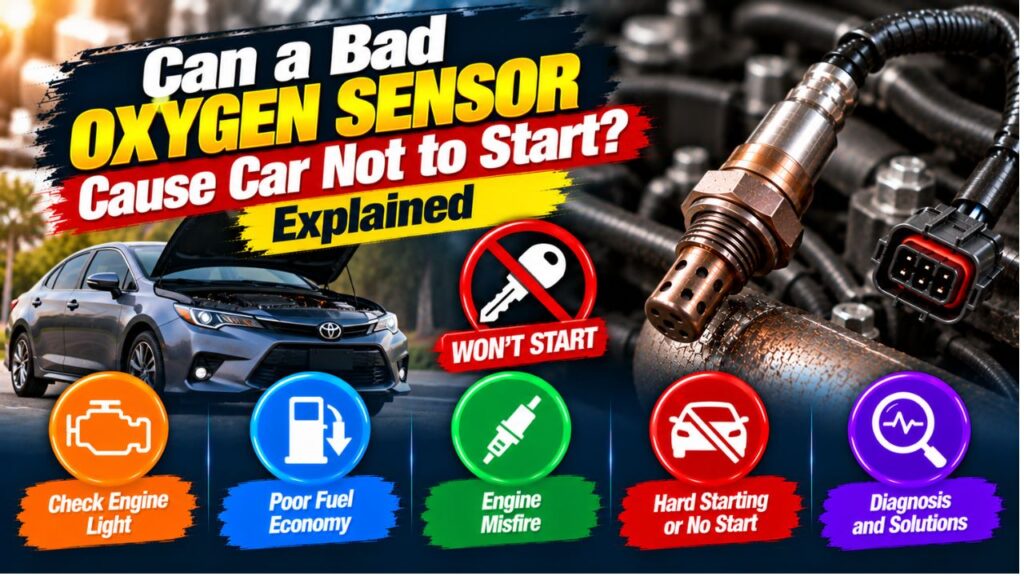
In most cases, no—a bad oxygen sensor will not prevent the engine from starting.
When you first turn the key or press the start button, the engine control module uses several important inputs to determine how much fuel to inject and when to fire the ignition system. During this initial period, the oxygen sensor is often still cold and has not yet reached its normal operating temperature.
The engine therefore commonly operates in open-loop mode, meaning fuel delivery is calculated mainly from preset programming and information from other sensors rather than real-time oxygen-sensor feedback.
Once the oxygen sensor warms up sufficiently, the engine computer can enter closed-loop operation and use O2 sensor information to fine-tune fuel delivery.
That is why a failed oxygen sensor often allows the car to start normally even though it may run poorly afterward.
Why Oxygen Sensors Usually Do Not Control Initial Starting
An oxygen sensor is installed in the exhaust system, where it measures the oxygen content of exhaust gases.
For the sensor to provide useful information, the engine must first:
- Crank.
- Receive fuel.
- Produce ignition spark.
- Begin combustion.
- Create exhaust gases.
The oxygen sensor therefore reacts to combustion rather than initiating it.
During a cold start, the engine computer relies more heavily on inputs such as:
- Engine coolant temperature
- Crankshaft position
- Camshaft position
- Throttle position
- Intake air temperature
- Mass airflow or manifold pressure
- Battery voltage
Once combustion begins and the oxygen sensor reaches operating temperature, its signal becomes much more useful for fuel adjustment.
This is a major reason why an O2 sensor failure generally causes poor running rather than a true no-start condition.
What Happens When an Oxygen Sensor Is Bad?
A bad oxygen sensor may send a signal that is:
- Incorrect
- Slow
- Stuck rich
- Stuck lean
- Completely absent
When the engine computer detects the problem, it may store a diagnostic trouble code and substitute a calculated or default value.
The vehicle may continue running, although not necessarily efficiently.
Typical effects include:
Poor fuel economy, rough idle, hesitation, increased emissions, check engine light, or rich or lean fuel corrections.
These symptoms are much more typical than a complete failure to start.
Can a Bad Oxygen Sensor Cause Hard Starting?
It can contribute indirectly in some situations, but it is not a common primary cause.
For example, an oxygen sensor that has been giving incorrect information may cause long-term fuel corrections to move significantly rich or lean.
Under certain conditions, those adaptations can influence how the engine behaves during starting or immediately afterward.
The vehicle might:
- Crank longer than normal
- Start and then stumble
- Start and stall
- Run roughly for several seconds
However, if the engine will not start at all, another problem should usually be investigated first.
Can a Bad O2 Sensor Make a Car Start and Then Die?
Possibly, but this also is not the most common explanation.
An engine may start using open-loop fueling and then begin using oxygen-sensor feedback as the sensor warms.
If the sensor signal is severely incorrect and the engine management system responds poorly, drivability can worsen after startup.
More commonly, a vehicle that starts and immediately dies has another problem, such as:
- Fuel pressure loss
- Immobilizer activation
- Major vacuum leak
- Idle-control problem
- Crank or cam sensor fault
- Throttle-body problem
The oxygen sensor should be diagnosed in context rather than assumed to be responsible.
Can a Bad Upstream Oxygen Sensor Affect Starting?
The upstream oxygen sensor, also called Sensor 1, has the greatest influence on fuel control after startup.
If it fails, the computer may receive inaccurate information about whether the engine is running rich or lean.
This can affect:
- Fuel trims
- Idle quality
- Fuel consumption
- Acceleration
- Emissions
But even a completely failed upstream sensor often does not stop the engine from starting because the computer can fall back on programmed values.
This is often called a fail-safe or substitute strategy.
Can a Bad Downstream Oxygen Sensor Cause a No-Start?
It is extremely unlikely.
The downstream oxygen sensor, usually called Sensor 2, is primarily used to monitor the performance of the catalytic converter.
It generally has much less influence over basic fuel control than the upstream sensor.
A failed downstream O2 sensor commonly causes:
- Check engine light
- Emissions-monitoring problems
- Failed inspection in some states
It usually does not cause a crank-no-start condition.
Oxygen Sensor Heater Problems and Starting
Modern oxygen sensors often contain an internal heater circuit.
The heater helps the sensor reach operating temperature quickly so closed-loop fuel control can begin sooner.
If the heater fails, the sensor may simply take longer to become active.
A heater-circuit failure can trigger diagnostic codes such as those associated with:
- Heater resistance
- Heater power
- Heater ground
- Open circuit
- Short circuit
This problem normally does not prevent starting.
The engine can generally start and run while the oxygen sensor warms naturally from exhaust heat.
Could an Oxygen Sensor Short Circuit Cause a No-Start?
This is one of the less common exceptions.
An oxygen sensor itself usually cannot stop the engine from starting, but an electrical short in the sensor wiring or heater circuit could potentially affect a shared fuse, reference circuit, power supply, or control-module circuit on some vehicles.
If a shared fuse blows, other critical engine components might lose power.
In that case, the oxygen sensor fault would be indirectly involved.
For example, if the O2 heater circuit shares a fuse with another engine-management component and that fuse fails, the vehicle could potentially experience more serious symptoms.
This depends completely on the vehicle’s wiring design.
A wiring diagram and proper electrical testing are needed to confirm this type of failure.
Can a Bad Oxygen Sensor Cause Too Much Fuel During Starting?
Normally, the oxygen sensor has limited influence during initial cold cranking.
However, if long-term fuel trims have been heavily influenced by incorrect sensor data, the engine’s fueling behavior may be affected indirectly.
A rich-running engine may show:
- Strong gasoline smell
- Wet spark plugs
- Rough startup
- Black exhaust smoke
- Poor fuel economy
Still, a severely rich no-start condition is more commonly caused by:
- Leaking fuel injectors
- Excessive fuel pressure
- Faulty coolant temperature sensor
- Ignition failure
- Engine control problems
An oxygen sensor should not automatically be blamed.
Can a Bad Oxygen Sensor Cause Flooding?
A failed O2 sensor by itself is usually not enough to flood an engine during cranking.
Flooding happens when too much fuel enters the cylinders and the mixture becomes too rich to ignite.
Possible causes include leaking injectors, repeated unsuccessful starting attempts, ignition failure, or incorrect engine-temperature information.
An oxygen sensor may contribute to rich operation once the engine is running, but it is not normally the main input controlling cold-start enrichment.
What Actually Causes a Car to Crank but Not Start?
If the starter spins the engine normally but the engine does not run, diagnosis generally focuses on four basic requirements:
Ignition Spark
The engine needs properly timed spark.
Possible ignition-related no-start causes include:
- Failed crankshaft position sensor
- Failed camshaft position sensor
- Ignition coil problem
- Ignition module failure on applicable vehicles
- Wiring problem
Fuel Delivery
The engine also needs sufficient fuel.
Possible problems include:
- Failed fuel pump
- Blown fuel pump fuse
- Bad fuel pump relay
- Low fuel pressure
- Injector control problem
Compression
The cylinders must build enough compression for combustion.
Mechanical causes can include:
- Timing belt or chain failure
- Valve timing problem
- Severe internal engine damage
Correct Engine Timing and Computer Inputs
The engine computer needs accurate information about engine position.
Without a valid crankshaft-position signal, many systems will not command proper spark or fuel injection.
This is much more likely to create a true no-start condition than an O2 sensor failure.
Bad Crankshaft Position Sensor vs. Bad Oxygen Sensor
A crankshaft position sensor is much more likely than an oxygen sensor to cause a crank-no-start.
The crank sensor tells the engine computer:
- Crankshaft position
- Engine speed
- When ignition and injection should occur
If the computer cannot determine crankshaft position, it may not trigger the ignition coils or injectors correctly.
An oxygen sensor, by comparison, mainly helps correct the fuel mixture after combustion is already taking place.
This difference is important when diagnosing a vehicle that will not start.
Can a Bad Camshaft Position Sensor Prevent Starting?
Yes, depending on the engine and control strategy.
The camshaft sensor helps the computer determine cylinder position and coordinate fuel injection and ignition timing.
Some engines may still start with a failed cam sensor after extended cranking, while others may not.
If the vehicle has a camshaft or crankshaft sensor trouble code along with a no-start, those codes generally deserve higher diagnostic priority than an oxygen sensor code.
Can a Weak Battery Look Like an O2 Sensor Problem?
A weak battery does not usually mimic a bad O2 sensor directly, but low voltage can create multiple misleading electronic trouble codes.
During cranking, battery voltage can drop substantially.
If it drops too far, the:
- Starter may turn slowly.
- Ignition coils may receive inadequate power.
- Fuel injectors may not operate normally.
- Engine computer may reset or behave unpredictably.
Testing battery condition and cranking voltage is a good early step in any starting diagnosis.
Can a Bad Oxygen Sensor Cause the Car to Start Better When Unplugged?
Sometimes drivers report that an engine runs differently after an O2 sensor is disconnected.
Disconnecting a faulty sensor forces the engine computer to recognize the missing signal and use a programmed substitute value.
If the original sensor was providing severely incorrect data, the fallback strategy may temporarily make the engine run more smoothly.
However, unplugging an O2 sensor is not a proper repair.
It will normally:
- Turn on the check engine light
- Store trouble codes
- Disable normal closed-loop operation
- Increase emissions
If unplugging the sensor dramatically changes engine behavior, that information can help diagnosis, but the underlying problem still needs to be confirmed.
Will a Car Start With the Oxygen Sensor Disconnected?
Most vehicles can start with an oxygen sensor disconnected.
The engine computer usually detects the open circuit and enters a fallback operating strategy.
The vehicle may run less efficiently and the check engine light will likely illuminate.
This fact further illustrates why a completely failed oxygen sensor by itself usually does not cause a total no-start.
Can a Bad O2 Sensor Cause Rough Starting When Warm?
It is possible for a fuel-control issue to become more noticeable during a warm restart.
When the engine is warm, the computer may enter closed-loop operation more quickly because the oxygen sensor reaches operating temperature sooner.
If the sensor sends inaccurate information, fuel corrections can begin affecting operation earlier.
Still, common warm-start problems can also involve:
- Leaking fuel injectors
- Fuel pressure loss
- Crank sensor heat failure
- Evaporative emissions purge valve faults
Those possibilities should also be considered.
O2 Sensor Trouble Codes and a No-Start Condition
If your car will not start and a scanner shows an oxygen sensor code, do not automatically assume the code explains the no-start.
An O2 sensor code may have been present before the starting problem developed.
For example, the vehicle may have stored:
- P0130 – O2 sensor circuit malfunction
- P0131 – Low voltage
- P0132 – High voltage
- P0133 – Slow response
- P0135 – Heater circuit fault
These codes can indicate real sensor or circuit problems, but none automatically proves that the oxygen sensor is preventing the engine from starting.
Look for other codes related to:
- Crankshaft position
- Camshaft position
- Immobilizer
- Fuel pressure
- Electronic throttle
- Power supply
Those may be much more relevant.
How to Diagnose a No-Start When an Oxygen Sensor Code Is Present
Start with the actual no-start condition rather than the stored O2 code.
First determine whether the engine:
- Does not crank at all
- Cranks slowly
- Cranks normally but does not fire
- Starts briefly and stalls
These are very different problems.
If the engine cranks normally, verify whether it has:
- Spark
- Fuel pressure
- Injector command
- Crankshaft-position signal
- Adequate compression
Then investigate the oxygen sensor if testing shows it is actually affecting fuel control or there is an electrical short involving its circuit.
This approach is more reliable than replacing the sensor first.
What If the Car Does Not Crank?
If the engine does not rotate when you try to start it, the oxygen sensor is almost certainly not the cause.
A no-crank condition is more commonly related to:
- Dead or weak battery
- Loose battery connections
- Starter motor
- Starter relay
- Ignition switch
- Park/neutral safety switch
- Clutch switch
- Immobilizer system
- Wiring
The oxygen sensor does not command the starter motor.
What If the Car Cranks Normally but Does Not Fire?
A crank-no-start requires a different diagnostic path.
More likely causes include:
- No fuel pressure
- No ignition spark
- Missing crankshaft signal
- Injector control failure
- Timing problem
- Flooded engine
- Immobilizer issue
Again, oxygen sensor failure usually appears much lower on the list.
When Should You Replace the Oxygen Sensor?
Replace an O2 sensor when proper diagnosis confirms that the sensor or its integrated heater has failed.
Testing may show:
- No signal
- Sensor stuck at an abnormal reading
- Very slow response
- Failed heater
- Internal short or open circuit
Before installing a replacement, inspect the wiring and exhaust system.
A new oxygen sensor will not solve a problem caused by:
- Broken wiring
- Exhaust leak
- Oil burning
- Coolant contamination
- Rich fuel condition
Correcting the underlying cause helps prevent repeat failure.
Can You Drive After the Car Starts With a Bad Oxygen Sensor?
A car may remain drivable with a faulty oxygen sensor, but the problem should not be ignored.
A bad upstream sensor can contribute to incorrect fueling, poor fuel economy, higher emissions, and potentially increased catalytic converter temperatures if the engine runs excessively rich.
If the vehicle barely runs, stalls repeatedly, has a flashing check engine light, or produces strong raw-fuel odors, continuing to drive is not advisable until the cause is diagnosed.
FAQs About Can a Bad Oxygen Sensor Cause Car Not to Start
Can a bad oxygen sensor cause a crank-no-start?
Usually, no. Most engines can start without normal oxygen-sensor feedback because initial startup occurs in open-loop operation.
Fuel, spark, compression, and crankshaft-position problems are generally more likely causes.
Can a bad O2 sensor make a car hard to start?
It can contribute indirectly to hard starting if incorrect fuel corrections have significantly affected engine operation, but this is uncommon.
Battery, fuel, ignition, and engine-position sensor problems should generally be checked first.
Will a car start with a bad upstream oxygen sensor?
Usually, yes.
The engine computer can normally use substitute fuel-control values until the O2 sensor is working correctly.
Will a car start if the O2 sensor is unplugged?
Most vehicles will still start.
The engine computer will detect the missing signal, set a trouble code, and use a fallback strategy.
Can an oxygen sensor fuse cause a car not to start?
Possibly, if the O2 sensor heater shares a fuse or power circuit with another critical engine-control component.
This depends on the vehicle’s electrical design and requires circuit testing.
Can a bad oxygen sensor cause a car to start and then stall?
It is possible but not common.
Fuel-pressure problems, major vacuum leaks, immobilizer issues, throttle problems, or sensor faults such as a crankshaft-position problem are generally more likely.
Can a bad downstream O2 sensor stop a car from starting?
It is extremely unlikely.
The downstream sensor’s primary role is monitoring catalytic converter efficiency rather than controlling initial starting.
What sensor is more likely to cause a car not to start?
A failed crankshaft position sensor is much more likely to produce a crank-no-start because the engine computer needs crankshaft-position information to coordinate ignition and fuel injection.
Conclusion
The overall answer to can a bad oxygen sensor cause car not to start is that it usually cannot. Oxygen sensors mainly help the engine computer fine-tune the air-fuel mixture after combustion has begun and the sensors have warmed sufficiently. During initial starting, the engine normally relies on other sensor inputs and programmed open-loop fueling, which is why most vehicles can still start even with a failed or disconnected O2 sensor.
A faulty upstream oxygen sensor can contribute to poor fuel economy, rough running, rich or lean operation, and occasionally hard starting or stalling, but a complete crank-no-start should first lead you toward more likely causes such as fuel pressure, ignition spark, crankshaft or camshaft position sensors, battery voltage, injector operation, engine timing, or compression.
The main exception is an unusual electrical failure where an O2 sensor or heater circuit shorts a shared fuse or power supply used by another essential engine component. Outside of that situation, replacing an oxygen sensor simply because the car will not start is unlikely to solve the problem. Diagnose the actual starting failure first, then address the oxygen sensor separately if testing confirms it is faulty.