How Long Do Oxygen Sensors Last? Lifespan, Signs, and Replacement
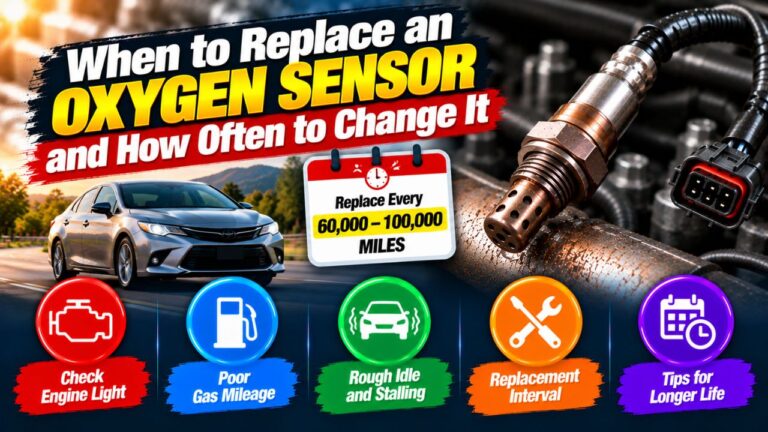
Most modern oxygen sensors can last around 60,000 to 100,000 miles or more, but there is no universal replacement mileage. Sensor type, engine condition, contamination, heat, and driving habits can all affect how long an O2 sensor remains accurate.
If you are wondering how long do oxygen sensors last, mileage alone does not tell the whole story. An oxygen sensor can continue working well beyond 100,000 miles on a healthy engine, while another may fail much earlier because of oil burning, coolant contamination, excessive fuel, exhaust leaks, or extreme heat.
Modern vehicles may also have several oxygen sensors. The upstream sensor, located before the catalytic converter, plays an important role in fuel-mixture control. The downstream sensor, located after the catalytic converter, is mainly used to monitor catalytic-converter performance. Because they work in different environments and perform different jobs, they do not always fail at the same time.
Rather than replacing oxygen sensors automatically at a certain mileage, it is usually better to consider vehicle manufacturer recommendations, diagnostic trouble codes, sensor data, fuel economy, and engine symptoms. This guide explains typical oxygen-sensor lifespan, what causes early failure, how to recognize a weak sensor, and when replacement actually makes sense.
How Long Do Oxygen Sensors Last on a Car?
Most modern heated oxygen sensors, also called O2 sensors, commonly remain in service for roughly 60,000 to 100,000 miles or longer.
Older unheated oxygen sensors used on earlier vehicles often had shorter service lives and could require attention at much lower mileage.
However, modern oxygen sensors are generally not treated as routine wear items that must automatically be replaced at one exact mileage on every vehicle.
A sensor may last:
- Less than 60,000 miles if heavily contaminated
- Around 60,000–100,000 miles under typical conditions
- Well beyond 100,000 miles on some vehicles
The correct approach is to diagnose sensor performance rather than assuming age alone means failure.
What Does an Oxygen Sensor Do?
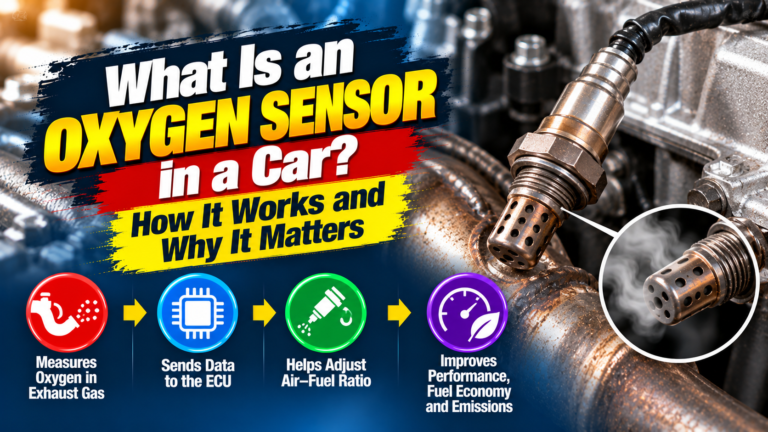
An oxygen sensor measures the amount of oxygen remaining in the exhaust gas.
The engine computer, commonly called the Engine Control Module (ECM) or Powertrain Control Module (PCM), uses this information to understand how efficiently the engine is burning its air-fuel mixture.
The upstream oxygen sensor is particularly important because it helps the computer adjust fuel delivery.
If the exhaust indicates too much oxygen, the mixture may be lean.
If there is relatively little oxygen, the mixture may be rich.
The computer repeatedly adjusts fuel delivery to maintain efficient combustion.
Modern wideband or air-fuel ratio sensors can provide even more precise mixture information than traditional narrowband oxygen sensors.
Upstream vs. Downstream Oxygen Sensor Lifespan
Many vehicles have at least two oxygen sensors per exhaust bank.
Their location affects both function and operating conditions.
Upstream Oxygen Sensor
The upstream sensor is located before the catalytic converter.
It is exposed directly to hot exhaust gases and combustion byproducts.
Because it constantly helps control fuel mixture, its signal changes rapidly during normal engine operation.
An upstream sensor may experience more contamination and thermal stress than a downstream sensor.
Downstream Oxygen Sensor
The downstream sensor is located after the catalytic converter.
Its primary job is generally to monitor catalyst efficiency.
The catalytic converter smooths out exhaust-gas fluctuations, so the downstream sensor normally sees a different exhaust environment than the upstream sensor.
Neither sensor automatically lasts longer in every vehicle, but failure patterns can differ because of their locations.
Do Oxygen Sensors Wear Out Over Time?
Yes.
An oxygen sensor can gradually become slower or less accurate as it ages.
The sensor is repeatedly exposed to:
- High exhaust temperatures
- Combustion gases
- Fuel additives
- Moisture
- Carbon
- Oil residue
- Road salt
- Thermal cycling
Even when the sensor does not fail completely, its response may become slower.
A sluggish sensor can sometimes affect fuel control before it becomes completely nonfunctional.
What Makes an Oxygen Sensor Fail Early?
Several problems can shorten sensor life substantially.
Oil Burning
An engine that burns oil can send oil-derived contaminants through the exhaust.
These deposits may coat the sensor element and interfere with accurate oxygen measurement.
Common causes of oil burning include worn:
- Piston rings
- Valve seals
- Turbocharger seals
- PCV components
Replacing an oxygen sensor without correcting serious oil consumption can result in another contaminated sensor.
Coolant Entering the Combustion Chamber
Coolant contamination can damage oxygen sensors.
A leaking head gasket, cracked cylinder head, or other cooling-system problem may allow coolant into a cylinder.
The sensor can become contaminated by combustion byproducts from the coolant.
If an O2 sensor repeatedly fails and the engine is losing coolant, the underlying engine problem needs diagnosis.
Rich Fuel Mixture
Running excessively rich means too much fuel is entering the engine relative to available air.
This can produce soot and carbon that contaminate the oxygen sensor.
Possible causes include:
- Leaking fuel injector
- Excessive fuel pressure
- Faulty mass airflow sensor
- Ignition misfire
- Engine-control problems
A rich-running engine can also damage the catalytic converter.
Misfires
A severe misfire allows unburned fuel and oxygen to enter the exhaust.
This can create abnormal exhaust temperatures and chemical conditions that stress both the oxygen sensor and catalytic converter.
Silicone Contamination
Certain silicone-based sealants can release compounds that damage oxygen sensors if the wrong product is used in areas exposed to engine or exhaust gases.
Only use sealants identified as safe for oxygen-sensor-equipped vehicles where required.
Physical Damage
Road debris, improper tool use, damaged wiring, or exhaust work can physically damage an oxygen sensor.
The sensor may also fail if its wiring contacts a hot exhaust pipe.
Does Fuel Quality Affect Oxygen Sensor Life?
It can.
Poor combustion, contaminated fuel, or inappropriate additives may create deposits that affect the sensor.
However, normal gasoline from reputable fuel stations should not routinely damage oxygen sensors.
Problems are more likely when the engine is already experiencing:
- Rich operation
- Oil burning
- Misfires
- Internal coolant leaks
Engine condition is often more important than fuel brand alone.
Can an Oxygen Sensor Last 150,000 Miles?
Yes.
Some oxygen sensors continue operating correctly beyond 150,000 miles.
There is no rule that a sensor must fail at 100,000 miles.
However, high mileage increases the possibility of:
- Slower response
- Heater-circuit wear
- Contamination
- Wiring deterioration
If the vehicle has high mileage but no oxygen-sensor trouble codes or performance issues, there is usually little reason to replace a sensor blindly without diagnosis.
Can an Oxygen Sensor Last 200,000 Miles?
It is possible.
A well-maintained vehicle can sometimes retain original oxygen sensors for 200,000 miles or more.
That does not mean every original sensor remains perfectly accurate at that mileage.
If the vehicle develops:
- Poor fuel economy
- Emissions-test failure
- Oxygen-sensor codes
- Fuel-trim problems
- Driveability symptoms
the sensors should be tested along with the rest of the fuel and exhaust system.
Signs an Oxygen Sensor May Be Failing
A weak or failed oxygen sensor can produce different symptoms depending on which sensor has failed and how the vehicle’s computer responds.
Common signs can include:
- Check engine light
- Poor fuel economy
- Rough idle
- Hesitation
- Failed emissions test
- Rich or lean mixture codes
- Increased exhaust emissions
- Poor engine performance in some cases
However, these symptoms are not unique to oxygen sensors.
Vacuum leaks, fuel injectors, ignition problems, exhaust leaks, and other faults can create similar symptoms.
Does a Bad Oxygen Sensor Always Turn On the Check Engine Light?
Not necessarily immediately.
A completely failed sensor will often set a diagnostic trouble code, but a sensor that is simply becoming slow may not trigger a warning right away.
Modern engine computers monitor several aspects of oxygen-sensor performance, including:
- Signal range
- Response rate
- Heater operation
- Electrical circuit behavior
Eventually, a sensor that falls outside acceptable limits will often set a fault code.
Common Oxygen Sensor Trouble Codes
Oxygen-sensor-related codes may identify:
- Sensor circuit fault
- Heater circuit fault
- Slow sensor response
- Signal stuck rich
- Signal stuck lean
For example, codes in the P0130–P0167 range commonly relate to oxygen sensor circuits on many OBD-II vehicles.
However, a trouble code mentioning an oxygen sensor does not automatically prove the sensor itself is bad.
The real cause could be:
- Wiring problem
- Connector corrosion
- Exhaust leak
- Vacuum leak
- Fuel-delivery issue
- Engine misfire
Proper diagnosis is important before buying a sensor.
Can a Bad Oxygen Sensor Reduce Fuel Economy?
Yes, particularly if an upstream oxygen sensor provides incorrect feedback to the engine computer.
The computer may respond by adding too much fuel.
That can increase:
- Fuel consumption
- Exhaust emissions
- Carbon buildup
However, a downstream sensor failure generally has less direct influence on normal fuel mixture than an upstream sensor.
Vehicle design matters, so sensor function should always be confirmed for the exact application.
Can a Bad Oxygen Sensor Damage the Catalytic Converter?
Indirectly, yes.
A faulty upstream sensor that contributes to prolonged rich operation can allow excess fuel into the exhaust.
That fuel may burn inside the catalytic converter, raising its temperature significantly.
However, catalytic-converter damage is more commonly associated with severe rich running or ignition misfires than with an oxygen sensor alone.
If an O2 sensor fault is accompanied by misfire or rich-mixture symptoms, repair it promptly.
Should Oxygen Sensors Be Replaced as Preventive Maintenance?
Usually, not automatically.
Some older service schedules recommended periodic oxygen-sensor replacement, but many modern vehicles do not specify a routine replacement interval.
If the manufacturer lists a replacement interval, follow it.
Otherwise, replace the sensor when testing shows that it is:
- Failed
- Too slow
- Contaminated
- Electrically damaged
- Unable to meet required performance
Replacing good sensors solely because of mileage can become unnecessarily expensive on vehicles with multiple O2 sensors.
Should You Replace All Oxygen Sensors at Once?
No.
Oxygen sensors do not generally need to be replaced as a complete set simply because one fails.
If one sensor has a confirmed failure, replacing that sensor alone is usually acceptable.
However, if several original sensors have very high mileage and show similar slow-response problems, replacing more than one may make sense after proper testing.
The important point is to diagnose each sensor rather than assuming they all failed together.
How Do You Know Which Oxygen Sensor Is Bad?
Diagnostic trouble codes often identify a sensor by bank and sensor number.
For example:
- Bank 1 Sensor 1
- Bank 1 Sensor 2
- Bank 2 Sensor 1
- Bank 2 Sensor 2
Bank 1 is the side of the engine containing cylinder No. 1.
Sensor 1 is usually the upstream sensor before the catalytic converter.
Sensor 2 is generally downstream of the catalytic converter.
On inline engines with one bank, you may only have Bank 1 sensors.
Always verify the exact exhaust layout before replacement.
Can You Test an Oxygen Sensor?
Yes.
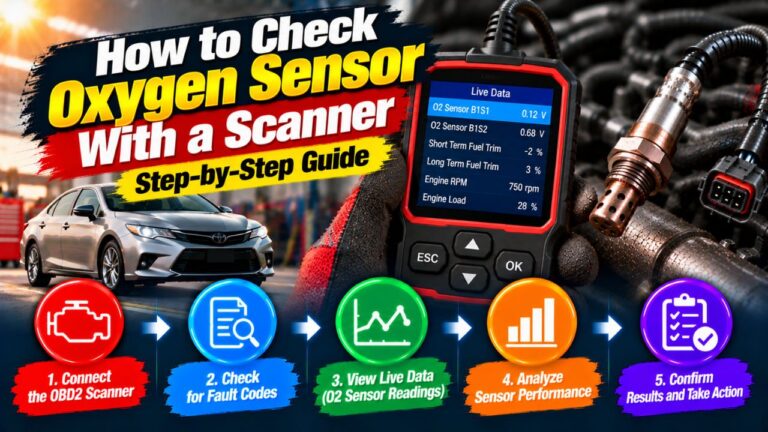
A scan tool is often one of the most useful diagnostic tools.
Depending on sensor type, you can examine:
- Sensor voltage
- Air-fuel ratio data
- Switching activity
- Heater operation
- Fuel trims
Traditional narrowband upstream sensors normally switch between rich and lean conditions once the engine reaches closed-loop operation.
Wideband sensors operate differently and should not be judged using the same voltage expectations.
A digital multimeter can be useful for certain electrical tests, but scan-tool data usually provides more useful real-time information.
Oxygen Sensor Heater Life
Modern oxygen sensors commonly contain an internal heater element.
The heater helps the sensor reach operating temperature quickly after startup.
A sensor may fail because of the heater circuit even if the sensing element itself still works.
Heater failures can result from:
- Internal heater burnout
- Wiring damage
- Blown fuse
- Connector problems
- Excessive electrical resistance
A heater-related trouble code should therefore be diagnosed electrically before automatically replacing the sensor.
Does Short-Trip Driving Shorten Oxygen Sensor Life?
It can contribute indirectly.
Frequent short trips prevent the engine and exhaust system from remaining fully hot for extended periods.
This can encourage:
- Condensation
- Carbon buildup
- Incomplete combustion deposits
The effect varies considerably by vehicle and operating conditions.
Longer fully warmed-up operation can help reduce certain deposits, but it will not restore an oxygen sensor that has already been chemically contaminated or electrically damaged.
Does Engine Overheating Damage O2 Sensors?
Excessive exhaust heat can shorten sensor life.
Engine overheating itself may not directly destroy the sensor, but problems that create abnormally high combustion or exhaust temperature can place additional thermal stress on it.
Examples include:
- Severe lean condition
- Misfire
- Incorrect ignition operation
- Catalytic-converter overheating
Repeated extreme temperature cycles can damage sensor components and wiring.
Can an Exhaust Leak Make a Good Oxygen Sensor Look Bad?
Yes.
An exhaust leak near an upstream sensor can allow outside air into the exhaust stream.
The additional oxygen may cause the sensor to indicate a lean condition even if the engine is not actually running lean.
The engine computer may then add fuel unnecessarily.
Before replacing an O2 sensor for a lean reading, inspect for exhaust leaks around:
- Exhaust manifold
- Gaskets
- Flanges
- Flex pipe
- Sensor threads
A leaking exhaust system can create misleading diagnostic data.
Can You Clean an Oxygen Sensor Instead of Replacing It?
Cleaning is generally not recommended as a dependable repair.
Oxygen sensors contain delicate ceramic sensing elements and specialized coatings.
Soaking or spraying them with:
- Carburetor cleaner
- Brake cleaner
- Fuel
- Strong solvents
can damage the sensing material or leave contamination behind.
If a sensor has become chemically contaminated or worn out, replacement is generally the proper repair.
More importantly, determine why contamination occurred so the new sensor does not fail prematurely.
What Happens if You Don’t Replace a Bad Oxygen Sensor?
The consequences depend on which sensor failed.
A bad upstream sensor may contribute to:
- Poor fuel economy
- Rich or lean operation
- Higher emissions
- Driveability issues
- Catalytic-converter stress
A failed downstream sensor may primarily affect emissions monitoring and cause a check engine light, although exact behavior varies by vehicle.
A persistent oxygen-sensor fault can also prevent the vehicle from passing an emissions inspection where OBD readiness and trouble codes are checked.
How Much Does Mileage Matter Compared With Engine Condition?
Engine condition often matters more.
Consider two vehicles with 100,000 miles.
One has:
- Regular oil changes
- No oil consumption
- No misfires
- Correct fuel mixture
The other burns oil, runs rich, and has repeated misfires.
The oxygen sensors in the second vehicle are exposed to far more contamination and heat stress even though mileage is identical.
That is why oxygen sensor lifespan cannot be predicted from the odometer alone.
How to Help Oxygen Sensors Last Longer
You cannot prevent normal aging, but maintaining the engine properly reduces unnecessary sensor contamination.
Useful habits include keeping the ignition and fuel systems in good condition, fixing misfires promptly, repairing oil or coolant consumption problems, and avoiding unapproved additives or sealants.
If the check engine light begins flashing because of a severe misfire, do not continue driving unnecessarily. A severe misfire can overheat both the catalytic converter and exhaust sensors.
When Should You Replace an Oxygen Sensor?
Replace an oxygen sensor when diagnosis confirms that it cannot perform correctly.
That may be because of:
- Slow response
- Failed heater
- Open electrical circuit
- Internal short
- Physical damage
- Contamination
- Incorrect signal
Do not replace an O2 sensor simply because a scan tool shows a lean or rich condition.
The sensor may actually be reporting a genuine engine problem correctly.
FAQs About How Long Do Oxygen Sensors Last
How long do oxygen sensors last on average?
Modern oxygen sensors commonly last around 60,000 to 100,000 miles or more.
Some continue functioning well beyond 100,000 miles, while contamination or engine problems can cause much earlier failure.
Should I replace my O2 sensor at 100,000 miles?
Not automatically.
If the manufacturer recommends replacement at that mileage, follow the service schedule. Otherwise, test the sensor and replace it only if performance is degraded or a fault is confirmed.
Can oxygen sensors last 150,000 miles?
Yes.
Many sensors can last 150,000 miles or longer when the engine runs correctly and the sensor remains uncontaminated.
Which oxygen sensor usually fails first?
There is no universal rule.
Upstream sensors experience direct exhaust exposure and perform continuous fuel-control work, but downstream sensors can also fail because of age, contamination, heat, or electrical problems.
Do upstream oxygen sensors wear out faster?
They can experience more severe operating conditions because they sit ahead of the catalytic converter, but that does not mean every upstream sensor fails before the downstream sensor.
How do I know my oxygen sensor needs replacing?
A check engine light, O2 sensor trouble code, poor fuel economy, abnormal scan data, or failed heater test may indicate a problem.
Confirm the sensor is actually defective before replacement.
Should I replace both oxygen sensors if one fails?
Usually no.
Replace the sensor that has been properly diagnosed as faulty unless testing shows the other sensors are also deteriorated.
Can a bad oxygen sensor cause poor gas mileage?
Yes, particularly an upstream sensor that causes incorrect fuel-mixture feedback.
The engine may inject more fuel than necessary, reducing fuel economy.
Conclusion
So, how long do oxygen sensors last? For most modern vehicles, a reasonable expectation is roughly 60,000 to 100,000 miles or more, but there is no fixed mileage at which every oxygen sensor should be replaced. Many sensors last well beyond 100,000 miles when the engine is healthy, while oil burning, coolant contamination, rich operation, misfires, exhaust leaks, and excessive heat can cause much earlier failure.
The most important takeaway is that oxygen sensors should generally be evaluated by actual performance rather than mileage alone. An older sensor that still responds correctly, has a functioning heater, and produces normal scan-tool data does not necessarily need replacement. Likewise, a newer sensor can fail early if another engine problem contaminates or overheats it.
If an oxygen-sensor code appears, diagnose the complete system before buying parts. Check the sensor circuit, wiring, exhaust leaks, fuel trims, engine condition, and relevant scan data. A trouble code that mentions an O2 sensor may be reporting another problem rather than proving that the sensor itself has failed.
The practical verdict is to maintain the engine well, repair misfires and oil or coolant consumption promptly, and replace an oxygen sensor when testing confirms it has become slow, damaged, contaminated, or electrically faulty. That approach avoids unnecessary replacement while protecting fuel economy, emissions performance, and the catalytic converter.