How to Clean PCV Valve Without Removing It Safely
You can sometimes clean the accessible PCV hose, port, and light deposits around the valve without removing the PCV valve, but you usually cannot thoroughly clean the valve’s internal mechanism while it remains installed. If the valve is sticking, clogged internally, or built into the valve cover, removal, replacement, or vehicle-specific service is often the better solution.
If you are trying to learn how to clean PCV valve without removing it, the first thing to understand is that PCV systems vary significantly between engines. Older vehicles may use a simple removable valve connected to a rubber hose, while many newer engines integrate the PCV regulator, diaphragm, oil separator, or passages directly into the valve cover.
Cleaning around an installed PCV valve can sometimes improve airflow when the problem is light sludge or contamination in the hose or accessible port. However, spraying large amounts of carburetor cleaner, brake cleaner, or another solvent directly into an installed PCV system is not a good general-purpose cleaning method. The cleaner can enter the intake, damage rubber or plastic components, disturb seals, or create a temporary running problem.
This guide explains what can realistically be cleaned without removing the PCV valve, how to do it more safely, what products to avoid, and how to tell when cleaning is unlikely to solve the problem.
How to Clean PCV Valve Without Removing It
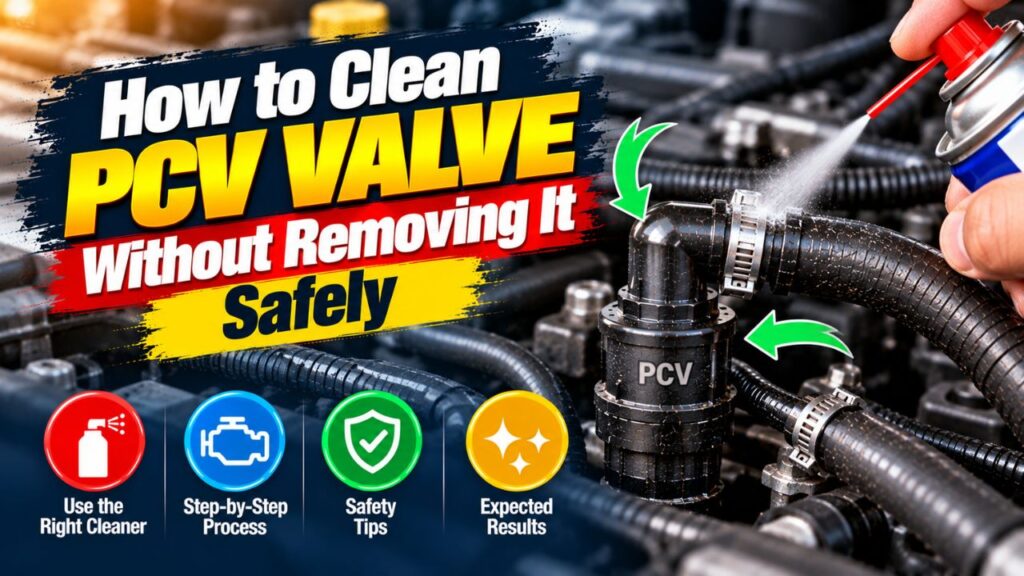
The safest way to clean PCV valve without removing it is to clean only the accessible parts of the system rather than trying to flood the internal valve with solvent.
Start with the engine off and cool. Inspect the PCV hose, fitting, and surrounding area. Disconnect the hose from the accessible end if the design allows it without removing the valve itself. Clean sludge or oil residue from the hose opening and PCV port using a lint-free cloth, small soft brush, or manufacturer-approved cleaner.
If the PCV valve itself is accessible but remains installed, wipe around its opening and remove external deposits. Do not pour cleaner into the valve or force compressed air through it unless the vehicle manufacturer specifically permits that procedure.
After cleaning, reconnect the hose securely and check the engine for normal idle, vacuum leaks, and other PCV-related symptoms.
The important limitation is that an installed PCV valve cannot usually be cleaned internally as thoroughly as a removed valve.
What Does the PCV Valve Do?
PCV stands for Positive Crankcase Ventilation.
During normal engine operation, a small amount of combustion gas can leak past the piston rings into the crankcase. This is called blow-by.
The PCV system routes these vapors back into the engine intake so they can be burned instead of allowing pressure and contaminants to build inside the crankcase.
Depending on the design, the PCV valve helps regulate how much vapor enters the intake under different engine operating conditions.
A properly functioning PCV system helps control:
- Crankcase pressure
- Moisture accumulation
- Oil vapor
- Sludge formation
- Emissions
When the valve or passages become restricted, crankcase ventilation can suffer.
Why Does a PCV Valve Get Dirty?
PCV systems continuously handle crankcase vapors containing small amounts of:
- Oil mist
- Moisture
- Combustion byproducts
- Fuel vapor
- Sludge-producing contaminants
Over time, these materials can leave deposits inside the PCV valve, hoses, oil separator, and passages.
Short-trip driving can make contamination worse because the engine may not stay hot long enough to evaporate moisture from the crankcase.
Poor oil-change habits can also contribute to sludge formation.
Can You Really Clean a PCV Valve Without Taking It Out?
Only partially.
You can clean accessible dirt and sludge from:
- PCV hose
- Hose fitting
- External valve opening
- Accessible ventilation port
But if the valve’s internal plunger, diaphragm, or metering mechanism is sticking, you generally cannot inspect or clean it properly while it remains installed.
Trying to force cleaner through the system can create more problems than it solves.
For that reason, in-place cleaning is best viewed as light maintenance for accessible contamination, not a complete repair for a failed PCV valve.
Step 1: Let the Engine Cool
Work with the engine off and cool enough to touch safely.
The PCV valve is often located near the valve cover or intake system, close to hot engine components.
A cool engine also makes rubber and plastic hoses easier to handle without unnecessary heat exposure.
Step 2: Locate the PCV System
The PCV valve may be located:
- In the valve cover
- In a rubber grommet
- On a PCV hose
- Inside an oil separator
- Integrated into the valve cover
Follow the hose between the crankcase ventilation point and the intake manifold or intake tube.
If you cannot find a separate valve, your engine may use an integrated PCV system.
Do not assume every engine has a small removable valve.
Step 3: Inspect the Hose Before Cleaning
A dirty PCV valve is not the only possible problem.
Check the hose for:
- Cracks
- Splits
- Soft or swollen sections
- Collapsed areas
- Loose fittings
- Heavy oil saturation
A cracked hose can create a vacuum leak.
A collapsed or heavily clogged hose can restrict crankcase ventilation even if the valve itself is working correctly.
If the hose is physically damaged, cleaning will not repair it. Replace it.
Step 4: Disconnect the Accessible Hose End
If your PCV system uses a removable hose connection, carefully disconnect the hose from the accessible fitting.
You may be able to do this while leaving the PCV valve installed.
Avoid pulling aggressively on old plastic fittings because they can become brittle with age.
If the connection does not release normally, check the vehicle’s service procedure before forcing it.
Step 5: Clean the PCV Hose
If the hose contains light oily residue, wipe the ends with a lint-free cloth.
For removable hoses that are heavily contaminated, cleaning may be possible with a product compatible with the hose material, but replacement can be more reliable when the hose is old, swollen, or internally restricted.
Make sure the hose is completely dry before reconnecting it if any approved liquid cleaner is used.
Do not leave solvent trapped inside the hose.
Step 6: Clean Around the PCV Port
With the hose disconnected, inspect the accessible PCV port.
Light sludge around the opening can be wiped away carefully.
A small soft brush or cotton swab may help with surface deposits, provided you do not push debris deeper into the system.
Keep loose material from falling into:
- Valve cover
- Intake manifold
- Vacuum passage
The goal is to remove visible surface contamination, not scrape aggressively inside the engine.
Step 7: Avoid Flooding the Valve With Cleaner
This is one of the most important precautions.
Do not spray large amounts of:
- Carburetor cleaner
- Brake cleaner
- Throttle-body cleaner
- Engine degreaser
directly into the installed PCV valve unless the manufacturer specifically approves it.
The cleaner may travel directly into the intake manifold.
Depending on the product and engine design, it may also affect:
- Rubber seals
- Plastic components
- PCV diaphragm
- Engine idle
- Oxygen sensor operation temporarily
A small amount of residue is very different from intentionally filling the PCV system with solvent.
Step 8: Reconnect Everything Securely
After cleaning, reconnect the PCV hose fully.
Make sure:
- Hose is seated
- Clamp is secure if fitted
- No fitting is cracked
- No vacuum connection has been left open
An improperly connected PCV hose can cause a significant vacuum leak and make the engine run worse than before.
Step 9: Start the Engine and Check Operation
Start the engine and allow it to idle.
Listen for:
- Hissing
- Whistling
- Rough idle
- Surging
- Misfire
If the engine suddenly runs poorly after the cleaning, recheck every hose and connection.
A loose PCV connection can introduce unmetered air into the intake.
Can You Spray Carb Cleaner Into a PCV Valve?
It is not a good universal method while the valve is installed.
Carburetor cleaner is a strong solvent intended for certain fuel and intake components. PCV systems may contain rubber diaphragms, seals, plastic housings, and other materials that may not be compatible with aggressive solvents.
If a traditional removable metal PCV valve is being cleaned off the vehicle, some technicians may use an appropriate solvent according to the component manufacturer’s guidance.
That is different from spraying cleaner through an installed PCV valve and allowing the chemical to enter the engine.
Can You Use Brake Cleaner on a PCV Valve?
Brake cleaner should not be treated as a general PCV cleaner.
It evaporates quickly, but formulations vary and may be harsh on certain plastics, rubber components, and coatings.
Modern PCV systems often contain materials far more complex than the simple metal valves used on older engines.
Use a manufacturer-approved cleaner if cleaning is specifically recommended.
Can You Use WD-40 to Clean a PCV Valve?
WD-40 is not a proper PCV cleaning solution.
It can leave an oily residue and is not designed to restore the internal metering function of a PCV valve.
If the valve is sticking internally, replacement is often a better solution than trying to lubricate it.
Can You Blow Compressed Air Through the PCV Valve?
Avoid doing this unless the service procedure specifically allows it.
Compressed air can:
- Damage an internal diaphragm
- Push debris deeper into passages
- Dislodge contamination
- Damage delicate components
An integrated PCV regulator can be especially sensitive.
Do not assume that because a passage carries air during engine operation, it is safe to blast it with shop air.
What If the PCV Valve Is Built Into the Valve Cover?
Many modern engines use an integrated PCV system.
In these designs, the PCV diaphragm or regulator may be molded into or attached to the valve cover.
You may not be able to remove or clean it as a separate part.
If the integrated PCV system fails, the repair may require:
- Replacing a diaphragm kit when available
- Replacing an oil separator assembly
- Replacing the complete valve cover
The correct repair depends on the vehicle.
External cleaning will not fix a torn diaphragm or internally failed regulator.
Signs Cleaning May Help
Light cleaning may be worthwhile if you see:
- Sludge around the hose opening
- Oily residue in the hose
- Dirt around the PCV fitting
- Minor deposits at an accessible port
If the system has no major drivability symptoms and the contamination is superficial, cleaning accessible areas can be reasonable preventive maintenance.
Signs the PCV Valve Probably Needs Replacement
Cleaning becomes less useful when the valve has actually failed.
Replacement or repair is more appropriate if you have:
- Persistent rough idle
- PCV-related vacuum leak
- Lean diagnostic codes
- Excessive crankcase pressure
- Heavy oil consumption through the PCV system
- Torn PCV diaphragm
- Valve that is mechanically stuck
- Repeated sludge blockage
A PCV valve is often inexpensive on engines that use a separate replaceable valve.
Replacing a questionable part can be more reliable than repeatedly trying to clean it.
Can a Dirty PCV Valve Cause Rough Idle?
Yes.
If the valve sticks open, too much air may enter the intake and act like a vacuum leak.
If it becomes clogged, crankcase ventilation may also become abnormal.
Depending on the design, symptoms can include:
- Rough idle
- High idle
- Hesitation
- Misfire
- Lean mixture
Cleaning external deposits will only help if the contamination is actually responsible for the airflow problem.
Can a Clogged PCV Valve Cause Oil Leaks?
Yes.
A severely restricted PCV system can allow crankcase pressure to rise.
That pressure can push oil through weak sealing points such as:
- Valve cover gasket
- Crankshaft seals
- Camshaft seals
- Other engine gaskets
Replacing a leaking seal without correcting excessive crankcase pressure can lead to another leak.
Can a Bad PCV Valve Cause Oil Consumption?
Yes.
A failed PCV system can sometimes pull excessive oil mist or even liquid oil into the intake.
The engine then burns that oil.
Possible signs include:
- Increased oil consumption
- Oil inside intake hoses
- Blue exhaust smoke
- Spark plug fouling
- Carbon deposits
If this is happening, simple external cleaning is unlikely to be enough.
Is Cleaning Better Than Replacing a PCV Valve?
For a traditional inexpensive removable PCV valve, replacement is often the better long-term solution when the valve is clearly malfunctioning.
Cleaning makes more sense when:
- Deposits are minor
- Valve is otherwise functional
- Replacement is not immediately available
- Manufacturer allows cleaning
Replacement is preferable when the valve is:
- Stuck
- Damaged
- Heavily contaminated
- Very old
- Inexpensive to replace
You should also inspect hoses and grommets at the same time.
Does a PCV Valve Have a Maintenance Interval?
Some manufacturers specify inspection or replacement intervals, while others treat the PCV system as an inspect-as-needed component.
Modern integrated PCV systems may not have a simple scheduled replacement interval at all.
Check the maintenance schedule for your exact vehicle.
Age alone does not prove the valve is bad, but high mileage combined with oil contamination, vacuum leaks, or crankcase-pressure problems justifies closer inspection.
Common Mistakes When Cleaning a PCV Valve Without Removing It
One common mistake is assuming that more solvent means better cleaning. Flooding the PCV system can introduce chemicals directly into the intake and does not guarantee that an internal restriction will be removed.
Another mistake is cleaning the valve while ignoring the hose. A split, collapsed, or blocked hose can cause nearly identical symptoms.
Many people also rely on the old PCV “rattle test.” A traditional valve that rattles may still meter airflow incorrectly, while a modern diaphragm-style PCV system may not rattle at all.
Finally, do not keep cleaning a clearly failed valve. A torn diaphragm, broken spring, damaged housing, or severely clogged internal passage generally needs repair or replacement.
When Should You Remove the PCV Valve Instead?
Removal is usually worthwhile when you need to:
- Inspect the internal valve
- Confirm severe contamination
- Test movement on a traditional valve
- Clean it thoroughly off the engine
- Replace the valve or grommet
A removable PCV valve is often easier to inspect properly outside the engine.
If it is difficult to access, integrated into the valve cover, or surrounded by brittle components, follow vehicle-specific service information rather than forcing it out.
When Should You Have a Mechanic Check the PCV System?
Professional diagnosis is useful when PCV-related symptoms continue after basic inspection.
Consider professional help if the engine has:
- Persistent lean codes
- Heavy oil consumption
- Excessive crankcase vacuum
- Excessive crankcase pressure
- Repeated seal leaks
- Blue smoke
- Severe sludge
- Integrated PCV failure
- Rough idle that does not improve
These symptoms can also be caused by problems unrelated to the PCV system, including engine wear and intake leaks.
Proper diagnosis prevents unnecessary parts replacement.
FAQs About How to Clean PCV Valve Without Removing
Can I clean a PCV valve while it is still installed?
You can clean the accessible hose, port, and exterior deposits, but you usually cannot thoroughly clean the internal valve mechanism while it remains installed.
If the valve is sticking internally, removal or replacement is generally more effective.
What can I spray into a PCV valve?
Do not spray chemicals into an installed PCV system unless the vehicle or component manufacturer specifically recommends a product and procedure.
Many modern systems contain rubber diaphragms and plastics that can be damaged by aggressive solvents.
Can I clean a clogged PCV valve with compressed air?
Compressed air is not a universally safe cleaning method.
It can damage diaphragms or push debris deeper into the system. Follow the manufacturer’s service procedure.
How do I know if my PCV valve is clogged?
Possible signs include excessive crankcase pressure, oil leaks, sludge, abnormal oil consumption, and poor crankcase ventilation.
These symptoms are not exclusive to the PCV valve, so inspection is important.
Can a dirty PCV valve cause a check engine light?
Yes.
A PCV fault can create a vacuum leak, lean mixture, or misfire that triggers diagnostic trouble codes.
Is it better to clean or replace a PCV valve?
If a traditional replaceable PCV valve is inexpensive and clearly defective, replacement is usually the more reliable repair.
Cleaning is more appropriate for light external contamination or when the manufacturer specifically allows it.
Can I drive with a clogged PCV valve?
A mildly restricted system may not cause an immediate breakdown, but continued driving can contribute to crankcase pressure, oil leaks, sludge, and other problems.
A confirmed PCV restriction should be repaired rather than ignored.
Conclusion
Learning how to clean PCV valve without removing it is mainly about understanding what can realistically be serviced in place. You can clean light sludge and oil residue from the PCV hose, fitting, and accessible port while leaving the valve installed, but you generally cannot restore a badly clogged, mechanically stuck, or damaged internal PCV mechanism through external cleaning alone.
The best approach is to inspect the entire system first. Clean accessible contamination, check the hose for cracks or restrictions, reconnect everything securely, and see whether the engine’s idle and crankcase ventilation return to normal. Avoid flooding the installed valve with carb cleaner, brake cleaner, or compressed air unless the vehicle manufacturer specifically approves that procedure.
The overall verdict is that in-place cleaning is useful for minor surface contamination, not as a substitute for repairing a failed PCV system. If the valve has a torn diaphragm, severe internal blockage, persistent vacuum leak, excessive oil consumption, or crankcase-pressure problem, removal, replacement, or vehicle-specific service is the more reliable solution.