What Happens When Catalytic Converter Is Clogged? Signs and Risks
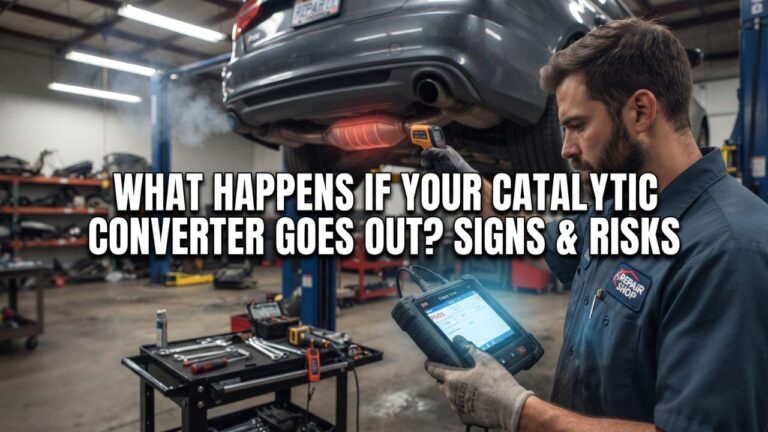
A clogged catalytic converter restricts exhaust flow, creating backpressure that makes the engine struggle to expel burned gases. The car may lose acceleration, struggle at higher RPM, consume more fuel, run hot, become hard to start, or stall. A severe blockage can prevent the engine from staying running at all.
The problem can get progressively worse. A mild restriction may first show up only during hard acceleration or climbing a hill. As more passages become blocked, the same car may begin struggling during normal driving and eventually at idle.
Finding the restriction early can prevent repeated stalling, excessive exhaust heat, unnecessary parts replacement, and being stranded. It also gives you a chance to find the engine fault that damaged the converter before another converter suffers the same fate.
For U.S. vehicle owners, the EPA classifies the catalytic converter as a major emissions component covered by the federal emissions warranty for 8 years or 80,000 miles on qualifying light-duty vehicles. Checking warranty status before approving replacement is worthwhile if the vehicle is still inside that period.
For what happens when catalytic converter is clogged, the main mechanical problem is restricted exhaust flow. The engine keeps producing exhaust gases, but the blocked converter limits how quickly those gases can leave. Pressure builds upstream, cylinder filling suffers, and power drops.
I’d pay close attention to the way the power loss develops. A vehicle that idles fairly well but feels increasingly weak as throttle and RPM rise fits an exhaust-restriction pattern. An engine that shuts off instantly with no previous loss of power may point more strongly toward fuel, ignition, sensor, or electrical trouble.
The sections below explain the effects of a blockage, the most useful symptoms, what causes the restriction, how shops test it, when driving should stop, and what needs to be repaired before a new converter goes on.
What Happens When Catalytic Converter Is Clogged?
A restricted converter affects the engine because an internal-combustion engine must move air through the cylinders and then push exhaust gases out.
When the exhaust outlet is restricted, the engine cannot breathe normally.
Exhaust Backpressure Rises
Exhaust backpressure is pressure resisting the flow of gases out of the engine.
Some pressure exists in every exhaust system, but a blocked converter can raise it far beyond normal operating levels. The engine then spends more effort pushing exhaust out of the cylinders.
Walker states that excessive backpressure ahead of the converter points toward converter restriction and gives general diagnostic reference figures below about 1.5 psi at idle and 3 psi at 2,000 RPM, though vehicle-specific specifications should be used when available.
Acceleration Becomes Weak
Loss of acceleration is one of the clearest drivability symptoms.
At idle, the engine produces a relatively small amount of exhaust. During acceleration, exhaust volume rises sharply. A partially blocked converter may pass enough gas for idle yet become a major restriction as RPM and load increase.
The driver may press farther on the accelerator without getting the expected increase in speed.
Walker and MagnaFlow both identify sluggish acceleration and loss of engine power among common restriction symptoms.
The Engine May Struggle to Reach Higher RPM
A clogged converter can make the engine feel as though it hits an invisible limit.
It may rev normally to a certain point, then flatten out, sputter, or refuse to accelerate further.
This often becomes more obvious:
- Climbing hills
- Entering a highway
- Towing
- Accelerating from low speed
- Driving at sustained higher engine load
The more completely blocked the substrate becomes, the sooner that restriction may appear.
Fuel Economy Can Drop
Poor exhaust flow can make the engine operate under abnormal load and reduce normal cylinder breathing.
Fuel economy may fall, especially when the driver compensates for poor acceleration by using more throttle.
A drop in gas mileage alone does not prove the converter is clogged. Tire pressure, fuel-system faults, oxygen-sensor problems, ignition faults, and many other conditions can produce similar changes.
The Engine Can Stall or Fail to Start
A severe blockage can restrict exhaust flow enough that the engine cannot keep running.
AutoZone, Walker, and MagnaFlow all list hard starting, stalling, or severe engine-operation problems among possible results of major converter restriction.
In an extreme case, the engine may start briefly and then die because exhaust cannot leave quickly enough for normal combustion to continue.
Key Takeaway: A clogged converter raises exhaust backpressure, with power loss appearing first in many cases and hard starting or stalling appearing as the restriction becomes severe.
Common Signs of a Clogged Catalytic Converter
No single symptom proves the converter is blocked.
The pattern matters more than one warning light or smell.
Sluggish Acceleration Under Load
A car that feels normal at light throttle but becomes very weak during harder acceleration deserves an exhaust-restriction check.
This symptom is more meaningful if the engine also struggles to reach higher RPM.
A failing fuel pump can create similar behavior, so exhaust restriction still needs testing before parts are ordered.
Hard Starting or Starting Then Dying
Severe backpressure can interfere with engine operation immediately after startup.
MagnaFlow lists hard-start and no-start conditions among possible symptoms of severe exhaust restriction.
If the engine cranks normally but starts only briefly, converter restriction belongs on the diagnostic list alongside fuel-pressure, ignition, crankshaft-sensor, and air-control faults.
Check Engine Light
A blocked or failing converter may turn on the check-engine light.
Common catalyst-related codes include P0420 and P0430, which relate to catalyst-system performance.
Those codes do not prove that the converter is physically clogged. AutoZone notes that P0420 can appear with catalyst deterioration while noticeable power loss tends to occur when exhaust restriction is also present.
Misfire, fuel-mixture, oxygen-sensor, or other codes may also reveal the problem that damaged the converter.
Excessive Heat Under the Vehicle
A converter can become extremely hot when unburned fuel reaches it or when internal passages become damaged.
Walker reports that periodic operation above about 1,600°F can damage catalyst material and that temperatures above roughly 1,700°F can damage or melt the substrate.
A converter that glows red, produces a strong scorching smell, or visibly discolors should be treated as a serious fault.
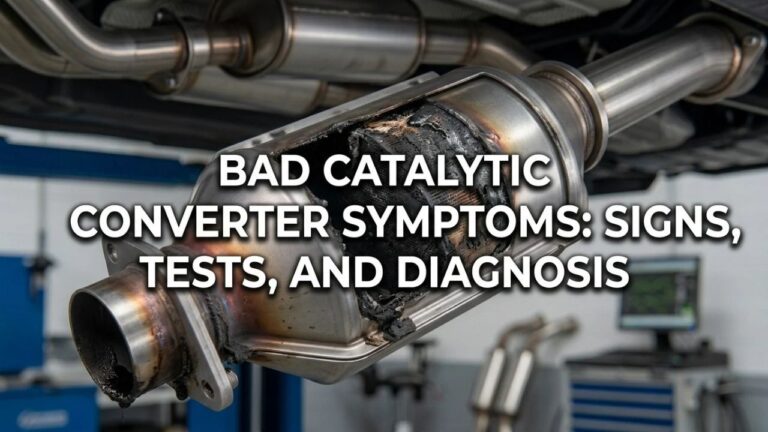
Rattling From the Converter
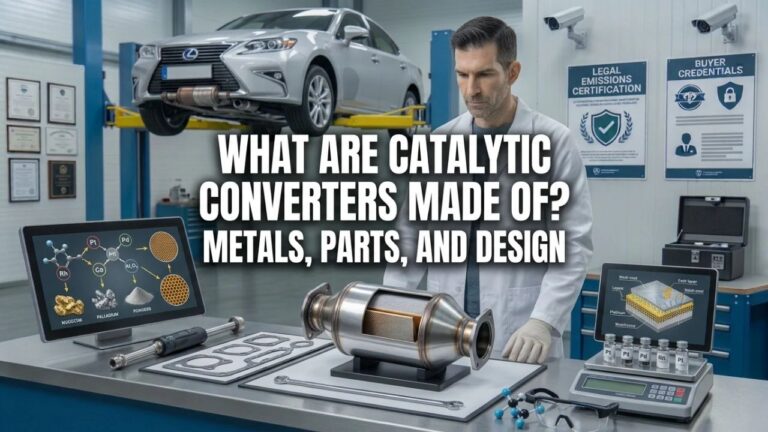
The converter contains a honeycomb-style internal substrate.
If that substrate cracks or breaks apart, pieces may rattle inside the metal shell.
Loose pieces can also shift and block exhaust passages. Walker notes that broken material from an upstream converter can plug another converter farther downstream.
Sulfur or Rotten-Egg Smell
A sulfur-like smell can appear with catalyst or fuel-mixture problems.
MagnaFlow lists a rotten-egg odor among possible converter warning signs.
The smell does not confirm a physical clog. It should be considered alongside power loss, codes, heat, and test results.
Key Takeaway: The strongest restriction pattern combines weak acceleration, limited high-RPM power, hard starting or stalling, abnormal heat, and test results showing high exhaust backpressure.
Why a Clogged Converter Causes Power Loss
An engine works as an air pump as well as a combustion device.
Fresh air enters, fuel burns, and the resulting gases must leave through the exhaust system.
Burned Gases Remain in the Cylinders
When backpressure becomes excessive, the engine cannot clear each cylinder as cleanly during the exhaust stroke.
Some burned gas remains behind.
That reduces the amount of fresh air-fuel charge available for the next combustion cycle.
The result is less torque and weaker acceleration.
Higher RPM Creates More Exhaust Flow
A partially blocked converter may be almost unnoticeable at idle.
Higher RPM creates much more exhaust volume.
The blockage then becomes the limiting point, which is why a car may idle normally yet become weak when the accelerator is pressed.
Heavy Load Makes the Restriction More Obvious
Going uphill, carrying heavy cargo, or accelerating quickly asks the engine to produce more power.
That creates more exhaust.
A converter that passes enough flow for light driving may no longer keep up under load.
This is why some drivers first notice a clogged converter on steep roads or during highway acceleration.
What Causes a Catalytic Converter to Become Clogged?
Converters often fail because another engine problem exposes them to abnormal fuel, oil, coolant, heat, or debris.
A converter should not be replaced until that cause has been investigated.
Misfires Can Melt the Substrate
A misfiring cylinder can send unburned fuel into the exhaust.
That fuel may burn inside the converter, creating extreme temperatures.
Walker identifies misfires and weak or absent spark among conditions that can overheat and melt converter material.
Once passages melt together, the resulting blockage cannot be corrected through normal driving.
A Rich Air-Fuel Mixture Can Overheat It
An engine running rich receives more fuel than it can burn correctly.
Excess fuel reaching the converter may react inside it and raise temperature sharply.
Possible causes include leaking injectors, fuel-pressure problems, ignition faults, sensor errors, and air-fuel control faults.
Oil Burning Can Contaminate the Honeycomb
An engine consuming oil may send oil-derived deposits through the exhaust.
Those deposits can coat catalyst surfaces and interfere with exhaust passages.
Oil consumption can come from worn piston rings, valve seals, turbocharger faults, or other internal engine problems.
Coolant Can Poison the Converter
An internal coolant leak can send coolant through the combustion chamber and into the exhaust.
Walker warns that internal cooling-system leaks can contaminate and damage the catalytic converter.
Unexplained coolant loss should be investigated before a converter is replaced.
The Internal Honeycomb Can Melt or Collapse
Extreme temperature can physically deform the internal substrate.
Walker describes a plugged converter as one where the substrate may melt and turn into a solid mass, causing major loss of power.
A melted converter needs replacement.
Broken Material Can Create an Intermittent Blockage
A cracked substrate can break into pieces that move inside the shell.
One position may restrict flow badly, while another lets more exhaust through.
That can create an intermittent problem in which the car feels stronger after stopping, cooling, or hitting a bump.
Key Takeaway: Misfires, rich running, oil consumption, coolant contamination, extreme heat, and broken catalyst material can all create converter restriction.
Can a Clogged Catalytic Converter Damage the Engine?
A severe restriction can create serious drivability and heat problems, but the relationship between converter damage and engine damage needs some care.
In many cases, the engine problem starts first and destroys the converter.
High Backpressure Makes the Engine Work Poorly
Excessive backpressure reduces cylinder scavenging and limits fresh air intake.
That leads to poor combustion, loss of power, rough running, and stalling.
Long periods of severe restriction should not be treated as normal driving.
Excessive Heat Can Affect Nearby Components
A badly overheated converter can raise temperatures around the exhaust system and surrounding components.
A 2018 NHTSA recall involving about 34,300 vehicles described a condition in which engine misfires could cause catalytic-converter overheating, with resulting damage to nearby wiring or components and possible engine stall or engine-compartment fire.
That was a vehicle-specific recall, not a statement that every clogged converter creates a fire risk.
The Original Engine Fault May Be the Bigger Threat
Repeated misfires, severe rich running, coolant leaks, and oil consumption can harm more than the converter.
These conditions should be repaired even if exhaust backpressure is still within specification.
Replacing the converter alone does not remove the source of the problem.
Key Takeaway: Severe restriction can create heat, stalling, and major drivability trouble, while the engine fault that damaged the converter may create its own repair risks.
How to Test for a Clogged Catalytic Converter
Testing matters because many converter symptoms overlap with fuel, ignition, sensor, and electrical faults.
A scan code alone is not enough.
Scan for Diagnostic Trouble Codes
Start with an OBD-II scan.
Look for catalyst codes such as:
- P0420
- P0430
Also check for:
- Misfire codes
- Rich or lean mixture codes
- Oxygen-sensor codes
- Fuel-system codes
- Airflow or pressure sensor codes
Resolve obvious engine faults rather than treating the catalyst code as an isolated problem.
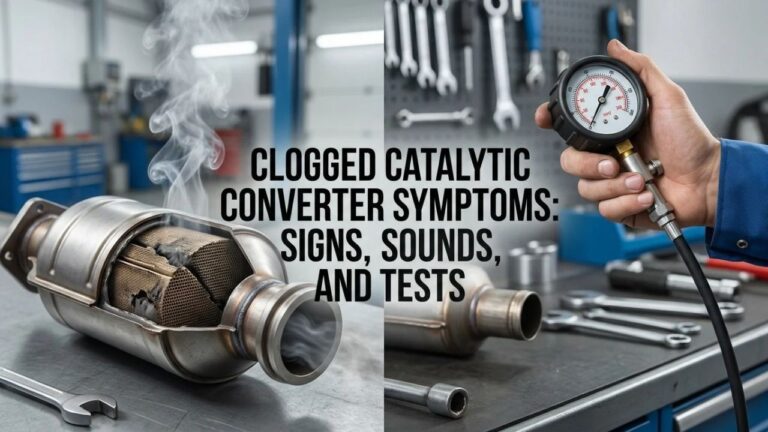
Perform an Exhaust Backpressure Test
A backpressure gauge can be installed at an oxygen-sensor port or another suitable exhaust test location.
Walker states that general backpressure on many vehicles should remain under roughly 1 psi at idle and 3 psi at 2,500 RPM, with high pressure ahead of the converter pointing toward restriction in the converter. Another Walker diagnostic page uses 1.5 psi at idle and 3 psi at 2,000 RPM as general references, reinforcing the need to use model-specific data where available.
This test is much stronger evidence of a physical clog than P0420 by itself.
Use an Engine Vacuum Test
A vacuum gauge can reveal a restricted exhaust.
Walker explains that vacuum should recover after RPM is raised. A large continuing drop can indicate exhaust blockage.
Vacuum testing does not identify the exact blocked part on its own. A crushed pipe, restricted muffler, or other exhaust fault can produce a similar result.
Inspect for Rattling and Heat Damage
A technician may check the converter for:
- Internal rattling
- Dented housing
- Blue or bronze heat discoloration
- Broken substrate
- Melted passages
Walker notes that a converter can appear normal at the ends while the substrate has melted internally, so exterior appearance cannot rule out a blockage.
Key Takeaway: Backpressure testing is one of the strongest ways to confirm a clog; codes, vacuum readings, rattling, and heat damage provide supporting evidence.
What to Do When a Catalytic Converter Is Clogged
A confirmed mechanical blockage usually means the converter needs replacement.
The bigger job is finding out why it failed.
Stop Driving if Power Loss Is Severe
If the car can barely accelerate, repeatedly stalls, struggles to start, or has an extremely hot converter, normal driving should stop.
A vehicle that stalls in traffic creates an obvious road hazard.
Have it towed if it cannot maintain normal power safely.
Repair Misfires or Fuel Problems First
Before installing a new converter, correct:
- Misfires
- Ignition faults
- Fuel-pressure problems
- Leaking injectors
- Rich air-fuel operation
- Oil consumption
- Coolant leaks
- Exhaust leaks affecting sensor readings
Walker advises correcting the root engine or emissions fault before replacing the converter because the same fault can damage the new unit.
Replace a Melted or Collapsed Converter
A converter with melted, broken, or collapsed substrate cannot restore its internal structure.
Cleaning additives cannot reopen ceramic passages that have fused together.
A physically blocked converter needs the correct replacement part once the cause of failure has been repaired.
Check Federal Warranty Coverage
If the vehicle is relatively new, check the warranty booklet before paying for replacement.
EPA states that the catalytic converter is one of the specified major emissions components covered for 8 years or 80,000 miles under the federal emissions defect warranty on applicable light-duty vehicles. Coverage can be denied when failure results from misuse or improper maintenance rather than a defect.
Key Takeaway: Confirm the restriction, repair the fault that caused it, replace structurally damaged converter material, and check warranty coverage before approving the repair.
Can You Drive With a Clogged Catalytic Converter?
A lightly restricted vehicle may still move, but continued driving is a poor plan once clear restriction symptoms appear.
Loss of power can worsen quickly if internal material shifts or melts further.
Stalling is another concern. A car that dies while entering traffic, climbing a grade, or crossing an intersection can place the driver in a difficult situation.
Excessive converter heat is an even stronger reason to stop.
If the check-engine light is flashing, the engine is actively misfiring, the converter is glowing, or the car can no longer maintain normal power, shut it down in a safe location and arrange diagnosis.
Conclusion
For what happens when catalytic converter is clogged, the main result is excessive exhaust backpressure. The engine cannot push exhaust out normally, so acceleration drops, higher RPM becomes difficult, fuel economy may decline, starting can become harder, and severe restriction may cause stalling.
The strongest clues are progressive power loss under load, high backpressure readings, unusual converter heat, rattling, and hard starting. P0420 or P0430 can support the diagnosis, but those codes do not prove a physical blockage.
A clogged converter also raises another question: what damaged it? Misfires, rich operation, oil burning, coolant leakage, or internal catalyst breakage should be addressed before replacement.
I’d verify the restriction with proper testing before buying a converter. If the substrate is melted or collapsed, replacement is the proper repair; if another engine fault is responsible, that fault needs to be corrected at the same time.
FAQs About a Clogged Catalytic Converter
What Does a Clogged Catalytic Converter Feel Like?
The car often feels weak or restricted during acceleration. It may respond normally at light throttle but struggle as RPM rises. Hills and highway merging can make the problem more obvious. Severe restriction may cause sputtering, hard starting, or stalling.
Can a Clogged Catalytic Converter Cause a Car to Stall?
Yes. A severe blockage can create enough backpressure to prevent the engine from moving exhaust gases normally. The vehicle may first lose power and then stall. A completely blocked exhaust can also make restarting difficult.
Can a Clogged Catalytic Converter Cause Overheating?
A damaged or restricted converter can become extremely hot, especially when unburned fuel reaches it. Walker reports that temperatures above roughly 1,600°F can damage catalyst material, with still higher temperatures capable of melting the substrate.
Will a Clogged Catalytic Converter Cause P0420?
It can, but P0420 does not specifically mean the converter is clogged. The code relates to catalyst-system performance below the expected threshold. A converter can lose emissions performance without becoming physically restricted.
Can a Clogged Catalytic Converter Cause Poor Gas Mileage?
Yes. Restriction can reduce normal engine breathing and lead to weak acceleration, which may cause the driver to use more throttle. Fuel economy can also fall because of the rich-running, misfire, or sensor fault that damaged the converter in the first place.
Can a Clogged Catalytic Converter Cause a No-Start?
A severely blocked converter can cause hard starting or a no-start condition because exhaust cannot escape normally. Fuel-pressure failure, ignition faults, crankshaft-sensor problems, battery issues, and several other faults are also common no-start causes.
Does a Clogged Catalytic Converter Always Make Noise?
No. A converter can be restricted without making an obvious sound. Rattling tends to occur when the internal substrate has broken loose. A melted substrate may produce severe power loss without a noticeable rattle.
Can a Clogged Catalytic Converter Be Cleaned?
Light contamination may respond differently from physical blockage, but melted, collapsed, or broken catalyst material cannot be repaired with a cleaner. A confirmed structural blockage normally requires converter replacement after the cause of failure has been corrected.