
Stopped Up Catalytic Converter Symptoms: Signs and Diagnosis
A stopped-up catalytic converter can make a vehicle feel weak, sluggish, and unable to breathe at higher engine speeds. Common signs include poor acceleration, loss of power, limited RPM, rough idle, hard starting, stalling, excess exhaust heat, and sometimes misfires. Severe blockage can eventually make the engine difficult or impossible to run.
The problem develops because exhaust gases cannot move freely through the converter. Pressure builds upstream, forcing the engine to work harder during the exhaust stroke and interfering with its ability to fill the cylinders with a fresh air-fuel charge.
Stopped up catalytic converter symptoms usually become most obvious during acceleration or hill climbing. Exhaust volume increases with engine speed and load, so a restriction that is barely noticeable at idle may make the vehicle feel severely underpowered once you press the accelerator.
There is useful U.S. warranty protection to check before paying for an early converter replacement. EPA guidance states that catalytic converters are among the specified major emissions components covered for 8 years or 80,000 miles on qualifying light-duty vehicles under federal emissions warranty provisions.
A stopped-up converter is not the same as a converter that merely has low catalyst efficiency. A converter can set P0420 or P0430 yet still flow exhaust normally. Physical blockage usually produces drivability symptoms such as sluggish acceleration, restricted RPM, or stalling.
If you are trying to determine how to tell if catalytic converter is stopped up, focus on the complete pattern of symptoms and confirm the restriction with proper testing. Power loss alone can also come from fuel delivery, ignition, transmission, air intake, or engine mechanical problems.
What Are the Main Stopped Up Catalytic Converter Symptoms?
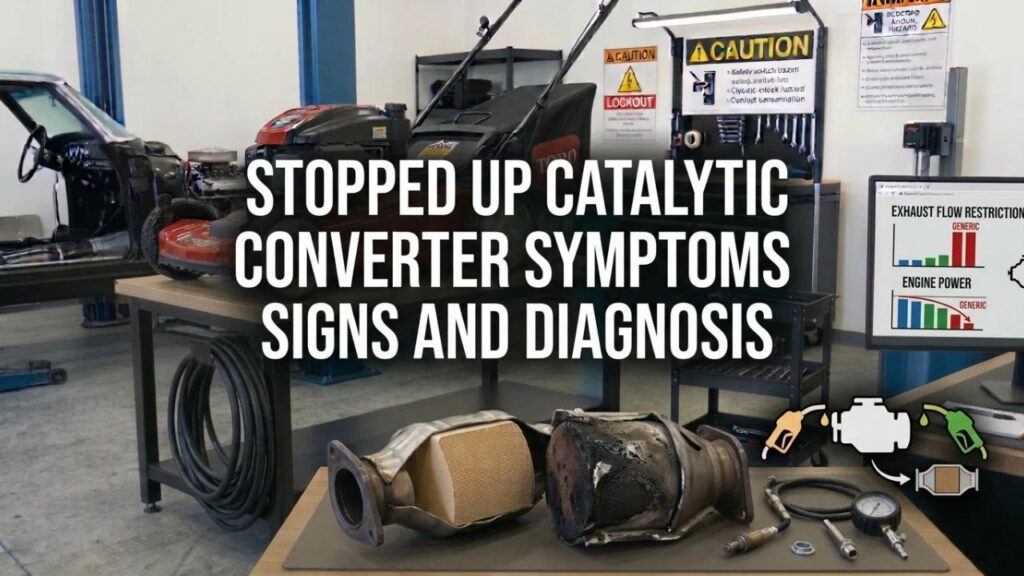
A converter restriction changes the way an engine breathes.
Symptoms often become more severe as exhaust demand rises.
Loss of Engine Power
Loss of power is one of the strongest signs of a restricted converter.
The engine may feel normal at first, then seem unable to produce its usual output.
You may notice weakness during:
- Hard acceleration
- Highway merging
- Hill climbing
- Passing
- Higher RPM operation
- Heavy vehicle load
Walker identifies sluggish operation and loss of power as common results when a converter substrate melts and creates a blockage.
A major restriction can make the vehicle feel as if something is physically holding it back.
Slow or Delayed Acceleration
Pressing the accelerator increases airflow, fuel delivery, and exhaust volume.
If the converter cannot pass that additional exhaust, backpressure rises.
The engine may:
- Accelerate slowly
- Hesitate
- Stop gaining speed normally
- Feel stronger after you release some throttle
- Struggle more as RPM increases
Firestone also identifies clogged exhaust components as a cause of increased backpressure and poor acceleration.
Engine Cannot Reach Normal RPM
A stopped-up converter can create an apparent RPM limit.
The engine may climb normally to a certain point and then struggle to rev farther.
For example, a vehicle might drive reasonably well below moderate RPM but feel severely restricted once the engine is asked for more power.
There is no single RPM at which this happens.
The point depends on:
- Degree of blockage
- Engine displacement
- Exhaust design
- Number of converters
- Engine load
A converter can therefore be partially clogged without making the engine idle badly.
Rough Idle
Severe restriction can eventually disturb combustion even at idle.
The engine may:
- Shake
- Surge
- Drop below normal idle speed
- Misfire
- Stall at traffic lights
Rough idle alone is not strong proof of converter blockage.
Vacuum leaks, spark plugs, ignition coils, injectors, throttle problems, and low compression commonly produce the same symptom.
Engine Stalling
A badly restricted exhaust can make the engine stall.
Stalling may occur:
- After the engine warms up
- During acceleration
- When returning to idle
- After driving under heavy load
Walker lists stalling among possible drivability symptoms of a failing or clogged catalytic converter.
Hard Starting
A severely restricted converter can make starting difficult because the engine cannot move exhaust gases freely.
The engine may:
- Crank longer than normal
- Start and immediately stall
- Require several attempts
- Run poorly for the first few seconds
Hard starting has many other causes, so fuel pressure, ignition spark, crankshaft position, battery condition, and injector operation should also be checked.
Misfires
A clogged exhaust can create enough backpressure to disturb cylinder operation.
Firestone notes that a clogged catalytic converter or damaged exhaust can create backpressure that disrupts engine performance and may contribute to misfire.
A P0300 random-misfire code may occur in severe cases.
The reverse sequence is also common: an existing misfire overheats and damages the converter.
Reduced Fuel Economy
A restricted converter may contribute to higher fuel consumption.
The engine may need more throttle to produce the same road speed.
The problem that damaged the converter—such as rich running or misfire—may also reduce MPG.
Excessive Exhaust Heat
A damaged converter may run abnormally hot, especially if unburned fuel is reaching it.
Possible signs include:
- Burning odor
- Excess heat beneath the floor
- Heat discoloration on the converter
- Smoke
- A red-hot converter in extreme cases
Walker states that prolonged temperatures above roughly 1,600°F can harm catalyst material, while still higher temperatures can damage or melt the substrate.
A visibly glowing converter calls for stopping the vehicle and diagnosing the cause.
Rattling From the Converter
The ceramic substrate inside a converter can crack or break apart after overheating or impact.
Loose pieces may rattle inside the housing.
Those pieces can also shift and partially block the outlet.
A loose heat shield can create a similar sound, so the converter needs inspection before replacement.
Key Takeaway: Strong clues include loss of power, slow acceleration, limited RPM, rough idle, stalling, hard starting, misfires, abnormal heat, and internal rattling. Symptoms that worsen under load are especially suspicious for exhaust restriction.
Why Does a Stopped Up Catalytic Converter Reduce Power?
A combustion engine works as an air pump.
It must take fresh air in and push burned gases out.
A restriction on either side reduces engine output.
Exhaust Backpressure Builds Up
The converter contains a honeycomb-like substrate with thousands of small passages.
Hot exhaust normally passes through these channels.
If they become melted, collapsed, coated, or blocked, exhaust pressure starts building ahead of the restriction.
The pistons then have to push against that pressure during the exhaust stroke.
Walker recommends backpressure testing when restriction is suspected and notes that high pressure ahead of the converter points toward a restricted converter.
Burned Gases Remain in the Cylinders
A cylinder should clear most of its burned gases before drawing in another charge.
Backpressure can interfere with that process.
Residual exhaust takes up space that should contain fresh air and fuel.
The next combustion cycle may therefore produce less power.
High RPM Makes the Problem Worse
Higher engine speed produces a greater volume of exhaust.
A partly blocked converter may flow enough at idle yet fail to pass enough gas during hard acceleration.
This creates a common symptom pattern:
- Engine starts normally.
- Idle seems acceptable.
- Light driving feels fairly normal.
- Acceleration becomes weak.
- Power gets worse as RPM rises.
Key Takeaway: Converter blockage creates backpressure that interferes with exhaust flow and cylinder filling, which is why power loss often becomes much worse as RPM and engine load increase.
How to Tell if Catalytic Converter Is Stopped Up
Symptoms can point toward restriction, but testing provides stronger evidence.
Several checks can be used together.
Check How the Vehicle Responds Under Load
Pay attention to when the power loss occurs.
A converter becomes more suspicious if the vehicle:
- Idles reasonably well
- Drives normally at very light throttle
- Loses power during acceleration
- Struggles badly uphill
- Cannot reach higher RPM
- Feels better after reducing throttle
This pattern fits an exhaust system that can handle low flow but not higher volume.
Scan for Trouble Codes
Connect an OBD-II scanner and record all stored and pending codes.
Possible codes include:
- P0420
- P0430
- P0300
- Cylinder-specific misfire codes
- Rich or lean fuel codes
- Oxygen-sensor codes
P0420 and P0430 do not mean the converter is physically stopped up.
They refer to catalyst performance below the expected threshold.
A restricted converter can exist with or without those codes.
Check Live Misfire Data
If the engine is misfiring, check which cylinders are affected.
A single-cylinder misfire points more strongly toward:
- Spark plug
- Ignition coil
- Injector
- Wiring
- Compression
Several cylinders misfiring along with broad power loss may fit an exhaust restriction better.
Inspect the Exhaust System
Before blaming the converter, inspect for:
- Crushed pipes
- Bent pipes
- Damaged muffler
- Impacted converter housing
- Loose internal parts
- Excess corrosion
A collapsed muffler or damaged pipe can create nearly identical backpressure symptoms.
Perform a Backpressure Test
A backpressure test is one of the most direct methods for diagnosing a restriction.
A technician can remove an oxygen sensor and install a pressure gauge in the sensor port.
Walker gives general diagnostic guidance of roughly:
- Less than 1 PSI at idle on many vehicles
- Less than 3 PSI around 2,500 RPM
Vehicle-specific specifications take priority.
If pressure is high ahead of the converter but normal behind it, the converter becomes a strong restriction suspect.
Perform an Engine Vacuum Test
A vacuum gauge can provide another clue.
Walker describes a restriction test in which manifold vacuum is observed at idle and then around 2,500 RPM. Vacuum that drops substantially and fails to recover can point toward an exhaust blockage.
Other engine problems can alter vacuum readings, including:
- Incorrect valve timing
- Ignition timing problems
- Mechanical engine wear
Use the test as supporting evidence.
Check Converter Temperature Carefully
Temperature readings before and after the converter can provide information about catalyst operation.
They are less direct for determining blockage than a backpressure test.
Fuel mixture, engine load, catalyst activity, and test conditions can all change exhaust temperatures.
Do not condemn a converter from one temperature reading.
Key Takeaway: The strongest confirmation comes from the symptom pattern combined with a backpressure test. OBD codes, vacuum behavior, exhaust inspection, and temperature measurements add supporting evidence.
What Causes a Catalytic Converter to Get Stopped Up?
Converters usually become restricted because something damaged or contaminated the substrate.
Finding that cause protects the replacement.
Engine Misfires
Misfires can send unburned fuel and oxygen into the exhaust.
The fuel may ignite inside the catalytic converter.
Extreme heat can soften or melt the ceramic substrate until its passages collapse.
Walker identifies misfire as a common cause of melted converters.
Common misfire causes include:
- Worn spark plugs
- Weak ignition coils
- Injector problems
- Low compression
- Ignition wiring faults
Rich Air-Fuel Mixture
An engine that runs excessively rich sends extra fuel into the exhaust.
Possible causes include:
- Leaking fuel injector
- Excessive fuel pressure
- Faulty sensor data
- Airflow measurement fault
- Ignition failure
Excess fuel can burn inside the converter and raise its temperature.
Oil Burning
Engine oil entering the cylinders creates deposits after combustion.
Those deposits can coat or obstruct the catalyst substrate.
Possible oil-consumption sources include:
- Worn piston rings
- Valve-seal wear
- Cylinder wear
- PCV problems
Coolant Contamination
Coolant entering the combustion chamber can pass into the exhaust.
The resulting contamination can damage catalyst material.
Possible warning signs include:
- Unexplained coolant loss
- Persistent white exhaust after warm-up
- Engine overheating
- Internal cooling-system leaks
Walker advises checking the cooling system because internal coolant leaks can poison a converter.
Broken Converter Material
A converter does not always become blocked by deposits.
The internal substrate can break apart.
Loose pieces may shift and obstruct the exhaust outlet.
An upstream converter can also break up and send debris into a downstream converter. Walker identifies this as another cause of a plugged unit.
Physical Impact
A hard impact from a rock, curb, pothole, or road debris can damage the housing and internal substrate.
A converter may look only slightly dented externally while its ceramic core has fractured.
Key Takeaway: Misfires, rich running, oil burning, coolant contamination, overheating, broken catalyst material, and impact damage can all produce a stopped-up converter.
Stopped Up Converter vs. Bad Fuel Pump
A weak fuel pump and a blocked converter can both cause sluggish acceleration.
Their test results differ.
| Symptom | Stopped Up Converter | Weak Fuel Pump |
| Poor acceleration | Common | Common |
| Weak high-RPM power | Common | Common |
| High exhaust backpressure | Yes | No |
| Low fuel pressure | No | Yes |
| Converter rattling | Possible | No |
| Engine may stall | Yes | Yes |
| Trouble under heavy load | Common | Common |
| Backpressure test abnormal | Yes | No |
Fuel pressure should be measured according to the vehicle manufacturer’s procedure.
Hearing the fuel pump run does not prove pressure is correct.
Stopped Up Converter vs. Bad MAF Sensor
Both problems can produce hesitation and weak acceleration.
A bad MAF sensor may also cause:
- P0100-series codes
- Incorrect airflow data
- Rich or lean fuel trims
- Rough idle
- Abnormal fuel economy
A stopped-up converter more strongly fits:
- Exhaust backpressure
- Power getting worse as RPM rises
- Converter rattling
- History of severe converter overheating
- Restricted exhaust test results
Both problems can exist together if bad airflow data caused rich running severe enough to damage the converter.
Stopped Up Converter vs. Bad Transmission
A transmission problem can feel like engine power loss.
Pay attention to RPM behavior.
Transmission Slip
A slipping automatic transmission may allow engine RPM to rise rapidly while road speed fails to increase normally.
The engine itself may still rev freely.
Converter Restriction
A stopped-up converter often prevents the engine from gaining RPM in the first place.
You press the accelerator, but the engine feels choked and reluctant to rev.
Actual diagnosis should include both engine and transmission data if the symptom pattern is unclear.
Can a Stopped Up Catalytic Converter Cause Rough Idle?
Yes, if the restriction is severe.
At an early stage, a partially blocked converter may cause no idle problem at all.
As blockage increases, residual exhaust and backpressure can make combustion less stable.
The engine may:
- Shake
- Surge
- Misfire
- Stall
Vacuum leaks, ignition problems, dirty injectors, and airflow faults are still common rough-idle causes, so test before replacing the converter.
Can a Stopped Up Catalytic Converter Cause a Misfire?
Yes.
Severe backpressure can disturb cylinder breathing and contribute to random or multiple-cylinder misfires.
The opposite chain is very common too:
Misfire → raw fuel in exhaust → extreme converter heat → melted substrate → stopped-up converter.
That is why an active misfire needs to be repaired before a new converter is installed.
A flashing check engine light often accompanies a serious active misfire and deserves prompt attention.
Can a Stopped Up Converter Cause Stalling?
Yes.
A severely restricted engine may eventually be unable to maintain stable combustion.
Stalling may become more noticeable:
- After warm-up
- Under acceleration
- At idle after a hard drive
- During hill climbing
A converter blockage severe enough to cause repeated stalling should be diagnosed promptly rather than treated as a minor emissions problem.
Can a Stopped Up Converter Cause Hard Starting?
Yes, in severe cases.
A heavily blocked exhaust can prevent the engine from moving enough gas to start and continue running normally.
The vehicle may:
- Crank for a long time
- Fire briefly
- Immediately stall
- Become harder to restart when hot
A complete crank-no-start also requires checks for fuel, spark, crankshaft position, compression, and timing.
Will a Stopped Up Catalytic Converter Trigger P0420?
It can, but P0420 does not specifically mean the converter is clogged.
P0420 refers to catalyst efficiency below threshold for Bank 1.
P0430 serves a similar function for Bank 2.
A converter may have:
- Low catalyst efficiency without blockage
- Blockage without an immediate P0420
- Both problems at once
This is why backpressure testing is more useful when the main complaint is power loss or restricted RPM.
Can You Drive With a Stopped Up Catalytic Converter?
A mild partial restriction may still allow the vehicle to move, but continued driving is risky if symptoms are progressing.
Avoid routine driving when you have:
- Severe loss of power
- Trouble maintaining safe road speed
- Repeated stalling
- Flashing check engine light
- Heavy misfire
- Strong burning smell
- Smoke
- Glowing converter
A restriction can worsen if internal catalyst material continues to melt or shift.
If the vehicle can no longer accelerate safely with normal traffic, towing is the safer option.
Can You Clean a Stopped Up Catalytic Converter?
Cleaning products cannot repair serious physical damage.
A cleaner will not restore a converter with:
- Melted substrate
- Collapsed passages
- Broken honeycomb
- Loose ceramic pieces
- Severe catalyst contamination
Some minor deposits may respond to correcting the engine fault and normal operation, but a truly stopped-up converter usually needs replacement once physical restriction has been confirmed.
Do not drill, punch, hollow out, or remove the catalyst material as a repair method.
Required emissions equipment should be restored using a legal replacement suited to the vehicle.
How Do You Fix a Stopped Up Catalytic Converter?
The repair has two parts.
Repair the Cause First
Check for:
- Misfires
- Rich fuel mixture
- Leaking injectors
- Oil consumption
- Coolant leaks
- Sensor problems
- Fuel-pressure faults
Installing a new converter without fixing the original cause can destroy the replacement.
Replace a Physically Blocked Converter
A converter with a melted or collapsed substrate normally needs replacement.
Use a converter that matches:
- Model year
- Make and model
- Engine
- Emissions certification
- Converter position
- State requirements
For qualifying U.S. light-duty vehicles, check the federal emissions warranty before paying. EPA states that catalytic converters are covered as specified major emissions components for 8 years or 80,000 miles, subject to applicable warranty terms.
Key Takeaway: Confirm the restriction, repair the engine fault that caused it, and replace a converter whose substrate is physically melted, collapsed, or broken.
Conclusion
The most common stopped up catalytic converter symptoms are weak acceleration, loss of power, difficulty reaching higher RPM, rough idle, hard starting, stalling, misfires, excessive heat, and possible rattling from damaged catalyst material.
Symptoms often become strongest when the engine is under load. A partially blocked converter may allow normal idle and light driving while making the vehicle feel severely restricted during highway acceleration or hill climbing.
For how to tell if catalytic converter is stopped up, do not rely on P0420, exhaust smell, or one symptom alone. Inspect the exhaust system, scan all trouble codes, check engine operation, and use a proper backpressure test when physical restriction is suspected.
If testing confirms a blocked converter, find the reason before installing another one. Misfires, rich running, oil consumption, coolant contamination, and overheating can destroy the replacement just as they damaged the original.
FAQs About Stopped Up Catalytic Converter Symptoms
What is the first sign of a stopped up catalytic converter?
Loss of acceleration under load is a common early clue. The vehicle may idle normally but become weak during highway merging, hill climbing, or higher-RPM driving. A backpressure test is needed to confirm that exhaust restriction is actually responsible.
How do you know for sure if a catalytic converter is stopped up?
A backpressure test is one of the strongest diagnostic methods. Excessive pressure measured ahead of the converter while pressure is normal behind it points toward converter restriction. Scan data, vacuum testing, and exhaust inspection can support the diagnosis.
Will a stopped up catalytic converter make the car lose power?
Yes. A blocked converter restricts exhaust flow and increases backpressure. The engine then struggles to clear burned gases and move enough fresh air through the cylinders. Power loss is usually most noticeable at higher RPM or heavy load.
Can a stopped up catalytic converter cause rough idle?
Yes, when the restriction becomes severe. A partially blocked converter may have little effect at idle. Severe blockage can disturb combustion enough to cause shaking, surging, misfires, or stalling.
Can a clogged catalytic converter stop a car from starting?
A severe blockage can contribute to hard starting or a start-and-stall condition. A complete no-start can also come from fuel-pressure, ignition, crankshaft-sensor, compression, or timing problems, so those systems need checking too.
Does P0420 mean the catalytic converter is stopped up?
No. P0420 indicates catalyst efficiency below the expected threshold on Bank 1. It does not directly measure exhaust restriction. A converter can set P0420 while flowing normally, and a physically blocked converter may exist without that code.
Can a stopped up catalytic converter cause stalling?
Yes. Severe exhaust restriction can prevent the engine from moving gases through the cylinders normally. The engine may lose power, run roughly, and eventually stall, especially after warm-up or under load.
Can you unclog a stopped up catalytic converter without replacing it?
Not if the substrate has melted, collapsed, or broken apart. Chemical cleaners cannot rebuild damaged ceramic material. A physically restricted converter normally needs replacement after the original cause of failure has been repaired.
