What Is Inside a Catalytic Converter? Parts, Metals, and Function
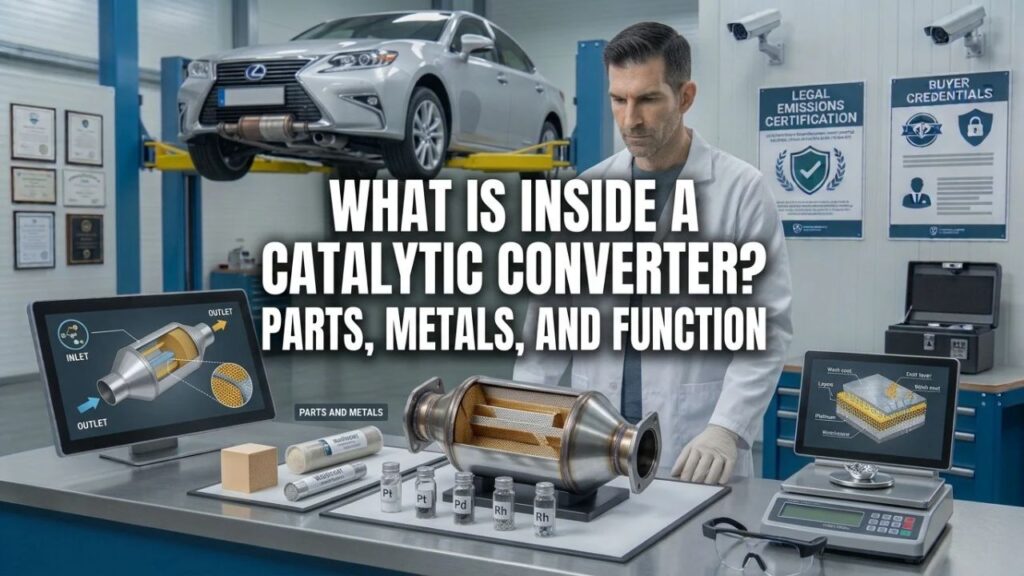
Inside a typical gasoline catalytic converter is a heat-resistant honeycomb core coated with a porous washcoat and tiny amounts of catalyst metals. The core sits inside a steel shell and is held by a cushioning mat. Exhaust flows through thousands of small passages where the coated surfaces convert carbon monoxide, hydrocarbons, and nitrogen oxides into less harmful gases.
The part looks like a simple metal can from underneath the vehicle, but most of the emissions work happens on microscopic surfaces inside the honeycomb. Damage to that structure can cause rattling, exhaust restriction, poor acceleration, catalyst codes, or failed emissions testing.
Understanding the internal layers also explains why a converter can become expensive to replace. The platinum-group metals are spread in very small particles over a large coated surface instead of existing as visible blocks or nuggets.
For U.S. vehicles, the EPA classifies catalytic converters as specified major emissions-control components. Qualifying light-duty vehicles receive federal emissions warranty coverage for the converter for 8 years or 80,000 miles, subject to the applicable warranty terms.
The direct answer to what is inside a catalytic converter is a metal housing, support mat, ceramic or metallic substrate, washcoat, and catalyst material that often contains platinum, palladium, rhodium, or a combination of those metals. Corning describes the core as a ceramic substrate with thousands of channels coated with a high-surface-area washcoat and precious-metal catalyst.
One detail is easy to misunderstand: the shiny steel housing is not the catalyst itself. The real chemical work takes place on the coated walls of the tiny passages inside the core. I’d think of the shell as protection, the honeycomb as the carrier, and the precious-metal coating as the part that drives the chemical reactions.
The sections below explain every major internal layer, what platinum, palladium, and rhodium do, why the core uses a honeycomb shape, how gasoline and diesel converters differ, what a damaged core looks like, and why failed converters can still contain recoverable metals.
What Is Inside a Catalytic Converter?
A modern converter is built as several layers working together. The exact construction changes by vehicle, emissions certification, engine type, and converter position.
| Internal Part | Common Material | Main Job |
| Outer housing | Heat-resistant steel | Protects and contains the core |
| Support mat | Heat-resistant fibrous mat | Holds and cushions the substrate |
| Substrate | Ceramic cordierite or metallic foil | Carries the catalyst coating |
| Washcoat | Porous metal oxides | Creates far more reactive surface area |
| Catalyst | Platinum, palladium, rhodium, or another catalyst system | Drives emissions-cleaning reactions |
Outer Metal Shell
The outside is generally a corrosion- and heat-resistant steel housing welded into the exhaust system.
It directs the entire exhaust stream through the internal catalyst rather than letting gas escape around it. The shell must survive road vibration, temperature cycling, water, salt, and impacts from debris.
Some converters also have an external heat shield around part of the housing. That shield reduces heat exposure to the vehicle floor and nearby components.
The metal canister itself normally contains little of the precious-metal catalyst responsible for exhaust treatment.
Support or Insulating Mat
Between the shell and ceramic core is a heat-resistant support mat.
Its job is to keep the brittle substrate firmly positioned while still accommodating vibration and thermal expansion. Corning identifies the mat as the layer that insulates the substrate and protects it against shock and vibration.
Without proper support, the ceramic brick could move inside the housing and eventually crack.
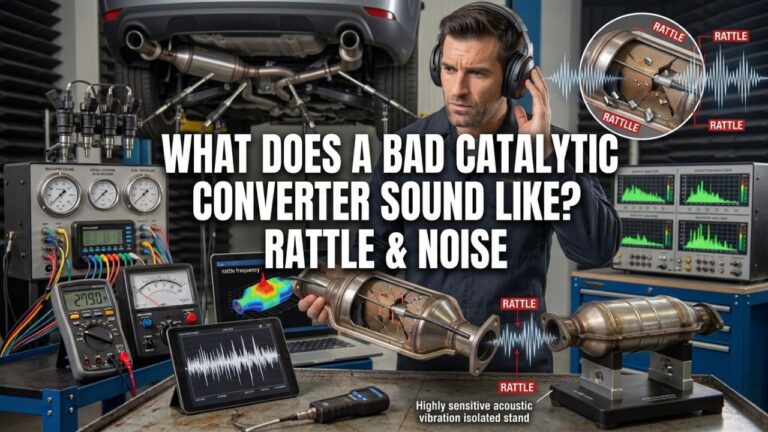
A damaged support system can contribute to the familiar loose rattling sound associated with a broken converter.
Honeycomb Substrate
The substrate is the large internal block you would see if a conventional converter were opened.
Most passenger-car designs use a ceramic material called cordierite. Corning developed synthetic cordierite for emissions-control substrates because it tolerates rapid heating and cooling with very little dimensional change.
Instead of being a solid brick, the material contains thousands of narrow parallel channels.
Exhaust enters one end, travels through those open passages, and exits the other side.
Some converter designs use thin metallic foil formed into similar channels instead of ceramic.
Washcoat
The bare ceramic alone is not enough.
Its channel walls receive a porous coating called the washcoat. Common formulations use high-surface-area metal oxides such as alumina, often combined with other materials that support oxygen storage and catalyst stability.
Corning describes the washcoat as the high-surface-area layer that carries the precious-metal coating.
The microscopic roughness of this layer gives the catalyst particles far more area to occupy than a smooth ceramic wall would provide.
Precious-Metal Catalyst
The active catalyst is dispersed across the washcoat in tiny particles.
Gasoline converters commonly use combinations of:
- Platinum (Pt)
- Palladium (Pd)
- Rhodium (Rh)
Johnson Matthey states that these metals are deposited as nanoparticles on the catalyst substrate rather than existing as large pieces of solid precious metal.
The exact mixture changes with the engine, catalyst design, emissions requirements, and market conditions.
Key Takeaway: The inside is a layered system: the shell protects it, the mat holds it, the honeycomb carries the coating, and tiny catalyst particles on the washcoat perform the exhaust reactions.
How the Parts Inside a Catalytic Converter Work Together
The converter works because exhaust gases are forced into close contact with a huge coated surface while flowing through a compact housing.
Why the Core Has a Honeycomb Shape
A large empty chamber would let exhaust pass through with little contact between the gas and catalyst.
The honeycomb divides that flow into thousands of small streams.
Each narrow channel places exhaust close to catalyst-coated walls while leaving open space for gas to pass through. Corning describes thousands of channels inside the substrate acting as the working surface for exhaust treatment.
The structure must balance two goals: expose as much coated area as possible while keeping exhaust restriction low enough for normal engine operation.
A melted or collapsed honeycomb breaks that balance and can create excessive backpressure.
Why the Washcoat Matters
The honeycomb provides the basic geometry, but the washcoat multiplies the microscopic area available for reactions.
Think of the difference between a smooth wall and a very porous surface. The porous layer provides far more places for tiny catalyst particles to sit in contact with passing exhaust.
Modern washcoat chemistry may also use cerium-based compounds to store and release oxygen. That oxygen-storage behavior supports three-way catalyst operation as the engine management system continually corrects the air-fuel mixture.
The catalyst metals are spread thinly across this coated area so a small amount can interact with a large volume of exhaust.
What Happens to the Exhaust Gases
A common gasoline three-way catalytic converter handles three major pollutants.
Carbon monoxide is oxidized into carbon dioxide.
Unburned hydrocarbons are oxidized mainly into carbon dioxide and water.
Nitrogen oxides are reduced mainly into nitrogen.
Johnson Matthey states that a three-way catalyst performs these oxidation and reduction reactions at the same time when the engine mixture is controlled near the required stoichiometric air-fuel ratio.
The catalyst speeds these reactions without being consumed in the same manner as fuel.
Key Takeaway: The honeycomb exposes exhaust to a large coated area, the washcoat carries the catalyst, and the catalyst speeds reactions that change harmful exhaust compounds into less harmful products.
What Precious Metals Are Inside a Catalytic Converter?
Platinum, palladium, and rhodium are the names most closely associated with automotive catalysts.
They belong to the platinum-group metals, or PGMs.
The U.S. Geological Survey states that the automotive industry has been the principal consumer of platinum-group metals since 1979 and identifies palladium, platinum, and rhodium as metals used in catalytic converters for automobile exhaust treatment.
Platinum
Platinum can support oxidation reactions that process carbon monoxide and hydrocarbons.
It is also used heavily in some diesel catalyst systems because catalyst chemistry differs between gasoline and diesel exhaust.
Platinum is not present as a shiny piece inside the converter. It is finely dispersed across the catalyst coating.
Its high-temperature stability and catalytic properties make a small amount useful across a very large coated area.
Palladium
Palladium is widely used for oxidation in gasoline-engine catalysts.
It promotes reactions that convert carbon monoxide and unburned hydrocarbons into carbon dioxide and water.
Modern gasoline converter formulations can use substantial palladium loading, though the exact blend differs from one converter design to another.
A converter labeled as a three-way catalyst does not automatically contain identical amounts of platinum, palladium, and rhodium.
Rhodium
Rhodium is strongly associated with the reduction side of three-way catalyst operation.
Its major role is processing nitrogen oxides and converting them mainly into nitrogen.
Johnson Matthey describes rhodium as the catalyst used for NOx reduction, while platinum and palladium support oxidation reactions.
Rhodium is used in much smaller quantities than the bulk ceramic structure surrounding it.
How Much Precious Metal Is Inside?
There is no single correct gram amount for every converter.
Metal loading changes with:
vehicle model, engine displacement, emissions standard, converter size, catalyst formulation, OEM or aftermarket construction, gasoline or diesel use, and model year.
That variation is why two converters that look almost identical from outside may have very different recycling values.
Be cautious with internet charts that assign one fixed number of grams to every catalytic converter. The vehicle-specific formulation determines the actual amount.
Key Takeaway: Platinum and palladium mainly support oxidation, rhodium handles much of the NOx reduction, and the quantity of each metal varies greatly between converter designs.
Ceramic vs Metallic Material Inside a Catalytic Converter
Most drivers picture a ceramic honeycomb when they think about the inside of a converter, but metallic substrates also exist.
Ceramic Cordierite Core
Ceramic cordierite is widely used because it handles intense thermal cycling while remaining light enough for automotive exhaust systems.
Corning describes synthetic cordierite as highly resistant to thermal shock and suitable for thin-walled honeycomb structures with thousands of parallel passages.
Its main weakness is brittleness.
A hard impact, severe overheating, or thermal damage can crack the ceramic block. Once pieces become loose, they may rattle inside the shell.
Broken pieces can also shift and partially block exhaust passages.
Metallic Foil Core
Some converters use thin metal foil folded, stacked, or wound into a channel structure.
The foil still receives a washcoat and catalyst coating, so the basic operating principle remains similar.
Metal substrates can have very thin walls and withstand certain demanding thermal or vibration conditions.
Seeing metal inside such a converter does not mean the entire core is made from platinum or another precious metal. The structural foil is separate from the thin catalyst coating.
What a Cut-Open Converter Looks Like
A typical ceramic converter opened at the end exposes a tightly packed grid of tiny square or rectangular holes.
The surface may look gray, tan, off-white, or darker after long service.
The precious metals cannot normally be identified by sight. They are distributed through the coating at microscopic scale.
You may also find more than one ceramic brick inside a single housing. MagnaFlow describes converter housings that contain multiple ceramic sections separated and held in place within the shell.
I would not cut open a serviceable converter just to inspect it. Opening the shell destroys the assembly, and broken ceramic or coating dust should not be treated as harmless material.
Key Takeaway: Ceramic cordierite is the common substrate, metallic foil is used in some designs, and neither type contains visible chunks of precious metal.
Are Oxygen Sensors Inside the Catalytic Converter?
No. Oxygen sensors are normally installed in the exhaust pipe or converter assembly before or after the catalyst, not buried inside the honeycomb.
The upstream sensor measures exhaust oxygen before the gases pass through the monitored catalyst. Its signal is heavily involved in fuel-control decisions on many gasoline engines.
The downstream sensor sits after the catalyst and provides information used to monitor catalyst operation.
On many OBD-II vehicles, the engine computer compares upstream and downstream sensor behavior when running the catalyst monitor.
This distinction matters when diagnosing P0420 or P0430. A sensor may screw directly into the converter housing, making it look like part of the converter, but the sensor tip still sits in the exhaust stream rather than inside the ceramic material.
What Is Different Inside a Diesel Catalytic Converter?
Diesel emissions systems use different chemistry because diesel exhaust normally contains far more oxygen than gasoline exhaust running near the stoichiometric air-fuel ratio.
A diesel oxidation catalyst, or DOC, commonly uses platinum and palladium to process carbon monoxide and hydrocarbons.
Johnson Matthey states that diesel oxidation catalysts use oxidation chemistry and that modern diesel systems can combine DOCs with particulate filters and selective catalytic reduction components.
A diesel particulate filter is not simply another conventional catalytic converter. Its porous structure physically captures particulate matter and periodically burns accumulated soot.
Selective catalytic reduction systems target nitrogen oxides through another catalyst system and use diesel exhaust fluid upstream of the SCR catalyst on many vehicles.
This means a modern diesel exhaust may contain several catalyst and filter sections that look like metal canisters but perform different jobs internally.
What Happens Inside a Catalytic Converter When It Fails?
A bad converter can fail chemically, physically, or through contamination.
The condition of the internal honeycomb often explains the symptoms.
The Honeycomb Cracks and Rattles
The ceramic core can crack from impact, severe heat, or loss of proper internal support.
Loose pieces may shake inside the metal shell, producing a metallic rattle.
A cracked substrate does not automatically create an immediate blockage, but fragments may shift and interfere with exhaust flow.
A loose external heat shield can make a similar noise, so a rattle needs proper diagnosis before the converter is replaced.
The Substrate Melts or Collapses
Severe overheating can distort or melt sections of the honeycomb.
When passages close, exhaust gases can no longer flow freely through the converter.
The engine may then show:
- Major loss of power under load
- Poor acceleration
- Hard starting
- Stalling
- Excess exhaust heat
- High exhaust backpressure
A persistent engine misfire or rich mixture can send unburned fuel into the converter, where it may burn and raise temperatures far beyond normal conditions.
Replacing the converter without correcting that engine fault risks damaging the new unit.
The Catalyst Becomes Contaminated
Oil, coolant, fuel-related deposits, and some chemical contaminants can coat catalyst surfaces.
The honeycomb may still look intact while the catalyst loses much of its ability to process exhaust gases.
This type of failure can produce P0420 or P0430 without a major physical clog.
The engine fault causing contamination should be corrected before a replacement converter is installed.
Key Takeaway: Cracking causes rattles, melting can block exhaust flow, and contamination can reduce catalyst activity even when the honeycomb still looks structurally intact.
Why Is the Material Inside a Catalytic Converter Worth Money?
The recycling value comes largely from the platinum-group metals in the catalyst coating.
Platinum, palladium, and rhodium are useful in many industrial processes, and used converters provide a source of recyclable material.
Johnson Matthey reports that large quantities of platinum-group metals used for automotive catalysts come back through recycling streams.
The value is not based on the weight of the entire converter.
Most of that weight comes from steel, ceramic material, tubing, flanges, and support components. The high-value metals represent only a small fraction of the total assembly.
Converter value can vary sharply because metal loading differs between part numbers.
That is why visual size alone is a poor way to judge how much platinum, palladium, or rhodium a converter contains.
Conclusion
What is inside a catalytic converter is much more than a hollow metal chamber. A typical gasoline converter contains a steel shell, heat-resistant support mat, ceramic or metallic honeycomb substrate, porous washcoat, and a catalyst formulation containing metals such as platinum, palladium, and rhodium.
The honeycomb creates thousands of exhaust passages, while the washcoat creates a huge microscopic working surface. Platinum and palladium support oxidation reactions, rhodium handles much of the nitrogen-oxide reduction, and the engine management system keeps exhaust chemistry within the range the catalyst needs.
A damaged honeycomb can crack, melt, or become restricted. Catalyst surfaces can also become contaminated even when the core still looks intact. That is why a failing converter may rattle, lose emissions performance, restrict exhaust flow, or show several symptoms at once.
My main point is to think of the converter as a coated chemical reactor rather than a container full of precious metal. The platinum-group metals exist as a very thin catalyst layer spread over an enormous internal surface.
FAQs About What’s Inside a Catalytic Converter
Is there platinum inside every catalytic converter?
Platinum is used in many converters, but not every design uses the same catalyst formula. Gasoline and diesel systems can use different combinations and loadings of platinum, palladium, and rhodium. Vehicle model, engine, emissions certification, and catalyst type determine the actual formulation.
Is the honeycomb inside a catalytic converter made of metal?
Usually not. Many passenger-car converters use a ceramic cordierite honeycomb. Some designs use a metallic foil substrate instead. In both cases, the substrate is a structural carrier that receives the washcoat and catalyst material.
Where is the rhodium inside a catalytic converter?
Rhodium is dispersed in microscopic catalyst particles across the coated substrate. It does not sit in a separate chamber or appear as a visible chunk of metal. In gasoline three-way catalysts, it is mainly associated with reactions that reduce nitrogen oxides.
Does a catalytic converter contain gold?
Gold is not one of the standard catalyst metals associated with typical automotive three-way converters. Platinum, palladium, and rhodium are the main precious metals used in conventional gasoline catalyst formulations.
Are there pellets inside a catalytic converter?
Modern automotive converters generally use monolithic honeycomb substrates rather than loose catalyst pellets. Some early converter designs used pellet-style catalyst beds, but honeycomb ceramic and metallic substrates became the dominant approach because they provide large surface area with controlled exhaust flow.
What is the white material inside a catalytic converter?
A light-colored material may be the ceramic substrate or part of the heat-resistant support mat, depending on where it appears. The ceramic honeycomb is commonly cordierite. The precious-metal catalyst is spread through a coating and normally cannot be identified as a separate shiny layer by eye.
Can the material inside a catalytic converter break apart?
Yes. A ceramic substrate can crack from overheating, physical impact, thermal stress, or internal support failure. Broken pieces may create a rattling sound and can sometimes shift enough to restrict exhaust flow.
Are catalytic converter metals solid pieces inside the shell?
No. Platinum, palladium, and rhodium are generally dispersed as tiny catalyst particles across the washcoat on the substrate walls. Cutting open the shell will normally reveal a coated honeycomb rather than nuggets, bars, or sheets of precious metal.