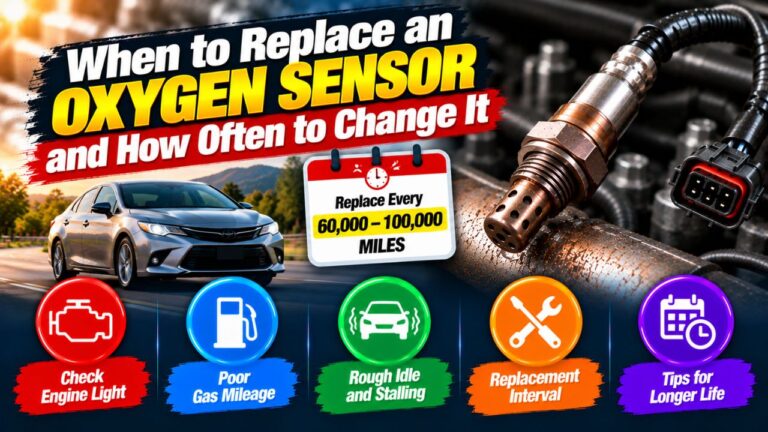
Are Oxygen Sensors Universal? Fitment, Types, and Compatibility
Oxygen sensors may look similar from one vehicle to another, which can make it seem like any sensor with the right thread size should work. In reality, compatibility depends on much more than whether the sensor physically screws into the exhaust.
No, oxygen sensors are not universally interchangeable. Some universal O2 sensors can work on multiple vehicles when correctly wired, but the sensor type, connector, wiring, heater circuit, thread size, signal characteristics, and vehicle application must all match.
If you are asking are oxygen sensors universal, it is important to distinguish between a universal oxygen sensor and a direct-fit oxygen sensor. A universal sensor is designed to cover multiple applications but may require splicing into the vehicle’s original connector. A direct-fit sensor comes with the correct connector and wiring arrangement for a specific vehicle or group of vehicles.
Using the wrong sensor can cause a check engine light, incorrect fuel-trim readings, poor drivability, increased emissions, or a sensor-heater fault. This guide explains the different O2 sensor types, why they are not all interchangeable, and how to choose the correct replacement.
Are Oxygen Sensors Universal?
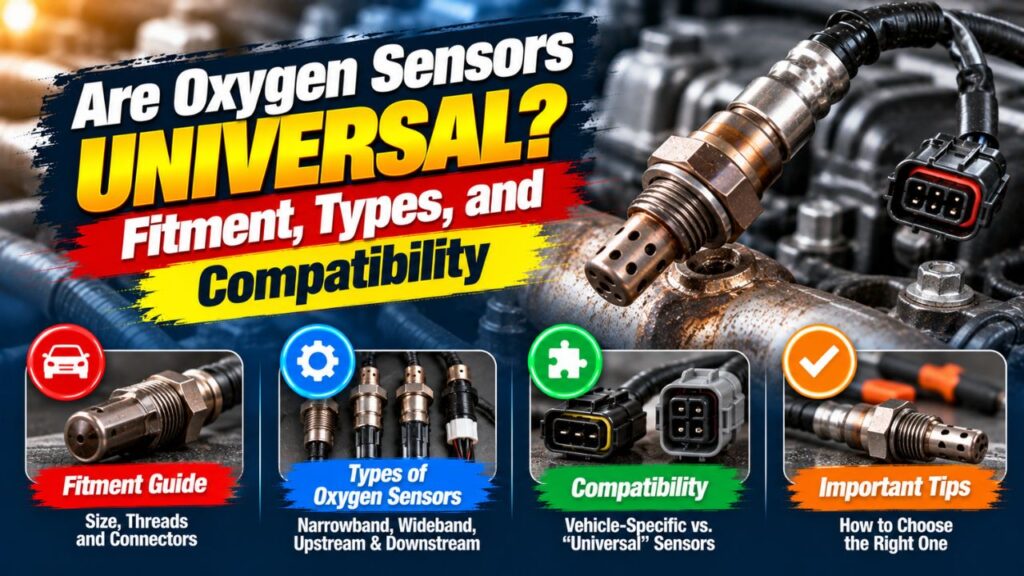
No. Are oxygen sensors universal? Not in the sense that one oxygen sensor will work correctly on every vehicle.
Oxygen sensors differ in several important ways, including electrical design, number of wires, heater resistance, connector shape, response characteristics, and whether the sensor is a conventional narrowband type or a wideband air-fuel ratio sensor.
Some aftermarket manufacturers sell universal sensors that can be adapted to multiple vehicles, but even those sensors must match the correct sensor technology and electrical requirements.
A universal sensor is therefore not a “one sensor fits every car” part.
What Does an Oxygen Sensor Do?
An oxygen sensor, often called an O2 sensor, measures oxygen content in the exhaust.
The engine control module uses that information to help manage the air-fuel mixture.
On most modern gasoline vehicles, oxygen sensors help the engine computer determine whether combustion is relatively rich or lean.
They also help monitor catalytic converter performance.
A vehicle may have multiple oxygen sensors located before and after the catalytic converter.
Upstream vs. Downstream Oxygen Sensors
Oxygen sensors are commonly divided into upstream and downstream positions.
Upstream Oxygen Sensor
The upstream sensor is usually located before the catalytic converter.
It is sometimes called:
- Sensor 1
- Pre-cat sensor
- Front O2 sensor
Its main job is to provide feedback for fuel control.
Because the engine computer relies heavily on this sensor, using the correct sensor type is especially important.
Downstream Oxygen Sensor
The downstream sensor is usually located after the catalytic converter.
It may be called:
- Sensor 2
- Post-cat sensor
- Rear O2 sensor
Its primary role is generally to monitor catalytic converter performance.
The upstream and downstream sensors on the same vehicle are not necessarily interchangeable.
Even if they have similar threads, their electrical characteristics or connectors may differ.
What Is a Universal Oxygen Sensor?
A universal oxygen sensor is an aftermarket sensor designed to work with more than one vehicle application.
Instead of including a vehicle-specific electrical connector, a universal sensor commonly comes with bare wires or a generic connection system.
The installer reuses or transfers the original connector.
This can reduce part cost and allow one sensor design to cover many applications.
However, the universal sensor must still match the correct:
- Sensor technology
- Number of wires
- Heater design
- Signal type
- Ground arrangement
- Vehicle requirements
It is universal only within a certain compatible group of applications.
What Is a Direct-Fit Oxygen Sensor?
A direct-fit oxygen sensor is designed to plug into the vehicle’s existing wiring harness without splicing.
It typically includes:
- Correct connector
- Correct wire length
- Correct sensor body
- Correct thread
- Correct electrical calibration for the application
For most DIY repairs, a direct-fit sensor is simpler and reduces the possibility of wiring errors.
It is often the better choice when the price difference is reasonable.
Universal vs. Direct-Fit Oxygen Sensor
The main difference is installation and application specificity.
| Feature | Universal O2 Sensor | Direct-Fit O2 Sensor |
| Vehicle connector included | Usually no | Yes |
| Splicing required | Often yes | Usually no |
| Fits multiple applications | Yes, within limits | Application-specific |
| Installation difficulty | Higher | Lower |
| Wiring mistake risk | Higher | Lower |
| Typical DIY convenience | Moderate | High |
Both can work correctly when properly matched.
The problem begins when a universal sensor is chosen only because the thread size appears correct.
Are All O2 Sensors the Same Thread Size?
No.
Many oxygen sensors use common metric thread sizes, but not every sensor is identical.
Even when two sensors have the same thread, that does not mean they are electrically compatible.
Thread size only determines whether the sensor can physically screw into the bung.
It does not tell you whether the engine computer can correctly interpret its signal.
Does the Number of Wires Matter?
Yes.
Oxygen sensors may have different numbers of wires depending on their design.
Older sensors may use only one wire, while newer heated sensors may use three or four wires. Wideband sensors may use five or more.
The wires can serve different functions, including:
- Signal
- Signal ground
- Heater power
- Heater ground
- Pump-current control on wideband designs
You should not assume that two sensors with the same wire count are interchangeable.
Wire color and circuit arrangement can also vary between manufacturers.
One-Wire Oxygen Sensors
Older one-wire sensors generally use the sensor body and exhaust system as part of the electrical ground path.
They usually do not contain an electric heater.
Because they rely on exhaust heat to reach operating temperature, they can take longer to become active after a cold start.
These sensors are much less common on newer vehicles.
Three- and Four-Wire Oxygen Sensors
Three- and four-wire sensors typically include an internal heater.
The heater allows the sensor to reach operating temperature more quickly.
This helps improve fuel control and emissions performance soon after startup.
A four-wire sensor often uses separate wires for:
- Signal
- Signal ground
- Heater power
- Heater ground
However, actual wiring must always be confirmed for the specific sensor and vehicle.
Wideband Oxygen Sensors Are Different
A wideband oxygen sensor, also called an air-fuel ratio sensor on many vehicles, works differently from a traditional narrowband sensor.
A conventional narrowband O2 sensor primarily indicates whether the mixture is richer or leaner than the stoichiometric point.
A wideband sensor can provide much more precise information across a broader range of air-fuel ratios.
Wideband sensors often use additional internal elements and more complicated control circuits.
You cannot normally replace a wideband sensor with a traditional narrowband sensor simply because the threads match.
Narrowband vs. Wideband O2 Sensors
These sensor types are not interchangeable.
Narrowband Sensor
A conventional zirconia narrowband sensor produces a voltage signal that changes rapidly around the stoichiometric air-fuel ratio.
It is commonly used for closed-loop fuel control on many older and some current vehicle applications.
Wideband Sensor
A wideband sensor uses a more complex measurement system to provide the engine computer with a more precise indication of mixture strength.
It typically works with a dedicated control circuit in the ECU.
Installing the wrong sensor technology can cause incorrect readings and diagnostic trouble codes.
Are Upstream and Downstream O2 Sensors Universal?
Not necessarily.
Some vehicles may use the same basic sensor in both locations, but many do not.
Differences can include:
- Connector
- Wire length
- Heater characteristics
- Sensor technology
- Calibration
- Body design
Always confirm the specific Bank and Sensor position when ordering.
What Do Bank 1 and Bank 2 Mean?
On engines with two cylinder banks, oxygen sensors are often identified using Bank 1 and Bank 2.
Bank 1 is the side of the engine containing cylinder number 1.
Bank 2 is the opposite cylinder bank.
A V6 or V8 may therefore use names such as:
- Bank 1 Sensor 1
- Bank 1 Sensor 2
- Bank 2 Sensor 1
- Bank 2 Sensor 2
Do not assume “driver side” or “passenger side” identifies Bank 1 on every vehicle.
Cylinder numbering varies by manufacturer.
Can You Use a Bank 1 Sensor on Bank 2?
Sometimes the part number is identical for both banks, and sometimes it is not.
The sensor itself may be electrically the same but use a different wire length or connector routing.
Always check the part catalog for the exact position.
If both sides share the same part number, they may be interchangeable.
If the manufacturer lists different part numbers, use the correct one.
Can You Use a Front O2 Sensor in the Rear?
Not unless the manufacturer specifies that they are the same part.
An upstream sensor may be designed for fast fuel-control response, while a downstream sensor may have different characteristics or wiring.
Even if the sensor physically fits, it can still cause faults.
Check the specific application rather than relying on appearance.
Are Oxygen Sensor Connectors Universal?
No.
Connector shapes vary between:
- Vehicle manufacturers
- Engine families
- Model years
- Sensor positions
- O2 sensor manufacturers
A direct-fit sensor should have the exact connector required for the vehicle.
A universal sensor generally avoids this problem by reusing the original connector through an approved connection method.
Can You Splice Oxygen Sensor Wires?
Universal sensors are often designed to be connected to the original wiring, but the splice method matters.
O2 sensor wiring operates in a harsh environment with:
- Heat
- Moisture
- Road salt
- Vibration
The connection must remain electrically reliable and weather-resistant.
Use the connection method supplied by the sensor manufacturer.
Avoid guessing wire functions based only on color because color codes can differ.
Should You Solder O2 Sensor Wires?
This depends on the sensor manufacturer and application.
Some universal-sensor manufacturers specify crimp-style connectors rather than soldering.
Certain oxygen sensor circuits can be sensitive to wiring resistance and contamination.
Some sensor designs also rely on reference air entering through parts of the wiring assembly, making improper sealing potentially problematic.
Follow the replacement sensor manufacturer’s installation instructions instead of using a generic wiring method.
Do Oxygen Sensors Need a Heater?
Many modern oxygen sensors do.
The internal heater allows the sensor to reach operating temperature quickly.
The engine computer monitors the heater circuit on many vehicles.
A sensor with an incorrect heater resistance or wiring arrangement may trigger codes such as heater-circuit faults even if the sensing element itself can produce a signal.
This is another reason physical fit does not guarantee compatibility.
Are OEM and Aftermarket O2 Sensors Interchangeable?
An aftermarket sensor can work correctly when it is designed and cataloged for the specific application.
The important factor is not simply whether the sensor is OEM or aftermarket.
It must match the vehicle’s requirements.
Some vehicle owners prefer the original-equipment sensor manufacturer because oxygen sensors can be sensitive to differences in response and heater characteristics.
For difficult diagnostic cases, using a sensor from the original supplier or a high-quality application-specific aftermarket manufacturer can reduce uncertainty.
Can the Wrong Oxygen Sensor Cause a Check Engine Light?
Yes.
An incompatible sensor may trigger codes related to:
- O2 sensor performance
- Heater circuit
- Slow response
- Fuel mixture
- Air-fuel ratio sensor performance
The engine computer expects the sensor to behave within a specific range.
If the signal or heater behavior does not match expectations, a code can be stored.
Can the Wrong O2 Sensor Affect Fuel Economy?
Yes.
The upstream oxygen sensor plays an important role in fuel control.
If the sensor provides inaccurate information, the engine computer may adjust fueling incorrectly.
Possible results include:
- Rich operation
- Lean operation
- Reduced fuel economy
- Poor drivability
- Increased emissions
However, poor fuel economy can have many other causes, so the O2 sensor should be properly diagnosed before replacement.
Can a Wrong Oxygen Sensor Cause Rough Idle?
It can, especially if an upstream sensor provides incorrect mixture information.
The engine may respond by adjusting fuel delivery.
However, rough idle is more commonly associated with problems such as:
- Vacuum leaks
- Ignition misfires
- Dirty injectors
- Intake issues
- PCV faults
Do not replace an oxygen sensor based on rough idle alone.
How to Choose the Correct Oxygen Sensor
The safest method is to select the sensor by exact vehicle application.
You should know the:
- Year
- Make
- Model
- Engine
- Sensor position
Also verify whether the vehicle requires a:
- Narrowband sensor
- Wideband air-fuel ratio sensor
- Heated sensor
- Specific connector design
When possible, compare the replacement part number with the original sensor application.
Check the Original Sensor Part Number
If the original oxygen sensor is still installed, its part number can be useful.
However, the number may be difficult to read because of:
- Heat
- Rust
- Dirt
- Age
Vehicle identification and a reliable parts catalog are usually easier than relying entirely on markings from an old sensor.
Should You Buy a Universal Oxygen Sensor?
A universal sensor can be a reasonable option when:
- It is explicitly listed as compatible with your vehicle.
- You are comfortable making electrical connections correctly.
- The sensor manufacturer provides clear wiring instructions.
For most DIY owners, a direct-fit sensor is easier and less likely to create installation errors.
The savings from a universal sensor may not be worthwhile if improper wiring leads to repeated trouble codes or additional diagnostic work.
Are Cheap Universal O2 Sensors Worth It?
Price alone should not determine your choice.
An oxygen sensor needs to work accurately in a high-temperature environment for a long time.
A low-quality sensor may produce:
- Slow response
- Heater problems
- Incorrect readings
- Short service life
Choosing a reputable, application-correct sensor is more important than simply buying the cheapest one that fits the exhaust threads.
How Long Do Oxygen Sensors Last?
There is no single lifespan for every O2 sensor.
Service life depends on:
- Sensor design
- Vehicle
- Engine condition
- Fuel quality
- Oil consumption
- Coolant contamination
- Operating temperature
A sensor can fail early if it becomes contaminated by oil, coolant, silicone, or excessive fuel.
Follow the vehicle manufacturer’s maintenance recommendations rather than replacing sensors only based on a universal mileage estimate.
What Damages Oxygen Sensors?
Several conditions can shorten O2 sensor life.
Oil burning can coat the sensing element with deposits.
Coolant entering the combustion chamber can contaminate the sensor.
A rich-running engine can create heavy carbon deposits.
Certain sealants and chemicals containing sensor-damaging compounds can also create problems.
Replacing a contaminated sensor without fixing the underlying engine problem may cause the new sensor to fail again.
Can You Clean an Oxygen Sensor?
Cleaning is generally not considered a reliable repair for a failed oxygen sensor.
The sensing element is designed to operate at very high temperatures, and contamination can become embedded or chemically damage the sensor.
Using cleaners, wire brushes, or solvents can damage the sensing element.
If testing confirms the sensor has failed, replacement is usually the appropriate repair.
Should You Replace All O2 Sensors at Once?
Not necessarily.
If one sensor fails, the others do not automatically require replacement.
However, if several sensors are the same age and have very high mileage, preventive replacement may make sense in some cases.
Diagnosis is still preferable to replacing multiple expensive sensors unnecessarily.
Common Mistakes When Replacing an Oxygen Sensor
One common mistake is ordering by appearance instead of exact application. Sensors that look nearly identical can operate differently.
Another mistake is confusing Bank 1 with Bank 2 or Sensor 1 with Sensor 2.
DIY installers also sometimes damage wiring by allowing it to touch hot exhaust components after installation.
Overtightening can damage threads, while leaving a sensor loose can cause an exhaust leak.
Some replacement sensors come with appropriate thread treatment already applied. Follow the sensor manufacturer’s installation instructions rather than applying additional compounds automatically.
FAQs About Are Oxygen Sensors Universal
Are universal oxygen sensors really universal?
No.
Universal sensors are designed to cover multiple compatible applications, but they still need to match the required sensor type, wiring, heater circuit, and electrical characteristics.
Can any 4-wire O2 sensor replace another 4-wire sensor?
No.
The same wire count does not guarantee compatibility. Signal characteristics, heater resistance, wiring functions, and connector requirements can differ.
Are all oxygen sensors the same size?
No.
Thread dimensions, sensor body shape, wiring length, and connectors can vary.
Even sensors with identical thread sizes may not be electrically interchangeable.
Can you use a universal O2 sensor instead of a direct-fit sensor?
Yes, if the universal sensor is specifically compatible with your vehicle and is wired according to the manufacturer’s instructions.
A direct-fit sensor is usually easier to install.
Are upstream and downstream O2 sensors the same?
Sometimes, but often they are different.
Check the vehicle’s parts listing for the exact Bank and Sensor position before ordering.
Are Bank 1 and Bank 2 oxygen sensors interchangeable?
They may be if both positions use the exact same part number.
If different parts are listed, they should not be assumed interchangeable.
Can the wrong oxygen sensor damage the engine?
The wrong sensor may cause incorrect fuel control, poor performance, or diagnostic trouble codes. Severe long-term mixture problems could contribute to other issues, but the more immediate problem is usually incorrect engine management and emissions performance.
How do I know which oxygen sensor fits my car?
Match the sensor to the exact year, make, model, engine, and sensor position. Confirm whether it is upstream or downstream and whether the vehicle uses a conventional O2 sensor or wideband air-fuel ratio sensor.
Conclusion
The final verdict on are oxygen sensors universal is no. Oxygen sensors may share similar threads and physical shapes, but compatibility depends on the sensor technology, electrical signal, heater circuit, wiring, connector, and exact position in the exhaust system.
A universal oxygen sensor can work across several vehicles, but only within the applications it was designed to support, and it usually requires correct wiring to the original connector. A direct-fit sensor is generally the simpler choice because it already matches the vehicle’s connector, wire length, and specified application.
The most important rule is to choose an O2 sensor by the exact year, make, model, engine, and Bank/Sensor position rather than by appearance or wire count alone. Matching the correct sensor prevents unnecessary check engine lights, inaccurate fuel control, and repeat repairs.