Can You Use Brake Cleaner on a Throttle Body? Risks and Fixes
No, you shouldn’t use brake cleaner on a throttle body. Although brake cleaner can dissolve grease, oil, and carbon deposits, its strong solvents may damage protective coatings, rubber seals, and sensitive electronic components. A dedicated throttle body cleaner is the safer choice because it’s formulated for cleaning throttle plates and intake passages.
It’s easy to understand why drivers consider using brake cleaner. You might already have a can in your garage, and both products remove stubborn grime. They even come in similar aerosol cans.
The problem is that a throttle body isn’t just another dirty metal part. Many modern vehicles have electronic throttle motors, position sensors, special surface coatings, and seals that require careful handling.
Using an unsuitable solvent may lead to rough idling, air leaks, sticking, or expensive repairs. Not every brief exposure causes damage, but the risk isn’t worth taking when a suitable cleaner is available.
This guide explains why brake cleaner is a poor choice, what to use instead, how to clean a throttle body correctly, and what to do if you’ve already sprayed brake cleaner inside it.
Can You Use Brake Cleaner on a Throttle Body?
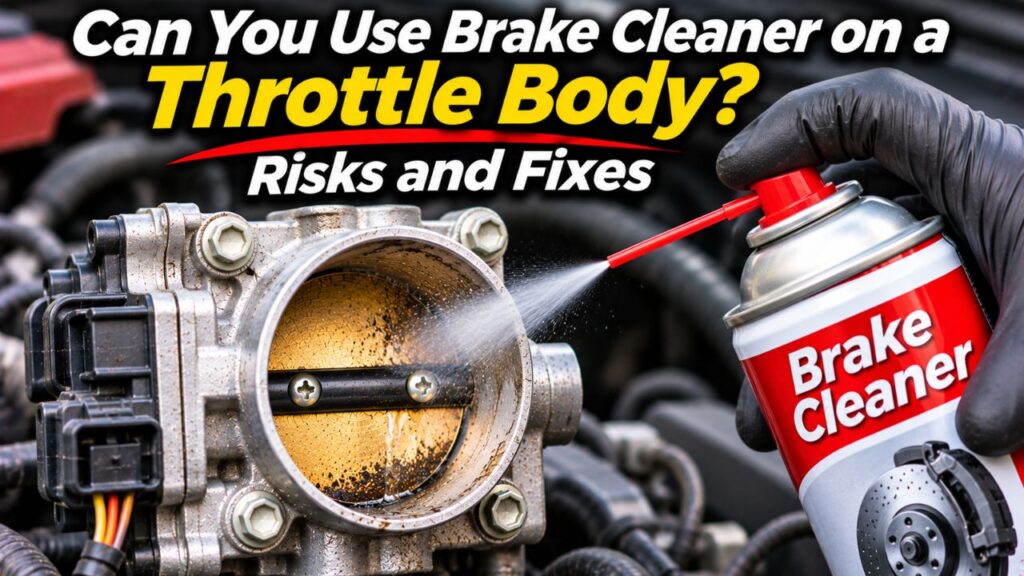
Brake cleaner may remove deposits from a throttle body, but it isn’t recommended for this job. Its solvent formulation can be incompatible with throttle body coatings, seals, plastics, and electronic components. Use a cleaner specifically approved for throttle bodies and follow the vehicle manufacturer’s cleaning instructions.
Why Brake Cleaner Seems Like a Good Option
Brake cleaner is designed to remove grease, oil, brake dust, and other contaminants from brake components.
It usually dries quickly and leaves little or no residue.
That makes it tempting to use on other automotive parts.
For example, a driver removing a dirty throttle body might notice thick black deposits around the throttle plate. A can of brake cleaner appears capable of dissolving that buildup.
It probably can remove some of the grime.
But cleaning power and material compatibility aren’t the same thing.
A solvent can remove deposits while also affecting a surface coating or nearby rubber component.
Are All Brake Cleaners Equally Risky?
No. Brake cleaner formulations vary.
The two broad categories are:
- Chlorinated brake cleaner: Contains chlorinated solvents and requires strict attention to chemical exposure warnings.
- Non-chlorinated brake cleaner: Often uses solvents such as acetone or other hydrocarbons and is commonly highly flammable.
Neither category should automatically be considered safe for throttle body cleaning.
The manufacturer’s brake cleaner compatibility guidance specifically advises against using brake cleaner on throttle bodies because it may damage coatings and sensitive components.
Why Can Brake Cleaner Damage a Throttle Body?
Brake cleaner can damage a throttle body because its solvents may react with protective coatings, certain plastics, seals, and electronic components. The risk depends on the cleaner’s chemical formula, the throttle body’s construction, and how the product is applied. Direct spraying can also carry solvent into areas that are difficult to clean or inspect.
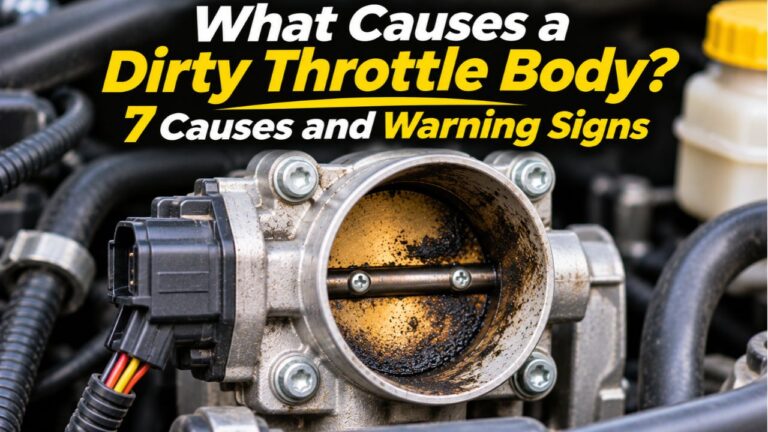
1. Damage to Protective Throttle Body Coatings
Some throttle bodies have factory-applied surface coatings.
These coatings may help control airflow near the throttle plate or protect specific surfaces.
An aggressive solvent can affect certain coatings, changing the condition of the throttle bore.
For example, a coated throttle body may look like ordinary bare aluminum. Scrubbing away a dark-looking layer could remove material that the manufacturer intended to remain.
That’s why making every surface shiny isn’t always the goal.
2. Damage to Rubber Seals and Plastic Parts
Throttle bodies may contain seals, gaskets, plastic covers, and other materials that aren’t compatible with every cleaning solvent.
Some brake cleaner formulations can cause certain plastics or elastomers to swell, soften, or deteriorate.
An elastomer is a flexible material commonly used in seals and gaskets.
If a seal becomes damaged, unwanted air may enter the engine through a leak.
That can cause rough idling or incorrect fuel mixture control.
The damage may not appear immediately after cleaning.
3. Problems With Electronic Throttle Components
Most modern gasoline vehicles use electronic throttle control.
An electric motor moves the throttle plate, while position sensors report its movement to the engine computer.
These components may sit inside or alongside the throttle body housing.
Spraying an unsuitable cleaner around the throttle shaft or electrical housing can allow liquid to reach sensitive areas.
That can lead to contamination or electrical problems.
For example, a throttle body may look clean after spraying, yet an affected position sensor could later produce abnormal readings.
Never soak an electronic throttle body in cleaning solvent.
4. Fire and Chemical Exposure Risks
Many brake cleaners and throttle body cleaners contain volatile solvents.
Some are highly flammable, and aerosol vapors can create hazards near sparks, hot components, and open flames.
Chlorinated brake cleaner also has serious chemical safety concerns, particularly around welding or intense heat.
Use cleaning products only as directed, in a well-ventilated area, with suitable eye and hand protection.
Don’t mix cleaners or spray them into a running engine unless a specific approved service procedure calls for it.
Brake Cleaner vs. Throttle Body Cleaner: What’s the Difference?
Brake cleaner and throttle body cleaner both remove contaminants, but they’re formulated for different automotive components. Brake cleaner targets oil and brake-system grime, while throttle body cleaner targets carbon, varnish, and deposits inside air-intake passages. A suitable throttle body product is the better choice for protecting compatible coatings and components.
| Feature | Brake Cleaner | Throttle Body Cleaner |
| Intended application | Brake components | Throttle plates and intake passages |
| Removes oil and grease | Yes | Often |
| Removes throttle deposits | May remove them | Formulated for the job |
| Coating compatibility | Not generally recommended | Depends on product approval |
| Rubber and seal compatibility | May cause damage | Depends on formulation |
| Electronic throttle use | Not recommended | Use only if approved |
| Best choice for throttle cleaning | No | Yes, when compatible |
Why the Correct Cleaner Matters
A purpose-made cleaner is designed around the type of deposits and materials normally found in its intended application.
A throttle body often develops a mixture of oily residue, dust, and carbon-containing deposits around the throttle plate.
A compatible cleaner helps loosen these deposits without requiring aggressive scraping.
Think of it like cleaning eyeglasses. A strong household solvent may remove fingerprints, but that doesn’t make it suitable for coated lenses.
The same principle applies here.
Even products labeled for throttle bodies have different directions and restrictions. Always check the label against your vehicle’s service instructions.
What Should You Use Instead of Brake Cleaner?
Use a dedicated throttle body and air-intake cleaner that is approved for your vehicle’s throttle system. The product should be compatible with the throttle body’s coatings and materials. A soft, lint-free cloth can help remove loosened deposits without scratching the plate or bore.
The Best Cleaner for Most Throttle Bodies
Choose a product specifically labeled for throttle body cleaning.
Look for wording such as:
- Throttle Body Cleaner
- Throttle Body and Air-Intake Cleaner
- Electronic Throttle Body Compatible
Don’t assume every product in these categories suits every vehicle.
If your service manual specifies a particular cleaning product, follow that recommendation.
For example, a modern electronic throttle body may require a specific solvent applied to a cloth rather than sprayed directly into the assembly.
The factory throttle body cleaning procedure for one electronic system instructs technicians to apply cleaner to a cloth, keep it out of the sensor area, and preserve the factory coating.
Can You Use Carburetor Cleaner Instead?
Carburetor cleaner isn’t automatically a safe replacement either.
Some carburetor cleaning products contain aggressive solvents that may affect throttle body coatings, seals, or other materials.
If the cleaner’s manufacturer explicitly approves throttle body use and the vehicle manufacturer permits it, the product may be suitable.
Otherwise, choose a dedicated throttle body cleaner.
Also, don’t confuse throttle body cleaner with mass airflow sensor cleaner. A mass airflow (MAF) sensor measures incoming air and may require its own specifically approved cleaning product.
How to Clean a Throttle Body Without Damaging It
The safest cleaning method is to follow your vehicle’s service procedure, use an approved throttle body cleaner, and avoid forcing the throttle plate. Many vehicles allow cleaning after removing the air intake duct, while others require throttle body removal, electronic disconnection, or a scan-tool relearn.
Step 1: Park Safely and Turn Off the Engine
Park on level ground and set the parking brake.
Switch off the engine and follow the manufacturer’s shutdown instructions.
Allow hot components to cool before handling them.
Wear protective gloves and safety glasses, and work in a well-ventilated area away from ignition sources.
Step 2: Locate the Throttle Body
Find the air intake tube running from the air filter housing toward the engine.
The throttle body is typically mounted where that tube connects to the intake manifold.
It contains a round throttle plate inside a circular opening.
Many modern units also have an electrical connector attached to the housing.
Step 3: Remove the Air Intake Duct if Permitted
Follow the vehicle’s service procedure to access the throttle opening.
Some designs require loosening a hose clamp and moving the intake tube.
Other designs require additional disassembly.
Check for attached hoses and electrical connections before moving anything.
Don’t pull on wires or force plastic fittings.
Step 4: Inspect the Throttle Plate
Look for carbon deposits and oily residue around the plate’s edges.
A dark ring near the closed plate can indicate buildup.
But don’t assume every dark area needs to be scrubbed away.
Some throttle bodies have factory coatings that must remain intact.
Heads Up: An electronic throttle plate can move unexpectedly when its control system is powered. Never place your fingers inside the opening unless the vehicle’s procedure makes it safe.
Step 5: Apply the Approved Cleaner
Use the application method specified for your vehicle.
For systems that permit cloth cleaning:
- Apply a small amount of approved cleaner to a clean, lint-free cloth.
- Gently wipe accessible deposits from the throttle bore.
- Clean only the surfaces allowed by the service procedure.
- Keep solvent away from electrical housings and sensor openings.
- Use a fresh section of cloth to remove loosened residue.
Don’t force the throttle plate open or adjust its factory stop screw.
Some vehicles require the throttle body to be removed before cleaning.
The proper throttle-body cleaning instructions provide further guidance on suitable cleaners, gentle cleaning tools, and safe intake duct removal.
Step 6: Reassemble the Intake System
Allow the cleaner to evaporate or dry as directed.
Make sure no cleaning cloth, brush, or loose item remains inside the intake opening.
Reinstall the air intake duct and reconnect any components removed during the procedure.
Check that the hose clamps are secure and the duct is properly seated.
An air leak after cleaning can cause rough idle, even when the throttle body itself is working normally.
Step 7: Perform Any Required Relearn
Some vehicles require an idle or throttle position relearn after cleaning.
A throttle relearn allows the engine control system to adapt to the throttle body’s operating position or airflow characteristics.
The exact process varies.
Some vehicles adjust automatically under specified conditions. Others require a diagnostic scan tool.
Don’t assume disconnecting the battery is a universal reset method.
What if You Already Sprayed Brake Cleaner on Your Throttle Body?
If you’ve already used brake cleaner on a throttle body, stop applying it and inspect the assembly before continuing. A small amount doesn’t guarantee damage, but the risk depends on the product formula and where the solvent reached. Don’t assume that a clean-looking throttle body is automatically unharmed.
If the Engine Hasn’t Been Started Yet
Leave the ignition off and avoid further spraying.
Check the brake cleaner label for drying, ventilation, and handling instructions.
If liquid has pooled around an electronic housing or entered an inaccessible area, don’t attempt to flush it with another cleaner.
Have the assembly inspected if you suspect solvent entered electrical components.
Don’t restart the engine while flammable solvent remains present.
If You’ve Already Started the Engine
Pay attention to changes in operation.
Possible warning signs include rough idle, hesitation, stalling, abnormal engine speed, and electronic throttle warnings.
These symptoms don’t prove chemical damage. An intake hose left loose during cleaning can create similar problems.
If the engine runs abnormally, shut it off and check the installation before driving.
Don’t repeatedly restart the engine to try to clear a serious fault.
Does One Spray Mean the Throttle Body Is Ruined?
No.
A brief exposure may leave no lasting damage, depending on the solvent and the components it contacted.
For example, a small amount reaching a compatible exposed metal surface may have little effect.
But extensive soaking or contact with sensitive coatings and seals creates more uncertainty.
The right move is to inspect the affected parts rather than replace the assembly on a hunch.
How Can You Tell if Throttle Body Cleaning Worked?
Throttle body cleaning has worked when deposits were the cause of the problem and the engine returns to stable, normal operation. Smooth idling, predictable acceleration, and the absence of related faults are useful signs. Cleaning won’t fix damaged sensors, faulty actuators, or unrelated ignition and fuel problems.
Signs of Improvement
You may notice:
- Smoother engine idle
- Less hesitation when accelerating
- Fewer stalls when stopping
- More consistent engine RPM
- Normal throttle response
For example, an engine that previously stumbled at stoplights may idle smoothly after deposits are removed and the required relearn is completed.
That’s a useful result, but it doesn’t mean every driving problem came from the throttle body.
What if the Engine Still Runs Roughly?
Check for loose intake connections and damaged hoses.
If the engine computer stored fault codes, read them before clearing anything.
Throttle actuator problems may produce codes such as P2101, P2111, or P2112, depending on the fault.
A dirty MAF sensor, vacuum leak, worn spark plug, or ignition coil problem can also cause rough running.
If cleaning doesn’t solve the issue, further diagnosis beats repeating the same procedure.
Common Throttle Body Cleaning Mistakes to Avoid
Throttle body cleaning can cause problems when you use the wrong solvent, force the plate, remove factory coatings, or allow liquid into sensitive electrical components. Improper reassembly may also create intake air leaks. A careful procedure reduces the chance of turning a minor cleaning job into a larger repair.
Avoid these mistakes:
- Using brake cleaner simply because it’s already available
- Spraying excessive cleaner into the intake
- Forcing an electronic throttle plate open
- Scraping the bore with sharp metal tools
- Removing a factory-applied coating
- Spraying cleaner directly onto electrical connectors
- Forgetting to reinstall or tighten intake hoses
- Skipping a required throttle relearn
- Starting the engine before solvent has safely evaporated
A common mistake is trying to make the throttle bore look completely bare and polished.
The better goal is to remove unwanted deposits while leaving the intended surfaces undamaged.
Don’t cut corners with an electronic throttle assembly. If the procedure requires specialized equipment or removal of electrical components, professional cleaning may be the safer option.
Frequently Asked Questions
Brake cleaner is not the preferred product for throttle body cleaning because solvent compatibility and electronic components matter. A cleaner formulated for the correct throttle system is a safer choice. These common questions cover alternative cleaners, accidental exposure, electronic throttle bodies, and what to expect after cleaning.
Can Brake Cleaner Damage an Electronic Throttle Body?
Yes. Brake cleaner may affect protective coatings, seals, plastics, or sensitive electronic components in an electronic throttle body. The actual risk depends on the chemical formulation and where it contacts the assembly. Use a cleaner specifically approved for the vehicle and follow its service procedure.
Can You Spray Brake Cleaner Directly Into the Throttle Body?
You shouldn’t spray brake cleaner directly into a throttle body. Direct spraying increases the chance that solvent will reach seals, coatings, or electrical components. Some vehicle manufacturers also prohibit direct spraying even with approved throttle cleaners. Applying the specified product to a cloth may be the required method.
Is Non-Chlorinated Brake Cleaner Safe for Throttle Bodies?
Not automatically. Non-chlorinated brake cleaners can contain strong solvents that affect certain plastics, rubber parts, and surface coatings. Many formulations are also highly flammable. The absence of chlorinated solvents doesn’t make a product suitable for electronic throttle assemblies. Follow the cleaner’s approved applications and the vehicle’s cleaning instructions.
Can You Use WD-40 to Clean a Throttle Body?
A standard multipurpose lubricant isn’t the right choice for throttle body cleaning. It can leave a film and isn’t designed to remove deposits from sensitive throttle surfaces. Some companies sell separate, dedicated throttle cleaning products. Choose a cleaner approved for the application rather than relying on a familiar brand name.
Can Brake Cleaner Cause Rough Idle After Cleaning?
Yes, improper cleaning or damage to sensitive throttle components can contribute to rough idle. A loose intake hose, disturbed connector, or missing throttle relearn may also explain the symptom. If the engine starts running poorly after cleaning, inspect the intake connections and check diagnostic trouble codes before replacing the throttle body.
Do You Need to Remove the Throttle Body Before Cleaning?
Not always. Some vehicles permit cleaning with the throttle body installed after removing the intake duct. Others require removing the assembly to protect electronics or access the correct surfaces. Follow the factory procedure for your exact engine. Don’t assume a method that works on an older cable-operated throttle is suitable for an electronic one.
Choose the Right Cleaner and Protect Your Throttle Body
Brake cleaner might remove grime from a throttle body, but that doesn’t make it a suitable cleaning product. Its solvents can affect certain coatings, seals, and electronic components, creating risks that a dedicated cleaner is designed to reduce.
For most gasoline engines, the better choice is a throttle body cleaner approved for the specific assembly. Follow the manufacturer’s application method, use gentle cleaning materials, and avoid forcing the throttle plate.
If you’ve already sprayed brake cleaner, don’t assume the assembly is ruined. Stop applying solvent, allow safe drying, and check for signs of damage or abnormal operation.
Remember that cleaning won’t repair a failed throttle actuator, damaged sensor, or electrical problem.
Your next step is to check your vehicle’s throttle body cleaning instructions and choose a compatible product before starting the job. A little care now can prevent an unnecessary replacement later.