How to Check a Throttle Body: 7 Checks Before You Replace It
To check a throttle body, inspect it for carbon buildup, damaged wiring, air leaks, and signs of a sticking throttle plate. Then use an OBD-II scanner to look for trouble codes and check throttle position readings. If you suspect an electrical problem, further testing can help determine whether the throttle body needs cleaning or replacement.
A faulty throttle body can cause rough idling, hesitation, stalling, poor acceleration, or reduced engine power. These problems often feel like fuel delivery or ignition faults, which makes diagnosis tricky. Sometimes a layer of carbon around the throttle plate causes trouble. Other times, a damaged sensor or electrical connection prevents the throttle from responding correctly.
The testing method depends on your vehicle. Older cars may use a mechanical throttle cable, while most modern gasoline vehicles have an electronically controlled throttle body. Electronic systems require extra care because forcing the throttle plate can damage its internal motor or gears.
This guide walks you through seven practical checks, explains what different test results mean, and helps you decide whether cleaning, repair, or replacement is the right next step.
Where Is the Throttle Body, and What Does It Do?
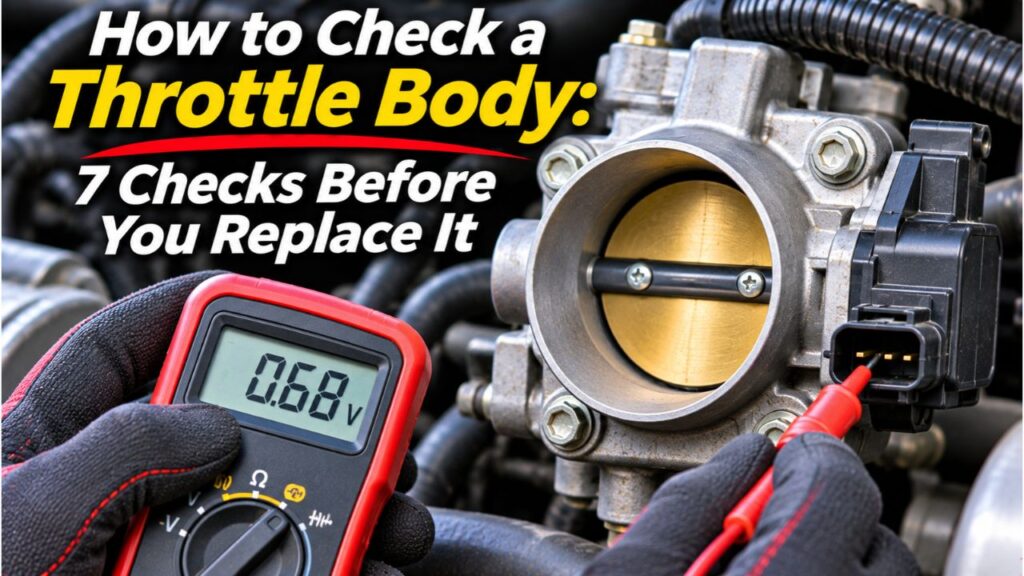
The throttle body controls how much air enters a gasoline engine by opening and closing a round plate inside the intake passage. It’s usually mounted between the air intake duct and the intake manifold. When you press the accelerator, the throttle opening changes to help control engine power and speed.
Think of the throttle plate as a movable door that controls airflow.
When the door opens farther, more air can enter the engine. The engine computer adjusts fuel delivery and other settings to match operating conditions.
There are two common designs:
| Throttle body type | How it operates | Common application |
| Mechanical | Accelerator cable moves the throttle plate | Many older gasoline vehicles |
| Electronic | Electric motor moves the plate under computer control | Most modern gasoline vehicles |
Electronic throttle bodies contain a throttle actuator motor and position sensors.
The throttle position sensor (TPS) reports the plate’s position to the engine computer.
The operation of electronic throttle control systems explains how accelerator pedal sensors, throttle motors, and engine computers work together.
To locate the throttle body, follow the large air intake tube from the air filter housing toward the engine.
The throttle body is generally attached where that tube meets the intake manifold.
How to Check a Throttle Body Step by Step
Start with a visual inspection of the throttle body, intake duct, and electrical connector. Then check diagnostic trouble codes and throttle position data if you have a compatible scanner. These seven checks help separate a dirty throttle plate from an electrical fault or another engine problem.
Step 1: Park Safely and Gather Your Tools
Park on level ground, shift into Park or the appropriate gear, and apply the parking brake.
Turn the engine OFF and allow it to cool.
You’ll need:
- Flashlight.
- Basic screwdriver or socket set.
- OBD-II scanner with live-data capability, if available.
- Clean, lint-free cloth.
- Vehicle service manual or repair information.
- Digital multimeter for approved electrical checks.
Don’t work near the throttle plate with the ignition ON.
An electronic throttle plate can move unexpectedly when the control system activates.
Step 2: Locate the Throttle Body
Open the hood and identify the air filter housing.
Follow the large intake tube toward the engine.
The throttle body is usually connected to the intake manifold and may have an electrical connector attached.
For example, on many four-cylinder engines, you’ll find it near the front or side of the intake manifold.
Some vehicles have engine covers or other components blocking access.
Use the vehicle’s service instructions before removing anything.
Step 3: Inspect the Air Intake Hose
Check the intake hose for cracks, loose clamps, disconnected vacuum lines, and damaged seals.
An air leak can cause rough idling or hesitation that resembles a throttle body problem.
Flexible intake hoses may develop cracks underneath their folds.
If the inspection requires removing the hose, loosen the appropriate clamp and carefully disconnect it according to the manufacturer’s instructions.
Avoid damaging nearby sensors or electrical connectors.
Pro Tip: Don’t jump the gun and replace the throttle body before checking the intake duct. A loose hose may be responsible for the symptoms.
Step 4: Check for Carbon Buildup
With the ignition OFF and the intake opening safely accessible, use a flashlight to inspect the throttle plate and surrounding bore.
The throttle plate is the round metal disc that controls airflow.
Look for:
- Thick black deposits near the plate edges.
- Sticky-looking residue inside the bore.
- Dirt or foreign material.
- Damaged plate edges.
- Signs of oil contamination.
A light coating of residue doesn’t automatically mean the throttle body is defective.
Heavy buildup around the plate’s closing area can interfere with airflow and contribute to idle problems.
For example, a vehicle that stalls when coming to a stop may have carbon deposits affecting the throttle’s normal idle position.
Safety Note: Never force an electronic throttle plate open with your fingers or a screwdriver. Some manufacturers allow controlled manual movement during cleaning, while others require a specific procedure.
Step 5: Inspect the Electrical Connector
Check the throttle body’s electrical connector and visible wiring.
Look for broken locking tabs, corroded terminals, damaged insulation, and loose connections.
A poor connector can interrupt the throttle motor’s control signals or the position sensor’s feedback.
That may cause hesitation, reduced power, or intermittent throttle warnings.
The technical guidance on electronic throttle body faults identifies poor connector contact as a cause worth checking before replacement.
Don’t disconnect or probe the connector while the circuit is energized unless the factory testing procedure specifically requires it.
Step 6: Read Throttle Body Trouble Codes
Connect a compatible OBD-II scanner to the vehicle’s diagnostic port.
Turn the ignition to the position required by the scanner, then read and record the stored codes.
Common throttle-related codes include:
| Code | General meaning |
| P0121 | Throttle or pedal position sensor A performance problem |
| P0221 | Throttle or pedal position sensor B performance problem |
| P2101 | Throttle actuator motor control performance problem |
| P2111 | Throttle actuator control system stuck open |
| P2112 | Throttle actuator control system stuck closed |
| P2135 | Throttle or pedal position sensor voltage correlation problem |
These descriptions are general. The exact diagnostic criteria depend on the vehicle.
A P2112 code, for example, may indicate that the throttle plate isn’t opening as expected.
Possible causes include mechanical sticking, electrical faults, or a defective actuator.
A trouble code doesn’t automatically prove the throttle body needs replacement.
Record the codes and related diagnostic data before clearing anything.
Step 7: Check Throttle Position Live Data
If your scanner supports live data, look for throttle position and accelerator pedal readings.
Common labels include:
- Throttle Position (TP or TPS).
- Accelerator Pedal Position (APP).
- Commanded Throttle Actuator.
- Actual Throttle Position.
Follow the manufacturer’s procedure for checking these readings.
On supported vehicles, a technician may compare accelerator pedal movement with throttle position data while the ignition is ON and the engine is OFF.
The readings should behave consistently with the vehicle’s control strategy.
But don’t expect throttle angle to match accelerator pedal position exactly.
The engine computer can limit or adjust throttle movement based on operating conditions.
If the scan tool supports a manufacturer-approved throttle actuator test, it may command the plate to move while monitoring its response.
Never place fingers or tools inside the opening during an actuator test.
How Do You Know if a Throttle Body Is Dirty or Bad?
A dirty throttle body often causes idle problems because carbon deposits interfere with airflow around the throttle plate. A defective throttle body may have a failed motor, damaged position sensor, or internal mechanical problem. Symptoms overlap, so physical inspection and scan-tool data are needed to tell them apart.
| Symptom | Possible cause | Recommended check |
| Rough idle | Carbon buildup or intake leak | Inspect plate and hoses |
| High idle | Air leak, buildup, or incorrect learned settings | Check intake and live data |
| Engine stalls at stops | Airflow control problem | Inspect deposits and scan codes |
| Delayed accelerator response | Throttle actuator, pedal sensor, or another control fault | Compare scan-tool readings |
| Reduced engine power | Electronic throttle fault or another engine management issue | Read trouble codes |
| Throttle plate sticks | Deposits or mechanical damage | Inspect using factory procedure |
| Warning light remains on | Sensor, wiring, or actuator fault | Perform circuit diagnosis |
Signs of a Dirty Throttle Body
A dirty throttle body may cause unstable idle speed, occasional stalling, or hesitation near idle.
Carbon deposits can change the amount of air passing around the throttle plate.
The engine computer may compensate for some buildup, but excessive deposits can affect performance.
For instance, an engine may idle unevenly after years of short trips and limited throttle maintenance.
Signs of a Faulty Electronic Throttle Body
A faulty electronic throttle body may produce actuator performance codes, inconsistent position feedback, or reduced engine power.
Modern systems sometimes enter limp mode, a protective operating state that limits performance after certain faults are detected.
Don’t assume limp mode proves the throttle body is defective.
Accelerator pedal sensors, wiring, and other engine control faults can trigger similar behavior.
Can You Check a Throttle Body With a Multimeter?
Yes, a digital multimeter can help test certain throttle body electrical circuits, including sensor reference voltage, ground connections, and signal output. The correct testing method depends on the vehicle’s wiring and throttle design. Modern electronic throttle bodies may require an oscilloscope or scan tool for accurate diagnosis.
On many sensor circuits, the engine computer provides a regulated reference voltage, commonly around 5 volts.
The throttle position sensor returns a changing electrical signal.
Older mechanical throttle bodies often use a separate TPS that can be tested according to the manufacturer’s procedure.
Electronic throttle bodies commonly contain multiple position sensors and a motor.
These circuits shouldn’t be tested by guessing their terminal functions.
Basic Electrical Checks
A technician may perform the following tests:
- Identify the correct terminal connections using the factory wiring diagram.
- Check the specified sensor reference voltage.
- Check the sensor ground circuit.
- Measure sensor output according to the service procedure.
- Compare the results with the manufacturer’s specifications.
Some throttle position sensors produce a smooth voltage change as the throttle plate moves.
Other designs use different signal patterns, so one universal voltage range doesn’t apply.
Never connect battery power directly to an electronic throttle motor or an unidentified terminal.
Incorrect testing can damage the throttle assembly or engine computer.
How Do You Check a Mechanical Throttle Body?
A mechanical throttle body can be checked by inspecting the accelerator cable, throttle linkage, return spring, and throttle plate movement. With the engine OFF, the plate should move smoothly through its intended travel and return to its normal closed position without sticking. The exact procedure depends on the vehicle.
A mechanical throttle body connects the accelerator pedal to the throttle plate using a cable.
Unlike an electronic unit, the cable physically moves the throttle linkage.
A basic inspection involves:
- Checking the cable for fraying or damage.
- Inspecting the linkage for dirt or corrosion.
- Moving the linkage gently according to the service procedure.
- Checking whether the return spring closes the plate.
- Looking for binding near the closed position.
For example, a frayed accelerator cable may make the pedal feel stiff even though the throttle body itself is clean.
Don’t adjust the factory throttle stop screw unless the manufacturer specifically instructs you to do so.
Changing the stop position can create idle and sensor calibration problems.
Should You Clean or Replace a Throttle Body?
Clean the throttle body when deposits are excessive and the manufacturer permits cleaning. Replace it when testing confirms a failed actuator motor, damaged internal sensor, worn mechanism, or another non-serviceable fault. Cleaning cannot repair broken electronics, while replacement won’t correct a damaged connector or intake leak.
When Cleaning Makes Sense
Cleaning may help when carbon deposits interfere with normal throttle plate operation.
If the service manual permits the procedure:
- Turn the ignition OFF.
- Remove the intake duct as instructed.
- Use the approved throttle body cleaning product.
- Apply cleaner using the specified method, often with a dampened lint-free cloth.
- Avoid flooding electrical components or the intake.
- Reassemble the duct and connections securely.
Don’t spray large amounts of cleaner into a running engine.
Also, don’t force the throttle plate open or soak its motor housing.
Some vehicles require a throttle idle relearn after cleaning or replacement.
The electronic throttle diagnostic process explains why fault codes must be considered alongside checks of sensors, connectors, and mechanical parts before a repair decision.
When Replacement Makes Sense
Replacement may be appropriate if the motor fails an approved test, the throttle plate mechanism is damaged, or the internal sensors produce confirmed incorrect readings.
Some throttle bodies contain sensors that aren’t separately serviceable.
When replacing an electronic throttle body, the vehicle may require an idle or throttle adaptation procedure.
This lets the engine computer learn the throttle’s operating positions.
Skipping a required relearn may cause high idle, unstable idle speed, or stalling.
Common Mistakes When Checking a Throttle Body
The most common mistakes are forcing an electronic throttle plate, assuming every throttle fault code means a failed throttle body, and cleaning components without checking the service procedure. These actions can create new electrical or mechanical problems. A careful inspection often prevents unnecessary parts replacement.
Avoid these mistakes:
- Forcing the throttle plate: Electronic gear mechanisms can be damaged.
- Spraying cleaner into electrical parts: Moisture can damage the actuator or sensor circuits.
- Ignoring intake air leaks: Cracked hoses can cause similar symptoms.
- Replacing parts based only on trouble codes: Codes identify faults, not always failed components.
- Skipping throttle relearn: Some vehicles require adaptation after service.
- Adjusting factory stop screws: Incorrect settings can disrupt idle control.
If the car has unpredictable acceleration, repeated stalling in traffic, or a serious throttle warning, avoid road-testing it until the problem is diagnosed.
Frequently Asked Questions
How Do You Check if a Throttle Body Is Working?
Inspect the throttle plate and intake duct, then read stored trouble codes with an OBD-II scanner. On compatible vehicles, check commanded and actual throttle position using live data or an approved actuator test. A working throttle body should respond according to the manufacturer’s specifications without sticking or producing related faults.
Can a Dirty Throttle Body Cause Rough Idle?
Yes. Carbon buildup near the throttle plate can change airflow at small throttle openings, contributing to rough idle or stalling. Other causes include intake leaks, ignition misfires, and fuel delivery problems. Inspect the throttle bore and related components before assuming cleaning will solve the issue.
Can You Test a Throttle Body Without a Scanner?
You can perform basic checks without a scanner by inspecting the intake hose, throttle body, wiring, and visible carbon deposits. On cable-operated systems, you may also check linkage movement with the engine OFF. Electronic actuator and sensor faults usually need diagnostic equipment for reliable confirmation.
What Happens if the Throttle Body Is Stuck Open?
A throttle plate stuck farther open than commanded may cause high engine speed or trigger the electronic throttle control system’s protective response. The engine computer may limit power or record a fault. Don’t operate a vehicle with uncontrolled engine speed. Shut it down safely and arrange professional diagnosis.
Will Cleaning a Throttle Body Fix Acceleration Problems?
Cleaning can help if excessive carbon deposits are causing the throttle plate to stick or interfere with airflow. It won’t repair a failed motor, sensor, damaged connector, or accelerator pedal circuit. Diagnose the problem before cleaning, and perform any required throttle relearn afterward.
Does a Throttle Body Need to Be Reprogrammed After Cleaning?
Some vehicles require an idle or throttle relearn after cleaning or replacing the throttle body, while others adapt automatically. The process varies by manufacturer and engine. Follow the specific service procedure rather than using a generic pedal sequence or disconnecting the battery to reset the system.
Check the Throttle Body Before Spending Money on Parts
A throttle body can cause rough idle, hesitation, stalling, and poor acceleration, but those symptoms don’t automatically mean the assembly has failed. Carbon buildup, damaged intake hoses, loose electrical connectors, and sensor problems can all affect throttle performance.
Start with the simplest checks. Inspect the intake duct, look for excessive deposits, and check the electrical connections. If you have an OBD-II scanner, record the trouble codes and examine throttle position data according to your vehicle’s procedure.
Cleaning may help when deposits interfere with airflow. A failed actuator or internal sensor, on the other hand, may require replacement. Some electronic systems also need a relearn after service.
Your next step is to identify the throttle body type and perform the visual inspection before testing its electronics. If the throttle responds unpredictably or electrical readings don’t match factory specifications, have a qualified automotive technician confirm the fault before replacing the assembly.