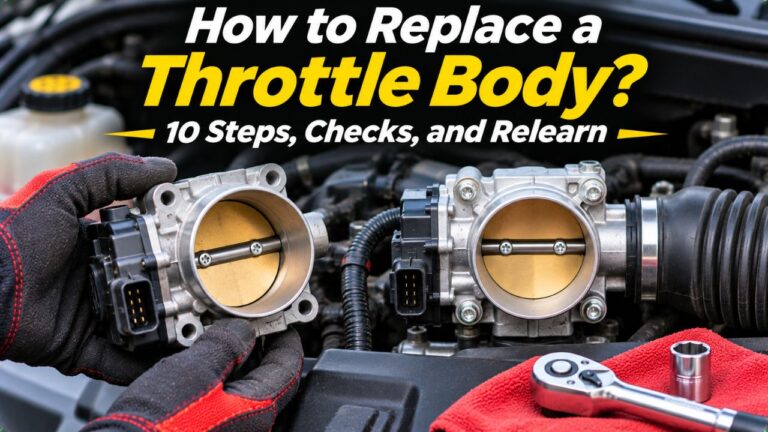
What Can You Use to Clean a Throttle Body? Safe Options Explained
You can use a dedicated throttle body and air intake cleaner to remove carbon deposits, oily residue, and grime from a car’s throttle body. Apply the cleaner with a soft, lint-free cloth, following the vehicle manufacturer’s instructions. Avoid ordinary brake cleaner, harsh household degreasers, and unapproved solvents that may damage sensitive components.
The throttle body controls how much air enters a gasoline engine. Over time, carbon and oil deposits can collect around the throttle plate, which may affect airflow and cause rough idling, hesitation, or stalling. Cleaning these deposits can help restore normal operation when buildup is the actual problem.
But not every cleaning product is suitable. Modern electronic throttle bodies may contain protective coatings, rubber seals, position sensors, and electric motors. Using the wrong chemical or forcing the throttle plate open can turn a simple maintenance job into an expensive repair.
This guide explains which cleaners work, which alternatives to avoid, what tools you need, and how to clean a throttle body safely without damaging its electronic parts.
What Can You Use to Clean a Throttle Body?

The best product for cleaning a throttle body is an automotive cleaner specifically labeled for throttle bodies or throttle plates. These products are designed to remove carbon, gum, and oily deposits from intake components. Choose one approved for your vehicle’s throttle body materials, especially if it has electronic controls or protective coatings.
1. Dedicated Throttle Body Cleaner
Throttle body cleaner is the preferred choice for most gasoline-powered vehicles.
It contains solvents formulated to loosen deposits that accumulate around the throttle plate and the inside walls of the throttle body.
These deposits often form when oily vapors from the crankcase ventilation system combine with dirt and other residue.
For example, a car with 70,000 miles may have a dark ring of deposits around the throttle plate. A compatible cleaner and soft cloth can remove that buildup without aggressive scraping.
Check the product label for compatibility with coated throttle bodies, seals, and electronic components.
The manufacturer’s throttle body cleaning instructions explain how the cleaner works and why excessive scrubbing should be avoided.
2. Throttle Plate Cleaner
Throttle plate cleaner is another suitable option when approved for the specific assembly.
The throttle plate is the round valve inside the throttle body that opens and closes to control airflow.
A dedicated cleaner can remove deposits around the edge where the plate meets the housing.
Some manufacturers specifically recommend applying throttle plate cleaner to a cloth instead of spraying it directly into the assembly.
This helps control the amount of solvent and prevents liquid from reaching sensitive internal components.
3. Soft, Lint-Free Cloth
A clean microfiber or other lint-free shop cloth is useful for wiping away loosened deposits.
Use a cloth that won’t shed fibers into the air intake.
For example, after applying a small amount of approved cleaner, gently wipe the dirty ring around the throttle bore instead of scraping it with a metal tool.
The throttle bore is the circular air passage inside the housing.
4. Soft Nylon Brush
A soft nylon detailing brush may help remove deposits on surfaces that the manufacturer permits you to brush.
Use light pressure.
Avoid brushing protective coatings or forcing the bristles into tight mechanical gaps.
If the buildup doesn’t loosen easily, don’t keep scrubbing until the surface becomes damaged.
Which Products Should You Avoid Using on a Throttle Body?
Avoid cleaners that aren’t approved for throttle body materials, particularly brake cleaner, harsh degreasers, gasoline, and household solvents. Some carburetor cleaners may also damage coatings, seals, or electronic parts. A product that removes grease effectively isn’t necessarily safe for a modern electronic throttle body.
Here is how common cleaning products compare.
| Cleaning Product | Recommended? | Reason |
| Dedicated throttle body cleaner | Yes | Designed for throttle body deposits |
| Approved throttle plate cleaner | Yes | Suitable when specified by the manufacturer |
| Carburetor cleaner | Usually no | Some formulas may damage coatings or seals |
| Brake cleaner | No | May harm sensitive components or protective coatings |
| MAF sensor cleaner | Not preferred | Designed for sensors, not stubborn throttle deposits |
| WD-40 Multi-Use Product | No | Leaves a lubricating film and isn’t a dedicated throttle cleaner |
| Rubbing alcohol | Not recommended | Material compatibility isn’t established |
| Gasoline or diesel fuel | No | Fire risk and unsuitable cleaning method |
| Dish soap and water | Not recommended | Moisture and residue can cause electrical problems |
Can You Use Carburetor Cleaner?
Carburetor cleaner can remove stubborn deposits, but it isn’t a universal substitute for throttle body cleaner.
Older vehicles often have simpler throttle assemblies made primarily from metal. Some manufacturer service procedures allow specified carburetor-cleaning products on particular components.
Modern throttle bodies may have coatings, plastic parts, rubber seals, and integrated electronics.
A harsh solvent can damage these materials.
Use carburetor cleaner only when the vehicle manufacturer specifically approves the exact product or formulation for that application.
Can You Use Brake Cleaner?
Brake cleaner isn’t recommended for throttle body cleaning.
It is designed primarily for brake components and may contain solvents that are unsuitable for throttle body coatings, seals, or electronic parts.
For example, a solvent that works well on a metal brake rotor may damage the protective surface inside an electronic throttle body.
Don’t take that chance to save a few dollars.
Can You Use WD-40?
Regular WD-40 Multi-Use Product isn’t a proper replacement for dedicated throttle body cleaner.
It can loosen certain deposits, but its lubricating film may remain on the surface and attract more dirt.
That is different from a cleaner formulated to remove intake deposits.
A product sold specifically for throttle bodies may be acceptable even if it comes from a manufacturer that also sells general-purpose lubricants. Judge the actual product by its label and approval.
Can You Use Household Cleaners?
Avoid dish soap, strong kitchen degreasers, rubbing alcohol, and household cleaning sprays unless the vehicle manufacturer explicitly approves them.
These products may leave residue or introduce moisture into areas that should remain dry.
The rule of thumb is simple: Use a product designed for the component you’re cleaning.
What Tools Do You Need to Clean a Throttle Body?
A basic throttle body cleaning job usually requires an approved cleaner, a soft lint-free cloth, safety glasses, gloves, and tools for removing the air intake duct. Some vehicles need additional equipment or throttle body removal. Check the service instructions before buying supplies or disconnecting components.
| Tool or Supply | Purpose |
| Throttle body cleaner | Loosens carbon and oily deposits |
| Lint-free cloth | Wipes away dissolved grime |
| Screwdriver or socket set | Removes intake hose clamps |
| Flashlight | Helps inspect the throttle plate |
| Safety glasses | Protects against chemical splashes |
| Chemical-resistant gloves | Reduces skin contact with cleaner |
| Small catch cloth | Collects cleaner runoff |
| Replacement gasket | Needed if removal requires a new seal |
Do You Need to Remove the Throttle Body?
Not always.
If deposits are light and the vehicle’s service procedure permits in-place cleaning, removing the air intake hose may provide enough access.
For heavier deposits, removing the throttle body may allow more controlled cleaning.
For example, if most carbon buildup is on the back of the throttle plate, you might not be able to reach it safely while the assembly remains installed.
Don’t remove extra components unless the cleaning procedure calls for it.
How Do You Clean a Throttle Body Safely?
To clean a throttle body, switch off the engine, remove the air intake duct, inspect the throttle plate, and gently wipe accessible deposits using an approved cleaner. Apply the cleaner to a cloth unless your vehicle’s instructions specify another method. Reassemble everything before starting the engine.
Step 1: Park and Cool the Engine
Park on level ground and apply the parking brake.
Turn the engine off and remove the ignition key or move the key fob away.
Allow hot engine components to cool.
Work in a well-ventilated area away from flames, sparks, or smoking materials.
Throttle body cleaners may contain flammable solvents, so follow the safety warnings on the container.
Step 2: Locate the Throttle Body
Open the hood and find the air filter housing.
Follow the large air intake tube toward the engine.
The tube typically connects to the throttle body, which is mounted near the intake manifold.
The intake manifold distributes air to the engine’s cylinders.
Step 3: Remove the Air Intake Duct
Loosen the clamp holding the intake hose to the throttle body.
Carefully pull the duct away.
Check for attached breather hoses, vacuum lines, or electrical fittings before moving it.
A small hose may be hidden underneath the intake duct.
Don’t pull hard enough to break a plastic connection.
Step 4: Inspect the Throttle Plate
Look inside the opening with a flashlight.
You may notice dark deposits around the edge of the plate and the surrounding bore.
A thin dark ring doesn’t automatically mean the throttle body requires extensive cleaning.
Some assemblies have factory-applied coatings that should not be removed.
If you cannot distinguish the coating from removable deposits, consult the service information before continuing.
Step 5: Apply the Correct Cleaner
For a cautious cleaning method, spray a small amount of compatible cleaner onto a lint-free cloth.
Gently wipe the accessible deposits.
Avoid soaking the assembly or allowing cleaner to collect around the throttle shaft, motor housing, or electrical connectors.
A manufacturer’s throttle cleaning bulletin specifically instructs technicians to use a cleaner-dampened cloth instead of directly spraying the throttle body on the covered applications.
Other vehicles and products permit different methods, so follow the instructions for your exact setup.
Safety Note: Don’t force an electronic throttle plate open. Its internal gears and motor can be damaged. Follow the approved method for positioning the plate, and keep fingers out whenever electrical power is available.
Step 6: Remove Deposits Gently
Wipe the plate and bore surfaces that the service procedure allows you to clean.
Use light pressure and repeat with a fresh area of the cloth as dirt comes away.
Don’t scrape with a screwdriver, steel brush, or sandpaper.
Avoid leaving cloth fibers or loosened debris inside the intake.
A little goes a long way. You don’t need to flood the throttle body with solvent to clean a thin layer of deposits.
Step 7: Reassemble the Intake
Allow the cleaned surfaces to dry according to the product instructions.
Reconnect the air intake duct and tighten its clamp securely.
Reattach any hoses or electrical connectors that were disconnected.
Check that the duct is properly seated and no tools remain in the engine compartment.
Step 8: Check Engine Operation
Start the engine only after completing the required reassembly and safety checks.
Some vehicles may idle differently after throttle body cleaning because the engine computer has adapted to the previous buildup.
If the idle remains unusually high or rough, the vehicle may require a throttle relearn.
Don’t keep driving with severe stalling or unpredictable accelerator response.
Can You Clean an Electronic Throttle Body With the Same Cleaner?
Yes, many electronic throttle bodies can be cleaned with a compatible throttle body cleaner, but the cleaning procedure may differ from that used on cable-operated designs. Electronic units contain motors, sensors, and internal gears. Protecting those parts is just as important as removing carbon from the throttle plate.
Why Electronic Throttle Bodies Need Extra Care
An electronic throttle body uses an electric motor to position the throttle plate.
The engine computer controls this motor based on accelerator pedal input and other operating conditions.
Unlike an older cable-operated throttle body, there may be no mechanical linkage for you to operate manually.
Forcing the plate can damage its gears or actuator.
Don’t insert a screwdriver to hold an electronic plate open.
Can Cleaner Damage the Throttle Position Sensor?
It can if an unsuitable solvent enters the sensor housing or damages its seals.
The throttle position sensor (TPS) reports the throttle plate’s position to the engine computer.
Many modern throttle bodies have integrated sensors that aren’t separately serviceable.
Avoid directing cleaner into the sensor housing or electrical connector.
Does the Throttle Body Need Relearning?
Some vehicles require a relearn or adaptation after cleaning, battery disconnection, or throttle body replacement.
A relearn allows the engine computer to update its stored throttle and idle settings.
The technical guidance on electronic throttle relearning explains why the procedure varies by manufacturer.
Don’t use a random relearn sequence intended for another vehicle.
Can You Clean a Throttle Body Without Special Cleaner?
You can remove small amounts of loose surface dirt with a clean, dry, lint-free cloth, provided the manufacturer’s procedure allows it. However, baked-on carbon and oily deposits usually need an approved cleaning solvent. Household chemicals aren’t reliable substitutes because their compatibility with throttle body components may be unknown.
What if You Only Have a Dry Cloth?
A dry cloth may remove loose dust or light surface residue.
It generally won’t dissolve hardened deposits around the throttle plate.
For example, a thin layer of dust near the intake opening may wipe away easily.
A sticky black ring around the plate is more likely to require a proper solvent.
What if the Throttle Body Is Very Dirty?
Heavy carbon deposits may need controlled cleaning with the assembly removed.
Trying to scrape stubborn buildup while the throttle body remains installed can damage the plate or push debris into the intake manifold.
If you don’t have the correct cleaner, it’s better to postpone the job than experiment with an unsuitable chemical.
That may sound easier said than done when your engine is running poorly, but replacing a damaged throttle body costs far more than a bottle of approved cleaner.
How Do You Know if a Throttle Body Needs Cleaning?
A throttle body may need cleaning when visible deposits interfere with airflow or throttle movement, particularly if the engine has rough idle, hesitation, or stalling. These symptoms can also come from intake leaks, sensors, or fuel delivery problems. Inspection and diagnosis should come before cleaning.
Common symptoms include:
- Rough or unstable idle
- Engine stalling at stoplights
- Hesitation when accelerating
- Uneven throttle response
- Unusual idle speed
- Visible carbon buildup around the throttle plate
For example, a car that idles roughly after many miles of driving may have deposits affecting airflow near the closed throttle position.
Cleaning might help if the deposits are responsible.
But a damaged sensor or faulty electronic actuator won’t be repaired by removing carbon.
How Often Should You Clean It?
There isn’t one cleaning interval that applies to every vehicle.
Some manufacturers recommend inspection or cleaning under specific conditions, while others don’t list routine throttle body cleaning as scheduled maintenance.
Driving conditions, engine design, and deposit buildup all affect how often service may be useful.
Don’t clean a properly functioning throttle body simply because a fixed number of miles has passed.
Frequently Asked Questions
What Is the Best Cleaner for a Throttle Body?
A dedicated throttle body and air intake cleaner approved for the vehicle is the best general choice. It is designed to loosen carbon, gum, and oily deposits. Check that the product is compatible with the throttle body’s coatings, seals, and electronic parts. Follow the manufacturer’s application instructions.
Can You Use Carb Cleaner to Clean a Throttle Body?
Some vehicle manufacturers approve particular carburetor-cleaning products for specific throttle body applications. However, ordinary carburetor cleaner isn’t a safe universal substitute. Certain formulas may damage coatings, plastic parts, or seals. Unless the vehicle service information explicitly approves it, use dedicated throttle body cleaner instead.
Can You Use MAF Cleaner on a Throttle Body?
Mass airflow (MAF) sensor cleaner is formulated for delicate airflow sensors rather than stubborn throttle body deposits. It may not remove oily carbon buildup effectively. Use the product intended for each component, and never spray ordinary throttle body cleaner directly onto a MAF sensor unless its manufacturer specifically permits that application.
Can You Use Water to Clean a Throttle Body?
Water isn’t recommended for cleaning throttle body deposits. It doesn’t dissolve baked-on oily carbon effectively and can enter electrical connectors, sensors, or actuator components. Soap and water may also leave residue. A compatible throttle body cleaner applied according to the manufacturer’s procedure is a better choice.
Can You Spray Throttle Body Cleaner Directly Into the Intake?
Only if both the vehicle’s service procedure and the cleaner’s instructions permit that method. Some manufacturers warn against spraying directly because solvent can carry dirt into the throttle shaft or electronic components. Applying cleaner to a cloth offers better control on many electronic throttle bodies.
Can Cleaning a Throttle Body Cause Problems?
Yes, if the wrong cleaner or procedure is used. Possible problems include damaged protective coatings, broken throttle gears, contaminated sensors, intake air leaks, or abnormal idle behavior. Using the approved cleaner, avoiding excessive force, and completing any required throttle relearn can reduce these risks.
Choose the Right Cleaner and Protect the Throttle Body
The safest general choice for removing throttle body deposits is a dedicated throttle body or throttle plate cleaner approved for your vehicle. A clean, lint-free cloth is usually enough to handle accessible deposits when used with the correct procedure.
Avoid substituting brake cleaner, household degreasers, gasoline, or general-purpose lubricants. These products may leave unwanted residue or damage sensitive components.
Electronic throttle bodies need extra care. Never force the plate open, soak the motor housing, or spray chemicals into electrical connectors. Some vehicles also require a throttle relearn after cleaning.
Remember that rough idle and hesitation don’t always mean the throttle body is dirty. Inspect the component and rule out other faults before cleaning.
Your next step is to check your vehicle’s service instructions and buy a compatible throttle body cleaner. Use the approved cleaning method, and stop if you find damaged electronic parts or a mechanical fault.