
Super Clean Your Car’s Carpets: Step-by-Step Guide
To super clean your car’s carpets, remove loose debris first, vacuum thoroughly, pretreat stains, apply a suitable carpet cleaner, agitate the fibers, extract or blot away the dirt, and let the carpet dry completely before replacing the mats.
Car carpet can hold far more dirt than it appears to on the surface. Sand, dust, dried mud, food crumbs, spills, road salt, and other debris work their way deep into the fibers and around seat rails and trim. Simply spraying cleaner and scrubbing often makes the carpet look better temporarily without removing everything trapped underneath.
The most effective approach is to clean in stages: remove dry contamination first, then use controlled moisture to deal with stains and embedded soil.
What Does It Mean to Super Clean Car Carpet?
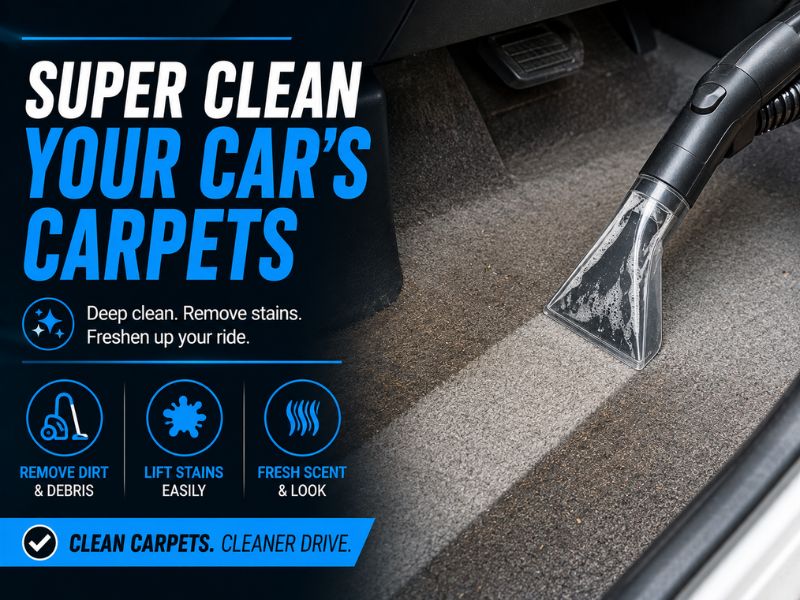
A deep-cleaned car carpet should be free of as much loose and embedded contamination as reasonably possible without soaking the material underneath.
That may include removing:
- Dust
- Sand
- Mud
- Food debris
- Sticky drink residue
- Light grease
- Road salt
- General staining
- Odor-causing residue
Not every old stain will disappear completely. Some spills can permanently discolor carpet fibers.
The goal is to lift contamination out of the carpet rather than simply spreading cleaner over it.
What You Need to Clean Car Carpets
You do not need a professional detailing shop to get good results.
Useful tools include:
- Vacuum cleaner
- Crevice attachment
- Carpet or upholstery brush
- Automotive carpet cleaner
- Microfiber towels
- Spray bottle
- Wet/dry vacuum or carpet extractor, if available
- Small detailing brush
- Gloves
Optional tools can include a blower or compressed-air source for loosening dirt and a drill brush for heavier carpet agitation.
The exact products matter less than using the correct process.
Step 1: Remove Floor Mats and Loose Items
Take everything out of the footwells before cleaning.
Remove:
- Floor mats
- Trash
- Bottles
- Papers
- Loose tools
- Small objects under the seats
Move the seats forward and backward to expose as much carpet as possible.
Pay particular attention to:
- Seat rails
- Door-entry edges
- Center-console sides
- Rear footwells
- Under-seat areas
If you leave the mats in place, you will miss some of the dirtiest parts of the carpet.
Step 2: Dry Brush the Carpet
Before reaching for shampoo, loosen the dry dirt.
Use a carpet or detailing brush to agitate the fibers.
This can bring buried material such as:
- Sand
- Dust
- Dried mud
- Fine gravel
closer to the surface.
Dry agitation is especially useful in heavily soiled driver footwells where dirt has been repeatedly pressed into the carpet.
This step helps prevent dry soil from turning into muddy residue when cleaner is introduced later.
Step 3: Vacuum Thoroughly
Vacuum slowly rather than making one fast pass.
Go over the carpet from several directions.
Use a crevice attachment around:
- Seat rails
- Console edges
- Door sills
- Pedal areas
- Tight corners
For heavily contaminated areas, repeat this sequence:
Brush, vacuum, brush again, then vacuum again.
The more dry dirt you remove now, the less material you have to deal with during wet cleaning.
Step 4: Identify the Stains
Before spraying the entire carpet, look for specific stains.
Common car-carpet stains include:
- Coffee
- Soda
- Mud
- Grease
- Food
- Road salt
- Pet-related messes
Different stains respond differently to cleaning products.
A cleaner that works well on general soil may not be the best option for oily residue or mineral deposits.
Test any unfamiliar cleaner in a hidden area first.
Step 5: Pretreat Stubborn Stains
Apply an appropriate stain treatment to the affected area.
Use enough product to contact the stain without flooding the carpet.
Allow the cleaner to work for the recommended dwell time.
Then gently agitate the area with a brush or microfiber towel.
Avoid aggressive scrubbing immediately. Hard scrubbing can spread a stain or damage the fibers before the cleaner has had time to loosen it.
Also avoid mixing different chemicals unless their manufacturers specifically say they are compatible.
Step 6: Apply Carpet Cleaner Lightly
Now work on the carpet in manageable sections.
Mist the cleaner across the fibers rather than soaking them.
The carpet should become damp enough for the cleaner to loosen dirt.
It should not become saturated.
Too much liquid can soak into:
- Carpet backing
- Padding
- Floor insulation
- Areas near wiring or connectors
More cleaner does not automatically produce a cleaner carpet.
Controlled moisture is usually more effective because it is easier to extract and dry.
Step 7: Agitate the Carpet
Use a carpet brush to work the cleaner through the fibers.
Work in small sections.
Use several directions rather than brushing only one way.
Give extra attention to high-traffic areas such as:
- Driver footwell
- Areas beside the pedals
- Door-entry edges
- Rear passenger footwells
Moderate agitation helps separate soil from the carpet fibers so that it can be removed during extraction.
Can You Use a Drill Brush on Car Carpet?
Yes, a drill brush can speed up agitation on some automotive carpets.
Use it carefully.
Choose a brush appropriate for fabric rather than a very aggressive scrub brush.
Run the drill at a controlled speed and use light to moderate pressure.
Avoid a drill brush if:
- Carpet fibers are delicate
- The material is already frayed
- The brush is too stiff
- The manufacturer advises against mechanical agitation
A drill brush does not actually remove the dirt. It only helps loosen it.
You still need to extract or blot away the contaminated solution afterward.
Step 8: Extract the Dirty Solution
This is where much of the visible improvement happens.
After cleaner and agitation loosen the soil, remove as much of that dirty moisture as possible.
Carpet Extractor
A carpet extractor can apply and recover cleaning solution.
It is useful for deep cleaning because it physically removes moisture and suspended dirt.
Wet/Dry Vacuum
A wet/dry vacuum can also pull moisture and loosened contamination from the carpet.
Microfiber Towels
If you do not have extraction equipment, blot the carpet repeatedly with clean microfiber towels.
Turn or replace the towels as they become dirty.
The goal is to remove contamination rather than allow it to dry back into the carpet.
How to Clean Car Carpet Without an Extractor
You can still get good results without specialized equipment.
Use this process:
- Vacuum thoroughly.
- Pretreat stains.
- Mist carpet cleaner lightly.
- Agitate with a brush.
- Blot with clean microfiber towels.
- Repeat if necessary.
- Use a lightly damp clean towel for residue removal if the cleaner’s instructions allow it.
- Blot again with dry towels.
- Allow the carpet to dry completely.
The key is using limited moisture.
Without an extractor, oversaturating the carpet becomes even more problematic because you have fewer ways to recover the liquid.
How to Remove Mud From Car Carpet
Mud is easiest to deal with when much of it can be removed dry.
If the mud has already dried:
- Break up the crusted material.
- Brush the area.
- Vacuum repeatedly.
- Pretreat the remaining discoloration.
- Agitate.
- Extract or blot.
Do not immediately saturate a thick layer of dried mud.
Adding water too early can turn removable dry dirt into muddy liquid that spreads deeper into the carpet.
How to Remove Salt Stains From Car Carpet
Road salt and winter residue can leave pale or crusty deposits.
Start by vacuuming away as much loose material as possible.
Then use an automotive carpet treatment appropriate for the residue.
Work gradually instead of soaking the area.
Agitate lightly and remove the loosened contamination with an extractor or towels.
Several controlled treatments are usually preferable to flooding the carpet once.
How to Remove Grease or Oil
Greasy stains require a little more care because they can spread.
If the spill is fresh, blot excess material rather than rubbing it outward.
Use a fabric-safe automotive cleaner suitable for oily contamination.
Work from the outer edge of the stain toward the center.
That helps reduce spreading.
Repeat the process if necessary.
Avoid soaking the area in an attempt to remove everything in one pass.
Some older oil stains may leave permanent discoloration even after most of the contamination has been removed.
How to Remove Coffee or Soda Stains
Fresh liquid spills should be blotted as soon as possible.
Do not aggressively rub the spill into a larger area.
Use a suitable fabric cleaner and work it through the stained fibers.
Then remove the dirty solution through extraction or blotting.
Sugary drinks can leave sticky residue even when the visible color disappears, so removing the residue itself is important.
A carpet can look clean while still feeling sticky if too much drink or cleaning product remains in the fibers.
How to Remove Bad Smells From Car Carpet
Odor control starts with finding the source.
A fragrance spray can temporarily cover a smell, but it will not remove contamination trapped in the carpet.
For lasting results:
- Locate the affected area.
- Remove loose dirt.
- Clean the contamination.
- Extract the residue.
- Dry the carpet fully.
Persistent musty odors may indicate moisture below the carpet, damp padding, or a water leak.
If the carpet repeatedly becomes wet, cleaning alone will not solve the problem until the moisture source is addressed.
Should You Shampoo Car Carpet?
Yes, when the carpet needs more than routine vacuuming.
Deep shampooing can help with:
- Embedded soil
- Old spills
- High-traffic areas
- General interior restoration
However, shampooing does not mean saturating the carpet.
The best results usually come from using enough solution to loosen dirt while keeping the total moisture controlled.
For lightly soiled carpet, a full shampoo may not be necessary. Spot cleaning and vacuuming may be enough.
How Wet Should Car Carpet Get?
Car carpet should become damp, not soaked.
Excess water can reach the padding underneath, which may take much longer to dry than the visible surface.
Oversaturation can contribute to:
- Long drying times
- Musty odors
- Cleaner residue
- Hidden moisture
- Unwanted water near electrical components
Use the least amount of liquid needed to release and remove the dirt.
If an extractor is available, make several dry extraction passes after the cleaning stage to recover as much moisture as possible.
How to Dry Car Carpet Properly
Drying is part of the cleaning process.
After extraction:
- Blot wet areas with dry towels
- Increase ventilation
- Open doors or windows when conditions are safe and dry
- Use fans when available
- Keep floor mats out
Do not immediately cover damp carpet with rubber mats.
The carpet underneath can remain wet much longer when airflow is blocked.
Avoid leaving the vehicle sealed for long periods with wet carpet inside.
How Long Does Car Carpet Take to Dry?
There is no single drying time that applies to every vehicle.
Drying depends on:
- Amount of moisture used
- Carpet thickness
- Padding
- Airflow
- Temperature
- Humidity
A lightly cleaned carpet with good airflow may dry relatively quickly.
An oversaturated carpet with wet padding can take much longer.
Do not judge dryness only by the top fibers. Low areas and padding can remain damp after the surface feels dry.
Can You Pressure Wash Car Carpet?
Pressure washing installed vehicle carpet is generally a poor choice.
The large amount of water can soak:
- Carpet backing
- Padding
- Floor insulation
- Electrical areas
It also makes drying much more difficult.
Removable floor mats are different. Some mats may tolerate heavier washing depending on their material and manufacturer instructions.
Installed carpet should usually be cleaned with much more controlled moisture.
Can You Use Household Carpet Cleaner in a Car?
Some products may work on automotive carpet, but do not assume every household cleaner is appropriate.
Potential problems include:
- Excessive foaming
- Sticky residue
- Strong fragrance
- Material compatibility issues
A product labeled for automotive fabric or carpet is generally easier to use with confidence.
Whatever you choose, follow the dilution and application instructions.
Test a hidden area first when using something new.
Common Mistakes When Cleaning Car Carpet
Avoid these common errors:
- Wet cleaning before vacuuming thoroughly
- Using too much cleaning solution
- Soaking the carpet
- Scrubbing stains aggressively
- Mixing cleaning chemicals
- Skipping dwell time
- Leaving detergent residue
- Failing to extract dirty moisture
- Putting mats back too soon
- Sealing the vehicle while carpet is wet
- Using an overly stiff brush
Most disappointing results come from either leaving dirt behind or leaving too much cleaner and moisture behind.
How Often Should You Deep Clean Car Carpet?
There is no universal schedule.
How often your carpet needs deep cleaning depends on how the vehicle is used.
You may need more frequent cleaning if the vehicle regularly deals with:
- Children
- Pets
- Mud
- Winter road salt
- Work boots
- Food and drinks
For normal use, vacuum regularly and clean spills quickly.
Deep clean when routine vacuuming and spot cleaning no longer keep the carpet looking and feeling clean.
Quick Maintenance Between Deep Cleans
Simple maintenance makes future cleaning easier.
- Vacuum high-traffic areas regularly
- Shake or vacuum floor mats
- Blot spills quickly
- Remove food debris
- Do not let mud build up
- Address water leaks promptly
- Clean winter salt before heavy deposits accumulate
Keeping loose dirt from becoming embedded is much easier than removing it later.
Frequently Asked Questions
How Do You Super Clean Car Carpets?
Vacuum thoroughly, pretreat stains, apply a suitable cleaner lightly, agitate the fibers, extract or blot the dirty solution, and allow the carpet to dry completely.
What Is the Best Way to Deep Clean Car Carpet?
The best process combines thorough dry vacuuming with controlled wet cleaning and extraction.
Can I Shampoo My Car Carpet?
Yes, but avoid oversaturating the carpet and padding.
How Do I Clean Car Carpet Without an Extractor?
Use light amounts of cleaner, agitate with a brush, and repeatedly blot with clean microfiber towels.
Can I Use a Drill Brush on Car Carpet?
Yes, on suitable carpet and with an appropriate brush, moderate speed, and light pressure.
How Do You Get Deep Dirt Out of Car Carpet?
Dry brushing and repeated vacuuming loosen embedded particles before wet cleaning.
How Do You Remove Mud From Car Carpet?
Allow heavy mud to dry when possible, break it up, vacuum it thoroughly, and then treat the remaining stain.
How Do You Remove Salt Stains From Car Carpet?
Vacuum loose deposits first, then use a carpet-safe treatment suitable for mineral or salt residue and extract the loosened material.
How Do You Get Bad Smells Out of Car Carpet?
Find and clean the source of the odor, remove the residue, and dry the carpet completely.
Can You Use Household Carpet Cleaner in a Car?
Some may be compatible, but an automotive-safe carpet product is generally preferable. Always test before broad use.
How Do You Dry Car Carpet After Cleaning?
Extract as much moisture as possible, blot with dry towels, increase airflow, and keep mats out until the carpet is fully dry.
Can Too Much Water Damage Car Carpet?
Too much water can soak the padding, increase drying time, create musty odors, and potentially reach areas that should remain dry.
Conclusion
To super clean your car’s carpets, start by removing as much dry contamination as possible, pretreat individual stains, apply a controlled amount of carpet cleaner, agitate the fibers, extract the dirty moisture, and let everything dry completely.
The dry-cleaning stage matters more than many people realize. Sand, dust, and dried mud should be brushed loose and vacuumed before shampoo is introduced. Otherwise, that dry debris can become harder to remove once it gets wet.
During the wet-cleaning stage, more product is not necessarily better. Controlled moisture allows the cleaner to work without unnecessarily soaking the padding underneath.
Agitation helps release embedded contamination, but extraction is what actually removes much of that loosened dirt. If you do not have an extractor, careful blotting with clean microfiber towels can still produce strong results.
Finally, do not rush the drying process. Reinstalling floor mats or closing up the vehicle while the carpet is still damp can trap moisture and contribute to odors.
The best way to super clean your car’s carpets is to focus on process rather than product quantity: loosen the dry dirt, treat stains carefully, use minimal moisture, remove the dirty solution, and make sure the carpet is completely dry before normal use.
