What Causes a Throttle Body to Go Bad? Warning Signs and Fixes
A throttle body can go bad because of carbon buildup, oil contamination, a failing throttle position sensor, a worn electronic motor, or damaged electrical connections. Heat, moisture, and normal wear can also contribute. A dirty throttle body may only need cleaning, while damaged internal electronics or mechanical components often require replacement.
Your throttle body controls how much air enters the engine. When it stops working correctly, you might notice rough idling, delayed acceleration, stalling, or a check-engine light. Some vehicles also display a reduced engine power warning.
The tricky part is that a dirty throttle body and a defective one can produce nearly identical symptoms. For example, carbon deposits may prevent the throttle plate from moving smoothly, while a failed electronic motor can cause similar behavior.
Replacing the entire assembly without checking the cause can turn a simple repair into an expensive mistake. This guide explains what damages throttle bodies, which symptoms deserve attention, how to identify the actual fault, and when cleaning makes more sense than replacement.
What Causes a Throttle Body to Go Bad?
Throttle bodies commonly develop problems from carbon deposits, oil vapors, electronic sensor failures, motor wear, moisture intrusion, and damaged wiring. These faults can interfere with throttle plate movement or prevent the engine computer from controlling airflow correctly. Some problems develop gradually, while electronic faults may appear suddenly.
| Cause | What happens | Possible result |
| Carbon buildup | Deposits collect around the throttle plate | Rough idle or sticking |
| Oil contamination | Oily residue accumulates inside the housing | Restricted airflow |
| Throttle position sensor failure | Incorrect plate position information reaches the computer | Hesitation or warning light |
| Electronic motor failure | Motor cannot control the plate correctly | Reduced power |
| Damaged wiring | Electrical signals or power become unreliable | Intermittent throttle operation |
| Moisture and corrosion | Electrical contacts deteriorate | Sensor or motor faults |
| Physical damage | Plate, shaft, or gears become damaged | Binding or improper movement |
1. Carbon Buildup Around the Throttle Plate
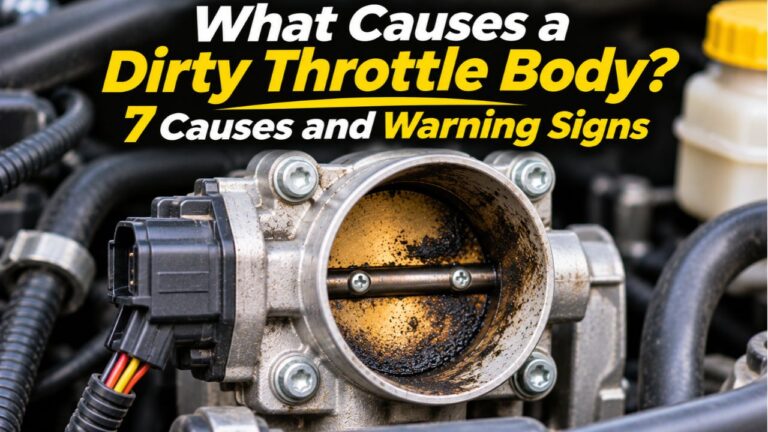
Carbon buildup is one of the most common reasons a throttle body becomes dirty and starts causing drivability problems.
The engine’s intake system carries air along with small amounts of oil vapor from the crankcase ventilation system.
Over time, these vapors can combine with dirt and form sticky deposits around the throttle plate.
The throttle plate is a circular valve inside the throttle body that controls airflow.
For example, a car used mainly for short city trips may develop deposits that interfere with airflow at idle.
A technical service bulletin about throttle body carbon deposits explains how buildup can contribute to unstable idling, hesitation, and reduced engine power.
Cleaning may correct this problem without replacing the assembly.
2. Oil Contamination From the Engine
Oil vapors entering the intake system can leave a sticky coating inside the throttle body.
A small amount of residue can be normal.
Excessive oil contamination may develop because of problems with the positive crankcase ventilation (PCV) system, excessive crankcase pressure, or other engine faults.
For example, a malfunctioning PCV component may allow abnormal amounts of oil vapor into the intake.
Cleaning the throttle body can remove the deposits, but fixing the underlying oil problem helps prevent them from returning.
3. Faulty Throttle Position Sensor
The throttle position sensor (TPS) reports the throttle plate’s position to the engine control module (ECM).
The ECM is the computer that manages engine functions.
When the sensor fails, the computer may receive inaccurate or inconsistent throttle position information.
This can cause hesitation, poor acceleration, or a warning light.
Sensor problems may result from internal wear, moisture, electrical faults, or damaged connections.
The technical information on throttle position sensor failures identifies electrical contact problems, contamination, and mechanical damage as possible causes.
Some vehicles allow separate sensor replacement. Others have sensors integrated into the throttle body assembly.
4. Electronic Throttle Motor Failure
Modern vehicles commonly use electronic throttle control instead of a traditional accelerator cable.
An electric motor opens and closes the throttle plate according to commands from the ECM.
Over time, motor contacts may wear or become contaminated.
Internal gears and moving components can also develop mechanical problems.
For example, certain vehicles were covered by a manufacturer’s electronic throttle body repair program because contamination of internal motor contacts could increase electrical resistance and trigger reduced-power operation.
This type of failure may require replacing the throttle body or following a manufacturer-specific repair procedure.
5. Damaged Wiring and Electrical Connectors
An electronic throttle body depends on reliable electrical connections.
Broken wires, loose terminals, corrosion, or damaged connector locks can interrupt motor operation and sensor signals.
For example, an engine might lose power intermittently after a damaged wiring connector becomes loose from vibration.
The throttle body itself may still be in good condition.
Common Mistake: Replacing the entire throttle body without checking its electrical connector and wiring.
6. Moisture and Heat Damage
Engine compartments experience repeated heating and cooling.
These temperature changes can stress plastic housings, electrical connections, and internal components.
Moisture entering an unsealed electrical connector may also cause corrosion.
An improperly sealed connector or damaged housing increases the chance of trouble.
Heat and moisture don’t automatically destroy a throttle body, but they can contribute to failures over time.
7. Damage During Cleaning or Installation
Improper cleaning can damage a throttle body that was previously working.
Forcing an electronic throttle plate open may harm its motor or gear mechanism.
Using harsh solvents can damage certain coatings or seals.
Incorrect installation may also create air leaks around the throttle body gasket.
Always follow the manufacturer’s procedure instead of forcing stuck components.
What Are the Symptoms of a Bad Throttle Body?
A failing throttle body can cause rough idling, stalling, hesitation, poor acceleration, unexpected engine speed changes, or reduced engine power. Modern vehicles may also activate the check-engine light or throttle control warning. Symptoms vary depending on whether deposits, mechanical binding, or electronic faults are responsible.
| Symptom | What you may notice | Possible throttle-related issue |
| Rough idle | Engine shakes while stopped | Carbon buildup |
| High idle | RPM stays higher than expected | Airflow control problem |
| Hesitation | Delayed response to gas pedal | Sensor or motor fault |
| Stalling | Engine shuts off at low speeds | Throttle movement or airflow issue |
| Reduced engine power | Vehicle accelerates poorly | Electronic throttle fault |
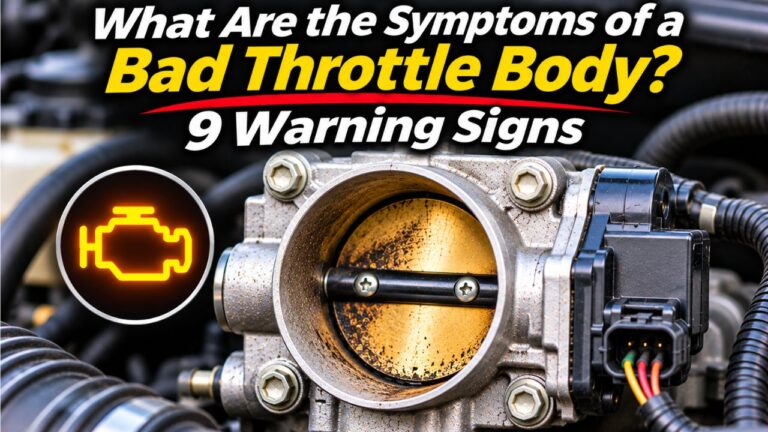
| Check-engine light | Warning appears on dashboard | Throttle system fault code |
| Unstable RPM | Engine speed rises and falls | Inconsistent throttle control |
Rough Idle and Engine Stalling
Carbon deposits can interfere with the small airflow adjustments needed at idle.
For example, your engine might shake while waiting at a stoplight but run more smoothly during highway driving.
A dirty throttle body is one possibility.
Vacuum leaks, ignition problems, and fuel system faults can create similar symptoms.
Delayed Acceleration
A faulty electronic throttle motor or position sensor may prevent the plate from responding correctly to accelerator input.
You might press the gas pedal and notice hesitation before the engine responds.
A serious throttle control fault may cause the vehicle to limit engine power.
A reduced engine power warning is a red flag that deserves prompt diagnosis.
How Can You Tell if a Throttle Body Is Dirty or Actually Bad?
A dirty throttle body often has visible carbon deposits around the throttle plate and may respond to proper cleaning. A defective throttle body may have failed sensors, damaged gears, or an electronic motor that cannot operate correctly. Trouble codes and electrical testing help separate these conditions.
| Feature | Dirty throttle body | Defective throttle body |
| Carbon deposits | Often visible | May or may not be present |
| Rough idle | Common | Possible |
| Electronic fault codes | Sometimes | Often possible |
| Cleaning helps | Frequently, if deposits caused the problem | Usually not if internal electronics failed |
| Replacement required | Usually not | Sometimes |
| Relearn procedure | May be needed | Often required after replacement |
Signs Cleaning Might Solve the Problem
Cleaning may help when the throttle plate has significant carbon buildup and the symptoms match an airflow restriction.
For example, a car with unstable idle and heavy deposits around the throttle opening may improve after the correct cleaning procedure.
Don’t assume that every dark stain indicates a problem.
Some deposits are harmless, and cleaning should follow the vehicle’s service recommendations.
Signs Replacement May Be Necessary
Replacement becomes more likely when testing confirms an internal motor failure, defective integrated sensor, damaged gears, or mechanical binding that cleaning cannot correct.
For example, if the computer commands the throttle plate to move but the internal motor cannot respond despite correct power and wiring, the assembly may need replacement.
Cleaning cannot repair broken internal electronics.
How Do You Diagnose a Bad Throttle Body?
Diagnosing throttle body problems starts with reading trouble codes, inspecting the air intake system, and checking for deposits or damaged connectors. The next steps depend on whether the vehicle uses a cable-operated or electronic throttle body. Electrical testing should follow the factory service procedure.
Step 1: Scan for Trouble Codes
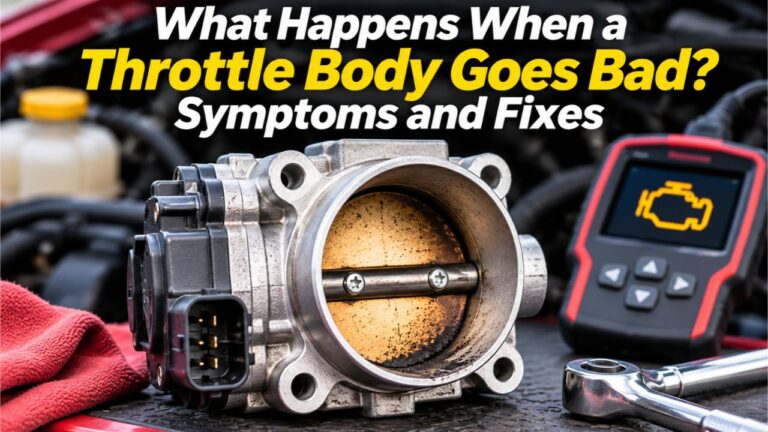
Connect a compatible OBD-II scanner and record stored and pending codes.
Several codes can point toward throttle system faults.
| Code | General meaning |
| P0121 | Throttle/pedal position sensor A range or performance problem |
| P2101 | Throttle actuator control motor range or performance problem |
| P2111 | Throttle actuator control system stuck open |
| P2112 | Throttle actuator control system stuck closed |
| P2135 | Throttle/pedal position sensor signal correlation problem |
| P0506 | Idle control system RPM lower than expected |
| P0507 | Idle control system RPM higher than expected |
These codes don’t automatically prove the throttle body needs replacement.
For example, P2101 could involve actuator operation, wiring, or another control problem.
Record freeze-frame data when available. It shows certain engine conditions at the time a fault was detected.
Step 2: Inspect the Air Intake System
Turn off the engine and allow it to cool.
Check the intake hose between the air filter housing and throttle body.
Look for cracks, disconnected hoses, loose clamps, and damaged fittings.
An air leak can create rough idle symptoms that resemble throttle body trouble.
For example, a cracked intake hose may allow unmetered air into the engine, making the computer struggle to control idle speed.
Step 3: Check for Carbon Deposits
Follow the manufacturer’s instructions to access the throttle opening.
Use a flashlight to inspect the throttle plate and inner housing.
Look for thick, sticky deposits around the plate’s edges.
Safety Note: Never place your fingers inside an electronic throttle body while its motor can operate. Don’t force the plate open or move it without following the factory procedure.
Step 4: Inspect Electrical Connections
Check accessible throttle body connectors with the ignition off.
Look for loose terminals, moisture, damaged insulation, and corrosion.
A connection problem may interrupt an otherwise healthy throttle body’s operation.
A qualified technician can perform additional circuit checks using the correct wiring diagram and diagnostic tools.
Step 5: Check Throttle Operation
Modern diagnostic scan tools can display commanded and actual throttle positions.
A technician may compare these readings during an approved test.
For example, if the computer commands movement but the plate doesn’t respond correctly, further actuator and wiring checks can help identify the fault.
Never apply battery voltage directly to unknown throttle body pins.
That can damage sensitive electronics.
Can Cleaning Fix a Bad Throttle Body?
Cleaning can correct throttle body problems caused by carbon deposits and oily buildup, particularly when those deposits interfere with idle airflow. It won’t repair a failed electronic motor, worn internal gears, defective integrated sensor, or damaged wiring. The right repair depends on what testing identifies.
When Cleaning Is Worth Trying
Cleaning may be appropriate when:
- Carbon buildup is clearly visible.
- Rough idle matches the manufacturer’s cleaning guidance.
- Electrical testing doesn’t indicate a failed component.
- The throttle plate and housing are physically undamaged.
Use a cleaner approved for your throttle body and follow the correct procedure.
Some electronic throttle bodies have coatings that can be damaged by aggressive scrubbing or unsuitable solvents.
Why Cleaning Sometimes Makes Idle Worse
Modern engine computers can learn adjustments that compensate for deposits.
After cleaning, more air may pass around the throttle plate than the computer expects.
This can cause unusually high or unstable idle speed until the learned settings are corrected.
Some vehicles automatically adjust. Others need a specific throttle or idle relearn procedure.
Don’t use a generic relearn method without confirming it applies to your vehicle.
Should You Repair or Replace a Bad Throttle Body?
A throttle body should be cleaned or repaired when the fault involves removable deposits, damaged external wiring, or a separately serviceable component. Complete replacement is more appropriate when internal electronics, gears, or the housing have failed and the manufacturer doesn’t provide a suitable individual repair.
| Confirmed problem | Appropriate repair |
| Carbon buildup | Clean using the approved method |
| Damaged intake hose | Repair or replace the hose |
| Corroded electrical connector | Repair the connection |
| Separately replaceable faulty sensor | Replace the sensor if specified |
| Failed internal throttle motor | Replace or repair according to factory guidance |
| Damaged internal gears | Replace the affected assembly |
| Cracked throttle housing | Replace the damaged component |
| Incorrect learned idle settings | Perform the required relearn |
Does the Entire Throttle Body Need Replacement?
Not always.
Older cable-operated systems may have separately replaceable sensors or idle control components.
Modern electronic throttle bodies often combine several parts into one assembly.
If an integrated component fails, complete replacement may be the approved repair.
For example, replacing an entire electronic throttle body may be necessary when its internal actuator motor has failed and no separate repair is supported.
How Much Does Throttle Body Replacement Cost?
Replacement cost depends on the vehicle, part quality, labor rate, and whether additional calibration is required.
A readily accessible throttle body may need relatively little labor.
Other vehicles require removal of intake components or additional electronic procedures.
An accurate estimate should separate parts, labor, diagnosis, and any required programming.
Before approving replacement, ask which test confirmed the throttle body was defective.
That question can save you from paying for an unnecessary repair.
How Can You Prevent a Throttle Body From Going Bad?
You can reduce throttle body problems by maintaining the air intake system, replacing air filters when required, addressing excessive oil contamination, and repairing damaged electrical connections. Proper cleaning methods also help protect electronic components. Normal wear can still cause failure, even when maintenance is performed correctly.
Maintain the Air Filter and Intake System
Use the correct engine air filter and replace it according to the maintenance schedule.
A damaged or poorly installed filter can allow unwanted dirt into the intake system.
Check that the air filter housing and intake duct are properly sealed.
Address Excessive Oil Deposits
Some oil vapor entering the intake is normal.
Heavy oil contamination deserves investigation.
Check the PCV system and related engine components according to the service manual.
For example, if thick oily deposits quickly return after cleaning, another engine problem may need attention.
Avoid Unnecessary Cleaning
There is no universal mileage interval for throttle body cleaning.
Some vehicles develop deposits faster than others.
Rule of thumb: Clean the throttle body when the manufacturer recommends it or when verified deposits are causing a problem.
Repeated aggressive cleaning can create more trouble than it prevents.
Can You Drive With a Bad Throttle Body?
Driving with a faulty throttle body can be unsafe if it causes stalling, unpredictable acceleration, or sudden loss of engine power. Mild carbon buildup may cause little noticeable trouble, but a serious electronic throttle fault can affect how the vehicle responds to the accelerator. The severity of the symptoms should guide your next action.
For example, a vehicle that unexpectedly enters reduced-power mode while merging onto a highway may not accelerate as expected.
If the engine stalls repeatedly, throttle response becomes unpredictable, or a reduced engine power warning appears, move to a safe location and stop driving.
Arrange professional diagnosis or towing when necessary.
A steady check-engine light without major driving symptoms also deserves attention.
Play it safe rather than treating unreliable throttle operation as a minor inconvenience.
Frequently Asked Questions
Throttle body problems can develop gradually from deposits or appear suddenly because of an electrical fault. The symptoms often overlap with other engine problems, which makes diagnosis more reliable than guessing. These answers address common questions about failure, cleaning, replacement, and vehicle maintenance.
Can a Throttle Body Go Bad Suddenly?
Yes. An electronic throttle body can develop a sudden fault if its actuator motor, sensor, or electrical circuit fails. Carbon buildup usually develops more gradually. A vehicle that unexpectedly loses throttle response or enters reduced-power mode should be inspected before continued driving.
Can a Dirty Air Filter Damage the Throttle Body?
A dirty air filter doesn’t normally damage the throttle body directly. However, a damaged, incorrectly installed, or poorly sealed filter can allow dirt into the intake system. That contamination may contribute to deposits or wear. Replace filters according to the manufacturer’s schedule and inspect the intake housing for leaks.
Can a Bad Throttle Body Cause a Car Not to Start?
Yes, certain throttle body faults can contribute to a no-start condition if airflow is severely restricted or the throttle system cannot operate as required. However, battery problems, ignition faults, and fuel delivery failures are also common causes. A no-start condition needs diagnosis before replacing the throttle body.
How Long Does a Throttle Body Usually Last?
Throttle bodies don’t have a universal replacement interval. Many last for a large portion of a vehicle’s service life, while others develop deposits or electronic faults earlier. Longevity depends on component design, contamination, driving conditions, and electrical reliability. Replace the assembly based on confirmed failure rather than mileage alone.
Will a New Throttle Body Improve Gas Mileage?
A new throttle body may restore normal fuel economy if the original unit was causing poor engine operation. Replacing a properly functioning throttle body generally won’t improve gas mileage. If the engine runs smoothly and airflow control is correct, other maintenance or operating factors may matter more.
What to Do When Your Throttle Body Starts Failing
A throttle body can develop problems because of carbon buildup, oil contamination, failing sensors, worn electronic motors, or damaged electrical connections. Some faults appear gradually, while others can interrupt throttle operation without much warning.
The most useful distinction is between a dirty throttle body and a defective one.
Carbon deposits may only require careful cleaning and, on certain vehicles, an idle relearn. Failed internal electronics, damaged gears, or a cracked housing may require replacement.
Don’t assume that rough idling or hesitation automatically means the entire throttle body has failed. Vacuum leaks, ignition problems, and damaged wiring can produce similar symptoms.
Start by recording diagnostic trouble codes and inspecting the intake system. Then check for visible deposits and electrical damage using the manufacturer’s procedures.
Your next step is to confirm whether the problem is mechanical, electrical, or simply contamination. That diagnosis will tell you whether cleaning, a smaller repair, or complete replacement is the right choice.