Does Tesla Have Catalytic Converter? EV Exhaust System Explained
No, Tesla vehicles do not use catalytic converters. Teslas are battery-electric vehicles, so they do not burn gasoline or diesel inside an internal combustion engine. Without combustion exhaust, there is no need for a catalytic converter, exhaust manifold, muffler, or conventional tailpipe emissions-control system.
A catalytic converter exists to treat harmful gases produced by combustion engines. Gasoline engines create pollutants such as carbon monoxide, unburned hydrocarbons, and nitrogen oxides. Tesla’s electric motors do not produce those exhaust gases.
The U.S. Environmental Protection Agency states that fully electric vehicles produce zero tailpipe emissions. Tesla’s current passenger-vehicle lineup is battery electric, which is why you will not find a conventional exhaust system underneath these vehicles.
For anyone asking does tesla have catalytic converter, the key distinction is that Tesla does not sell conventional gasoline or plug-in hybrid passenger cars. Its vehicles store electricity in a battery pack and use electric motors to move the wheels.
That also means Tesla owners do not face normal catalytic-converter problems such as P0420 catalyst-efficiency codes, clogged converter symptoms, converter overheating, or catalytic-converter theft. Electric vehicles have a different group of components that need inspection and maintenance.
The sections below explain why Teslas do not need catalytic converters, what replaces the gasoline powertrain, which exhaust-related parts are missing, and how Tesla differs from hybrids and conventional cars.
Why Doesn’t a Tesla Need a Catalytic Converter?
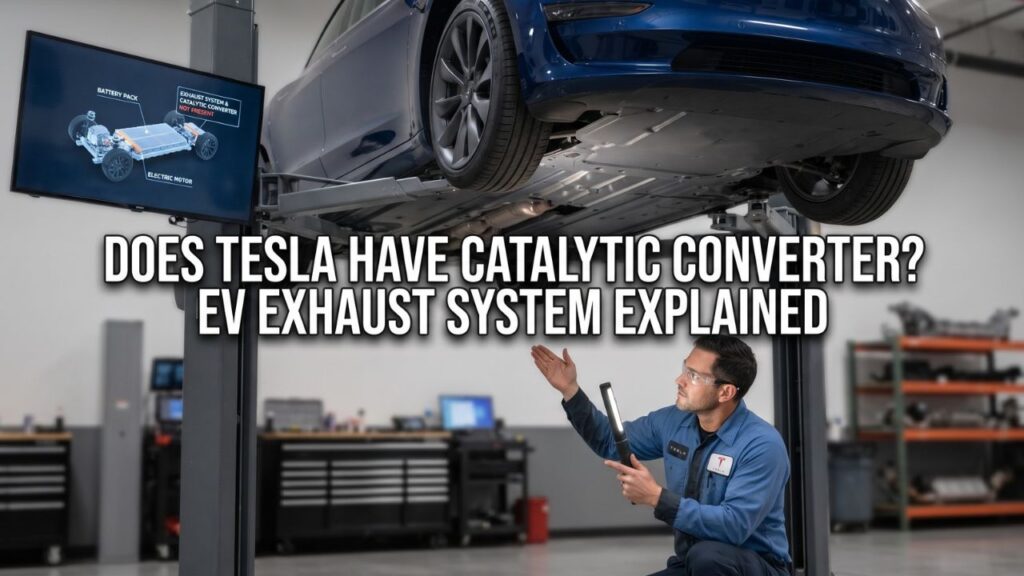
A catalytic converter is only useful when an engine produces combustion exhaust.
Tesla vehicles operate without that type of engine.
Tesla Uses Electric Motors Instead of a Gasoline Engine
A gasoline-powered vehicle creates mechanical energy by burning an air-fuel mixture inside its cylinders.
That combustion creates exhaust gases.
A Tesla takes a different path:
- Electrical energy is stored in the high-voltage battery.
- The inverter controls electrical power sent to the drive motor.
- The electric motor converts electrical energy into mechanical rotation.
- The motor turns the wheels through the drive unit.
Nothing needs to be burned inside cylinders to create propulsion.
Without combustion, there is no stream of hot exhaust gases that needs chemical treatment.
Catalytic Converters Treat Combustion Pollutants
A three-way catalytic converter on a gasoline vehicle mainly reduces:
- Carbon monoxide
- Unburned hydrocarbons
- Nitrogen oxides
The converter contains catalyst materials such as platinum, palladium, and rhodium.
Hot exhaust flows through a coated internal substrate, where chemical reactions change those pollutants into less harmful substances.
A Tesla does not generate those combustion pollutants at a tailpipe, so installing a catalytic converter would serve no purpose.
Tesla Has No Conventional Exhaust Pipe
A typical gasoline exhaust system may include:
- Exhaust manifold
- Oxygen sensors
- Catalytic converter
- Resonator
- Muffler
- Exhaust pipes
- Tailpipe
A battery-electric Tesla does not need that system.
The EPA confirms that electric vehicles have no tailpipe emissions and notes that they use a battery and electric motor rather than a gasoline tank and internal combustion engine.
Key Takeaway: Tesla does not need a catalytic converter because its electric motors produce no combustion exhaust for a catalyst to treat.
Do Any Tesla Models Have a Catalytic Converter?
Tesla’s battery-electric vehicles do not use catalytic converters.
That applies across its passenger-vehicle range.
Tesla Model 3
The Model 3 uses a high-voltage battery and electric drive unit.
It has no gasoline engine, fuel tank, exhaust manifold, catalytic converter, muffler, or tailpipe.
You therefore cannot have a conventional clogged catalytic converter on a Model 3.
Tesla Model Y
The Model Y follows the same battery-electric principle.
Its electric drive system produces no combustion exhaust.
No catalytic converter is needed.
Tesla Model S
The Model S has always been designed around battery-electric propulsion.
It does not use a gasoline range-extender engine, so it has no converter.
Tesla Model X
The Model X is also fully electric.
There is no combustion engine or conventional emissions-control exhaust system underneath it.
Tesla Cybertruck
Cybertruck is battery electric as well. Tesla lists battery capacity, charging, electric power output, and electric drive specifications rather than an internal combustion powertrain.
It therefore does not need a catalytic converter.
Key Takeaway: Model 3, Model Y, Model S, Model X, and Cybertruck use battery-electric propulsion and do not have catalytic converters.
Does a Tesla Have an Exhaust System?
Not a conventional combustion-engine exhaust system.
This is one of the clearest differences between Tesla EVs and gasoline-powered vehicles.
No Exhaust Manifold
A gasoline engine uses an exhaust manifold to collect burned gases leaving the cylinders.
A Tesla has no combustion cylinders.
There is nothing for an exhaust manifold to collect.
No Oxygen Sensors for Exhaust Monitoring
Gasoline vehicles commonly use upstream and downstream oxygen sensors.
The upstream sensor assists with fuel control, while downstream sensor data is often used to monitor catalyst operation.
A Tesla has no exhaust stream requiring those sensors.
That means no conventional:
- Bank 1 Sensor 1
- Bank 1 Sensor 2
- Bank 2 Sensor 1
- Bank 2 Sensor 2
Those terms belong to combustion-engine emissions systems.
No Muffler or Resonator
Mufflers reduce the noise created by exhaust pressure pulses.
Resonators manage selected exhaust sound frequencies.
Since a Tesla has no combustion exhaust pulses, neither component is needed for that purpose.
No Tailpipe
A Tesla does not need a tailpipe for combustion gases.
The EPA describes fully electric vehicles as producing no tailpipe emissions, unlike plug-in hybrids when their gasoline engines are operating.
Key Takeaway: A Tesla lacks the exhaust manifold, oxygen sensors, catalytic converter, muffler, resonator, and tailpipe found on gasoline-powered cars.
Tesla vs. Gasoline Car Emissions Systems
The mechanical differences become clearer when the two vehicle types are compared directly.
| Component | Tesla EV | Gasoline Vehicle |
| Gasoline engine | No | Yes |
| Fuel tank | No | Yes |
| Exhaust manifold | No | Yes |
| Catalytic converter | No | Yes |
| Exhaust oxygen sensors | No | Usually |
| Muffler | No conventional exhaust muffler | Yes |
| Tailpipe | No combustion tailpipe | Yes |
| High-voltage battery | Yes | Usually no |
| Electric drive motor | Yes | Vehicle-dependent |
| Tailpipe emissions | Zero | Yes |
A Tesla still has environmental impacts connected with vehicle manufacturing, battery production, electricity generation, tire wear, and other factors.
Those impacts are separate from tailpipe emissions.
The EPA makes the same distinction: fully electric vehicles have no tailpipe emissions, while emissions may still occur where the electricity used for charging is generated.
Do Hybrid Cars Have Catalytic Converters?
Yes. This is where Tesla and hybrid vehicles differ.
A hybrid may use an electric motor, but it also has an internal combustion engine.
Regular Hybrids Have Catalytic Converters
Vehicles such as many Toyota, Honda, Hyundai, and Ford hybrids still burn gasoline.
Whenever the engine runs, it produces exhaust.
That exhaust needs emissions-control equipment, including a catalytic converter.
Plug-In Hybrids Also Need Catalytic Converters
A plug-in hybrid can drive some distance using electricity alone.
Once its gasoline engine starts, combustion emissions are produced.
The EPA states that plug-in hybrids generate tailpipe emissions when operating on gasoline.
They therefore still need catalytic converters.
Tesla Is Not a Plug-In Hybrid
Tesla passenger vehicles are fully electric rather than plug-in hybrids.
There is no gasoline engine waiting to turn on after battery charge falls.
The vehicle continues operating from battery power until charging is needed.
Key Takeaway: Hybrids and plug-in hybrids still need catalytic converters because they contain combustion engines; Tesla vehicles do not.
Can a Tesla Get a P0420 Catalytic Converter Code?
A battery-electric Tesla will not have a conventional P0420 catalytic-converter fault.
P0420 is an OBD-II diagnostic trouble code generally associated with:
Catalyst System Efficiency Below Threshold, Bank 1
That code requires an engine emissions system with a catalytic converter and exhaust sensors monitoring catalyst performance.
Tesla does not use that powertrain architecture.
Tesla Has Its Own Diagnostic Alerts
Electric vehicles can still detect faults.
A Tesla may report issues related to:
- Battery pack
- Charging system
- Drive unit
- High-voltage isolation
- Cooling system
- Low-voltage electrical system
- Sensors
- Braking system
- Thermal management
Those faults require EV-specific diagnosis.
A generic catalytic-converter troubleshooting approach does not apply.
Can a Tesla Catalytic Converter Be Stolen?
No, because there is no catalytic converter to steal.
Catalytic-converter theft became common on gasoline and hybrid vehicles because converters contain precious metals that can have recycling value.
Teslas do not contain this exhaust component.
Why Hybrids Can Still Be Targets
Some hybrid vehicles have attracted catalytic-converter thieves because they still use gasoline engines and catalytic converters.
A hybrid being partly electric does not make it converter-free.
Tesla differs because it is fully electric.
Other Tesla Components Still Need Security
The absence of a catalytic converter removes one specific theft target.
It does not make the vehicle immune to:
- Wheel theft
- Vehicle theft
- Charging-equipment theft or vandalism
- Exterior component theft
- Property damage
Still, Tesla owners do not need catalytic-converter cages or shields for the vehicle itself.
Does Tesla Use Platinum, Palladium, or Rhodium in a Catalytic Converter?
No catalytic converter means no catalyst-related requirement for those metals.
Traditional automotive catalytic converters commonly use:
- Platinum
- Palladium
- Rhodium
These metals promote chemical reactions in hot exhaust.
A Tesla EV has no hot combustion exhaust requiring such treatment.
That does not mean these elements can never appear anywhere in the supply chain or in unrelated electronic components. The point is that Tesla vehicles do not need them for a conventional catalytic converter.
What Does Tesla Use Instead of an Engine and Exhaust?
Removing the combustion engine changes much more than the catalytic converter.
A Tesla drivetrain centers on electrical components.
High-Voltage Battery Pack
The battery stores electrical energy used for propulsion.
Its capacity and construction vary by vehicle and configuration.
It replaces the gasoline or diesel energy source used by combustion cars.
Electric Drive Motor
The electric motor converts electrical energy into mechanical motion.
Tesla vehicles may use one or more drive motors according to drivetrain configuration.
Unlike a combustion engine, the motor does not need intake and exhaust strokes.
Power Electronics
An inverter and associated electronics control the energy supplied to the motor.
These components manage power delivery rather than fuel injection and ignition timing.
Thermal Management System
Battery packs, power electronics, motors, and the cabin generate or require heat under different conditions.
Tesla uses thermal-management hardware to keep these systems within their intended operating temperature ranges.
This cooling hardware should not be confused with an exhaust system.
Regenerative Braking
Tesla vehicles can recover some kinetic energy during deceleration and return electrical energy to the battery.
A gasoline vehicle commonly loses much of that energy as brake heat.
Regeneration also changes brake-use patterns, although Tesla vehicles still have conventional friction brakes.
Key Takeaway: Tesla replaces the combustion engine and exhaust hardware with a battery pack, electric drive unit, power electronics, thermal management, and regenerative braking.
Do Electric Cars Need Emissions-Control Equipment?
Battery-electric cars do not need tailpipe emissions-control equipment because there is no combustion tailpipe.
That removes many components associated with gasoline emissions.
Components an EV Does Not Need
A full battery EV typically does not require:
- Catalytic converter
- Gasoline evaporative-emissions canister
- Exhaust gas recirculation system
- Exhaust oxygen sensors
- Diesel particulate filter
- Gasoline particulate filter
- Selective catalytic reduction system
Different EV designs can contain unrelated sensors or filtration equipment, but these are not conventional combustion emissions systems.
EVs Still Have Environmental Impacts
Zero tailpipe emissions does not mean zero environmental impact across the vehicle’s entire life.
Electricity generation can produce emissions depending on the local power source.
Vehicle and battery manufacturing also require materials and energy.
Tires and brakes produce particulate wear as well.
The EPA specifically distinguishes tailpipe emissions from emissions associated with electricity generation.
Key Takeaway: Tesla produces zero combustion tailpipe emissions, but electricity generation, manufacturing, tires, and other parts of vehicle use still have environmental impacts.
What Maintenance Does a Tesla Avoid Without a Catalytic Converter?
Removing the combustion engine eliminates several familiar maintenance and repair categories.
No Catalytic Converter Replacement
Tesla owners do not face converter problems such as:
- P0420 caused by catalyst aging
- P0430 catalyst faults
- Melted catalyst substrate
- Clogged converter
- Converter rattling
- Stolen converter
- Converter heat-shield repair
That can remove a costly repair category from long-term ownership.
No Exhaust System Rust Repair
Traditional exhaust pipes and mufflers can rust, crack, or develop leaks.
Tesla does not have a combustion exhaust system requiring those repairs.
No Spark Plugs
Spark plugs ignite the air-fuel mixture in gasoline engines.
An EV motor needs no spark plugs.
No Engine Oil Changes
An electric drive motor does not use crankcase engine oil in the same manner as an internal combustion engine.
Tesla owners therefore do not schedule routine engine-oil and filter changes.
No Fuel Injectors
There is no gasoline being injected into combustion cylinders.
Fuel injectors, high-pressure gasoline pumps, and conventional fuel rails are absent.
Key Takeaway: Without a combustion engine, Tesla avoids catalytic-converter repairs along with spark-plug service, engine-oil changes, fuel-injector problems, and conventional exhaust repairs.
What Can Cause a Tesla to Smell Like Exhaust?
A Tesla should not generate gasoline-engine exhaust.
If you smell exhaust while sitting in or driving a Tesla, consider an external source.
Exhaust From Nearby Vehicles
Traffic can pull fumes toward the cabin air intake.
This is common when sitting behind:
- Diesel trucks
- Buses
- Older gasoline vehicles
- Motorcycles
- Cars with exhaust leaks
The odor can enter temporarily through the ventilation system.
Parking Garage Fumes
Enclosed or partially enclosed garages can contain exhaust from other combustion vehicles.
A Tesla may bring those outside odors into the cabin through ventilation.
Burning Smells Need Separate Attention
A burning odor from a Tesla should not be labeled as catalytic-converter trouble.
Possible sources require inspection and can include:
- Debris touching a hot component
- Electrical fault
- Brake overheating
- Tire contact
- Foreign material
- Cabin HVAC issue
Stop driving and arrange inspection if the smell is strong, persistent, accompanied by smoke, or paired with a warning message.
Key Takeaway: Tesla cannot create normal gasoline exhaust, so exhaust odor usually comes from another vehicle or surrounding air; persistent burning smells require a different diagnosis.
Can You Add a Catalytic Converter to a Tesla?
There is no practical reason to install one.
A catalytic converter needs a stream of combustion exhaust flowing through its catalyst substrate.
A Tesla has no such exhaust stream.
Installing an unused converter under the car would:
- Provide no emissions benefit
- Add weight
- Add cost
- Serve no mechanical function
Catalytic converters belong to combustion powertrains, not battery-electric propulsion systems.
Does Tesla Have a Muffler?
No conventional exhaust muffler is required.
A muffler exists mainly to reduce sound from combustion exhaust pulses.
Electric motors produce different types of noise, such as motor whine, tire noise, gear noise, cooling-system sounds, and airflow.
Those sounds are managed through vehicle insulation, acoustic materials, drivetrain engineering, and body design rather than a traditional exhaust muffler.
Will Tesla Ever Need a Catalytic Converter?
A fully battery-electric Tesla will not need one as long as it remains a vehicle with no onboard combustion engine.
If a manufacturer built a vehicle with both a battery-electric drive system and a gasoline range extender, that combustion engine could require emissions equipment.
Tesla’s battery-electric design does not use such an engine in its current passenger vehicles.
That means the underlying reason remains simple: no combustion exhaust means no catalytic converter.
Conclusion
So, does tesla have catalytic converter? No. Tesla vehicles are battery electric and do not burn gasoline or diesel inside an internal combustion engine. They therefore produce no combustion tailpipe exhaust that would require catalytic treatment.
A Tesla does not use the conventional chain of exhaust manifold, oxygen sensors, catalytic converter, muffler, and tailpipe found underneath gasoline-powered cars.
This also means Tesla owners do not face common converter problems such as clogging, P0420 catalyst-efficiency faults, converter overheating, rattling catalyst cores, or catalytic-converter theft.
Tesla vehicles still require maintenance and can develop electrical, battery, cooling, suspension, brake, tire, and drive-unit problems. Those systems are simply different from the emissions hardware found on combustion vehicles.
FAQs About Tesla and Catalytic Converters
Do Tesla Model 3 cars have catalytic converters?
No. The Tesla Model 3 is fully electric. It has no gasoline engine and produces no combustion exhaust, so it does not need a catalytic converter, exhaust manifold, muffler, or conventional tailpipe.
Does a Tesla Model Y have a catalytic converter?
No. Model Y uses battery-electric propulsion. Electricity stored in its high-voltage battery powers the drive motor, so no combustion gases are created and no converter is required.
Does Tesla Cybertruck have a catalytic converter?
No. Cybertruck is battery electric. It does not have a gasoline or diesel engine producing exhaust, which eliminates the need for a catalytic converter and conventional emissions exhaust system.
Can someone steal a catalytic converter from a Tesla?
No. There is no catalytic converter underneath a Tesla to steal. Converter theft applies mainly to gasoline and hybrid vehicles that use combustion engines and precious-metal catalyst materials.
Do hybrid electric cars have catalytic converters?
Yes, hybrids generally do. They use gasoline engines alongside electric motors, and the gasoline engine produces exhaust. A hybrid therefore needs emissions equipment such as a catalytic converter. Tesla vehicles are fully electric rather than hybrids.
Can a Tesla get a P0420 code?
A battery-electric Tesla does not have a conventional catalytic converter monitored by exhaust oxygen sensors, so the normal gasoline-vehicle P0420 catalyst-efficiency fault does not apply. Tesla uses its own diagnostic system for EV-related faults.
Does Tesla have an exhaust pipe?
No conventional combustion exhaust pipe is required. Tesla’s electric motors do not create burned fuel gases that need to be routed through a catalytic converter, muffler, and tailpipe.
Why doesn’t an electric car need a catalytic converter?
A catalytic converter treats pollutants created when gasoline or diesel burns inside an engine. An electric car uses stored electricity to run an electric motor. Since there is no combustion exhaust, there are no tailpipe pollutants for a catalytic converter to process.