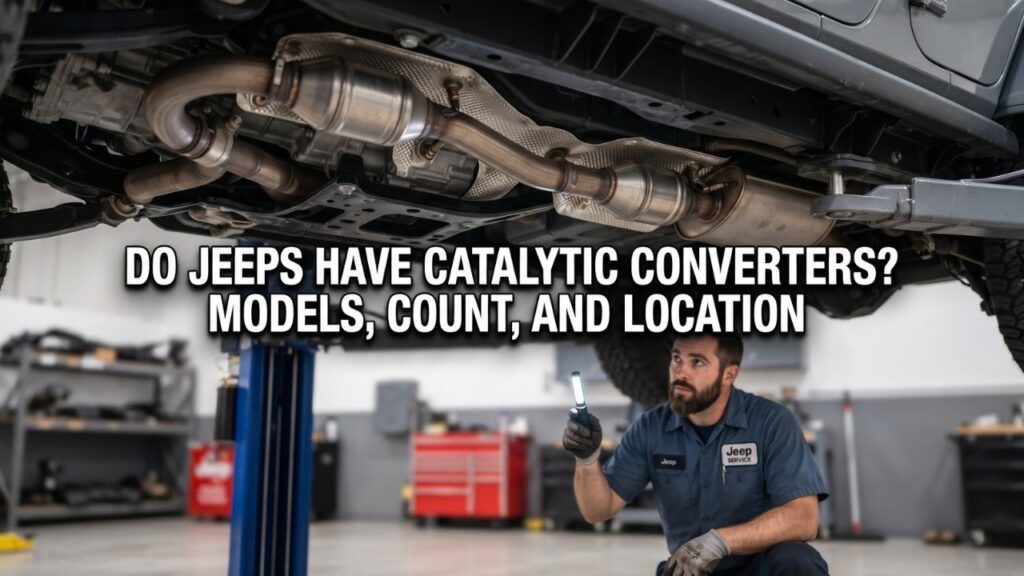
Do Jeeps Have Catalytic Converters? Models, Count, and Location
Yes. Nearly every modern gasoline-powered Jeep has at least one catalytic converter, and many engines use two or more catalyst sections. Jeep 4xe plug-in hybrids also need catalytic converters because they still have gasoline engines. A fully electric Jeep does not need one because it produces no engine exhaust.
The exact setup varies by model year, engine, emissions package, and exhaust layout. A four-cylinder Jeep may use one main converter assembly, while a V6 or V8 can use separate converters for the two cylinder banks. Some systems also contain more than one catalyst stage.
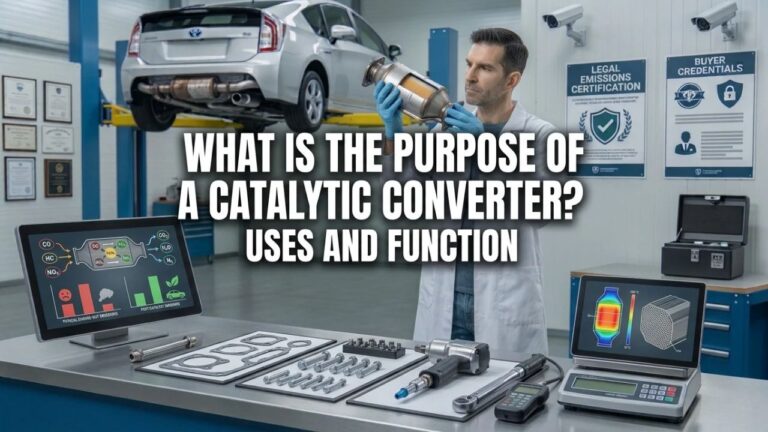
Catalytic converters are part of the emissions system, sitting in the exhaust path between the engine and tailpipe. Their job is to convert carbon monoxide, unburned hydrocarbons, and nitrogen oxides into less harmful exhaust products before gases leave the vehicle.
For U.S. owners, catalytic converters receive special federal emissions-warranty treatment. The EPA states that catalytic converters are specified major emission-control components covered for 8 years or 80,000 miles on eligible light-duty vehicles, subject to the federal warranty conditions.
The answer to do Jeeps have catalytic converters is therefore yes for normal modern gasoline and hybrid Jeep models. Current Mopar parts catalogs list converters for Wrangler, Grand Cherokee, Grand Cherokee 4xe, Compass, Gladiator, and other combustion-engine Jeep applications.
Older Jeeps need a more careful answer. Very early models built before catalytic converters became common may not have one, and exhaust systems on modified older Jeeps may no longer match their factory configuration. The sections below explain which Jeep types use converters, how many may be fitted, where to find them, and how to identify the setup on your own vehicle.
Do Jeeps Have Catalytic Converters in Modern Models?
Modern Jeeps with gasoline engines use catalytic converters as part of their emissions systems.
That includes mainstream models such as Wrangler, Gladiator, Grand Cherokee, Grand Cherokee L, and Compass.
Jeep Wrangler
Modern Wrangler models have catalytic converters.
Mopar’s current catalog lists catalytic-converter assemblies for 2024–2026 Jeep Wrangler applications, including 2.0-liter turbo models. Mopar also lists converters in the exhaust system for Wrangler 4xe models.
The number and exact position vary with engine choice.
A four-cylinder turbo exhaust layout is different from a V6 layout, and Wrangler 4xe combines an electric drive system with a gasoline engine, so it still needs exhaust-emissions hardware.
Jeep Gladiator
The Gladiator also uses catalytic converters.
For a 2025 Gladiator with the 3.6-liter V6, current parts information lists a converter on the driver side and another on the passenger side, showing a dual-bank setup.
This arrangement places catalyst material relatively close to the engine, where exhaust temperatures rise quickly after startup.
Jeep Grand Cherokee
Grand Cherokee models with combustion engines use catalytic converters.
Mopar catalogs include catalytic-converter assemblies for both older and newer Grand Cherokees. A current parts listing for the 2025 Grand Cherokee L 3.6-liter V6 identifies separate driver-side and passenger-side converter assemblies.
Older V8, V6, diesel, and newer turbo or hybrid versions may use different layouts.
Jeep Compass
Current Compass models also have catalytic converters.
Mopar’s 2026 Compass exhaust catalog lists a catalytic converter connected near the turbocharger on the 2.0-liter turbo engine. The same general converter assembly appears in 2024 and 2025 Compass exhaust catalogs.
Jeep 4xe Plug-In Hybrids
A Jeep 4xe still has a gasoline engine.
That means the vehicle still produces exhaust whenever the engine runs and therefore still uses catalytic emissions equipment.
Mopar’s current 2025 Wrangler 4xe and Grand Cherokee 4xe exhaust catalogs both list catalytic converters.
The fact that the Jeep can travel for periods on electric power does not remove the need for a converter when its engine starts.
Key Takeaway: Modern gasoline Jeeps and Jeep 4xe plug-in hybrids use catalytic converters. The number and arrangement change with engine and exhaust design.
Do Electric Jeeps Have Catalytic Converters?
A battery-electric Jeep does not need a catalytic converter because it does not burn gasoline or diesel fuel.
A catalytic converter only works on engine exhaust gases.
Jeep Wagoneer S
The Wagoneer S is an all-electric Jeep.
Jeep’s current specifications list its powertrain as all electric, with no cylinder configuration and no gasoline engine. Since there is no combustion exhaust system, there is no catalytic converter to treat tailpipe gases.
This same principle applies to any fully battery-electric vehicle.
Hybrid and Electric Are Not the Same Here
A plug-in hybrid has both an electric drive system and an internal-combustion engine.
A full EV has no combustion engine.
That creates a simple distinction:
| Jeep powertrain | Catalytic converter? |
| Gasoline | Yes |
| Diesel | Uses exhaust-treatment catalysts |
| Plug-in hybrid 4xe | Yes |
| Full battery electric | No |
Diesel exhaust systems can contain oxidation catalysts, particulate filters, and selective catalytic reduction components rather than the simpler layout seen on many gasoline vehicles.
Key Takeaway: Fully electric Jeeps do not need catalytic converters. Jeep 4xe models still use them because their gasoline engines produce exhaust.
How Many Catalytic Converters Does a Jeep Have?
There is no single number for every Jeep.
Some use one converter assembly, while others use two or multiple catalyst sections.
Four-Cylinder Jeeps May Use One Main Converter Assembly
A turbocharged four-cylinder engine commonly has a close-coupled catalyst near the turbo or exhaust outlet.
The current Jeep Compass 2.0-liter turbo parts catalog lists one main catalytic-converter assembly in its exhaust diagram.
The exact internal catalyst arrangement may contain multiple catalyst zones even when the parts catalog describes the unit as one assembly.
V6 Jeeps Often Have Two Primary Converters
A V6 has two cylinder banks.
Many Jeep V6 exhaust layouts therefore use one catalyst path for each bank.
Current 2025 Gladiator 3.6-liter parts information lists:
- Driver-side converter
- Passenger-side converter
The 2025 Grand Cherokee L 3.6-liter catalog uses a similar driver-side and passenger-side arrangement.
Some Jeep Engines Use More Than Two Catalyst Sections
A vehicle can contain primary converters near the engine plus downstream catalyst material farther along the exhaust.
This is why counting visible canisters under the Jeep does not always tell the full story.
Some catalyst sections may be integrated into:
- Exhaust manifolds
- Front pipes
- Turbo outlet assemblies
- Diesel particulate-filter assemblies
- Larger converter-and-pipe units
If you need an exact number for parts replacement, theft protection, or repair planning, use the year, model, engine, VIN, and emissions package rather than a Jeep-wide rule.
Key Takeaway: A Jeep may use one, two, or several catalyst sections. Four-cylinder and V6 layouts can differ sharply, so check the exact engine and VIN.
Where Is the Catalytic Converter Located on a Jeep?
The catalytic converter sits in the exhaust system after combustion gases leave the engine.
Modern emissions systems commonly place at least some catalyst material close to the engine so it heats rapidly.
Near the Exhaust Manifold
On naturally aspirated engines, converters may sit near the exhaust manifolds.
A V6 can have one converter on each side of the engine, following the exhaust flow from each cylinder bank.
This layout can make the converters less obvious than a large single canister located farther beneath the vehicle.
Near the Turbocharger
Turbocharged Jeeps may place the converter close to the turbo outlet.
Mopar’s current Compass catalog refers to hardware connecting the catalytic converter to the turbo, which confirms this close-coupled location on the 2.0-liter turbo application.
Current Wrangler parts listings also identify converter-to-turbocharger connections on applicable engines.
Under the Vehicle
Older designs and secondary catalyst sections may sit farther downstream beneath the Jeep.
A traditional layout follows this path:
Engine → exhaust manifold → catalytic converter → exhaust pipe → muffler → tailpipe
The exact sequence can change when multiple converters, resonators, particulate filters, or turbochargers are present.
Why Modern Converters Sit Close to the Engine
Catalysts need heat before their chemical reactions work well.
Mounting them closer to the engine exposes them to hotter exhaust sooner after startup.
This is why newer converters may be tucked high in the engine bay or close to the exhaust manifold rather than hanging in an easily visible section near the center of the vehicle.
Key Takeaway: Look between the engine and muffler, with special attention near the exhaust manifolds or turbocharger. Modern Jeep converters are often mounted close to the engine.
Did Older Jeeps Always Have Catalytic Converters?
No.
Very old Jeeps can predate widespread catalytic-converter use.
The EPA states that catalytic converters have been installed on most U.S. cars and trucks since 1975. Vehicles from earlier eras may therefore have no factory converter at all.
Pre-Emissions-Era Jeeps
Classic CJ, military, and early civilian Jeep models may have been built before catalytic converters became standard emissions hardware.
Their exhaust systems can also have been changed several times over decades of ownership.
Do not determine what an old Jeep should have solely from what is installed today.
Later Cherokee and Wrangler Models
Jeep warranty material from earlier model years specifically lists catalyst coverage for Cherokee and Wrangler applications, confirming factory catalyst use on these models during the emissions-control era.
A 1993 Cherokee 4.0-liter service procedure, for example, includes removal and installation instructions for its catalytic converter.
Modified Off-Road Jeeps
A modified older Jeep may have an exhaust system that no longer matches factory equipment.
Previous owners may have replaced:
- Exhaust manifolds
- Header pipes
- Catalytic converters
- Mufflers
- Complete exhaust systems
Removal of required emissions equipment for street use can violate federal anti-tampering law.
For an older Jeep, I would use the VIN and factory emissions information to establish what equipment it originally required.
Key Takeaway: Very old Jeeps may predate catalytic converters, but gasoline Jeeps from the modern emissions era normally use them. Modified older vehicles need VIN-specific verification.
How to Tell if Your Jeep Has a Catalytic Converter
You can usually identify the converter through the exhaust layout, parts information, or vehicle emissions data.
Follow the Exhaust From the Engine
With the Jeep completely cool and safely positioned, look along the exhaust path.
A converter commonly looks like a widened metal chamber built into the exhaust pipe.
It may have:
- Stainless-steel shell
- Heat shield
- Oxygen sensor before it
- Oxygen sensor after it
- Flanges or welded connections
Do not crawl beneath a vehicle supported only by a jack.
Check the Underhood Emissions Label
The emissions label can identify the vehicle’s certified emissions configuration.
Older EPA guidance notes that catalyst-equipped vehicles may identify catalyst use on their emissions labeling.
Modern labeling varies, so use it together with the VIN and parts catalog.
Look Up the VIN
The VIN identifies the exact engine and vehicle configuration.
A Jeep dealer or OEM parts catalog can use that information to identify the converter assemblies fitted to the vehicle.
This is the best approach when a model year offered several engines.
Check for Oxygen Sensors
Gasoline catalyst systems normally use oxygen sensors around the converter.
A sensor mounted ahead of the catalyst monitors exhaust from the engine, while a downstream sensor may be used to monitor catalyst operation.
Sensor presence does not tell you the exact converter count, but it can make the catalyst section easier to locate.
Key Takeaway: Visual inspection, the emissions label, VIN-specific parts information, and oxygen-sensor placement can identify the converter layout on your Jeep.
What Does the Catalytic Converter Do on a Jeep?
The converter changes harmful exhaust pollutants through chemical reactions.
For gasoline vehicles, a three-way catalyst targets three main pollutant groups:
- Carbon monoxide
- Hydrocarbons
- Nitrogen oxides
The EPA describes catalytic converters as major emissions components that convert these pollutants into less harmful substances before exhaust leaves the vehicle.
Catalyst Metals Drive the Reactions
Converters use catalyst materials such as:
- Platinum
- Palladium
- Rhodium
These metals coat a honeycomb-like substrate with many small exhaust passages.
The catalyst itself is not consumed in the same way as fuel, though contamination, extreme heat, impact, and age can damage the structure.
Oxygen Sensors Work With the Converter
The engine computer uses oxygen-sensor information to manage the air-fuel mixture and monitor catalyst behavior.
When downstream sensor activity suggests the converter is no longer storing and processing oxygen as expected, the computer may set codes such as P0420 or P0430.
A catalyst code still needs diagnosis because sensor faults, exhaust leaks, and engine problems can influence the monitor.
Key Takeaway: Jeep catalytic converters reduce harmful exhaust pollutants, while oxygen sensors and the engine computer monitor conditions around the catalyst.
Signs a Jeep Catalytic Converter May Be Bad
A converter can lose chemical activity, become contaminated, break internally, or clog.
The symptoms vary with the type of failure.
Check Engine Light
P0420 or P0430 may appear when catalyst operation drops below the computer’s expected threshold.
Do not replace the converter based solely on the code.
Weak Acceleration
A clogged converter restricts exhaust flow.
A Jeep may idle acceptably but lose power during:
- Hard acceleration
- Highway merging
- Hill climbing
- Higher engine speeds
- Towing
Rotten-Egg Smell
A sulfur-like odor can accompany abnormal catalyst or fuel-system operation.
A rich-running engine may also create the condition, so the smell does not identify the converter by itself.
Rattling Noise
Broken catalyst material can rattle inside the metal housing.
The sound may be noticeable during startup, idle, or throttle changes.
Excessive Heat
A severe misfire or rich mixture can send unburned fuel into the exhaust and overheat the converter.
A glowing converter, smoke, or extreme heat beneath the Jeep calls for prompt attention.
Key Takeaway: Catalyst codes, weak acceleration, sulfur odor, rattling, and unusual heat are common converter warning signs, but the engine should be diagnosed before replacing the part.
Can You Drive a Jeep Without a Catalytic Converter?
A modern Jeep designed with a converter should not be operated on public roads with that required emissions device removed.
The EPA’s converter policy treats removal or disabling of required emissions equipment as tampering under the Clean Air Act.
A missing converter can also cause:
- Check Engine light
- Catalyst-monitor codes
- Louder exhaust
- Exhaust odor changes
- Emissions-test failure
- Problems with vehicle registration in emissions-test areas
Replacing a failed converter with the correct vehicle-approved unit is the proper repair.
Conclusion
If your question is do Jeeps have catalytic converters, the answer is yes for nearly all modern gasoline-powered Jeep vehicles. Wrangler, Gladiator, Grand Cherokee, Compass, and Jeep 4xe models all use catalyst-equipped exhaust systems.
The exact number varies. A turbo four-cylinder may use one main converter assembly, while V6 applications can use separate driver- and passenger-side converters. Some exhaust systems contain extra catalyst sections or combine catalysts with other emissions components.
Fully electric Jeeps are the main modern exception because they have no combustion exhaust. Very old Jeeps built before widespread catalyst use may also lack a factory converter.
I would check the VIN before ordering parts or deciding how many converters a Jeep has. Model name alone is not enough when the same Jeep was sold with several engines and emissions packages.
FAQs About Jeep Catalytic Converters
Do Jeep Wranglers Have Catalytic Converters?
Yes. Modern Jeep Wranglers use catalytic converters.
Current Mopar catalogs list catalytic-converter assemblies for gasoline Wrangler models and Wrangler 4xe applications. The exact number and location change with engine and model year.
How Many Catalytic Converters Does a Jeep Wrangler Have?
The number varies by engine and year.
Some Wrangler exhaust systems use multiple catalyst sections, while others package catalyst material into fewer assemblies. Use the VIN and OEM exhaust diagram to get the correct count for a specific Wrangler.
Does a Jeep Grand Cherokee Have a Catalytic Converter?
Yes. Gasoline and plug-in-hybrid Grand Cherokee models have catalytic converters.
Current 3.6-liter Grand Cherokee L parts information lists separate driver-side and passenger-side converter assemblies, while other engines use different layouts.
Does a Jeep Compass Have a Catalytic Converter?
Yes.
Current Jeep Compass models with the 2.0-liter turbo gasoline engine use a catalytic converter mounted near the turbocharger in the exhaust system.
Does a Jeep 4xe Have a Catalytic Converter?
Yes.
A 4xe is a plug-in hybrid rather than a full EV. Its gasoline engine produces exhaust whenever it runs, so Wrangler 4xe and Grand Cherokee 4xe models use catalytic converters.
Do Electric Jeeps Have Catalytic Converters?
No. A full battery-electric Jeep has no gasoline or diesel engine and produces no combustion exhaust.
The all-electric Jeep Wagoneer S therefore does not need a catalytic converter.
Where Is the Catalytic Converter on a Jeep?
It is located in the exhaust system between the engine and the muffler.
On newer Jeeps, it is often close to the exhaust manifold or turbocharger. V6 models may have separate converter assemblies on the driver and passenger sides.