How Many Catalytic Converters Are on a Ford F-150? Full Guide
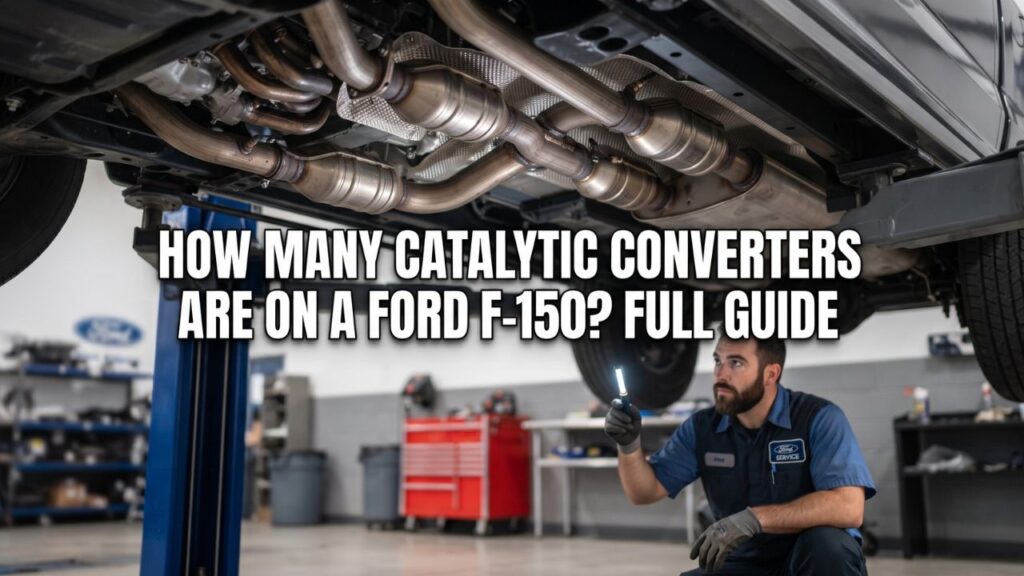
Most gasoline Ford F-150s use two main catalytic-converter assemblies—one for each cylinder bank. Some older F-150 engines use four individual catalyst sections, with two positioned in each side of the exhaust. The exact count depends on model year, engine, emissions package, and how individual catalyst bricks are counted.
This last point explains much of the confusion. Ford may sell a complete left-side exhaust section as one converter assembly, even though that welded assembly can contain more than one catalyst brick.
Older F-150s are especially likely to create conflicting answers. Repair information for 2004–2006 trucks states that the 4.6L and 5.4L V8 versions use four catalysts—an upstream and downstream catalyst in each exhaust pipe—while the 4.2L V6 uses two.
Newer Ford parts catalogs commonly list separate driver-side and passenger-side catalytic-converter assemblies. For example, Ford parts listings for the 2020 2.7L, 3.3L, 3.5L EcoBoost, and 5.0L F-150 identify left and right converter assemblies. Current 2024 catalogs follow the same left/right arrangement for several gasoline engines.
So, for how many catalytic converters are on a Ford F150, the safest short answer is two main converter assemblies on most newer gasoline trucks, but some F-150 configurations have four individual catalyst sections. You need the year and engine to give an exact count.
Below, I’ll break down the common F-150 configurations, explain why one source may say two while another says four, show where the converters sit, and cover Bank 1 versus Bank 2, oxygen sensors, replacement, and identification.
How Many Catalytic Converters Are on a Ford F150?
There is no single converter count that applies to every Ford F-150 ever built.
The truck has been offered with V6, V8, turbocharged EcoBoost, hybrid, and diesel powertrains across many generations.
For most modern gasoline F-150s, expect a left and right catalytic-converter assembly, one serving each side of the engine.
Older trucks may contain two catalyst bricks inside each bank’s welded exhaust assembly, creating four actual catalytic sections.
Two-Converter Setup
A two-unit arrangement generally means:
- One converter or converter assembly on Bank 1
- One converter or converter assembly on Bank 2
Ford parts catalogs show this left/right arrangement on many F-150 engines from the 2010s and 2020s.
For example, the 2020 5.0L Ford catalog lists a separate right converter and left converter. The 2020 3.5L EcoBoost catalog does the same.
Four-Catalyst Setup
Some F-150 exhaust systems contain:
- One upstream catalyst on Bank 1
- One downstream catalyst on Bank 1
- One upstream catalyst on Bank 2
- One downstream catalyst on Bank 2
That gives four catalyst sections.
Repair-manual information for the 2004–2006 4.6L and 5.4L V8 specifically describes four catalysts, with an upstream and downstream catalyst in each exhaust pipe.
California emissions documentation also records a 2000 4.6L F-150 test vehicle using two front and two rear converters, confirming that four-converter F-150 configurations existed from the factory.
Why Parts Stores May Still Say the Truck Has Two
Two catalysts on the same side may be welded into one complete assembly.
The replacement catalog may therefore show:
- Left converter assembly
- Right converter assembly
A mechanic inspecting the pipe may count four catalyst housings or catalyst bricks, while a parts catalog counts two replaceable assemblies.
Both descriptions can refer to the same exhaust system.
Key Takeaway: Most newer gasoline F-150s are serviced as two left/right converter assemblies, while several older V8 systems contain four individual catalyst sections—two per bank.
Ford F-150 Catalytic Converter Count by Engine and Generation
The following breakdown covers common U.S. configurations. Exact emissions packages can vary, so the VIN and underhood emissions label remain the best final checks.
| F-150 Configuration | Common Converter Layout |
| Older 4.2L V6 | Commonly 2 |
| 1997–2000s 4.6L V8 | 2 or 4 depending on year/emissions design |
| 2004–2006 4.6L V8 | 4 catalyst sections |
| 1997–2010 5.4L V8 | Often multiple catalyst sections; configuration varies |
| 2009–2014 gasoline F-150 | Commonly left/right converter assemblies |
| 2011+ 3.5L EcoBoost | Commonly left/right assemblies |
| 2015+ 2.7L EcoBoost | Commonly left/right assemblies |
| 2011+ 5.0L V8 | Left/right assemblies; individual catalyst sections may vary |
| 2018+ 3.3L V6 | Left/right exhaust catalyst arrangement in applicable catalogs |
| 2021+ 3.5L PowerBoost | Left/right catalyst arrangement |
| 3.0L Power Stroke diesel | Uses a more complex diesel aftertreatment system |
This table is a starting point rather than a substitute for VIN-specific parts information.
1997–2003 Ford F-150
Many trucks from this era are described as having four catalyst sections.
Information for 1997–2003 F-150 oxygen-sensor layouts shows four O2 sensors across the two exhaust banks, with sensors positioned around the catalyst system.
Four-catalyst systems are especially associated with some V8 applications from this generation.
Do not assume every 4.2L V6 uses the same arrangement as a 4.6L or 5.4L V8.
2004–2006 Ford F-150
This generation gives one of the clearest examples of engine-dependent converter count.
Repair-manual information states:
- 4.2L V6: two converters
- 4.6L V8: four catalysts
- 5.4L V8: four catalysts
On the V8, each side contains an upstream and downstream catalyst inside a welded assembly.
This is why an owner of a 2005 5.4L may physically see four enlarged catalyst sections under the truck even though a replacement catalog sells left and right assemblies.
2009–2014 Ford F-150
Ford parts catalogs for this era frequently identify a separate driver-side and passenger-side converter assembly.
A 2010 4.6L listing, for example, identifies separate right and left converters. Ford listings for other engines follow a similar bank-specific design.
A 2011 3.5L F-150 catalog also lists one right and one left catalytic converter assembly.
Some assemblies can contain more than one catalyst section, so physical catalyst count and service-part count may not match.
2015–2020 Ford F-150
Most gasoline versions in this generation are serviced with left and right converter assemblies.
The 2020 Ford parts catalog lists passenger-side and driver-side converters for:
- 2.7L
- 3.3L
- 3.5L EcoBoost
- 5.0L
The 3.5L EcoBoost also has application differences based on exhaust configuration.
For a typical owner trying to buy a replacement part, thinking in terms of two bank-specific converter assemblies is usually the most useful approach.
2021 and Newer Ford F-150
The newer generation continues to use engine-specific left/right catalyst components.
Ford parts information for the 2024 F-150 lists driver- and passenger-side converters across multiple gasoline applications, including the 3.5L and 5.0L.
The PowerBoost hybrid still uses a gasoline engine and requires an exhaust emissions system, so the presence of a hybrid electric motor does not eliminate catalytic converters.
Key Takeaway: Converter count changes across F-150 generations, with older V8s often having four catalyst sections and newer gasoline trucks commonly using two bank-specific converter assemblies.
Why Does a Ford F-150 Need More Than One Catalytic Converter?
Most F-150 V6 and V8 engines have two cylinder banks.
Each bank has its own exhaust path near the engine.
One Exhaust Path for Each Bank
On a V-engine, one row of cylinders forms Bank 1 and the other forms Bank 2.
Exhaust leaves both sides separately before the pipes merge farther downstream on many models.
Placing catalyst material in each path lets both banks receive exhaust treatment while the gases are still hot.
Faster Catalyst Warm-Up
Catalytic converters need heat before they operate at their intended conversion rate.
Placing primary catalyst material near the engine gets it hot soon after startup.
This reduces cold-start emissions.
Primary and Secondary Catalyst Stages
Some older F-150 systems use more than one catalyst stage in each exhaust pipe.
The front catalyst receives very hot exhaust near the engine.
A second catalyst farther downstream provides more catalyst volume and another emissions-treatment stage.
That arrangement creates the four-catalyst layouts found on some older trucks.
Key Takeaway: Multiple converters let Ford treat exhaust from both cylinder banks and, on some designs, use separate primary and secondary catalyst stages.
Where Are the Catalytic Converters on a Ford F-150?
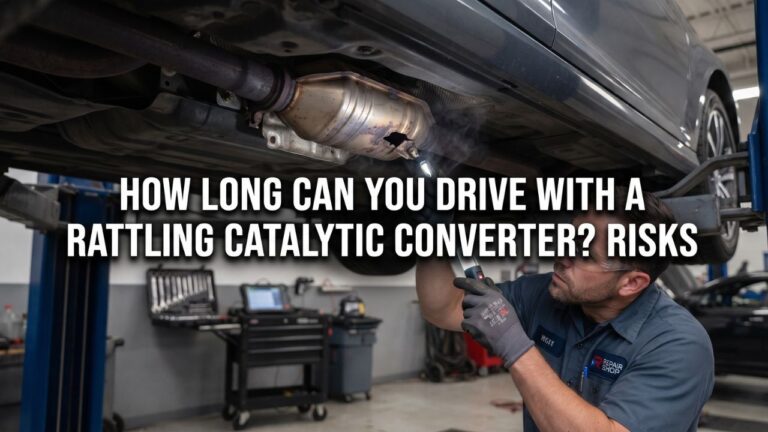
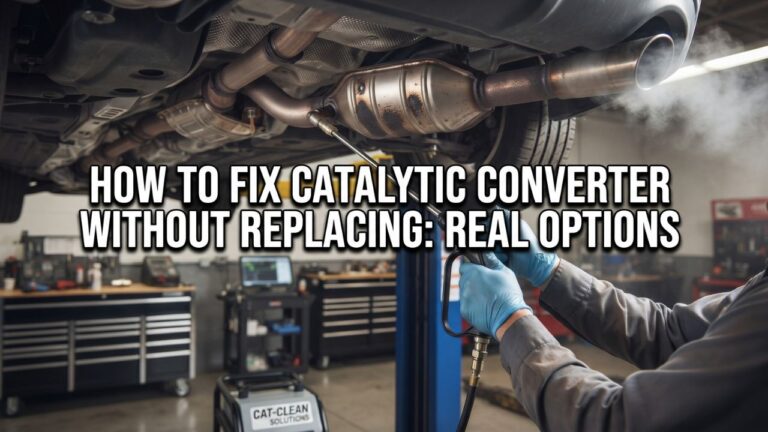
The converters are in the exhaust system between the engine and muffler.
Exact placement varies with the engine.
Driver-Side Converter
One exhaust path leaves the driver-side cylinder bank and runs into the driver-side converter assembly.
Parts catalogs commonly call this the left catalytic converter.
Passenger-Side Converter
The opposite cylinder bank feeds the passenger-side assembly.
Parts catalogs identify this as the right catalytic converter.
Ford parts listings for 2015, 2020, 2021, and 2024 trucks repeatedly use driver-side/left and passenger-side/right converter descriptions.
Older Four-Catalyst Systems
On a four-catalyst system, follow either exhaust pipe away from the engine.
You may find one enlarged catalyst section followed shortly by another.
Repeat the same inspection on the opposite bank.
This gives two catalyst sections per side.
Does the Ford F-150 5.0 Have Two or Four Catalytic Converters?
This question causes a lot of conflicting answers because people count different parts.
Modern 5.0L F-150 parts catalogs often treat the system as two converter assemblies, one on each bank.
For example, the 2020 5.0L catalog lists one right converter and one left converter.
Some 5.0L exhaust assemblies may contain multiple catalyst sections within those larger assemblies, which leads technicians or aftermarket sellers to describe the truck as having four catalysts.
If you are replacing a converter, the number of serviceable assemblies is more useful than the number of catalyst bricks inside them.
Use the VIN when ordering rather than buying based on a generic statement that every 5.0L has two or four.
How Many Catalytic Converters Does a 3.5 EcoBoost F-150 Have?
The common service layout uses two catalytic-converter assemblies, one for each engine bank.
Ford’s 2020 3.5L EcoBoost catalog lists separate right and left converters. The 2024 catalog continues to list passenger- and driver-side 3.5L EcoBoost converter components.
Turbochargers change exhaust routing, so these converters are positioned differently from those on naturally aspirated engines.
Do not order a 3.5L converter based only on engine displacement. Build date, single versus dual outlet configuration, and other application details can change part numbers.
How Many Catalytic Converters Does a 2.7 EcoBoost Have?
A modern 2.7L EcoBoost F-150 commonly uses two bank-specific converter assemblies.
The 2020 Ford parts catalog identifies separate passenger-side and driver-side converter assemblies for the 2.7L engine.
As with the 3.5L, the correct replacement depends on year, emissions certification, build details, and converter position.
What About the F-150 PowerBoost Hybrid?
The PowerBoost combines a gasoline engine with an electric hybrid system.
Because the gasoline engine still burns fuel and produces exhaust, it still needs catalytic emissions treatment.
Ford’s 2024 exhaust catalog lists catalytic-converter components for the 3.5L PowerBoost alongside the other F-150 engines.
The hybrid system therefore does not mean the truck is converter-free.
What About the 3.0L Power Stroke Diesel F-150?
The diesel F-150 is different from the gasoline versions.
Diesel emissions systems can combine several aftertreatment components, such as:
- Diesel oxidation catalyst
- Diesel particulate filter
- Selective catalytic reduction components
- Diesel exhaust fluid dosing equipment
Ford’s 2020 F-150 catalog lists the 3.0L system separately as a diesel aftertreatment/filter assembly rather than the same simple left/right gasoline converter setup.
For a diesel truck, do not use a gasoline F-150 converter count as your parts reference.
Bank 1 vs Bank 2 Catalytic Converter on an F-150
Diagnostic trouble codes may identify a converter by bank rather than by left or right side.
What Is Bank 1?
Bank 1 is the side of the engine containing cylinder number 1.
It is not safe to assume Bank 1 is always the driver or passenger side across every engine.
Check the firing order or factory service information for the exact engine.
What Is Bank 2?
Bank 2 is the opposite cylinder bank.
Codes such as P0430 may reference Bank 2 catalyst efficiency.
P0420 and P0430
Common codes include:
- P0420 — Catalyst System Efficiency Below Threshold, Bank 1
- P0430 — Catalyst System Efficiency Below Threshold, Bank 2
These codes identify catalyst-system efficiency trouble on a specific bank.
They do not automatically mean every converter section on that side needs replacement.
A technician should also check oxygen sensors, exhaust leaks, misfires, fuel trims, and engine condition.
Key Takeaway: Bank numbers identify engine cylinder groups, not a universal driver/passenger position, so verify the exact engine before ordering a bank-specific converter.
How Many O2 Sensors Does an F-150 Have Around the Converters?
Many gasoline F-150s use four oxygen sensors:
- Bank 1 Sensor 1
- Bank 1 Sensor 2
- Bank 2 Sensor 1
- Bank 2 Sensor 2
The upstream Sensor 1 units monitor exhaust before the main catalyst-monitoring point.
The downstream Sensor 2 units provide information used by the PCM to monitor catalyst operation.
Older trucks with multiple catalyst bricks can still use four sensors rather than one sensor for every catalyst section.
This is another reason you cannot determine converter count simply by counting oxygen sensors.
How Can I Tell Exactly How Many Catalytic Converters My F-150 Has?
If you need an exact answer for your truck, use several identifying details.
Check the Model Year
Start with the year.
A 2004 F-150 and a 2024 F-150 may use very different exhaust designs even when both have V8 engines.
Find the Engine Size
Common F-150 engines include:
- 4.2L V6
- 4.6L V8
- 5.4L V8
- 3.7L V6
- 3.3L V6
- 2.7L EcoBoost
- 3.5L EcoBoost
- 5.0L V8
- 3.5L PowerBoost
- 3.0L diesel
Engine size dramatically narrows the correct layout.
Read the Underhood Emissions Label
The emissions label provides certification information that can affect converter selection.
California/green-state and federal configurations may use different part numbers even when the engine is the same.
Use the VIN
A VIN-specific Ford parts lookup is one of the best ways to determine which converter assemblies the truck was built with.
Ford catalogs can also distinguish:
- Driver vs passenger side
- Engine option
- Production date
- Single vs dual exhaust
- Federal vs other emissions packages
Inspect the Exhaust Physically
With the truck completely cool and safely raised on proper equipment, follow the exhaust from both manifolds toward the muffler.
Count the enlarged converter housings or catalyst sections.
Never crawl under a truck supported only by a floor jack.
Key Takeaway: Year, engine, emissions label, VIN, and a physical exhaust inspection give a far more reliable converter count than a generic F-150 answer.
Do You Need to Replace All F-150 Catalytic Converters at Once?
Not automatically.
A truck with two or four catalyst sections does not always need every one replaced because one fails.
The correct repair depends on how the converters are packaged.
One Welded Assembly May Contain Two Catalysts
On some older trucks, two catalyst sections on one bank are welded into the same pipe assembly.
If one internal catalyst fails, replacing the complete assembly may be the practical or required repair.
The Opposite Bank May Still Be Good
A Bank 1 catalyst fault does not prove Bank 2 has failed.
Testing should determine which side has the problem.
Fix the Root Cause First
Converters often fail because of another engine problem.
Check for:
- Misfires
- Rich fuel mixture
- Oil consumption
- Coolant entering the engine
- Exhaust leaks
- Injector faults
- Ignition problems
Installing new converters while the engine is still sending unburned fuel into the exhaust can damage the replacement parts.
Conclusion
For how many catalytic converters are on a Ford F150, the answer depends on the truck’s year, engine, emissions package, and how the catalyst system is counted.
Most newer gasoline F-150s are serviced with two main converter assemblies—one on the driver side and one on the passenger side. Ford catalogs confirm this left/right arrangement across many recent 2.7L, 3.3L, 3.5L, and 5.0L applications.
Some older F-150s have four actual catalyst sections. The 2004–2006 4.6L and 5.4L V8 systems are a clear example, with an upstream and downstream catalyst on each bank.
If you are buying parts, I would not rely on a general “two” or “four” answer. Use the year, engine, emissions label, and VIN to identify the correct left or right assembly and avoid ordering the wrong converter.
FAQs About Ford F-150 Catalytic Converter Count
Does a Ford F-150 Have 2 or 4 Catalytic Converters?
Both configurations exist.
Many newer F-150s use two replaceable converter assemblies, one per cylinder bank. Some older V8 systems contain two catalyst sections on each bank, giving four individual catalysts.
The year and engine are needed for an exact answer.
How Many Catalytic Converters Does a 5.4 F-150 Have?
Some 5.4L F-150s have four catalyst sections, especially configurations where each exhaust bank contains an upstream and downstream catalyst.
Other parts references may describe the same setup as two complete left/right converter assemblies because the catalyst sections are welded into larger assemblies.
How Many Catalytic Converters Does a 5.0 F-150 Have?
Modern Ford parts catalogs generally list a left and right converter assembly for the 5.0L F-150.
Some sources count multiple catalyst bricks inside those assemblies separately, so you may also see the system described as having four catalyst sections. Verify the exact year and VIN before ordering parts.
How Many Catalytic Converters Does a 3.5 EcoBoost F-150 Have?
The common service configuration uses two main converter assemblies, one serving each exhaust bank.
Ford catalogs list separate driver-side and passenger-side converters for recent 3.5L EcoBoost trucks.
How Many Catalytic Converters Does a 2.7 EcoBoost F-150 Have?
A modern 2.7L EcoBoost F-150 commonly has two main converter assemblies, one on each bank.
Exact part numbers vary by year and emissions configuration, so use the VIN for replacement-part lookup.
Does an F-150 Have One Catalytic Converter on Each Side?
Many gasoline F-150s do.
V6 and V8 engines generally have separate exhaust paths coming from the two cylinder banks, and Ford commonly lists a left and right converter assembly.
Older systems can place more than one catalyst section on each side.
Can One F-150 Catalytic Converter Fail While the Other Is Good?
Yes.
One bank can develop a failed catalyst while the converter on the opposite bank still works correctly. P0420 and P0430 codes can help identify which bank the PCM sees as having low catalyst efficiency.
Diagnosis should confirm the fault before parts are replaced.
How Do I Find the Exact Catalytic Converter Count on My F-150?
Check the model year, engine, underhood emissions label, and VIN. Then compare that information with a Ford parts catalog or factory service information.
A physical inspection of the exhaust can also show how many catalyst housings are present, but remember that multiple catalyst sections may be welded into a single replaceable assembly.