Can You Drive With a Broken Catalytic Converter? Risks and Signs
You may be able to drive a short distance with a damaged catalytic converter if the engine still runs normally, the check engine light is steady, and there are no exhaust fumes, major power loss, overheating, or severe rattling. A clogged, leaking, or overheated converter can make continued driving unsafe and may leave you stranded.
The word “broken” can describe several different problems. A converter may simply have low catalyst efficiency, or its ceramic core may be cracked, melted, clogged, or loose. The outer housing can also develop a hole that releases exhaust underneath the vehicle.
For drivers asking can you drive with a broken catalytic converter, the safest answer depends on the type of failure. A vehicle with only a catalyst-efficiency fault may still drive normally for a limited period, while a severely restricted converter can cause weak acceleration, stalling, rough running, and extreme exhaust heat.
Exhaust leaks deserve extra attention because gases can enter the passenger compartment. Carbon monoxide cannot be detected reliably by smell, making cabin fumes, headache, dizziness, or nausea reasons to stop driving and move into fresh air.
There may also be warranty coverage worth checking. On qualifying U.S. light-duty vehicles, major emissions components such as the catalytic converter generally receive federal emissions warranty coverage for 8 years or 80,000 miles, subject to applicable warranty terms.
The sections below explain which converter failures may allow limited driving, which symptoms mean you should stop, how a broken converter can affect the engine, and what should be diagnosed before replacement.
Can You Drive With a Bad Catalytic Converter for a Short Distance?
Sometimes.
A short drive to a repair shop may be reasonable if the vehicle runs normally and there are no signs of severe restriction, overheating, or exhaust entering the cabin.
A Catalyst-Efficiency Failure May Not Affect Driving
A converter can lose some of its ability to treat exhaust while still allowing gases to flow freely.
The vehicle may have:
- A steady check engine light
- P0420 or P0430
- Normal acceleration
- Normal idle
- No unusual exhaust noise
- No overheating
In that situation, the converter may have an emissions problem rather than a mechanical blockage.
The car can often continue running normally for a limited time while diagnosis is arranged.
A Physically Broken Converter Is More Concerning
The internal ceramic substrate can crack or break apart.
Loose pieces may initially create only a rattling sound.
If those pieces shift, they can partially block the outlet and suddenly restrict exhaust flow.
Power may then drop sharply.
A Clogged Converter Should Not Be Ignored
A melted or collapsed catalyst core can trap exhaust upstream.
As engine speed rises, backpressure increases.
The vehicle may struggle to accelerate or maintain highway speed.
A severe blockage can lead to:
- Stalling
- Rough idle
- Misfires
- Hard starting
- Excessive heat
Key Takeaway: Limited driving may be possible with a mild catalyst-efficiency problem, but physical damage, clogging, overheating, or exhaust leakage calls for faster repair.
When Should You Stop Driving Immediately?
Certain symptoms indicate that continuing to drive carries greater risk.
The Check Engine Light Is Flashing
A flashing check engine light commonly points to an active misfire severe enough to threaten the catalytic converter.
Unburned fuel can enter the exhaust and burn inside the catalyst.
That can raise converter temperature enough to melt the internal substrate.
If the light flashes and the engine shakes or loses power, reduce load and stop driving as soon as you can safely do so.
The Vehicle Has Major Power Loss
A severely clogged converter can prevent exhaust from leaving the engine.
You may notice:
- Very slow acceleration
- Poor hill-climbing ability
- Engine refusing to rev
- Vehicle unable to maintain road speed
- Stalling under load
Driving farther may leave the vehicle unable to move safely with traffic.
You Smell Exhaust Inside the Cabin
Exhaust entering the cabin is a reason to stop.
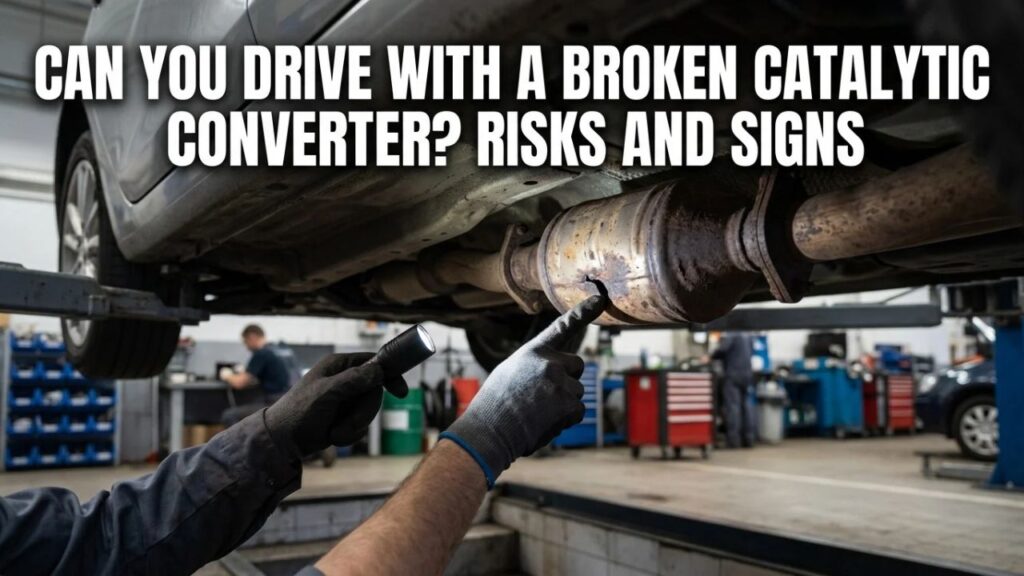
A hole or crack in the converter or nearby pipe can release gases underneath the passenger area.
Do not rely on odor alone to judge carbon-monoxide exposure.
Move into fresh air if occupants develop headache, dizziness, weakness, nausea, or unusual drowsiness.
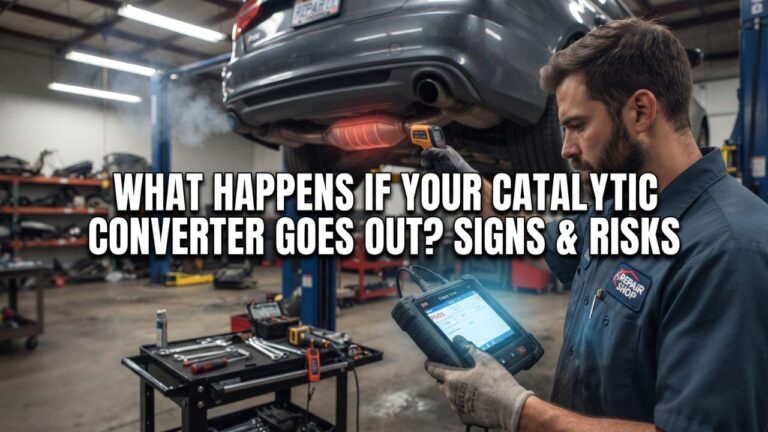
The Converter Is Glowing or Producing Extreme Heat
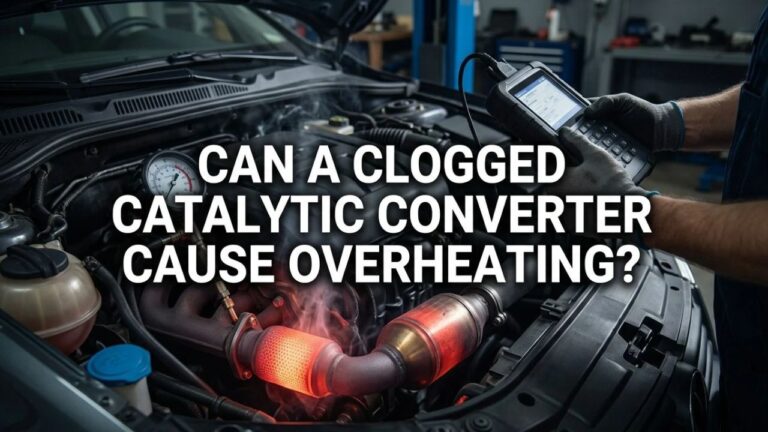
A catalytic converter can operate at very high temperature during normal driving, but visible red glowing is abnormal.
It may indicate:
- Severe misfire
- Rich fuel mixture
- Raw fuel entering the exhaust
- Internal converter damage
Stop driving if you see smoke, glowing metal, or intense burning odor from beneath the vehicle.
The Converter Is Rattling Heavily
A slight heat-shield rattle is different from broken catalyst material moving inside the housing.
Heavy internal rattling can mean the ceramic core has fractured.
Loose material may eventually block exhaust flow.
Key Takeaway: Stop driving for a flashing check engine light, severe power loss, cabin fumes, visible converter overheating, smoke, or heavy internal rattling.
What Happens If You Keep Driving With a Broken Catalytic Converter?
The outcome depends on the failure.
Some problems mainly affect emissions, while others interfere with basic engine operation.
Exhaust Restriction Can Get Worse
Broken ceramic pieces can shift inside the converter.
A partially blocked outlet may become more restricted without much warning.
You may start with mild hesitation and later experience severe power loss.
Fuel Economy May Decline
A restricted exhaust can make the engine work harder.
Fuel economy may also drop because the original fault that damaged the converter is still present.
Examples include:
- Rich fuel mixture
- Misfires
- Faulty injectors
- Sensor problems
The converter may therefore be only one part of the repair.
Engine Performance Can Deteriorate
Backpressure can interfere with the engine’s ability to clear burned gases.
Symptoms may progress to:
- Rough idle
- Hesitation
- Misfire
- Poor throttle response
- Stalling
A badly blocked exhaust can make the vehicle difficult to drive.
Nearby Parts Can Be Damaged by Heat
A converter overheating from raw fuel can expose nearby components to excessive temperatures.
Possible areas include:
- Exhaust wiring
- Oxygen-sensor wiring
- Heat shields
- Floor insulation
- Underbody components
The original engine fault should be repaired before a replacement converter is installed.
Key Takeaway: Continued driving can turn a mild converter problem into restriction, poor performance, heat damage, or a roadside breakdown.
Can a Broken Catalytic Converter Damage the Engine?
A damaged converter can affect the engine if it restricts exhaust flow severely.
Backpressure Makes Exhaust Harder to Expel
During the exhaust stroke, each piston pushes burned gases out of the cylinder.
A blocked converter creates resistance.
The engine then uses part of its output pushing against that pressure.
Cylinder Filling Can Suffer
If exhaust gases do not clear normally, less space is available for a fresh air-fuel charge.
That can reduce torque and power.
Severe restriction may also contribute to unstable combustion.
Exhaust Temperatures Can Rise
A blocked or overheated exhaust system can raise temperatures around the manifold and converter.
The larger problem may still be the fault that caused the converter damage.
A misfire or excessively rich mixture can create both converter damage and poor engine operation.
Can You Drive With a Rattling Catalytic Converter?
You may be able to drive briefly, but it should be inspected soon.
Rattling can come from two very different sources.
Loose Heat Shield
The metal shield surrounding the converter can loosen from corrosion or damaged fasteners.
This may create a tinny rattle while the catalyst itself remains healthy.
A heat-shield repair can be much cheaper than replacing the converter.
Broken Internal Honeycomb
A deeper rattle from inside the housing may mean the ceramic substrate has fractured.
The broken material can:
- Move around
- Break into smaller pieces
- Obstruct the exhaust outlet
- Reduce engine power
A converter with a broken substrate generally requires replacement.
Key Takeaway: A loose heat shield may be a minor repair, while internal ceramic rattling can lead to exhaust blockage and should be inspected promptly.
Can You Drive With a Hole in the Catalytic Converter?
A hole creates an exhaust leak, so routine driving is not a good idea.
The Vehicle May Become Much Louder
A perforated converter housing allows pressurized exhaust to escape.
Common sounds include:
- Hissing
- Ticking
- Raspy exhaust
- Loud roaring during acceleration
Exhaust Can Escape Under the Passenger Area
This is the main safety concern.
A leak beneath the vehicle can allow exhaust to move toward cabin openings or the ventilation intake.
Carbon monoxide is the main concern because it is colorless and odorless.
Sensor Readings May Be Affected
Leaks near oxygen sensors can alter exhaust readings.
That may contribute to:
- Check engine light
- Fuel-trim changes
- Catalyst-monitor codes
- Poor fuel economy in some cases
A small external hole does not usually cause the same power loss as a clogged converter unless internal damage is present too.
Key Takeaway: A converter hole mainly creates an exhaust-leak and fume risk; have it repaired before continuing normal driving.
Can You Drive With a Clogged Catalytic Converter?
A mildly restricted converter may still allow the vehicle to move, but driving becomes less advisable as restriction increases.
Partial Blockage
Early signs may include:
- Hesitation under hard acceleration
- Reduced high-RPM power
- Poor hill climbing
- Normal idle
The vehicle may feel acceptable during slow driving.
Severe Blockage
As flow decreases, symptoms can become much stronger:
- Rough idle
- Stalling
- Severe power loss
- Engine struggling to rev
- Hard starting
- Misfires
At this stage, continuing to drive can leave you stranded.
The Car May Run Better When Cold
Some damaged converters become more restrictive after they heat up.
A vehicle might start normally, then lose power after several minutes.
This pattern is not proof by itself, but it supports further exhaust testing.
Key Takeaway: A partially clogged converter may allow temporary driving, but severe restriction can rapidly reduce power and cause stalling.
How Far Can You Drive With a Bad Catalytic Converter?
There is no reliable mileage limit.
One vehicle may travel for weeks with a catalyst-efficiency code and no drivability problem.
Another may become nearly undriveable within a few miles because broken material shifts and blocks exhaust flow.
Base the decision on symptoms rather than distance.
Limited Driving May Be Reasonable When
The vehicle has:
- Steady check engine light
- Normal engine temperature
- Normal acceleration
- No exhaust fumes
- No severe rattling
- No stalling
- No flashing warning light
Driving directly to a repair facility may be reasonable.
Avoid Further Driving When
The vehicle has:
- Flashing check engine light
- Strong misfire
- Severe loss of power
- Stalling
- Smoke
- Glowing converter
- Cabin exhaust smell
- Burning odor
A tow may be the better choice.
Why Does a Catalytic Converter Break?
Converters can fail internally or externally.
Engine Misfires
Misfires allow unburned fuel to enter the exhaust.
The fuel can burn inside the converter and create enough heat to melt the substrate.
Rich Air-Fuel Mixture
Too much fuel can create the same overheating problem.
Possible causes include:
- Leaking fuel injector
- Fuel-pressure problem
- Incorrect sensor input
- Ignition fault
Oil Consumption
Burned engine oil leaves deposits and ash.
Those deposits can coat the catalyst and damage its ability to process exhaust.
Coolant Entering the Engine
Internal coolant leaks can contaminate the converter.
A failed head gasket or other engine problem should be repaired before converter replacement.
Road Impact
The converter housing can be hit by:
- Rocks
- Curbs
- Road debris
- Off-road obstacles
A strong impact can crack the ceramic substrate even if the outer housing looks mostly intact.
Corrosion
Older converter housings and pipes can rust through.
Road salt and moisture can speed up external corrosion.
Key Takeaway: Misfires, excess fuel, oil or coolant contamination, road impact, and corrosion are common reasons converters fail before normal aging would cause problems.
How Can You Tell How Bad the Converter Is?
Diagnosis should separate an emissions-efficiency problem from a physical restriction.
Read the Diagnostic Codes
Common catalyst codes include:
- P0420 — Catalyst System Efficiency Below Threshold, Bank 1
- P0430 — Catalyst System Efficiency Below Threshold, Bank 2
Those codes do not prove the converter is clogged.
Look for other codes involving:
- Misfires
- Fuel mixture
- Oxygen sensors
- Airflow
- Injectors
Those faults may have caused the converter damage.
Inspect for Exhaust Leaks
Look for:
- Rust holes
- Cracked welds
- Broken flanges
- Soot marks
- Damaged pipes
A leak can affect catalyst-monitor readings and create cabin-fume concerns.
Listen for Internal Rattling
With the exhaust cool, a technician can inspect the converter for signs of loose substrate.
Do not strike or puncture the converter.
Test Exhaust Backpressure
A backpressure test is useful when clogging is suspected.
Pressure that rises excessively as RPM increases supports an exhaust restriction.
A collapsed muffler or crushed pipe can cause similar results, so the restriction still needs to be located.
Check the Engine Before Replacing the Converter
Inspect:
- Spark plugs
- Ignition coils
- Fuel trims
- Injectors
- Oil consumption
- Coolant loss
- Compression where needed
This protects the replacement converter from the same failure.
Key Takeaway: Trouble codes, exhaust inspection, backpressure testing, and engine diagnosis can show if the converter has low efficiency, a leak, broken internals, or a true blockage.
Will a Broken Catalytic Converter Cause a Check Engine Light?
Often, but not always.
P0420 and P0430 are common when the catalyst no longer performs within the expected range.
A physically broken converter may also trigger:
- Oxygen-sensor codes
- Fuel-related codes
- Misfire codes
A small housing hole or developing restriction may exist before the computer turns on the warning light.
Do not use the absence of a light as proof that the converter is healthy.
Can You Drive Without a Catalytic Converter?
A gasoline vehicle may physically run after the converter has been removed or stolen, but that does not make routine driving appropriate.
Removing or bypassing required emissions equipment can violate U.S. federal anti-tampering rules.
A missing converter may also cause:
- Extremely loud exhaust
- Check engine light
- Exhaust fumes
- Failed emissions inspection
- Damaged oxygen-sensor wiring after theft
The proper repair is installing a legal replacement that matches the vehicle’s emissions configuration.
How Much Does a Broken Catalytic Converter Cost to Fix?
Cost depends on the damage.
A loose heat shield or nearby exhaust leak can cost much less than a complete converter replacement.
Possible repairs include:
| Problem | Typical Repair |
| Loose heat shield | Secure or replace shield |
| Damaged gasket or flange | Repair exhaust connection |
| Small adjacent pipe leak | Repair or replace pipe section |
| Faulty oxygen sensor | Replace sensor after diagnosis |
| Broken catalyst substrate | Replace converter |
| Melted or clogged converter | Replace converter |
| Severely rusted housing | Replace converter |
Converter replacement can range from under $1,000 on some applications to several thousand dollars for OEM, luxury, manifold-integrated, or multi-converter systems.
Check federal emissions warranty coverage before paying for an early failure.
Should You Repair the Converter Before Driving Again?
Repair urgency depends on the symptoms, but delaying diagnosis rarely provides an advantage.
A steady catalyst code with normal drivability gives you more flexibility than severe restriction or an exhaust leak.
Before the vehicle returns to routine use, the repair should address both:
- The damaged converter.
- The problem that caused the damage.
For example, fitting a new converter while leaving a failed ignition coil in place can overheat the replacement.
Conclusion
So, can you drive with a broken catalytic converter? In some cases, a short drive may be possible if the car runs normally, the check engine light is steady, and there are no fumes, overheating, stalling, or major power loss.
A clogged, melted, leaking, or severely rattling converter deserves faster attention. Strong power loss indicates possible exhaust restriction, while exhaust odor inside the cabin raises a separate safety concern.
Do not judge the converter only from P0420 or P0430. Those codes indicate catalyst-performance problems but do not tell you if the converter is physically blocked.
Have the exhaust and engine diagnosed before replacing parts. If the vehicle has a flashing check engine light, extreme converter heat, severe misfire, cabin fumes, or difficulty maintaining road speed, stop driving and arrange repair or towing.
FAQs About Driving With a Broken Catalytic Converter
Can I drive for a week with a bad catalytic converter?
Possibly if the only issue is reduced catalyst efficiency and the vehicle runs normally, but there is no guaranteed safe time period. A damaged substrate can shift or a misfire can overheat the converter. Arrange diagnosis rather than using a fixed number of days.
Can a broken catalytic converter leave you stranded?
Yes. If broken internal material blocks exhaust flow, engine power can drop sharply. A severe restriction may cause rough idle, stalling, hard starting, or an inability to accelerate enough for normal driving.
Is it safe to drive with a rattling catalytic converter?
A brief drive may be possible, but internal rattling can indicate a fractured ceramic core. Pieces may move and restrict the exhaust. A loose heat shield can create a similar noise, so have the source identified soon.
Can a bad catalytic converter damage the engine?
A severely clogged converter can create excessive exhaust backpressure, reduce engine power, and interfere with cylinder breathing. The engine fault that caused the converter failure, such as a misfire or rich mixture, can also create further damage if ignored.
Can I drive with P0420?
A vehicle with P0420 may still drive normally because the code indicates catalyst efficiency below the expected threshold rather than proving physical blockage. Check for misfires, exhaust leaks, sensor faults, and converter damage before deciding how urgently repairs are needed.
Can I drive with a hole in my catalytic converter?
Routine driving is not recommended. A hole releases exhaust underneath the vehicle and may allow gases to enter the passenger compartment. It can also create loud exhaust noise and disturb nearby oxygen-sensor readings.
Should I tow a car with a clogged catalytic converter?
Towing is a safer choice if the car has severe power loss, stalls repeatedly, cannot maintain traffic speed, produces smoke, has a glowing converter, or shows a flashing check engine light. Mild symptoms still deserve prompt diagnosis.
Will replacing a catalytic converter fix the problem permanently?
Only if the converter itself has failed and the original cause is corrected. Misfires, rich fueling, oil burning, coolant leaks, or other engine faults can damage a new converter if they remain unresolved.