Can a Bad Oxygen Sensor Cause Rough Idle? Causes and Fixes
A rough idle can make an otherwise normal car shake, stumble, surge, or feel as if the engine might stall while you are stopped. Since oxygen sensors help the engine computer control the air-fuel mixture, it is reasonable to wonder whether a failing sensor could be responsible.
Yes, a bad oxygen sensor can cause rough idle, especially if an upstream sensor sends inaccurate information that makes the engine run too rich or too lean. However, rough idle has many other common causes, so the oxygen sensor should be tested before it is replaced.
When considering can a bad oxygen sensor cause rough idle, the location of the sensor matters. The upstream oxygen sensor—sometimes called Sensor 1 or an air-fuel ratio sensor—provides important feedback for fuel control. If its signal becomes inaccurate, slow, or stuck, the engine control module may make incorrect fuel corrections that affect idle quality.
A downstream oxygen sensor usually has much less influence on normal fuel control because its primary job is monitoring the catalytic converter. For that reason, a bad downstream sensor is less likely to be the direct cause of a rough idle.
This guide explains how an oxygen sensor can affect idle, the symptoms that may appear with it, how to distinguish an O2 sensor problem from vacuum leaks or ignition faults, and how to diagnose the issue without replacing parts unnecessarily.
Can a Bad Oxygen Sensor Cause Rough Idle?
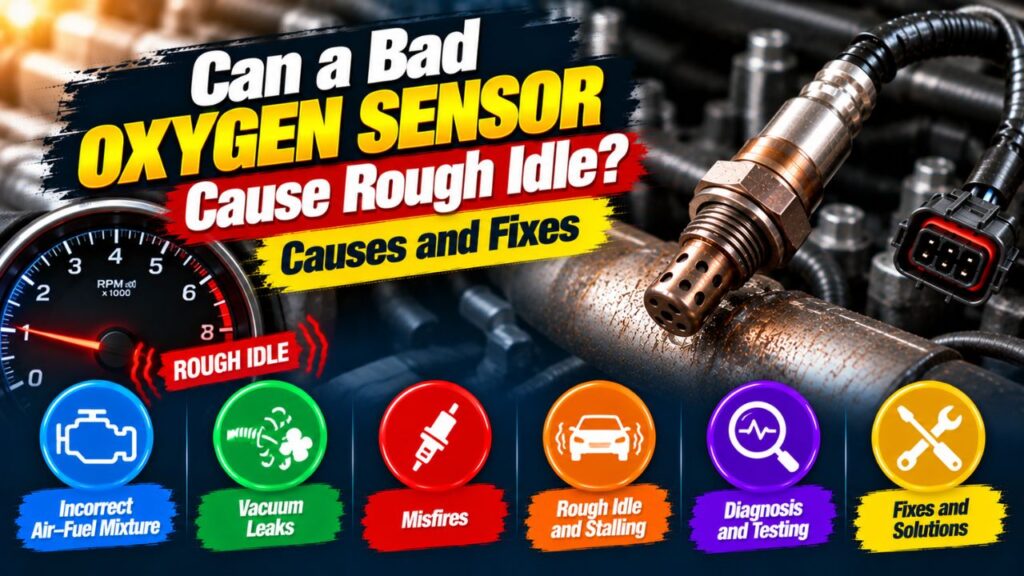
Yes, a bad oxygen sensor can cause rough idle when incorrect sensor feedback causes the engine computer to deliver too much or too little fuel.
During normal operation, the upstream oxygen sensor monitors oxygen remaining in the exhaust after combustion. The engine control module (ECM) or powertrain control module (PCM) uses that information to make continuous corrections to fuel-injector operation.
If the sensor falsely reports that the engine is running lean, the computer may add too much fuel.
If it falsely reports that the mixture is rich, the computer may reduce fuel delivery too much.
Either situation can make combustion less stable, particularly at idle where the engine is operating at relatively low speed and small airflow changes can have a noticeable effect.
However, an O2 sensor is only one possible cause. Vacuum leaks, dirty throttle bodies, PCV faults, ignition problems, fuel injectors, and other issues cause rough idle more frequently on many vehicles.
Why Idle Is Sensitive to Air-Fuel Mixture Problems
An engine running at idle has less rotational momentum than it does at higher RPM.
Each cylinder must produce relatively small, consistent combustion events to keep the engine running smoothly.
A minor mixture problem that is barely noticeable at highway speed may cause obvious shaking at 600–800 RPM.
At idle, the computer is constantly balancing several factors, including:
airflow, fuel delivery, ignition timing, throttle position, engine load, and oxygen-sensor feedback.
If one input becomes inaccurate, the ECM may struggle to keep engine speed stable.
This can result in an idle that:
- Shakes
- Surges up and down
- Feels uneven
- Drops too low
- Occasionally stalls
A rough idle does not identify which component has failed, but it provides an important clue.
How an Oxygen Sensor Controls Fuel Mixture
The upstream oxygen sensor sits in the exhaust stream before the catalytic converter.
After combustion, it measures oxygen-related conditions in the exhaust and sends information to the ECM.
During closed-loop operation, the computer uses this signal to adjust fuel delivery.
A simplified process looks like this:
Engine burns air and fuel → exhaust reaches O2 sensor → sensor reports mixture condition → ECM changes injector pulse width → mixture changes → O2 sensor measures the result.
This cycle happens continuously while the engine is running under appropriate conditions.
If the sensor becomes slow or inaccurate, fuel correction can also become inaccurate.
That is how a sensor that never physically touches the fuel injectors can still affect how smoothly the engine idles.
Upstream vs. Downstream O2 Sensor and Rough Idle
Not every oxygen sensor has the same influence on engine operation.
Upstream Oxygen Sensor
The upstream O2 sensor, usually identified as Sensor 1, is located before the catalytic converter.
Its signal is commonly used for fuel control.
A bad upstream sensor can therefore contribute to:
Poor idle
Fuel-trim problems
Reduced gas mileage
Rich or lean operation
Hesitation
Increased emissions
Check engine light
If an oxygen sensor is genuinely causing rough idle, the upstream sensor is usually the more likely one.
Downstream Oxygen Sensor
The downstream sensor, usually Sensor 2, is located after the catalytic converter.
Its main purpose is to monitor catalyst efficiency.
A failed downstream sensor may turn on the check engine light without causing a noticeable change in idle quality.
There are vehicle-specific exceptions, but a downstream sensor is generally much less likely to be the reason the engine is shaking at a stop.
How a Bad O2 Sensor Can Make the Engine Run Rich
A faulty oxygen sensor may incorrectly indicate that the exhaust is too lean.
The ECM responds by adding fuel.
If too much fuel is added, the engine can run rich.
A rich mixture may produce:
Rough idle
Strong fuel smell
Poor fuel economy
Black exhaust deposits
Spark plug fouling
Hesitation
In severe cases, excess fuel can interfere with smooth combustion and may eventually overheat the catalytic converter.
A rich condition can also be caused by many other components, so an O2 sensor should not be blamed based on symptoms alone.
How a Bad O2 Sensor Can Make the Engine Run Lean
The opposite can also happen.
If the oxygen sensor falsely reports that the mixture is rich, the computer may reduce fuel delivery.
The engine may then operate too lean.
Lean combustion can cause:
Rough idle
Hesitation
Misfires
Surging
Stalling
Loss of power
Lean conditions can be particularly noticeable at idle because even a relatively small amount of unmetered air can significantly change the mixture.
Can a Slow Oxygen Sensor Cause Rough Idle?
Yes.
An oxygen sensor does not have to fail completely to create problems.
A sensor can become slow or lazy, meaning it still produces a signal but responds too slowly to changing exhaust conditions.
The ECM then receives delayed feedback and may not correct the fuel mixture as accurately as intended.
A slow sensor can contribute to:
Fuel-trim fluctuations
Reduced fuel economy
Higher emissions
Poor throttle response
Unstable idle
The problem may be subtle and intermittent rather than causing the engine to run badly all the time.
Can an O2 Sensor Cause an Engine to Surge at Idle?
Potentially.
If the ECM continually adds and removes too much fuel because of inaccurate sensor feedback, idle speed can fluctuate.
You may notice the tachometer moving slightly up and down while the vehicle is stopped.
However, idle surging is also commonly caused by:
Vacuum leaks
Dirty throttle body
Idle air control problems on older vehicles
PCV faults
Electronic throttle issues
MAF sensor problems
Surging should therefore be diagnosed using scan data rather than assumed to be an oxygen-sensor failure.
Can a Bad Oxygen Sensor Cause the Engine to Stall?
It can contribute to stalling if the incorrect fuel mixture becomes severe enough.
For example, if the engine runs excessively lean at idle, combustion can become unstable and the engine may stall when:
Coming to a stop
Idling in traffic
Starting cold or warm
Turning on an accessory load
However, stalling is usually a reason to investigate the entire air, fuel, ignition, and throttle-control systems.
An oxygen sensor is only one possibility.
Can a Bad O2 Sensor Cause Misfires at Idle?
Yes, indirectly.
The oxygen sensor itself does not create the spark.
But if incorrect feedback causes the mixture to become excessively rich or lean, cylinders may not burn consistently.
That can lead to misfire codes such as:
P0300 for random or multiple-cylinder misfire
P0301 for Cylinder 1
P0302 for Cylinder 2
and similar cylinder-specific codes.
The important distinction is that a misfire can also affect the O2 sensor reading.
When a cylinder misfires, unused oxygen can pass into the exhaust. The oxygen sensor may interpret that as a lean condition.
The sensor can therefore appear to be reporting a problem when it is actually responding correctly to a misfiring engine.
Can a Bad O2 Sensor Cause Rough Idle Only When Warm?
Yes, and this pattern makes sense because oxygen sensors play a larger role after the engine warms up and enters closed-loop fuel control.
During a cold start, many engines initially operate in open loop.
The ECM relies more heavily on programmed fuel maps and sensors such as:
Engine coolant temperature sensor
MAF or MAP sensor
Throttle position
Engine speed
Once the O2 sensor reaches operating temperature, the ECM begins using its feedback more actively.
If the idle is smooth when cold but becomes rough several minutes later, an oxygen-sensor or fuel-control problem becomes one possibility.
It is not proof, however. Other heat-related faults can create the same pattern.
Can a Bad O2 Sensor Cause Rough Idle Only When Cold?
It is less likely.
Modern oxygen sensors contain heaters so they can reach operating temperature quickly, but the ECM still depends less on O2 feedback during the earliest moments of a cold start.
A rough idle that occurs only when the engine is cold may be more closely related to:
Vacuum leaks
Coolant-temperature sensor problems
Fuel injector issues
Ignition problems
Intake carbon buildup
Incorrect cold-start fueling
A scan tool can help determine whether the vehicle is in open or closed loop when the problem occurs.
What Other Symptoms Occur With a Bad Oxygen Sensor?
Rough idle is more meaningful when it appears alongside other oxygen-sensor symptoms.
Check Engine Light
A failed O2 sensor commonly illuminates the check engine light.
The stored trouble code may identify:
Signal problem
Slow response
Heater failure
Circuit fault
Sensor stuck rich or lean
The code still needs diagnosis because wiring and engine problems can create similar results.
Poor Fuel Economy
A faulty upstream sensor can cause the ECM to add unnecessary fuel.
You may notice lower MPG or more frequent trips to the gas station.
Strong Exhaust or Fuel Smell
A rich-running engine may produce a strong exhaust odor.
If you smell raw gasoline outside the exhaust system or around the engine, check for an actual fuel leak because that is a separate safety concern.
Hesitation
Fuel mixture errors can make the engine hesitate during throttle changes.
Failed Emissions Test
A malfunctioning oxygen sensor can increase emissions and keep OBD readiness or check-engine-light requirements from being satisfied.
Common O2 Sensor Codes Related to Rough Running
Several trouble codes may appear when oxygen-sensor operation is abnormal.
Common examples include:
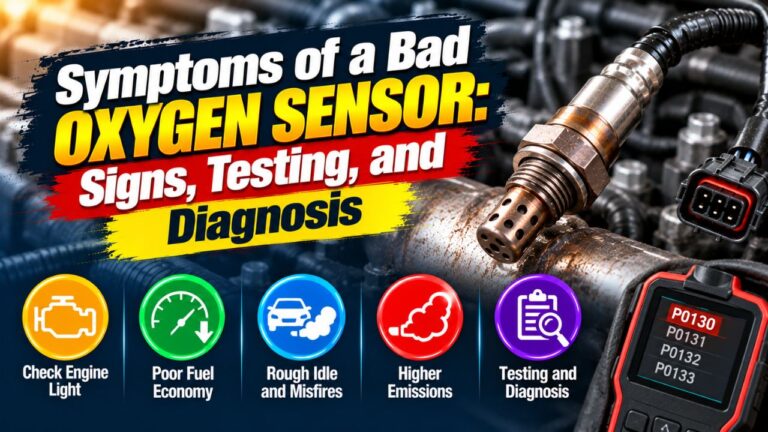
P0130: O2 sensor circuit malfunction, Bank 1 Sensor 1
P0131: O2 sensor circuit low voltage
P0132: O2 sensor circuit high voltage
P0133: O2 sensor slow response
P0134: O2 sensor no activity detected
P0135: O2 sensor heater circuit malfunction
Vehicles with two cylinder banks may use corresponding P015x codes for Bank 2.
Other codes can appear depending on the sensor type and manufacturer.
A code should be considered a starting point for diagnosis rather than an instruction to automatically install a new sensor.
Can a Vacuum Leak Make It Look Like the O2 Sensor Is Bad?
Yes, and this is extremely important.
A vacuum leak allows air into the engine that the computer may not have measured.
The mixture becomes lean.
The oxygen sensor detects additional oxygen in the exhaust and reports the lean condition correctly.
The ECM responds by adding fuel.
You may then see:
Positive fuel trims
Lean codes such as P0171 or P0174
Rough idle
O2 sensor readings indicating lean operation
The oxygen sensor may be completely healthy.
Replacing it will not fix the vacuum leak.
Why Vacuum Leaks Often Cause Rough Idle
Vacuum leaks tend to have their strongest effect at idle because normal engine airflow is relatively low.
Imagine an engine normally consuming a small amount of air at idle.
A leak adding a fixed amount of extra air can represent a significant percentage of total airflow.
At higher RPM, the same leak becomes a smaller percentage of the engine’s total airflow.
This is why an engine with a vacuum leak may idle poorly but run much better when the throttle is opened.
Can a Bad PCV Valve Mimic a Bad O2 Sensor?
Yes.
A PCV valve stuck open or torn PCV diaphragm can act like a vacuum leak.
It may cause:
Rough idle
Lean fuel trims
P0171 or P0174
Whistling
High idle
Misfires
The oxygen sensor may report lean exhaust because the PCV system is introducing extra air.
Again, the O2 sensor is reporting the problem rather than causing it.
Can a Dirty MAF Sensor Cause the Same Symptoms?
Yes.
The mass airflow sensor (MAF) measures air entering the engine.
If it underreports airflow, the ECM may inject too little fuel.
The oxygen sensor then sees a lean condition.
Possible results include:
Rough idle
Hesitation
Lean codes
Poor acceleration
Fuel-trim problems
This is another reason both MAF and O2 sensor data should be considered during diagnosis.
Can Bad Spark Plugs Cause O2 Sensor-Like Symptoms?
Absolutely.
Worn or fouled spark plugs can cause misfires.
Misfires send unburned oxygen into the exhaust.
The O2 sensor sees the extra oxygen and may report a lean condition.
If a technician interprets that signal without checking ignition performance, a perfectly good oxygen sensor could be replaced unnecessarily.
Spark plugs and ignition coils should be considered when the engine has:
Rough idle
Misfire codes
Shaking
Poor acceleration
Can an Exhaust Leak Affect O2 Sensor Readings?
Yes.
An exhaust leak before or close to the upstream O2 sensor can pull outside air into the exhaust.
That additional oxygen can make the sensor report a leaner condition than actually exists.
The ECM may then add unnecessary fuel.
A small exhaust leak can sometimes be most noticeable at idle because exhaust flow is relatively low.
Check for leaks around:
Exhaust manifold
Manifold gasket
Flex pipe
O2 sensor threads
Pipe connections
before assuming the sensor itself is defective.
Can Dirty Fuel Injectors Cause Rough Idle?
Yes.
A partially restricted injector may deliver less fuel to one cylinder.
That cylinder can run lean and contribute to an uneven idle.
A leaking injector can create the opposite problem by delivering too much fuel.
O2 sensors measure the combined result in the exhaust, so injector faults can change sensor data without the sensor being defective.
Can a Dirty Throttle Body Cause Rough Idle?
Yes.
Modern electronic throttle bodies control very small airflow amounts at idle.
Carbon deposits around the throttle plate can interfere with airflow and idle control.
Symptoms may include:
Low idle
Surging
Stalling
Roughness
Delayed throttle response
Cleaning procedures vary between vehicles, and some electronic throttle systems may require an idle relearn afterward.
Can Engine Mechanical Problems Cause Rough Idle?
Yes.
Oxygen-sensor diagnosis should not ignore basic engine health.
Mechanical problems can include:
Low compression
Burned valve
Worn piston rings
Incorrect valve timing
Timing chain problems
Head gasket issues
A weak cylinder can create exhaust oxygen readings that look abnormal because combustion is incomplete.
If one cylinder consistently misfires despite good ignition and fuel delivery, mechanical testing may be necessary.
How to Tell if the O2 Sensor Is Causing Rough Idle
The best approach is to combine symptoms, trouble codes, and live scan data.
Check for Trouble Codes
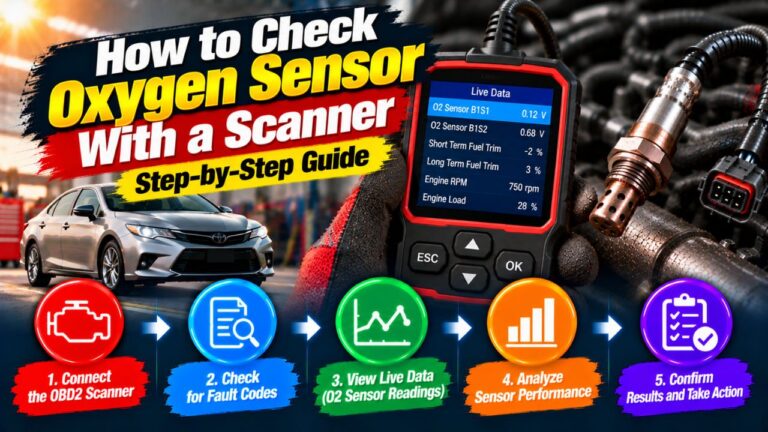
Connect an OBD-II scan tool and read both stored and pending codes.
Do not erase them before recording the information.
Codes involving the upstream sensor may strengthen suspicion, but they still do not confirm failure.
Look at Fuel Trims
Check:
Short-term fuel trim (STFT)
and
Long-term fuel trim (LTFT).
Large positive trims mean the computer is adding fuel.
Large negative trims mean it is removing fuel.
The pattern can help identify whether the engine is actually running lean or rich.
Compare Idle and Higher RPM
Fuel trims that are strongly positive at idle but improve around 2,500 RPM often suggest a vacuum leak.
If the problem remains similar across different loads, other causes become more likely.
This is a useful distinction because a vacuum leak can easily be mistaken for an O2 sensor failure.
How to Check a Narrowband Oxygen Sensor
A warmed-up narrowband upstream O2 sensor typically changes its signal repeatedly as the ECM adjusts mixture.
On many conventional systems, voltage may move approximately between:
0.1 volt and 0.9 volt
during normal closed-loop operation.
A sensor that remains fixed at one value may be:
Faulty
Too cold
Disconnected
Affected by a wiring problem
Reporting a genuine rich or lean condition
This is why simply observing voltage is not enough.
Wideband O2 Sensors Need Different Diagnosis
Many modern vehicles use wideband air-fuel ratio sensors instead of traditional narrowband sensors.
These sensors do not necessarily switch between 0.1 and 0.9 volts.
Depending on the vehicle, a scan tool may display:
Lambda
Equivalence ratio
Air-fuel ratio
Pump current
Manufacturer-specific voltage
Use the service information for the specific vehicle.
Testing a wideband sensor using narrowband expectations can lead to an incorrect diagnosis.
What Is a Good Fuel-Trim Range?
There is no universal cutoff that applies perfectly to every engine, but fuel trims close to zero generally indicate that the computer is making relatively small corrections.
Small positive or negative adjustments are normal.
Large corrections—especially persistent corrections above roughly 10% in one direction—deserve further investigation.
Values around 20% or more often indicate a significant air, fuel, sensor, or exhaust problem.
Always evaluate both STFT and LTFT together and consider manufacturer specifications.
Should You Unplug the O2 Sensor to Test It?
Unplugging a sensor may change how the engine runs because the ECM can enter a fallback strategy.
If the idle improves, that may provide a clue, but it is not definitive proof that the sensor is bad.
Disconnecting the sensor can:
Set additional codes
Disable normal fuel feedback
Change fuel strategy
Cause the engine to run on substitute values
Professional diagnosis should rely on scan data and proper testing rather than an unplug test alone.
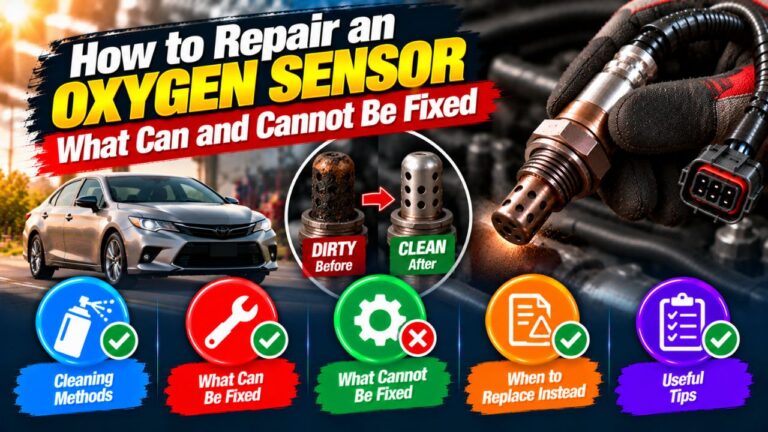
Can You Clean an Oxygen Sensor to Fix Rough Idle?
Generally, no.
Oxygen sensors are not normally designed to be cleaned as a maintenance procedure.
Applying:
Carburetor cleaner
Brake cleaner
Solvent
Fuel additives directly to the sensor
can damage the sensing element or leave contamination behind.
If the sensor is fouled by oil, coolant, or excessive fuel, the underlying engine problem should be repaired.
A confirmed damaged or contaminated sensor is usually replaced.
When Should an Oxygen Sensor Be Replaced?
Replace the sensor when diagnosis confirms that it is faulty.
Evidence may include:
An open or shorted circuit
Failed heater element
No sensor response
Response that is significantly too slow
Implausible readings
Internal sensor failure
Severe contamination
If the trouble is actually caused by wiring, an intake leak, or fuel pressure, a new O2 sensor will not solve the problem.
Can a New O2 Sensor Fix Rough Idle?
Yes, if the old sensor was genuinely responsible.
After replacement, the ECM can regain accurate exhaust feedback and correct the fuel mixture more effectively.
However, improvement may not always be immediate.
The computer may need time to relearn fuel trims.
On some vehicles, previously stored fuel adaptations can also be reset with a scan tool after the underlying problem is repaired.
Do not reset adaptive values as a substitute for proper diagnosis.
What if the Rough Idle Remains After Replacing the O2 Sensor?
If the engine still runs rough, the sensor was either not the root cause or another problem exists.
Recheck:
Fuel trims
Misfire counters
Vacuum leaks
PCV system
MAF data
Fuel pressure
Ignition coils
Spark plugs
Fuel injectors
Compression
Exhaust leaks
Replacing additional sensors without testing can quickly become expensive.
Can Both O2 Sensors Go Bad at the Same Time?
It is possible but less common than a shared problem affecting their readings.
If several sensors suddenly report similar abnormalities, consider:
Wiring problem
Fuse failure
Rich or lean engine condition
Exhaust leak
Fuel-system problem
Power or ground issue
Sensor contamination
Multiple sensors exposed to the same oil or coolant contamination can also deteriorate together.
Does Mileage Matter?
Oxygen sensors wear over time.
A high-mileage sensor may respond more slowly than it did when new, particularly if the engine has experienced oil consumption, rich operation, or coolant contamination.
However, mileage alone does not prove failure.
A properly functioning high-mileage sensor does not necessarily need replacement unless the vehicle manufacturer specifies a maintenance interval.
Is It Safe to Drive With a Rough Idle From a Bad O2 Sensor?
A mild rough idle may not immediately make the vehicle unsafe to drive, but ignoring a confirmed sensor problem is not ideal.
Incorrect fuel control can increase:
Fuel consumption
Emissions
Spark plug fouling
Catalytic-converter temperature
If the check engine light is flashing, the vehicle may have a severe misfire capable of damaging the catalytic converter.
A flashing light should be addressed promptly.
If the vehicle stalls, runs extremely poorly, smells strongly of fuel, or loses significant power, avoid unnecessary driving until it is diagnosed.
Common Mistakes When Diagnosing Rough Idle
One major mistake is assuming an O2 code means the sensor is bad. The sensor may simply be reporting a genuine lean or rich condition.
Another common mistake is overlooking vacuum leaks. Since leaks are often most influential at idle, they can closely mimic a failing upstream oxygen sensor.
It is also easy to ignore spark plugs and coils. A misfire can make the exhaust appear lean even though the real problem is ignition.
Finally, testing a wideband air-fuel sensor as though it were a traditional narrowband O2 sensor can lead to the wrong conclusion. Always identify which sensor technology the vehicle uses before interpreting live data.
FAQs About Can a Bad Oxygen Sensor Cause Rough Idle
Can a Bad Upstream O2 Sensor Cause Rough Idle?
Yes. The upstream sensor directly influences fuel correction on many vehicles.
If it sends inaccurate information, the ECM may command a fuel mixture that is too rich or too lean, making idle unstable.
Can a Bad Downstream O2 Sensor Cause Rough Idle?
Usually, it is much less likely.
The downstream sensor mainly monitors catalytic-converter efficiency and generally has less influence on normal fuel control.
If the engine idles roughly and only a downstream-sensor code is present, investigate other causes as well.
Can a Bad O2 Sensor Cause the Engine to Shake?
Yes, indirectly.
If inaccurate sensor feedback causes unstable combustion or misfires, the engine can shake noticeably at idle.
However, worn spark plugs, faulty coils, vacuum leaks, injectors, and compression problems are also common causes.
Can a Bad Oxygen Sensor Cause High Idle?
It can contribute to unstable fuel control, but a consistently high idle is more commonly associated with extra airflow entering the engine through a vacuum leak, PCV fault, throttle problem, or idle-control issue.
Can a Bad Oxygen Sensor Cause Stalling at Stops?
Yes, if the sensor causes the mixture to become sufficiently incorrect.
Still, stalling at stops can also result from throttle-body problems, vacuum leaks, fuel pressure issues, or other engine faults.
Will a Bad O2 Sensor Always Turn On the Check Engine Light?
Not necessarily immediately.
A sensor can become slow or inaccurate before the ECM determines that its performance has fallen outside the acceptable range.
Eventually, many significant sensor failures will trigger a code.
How Do I Know if Rough Idle Is From an O2 Sensor or Vacuum Leak?
Compare fuel trims at idle and higher RPM and inspect the intake system for leaks.
If positive fuel trims are much higher at idle but improve as RPM increases, a vacuum leak is often more likely.
A smoke test can be particularly useful for finding intake leaks.
Will Replacing an O2 Sensor Improve Idle?
Yes, if diagnosis confirms that the sensor is sending incorrect fuel-control information.
If the rough idle is caused by a vacuum leak, ignition fault, dirty throttle body, or fuel problem, replacing the O2 sensor will not fix it.
Conclusion
The overall answer to can a bad oxygen sensor cause rough idle is yes, particularly when a faulty upstream O2 or air-fuel ratio sensor sends inaccurate information that causes the ECM to make incorrect fuel adjustments. A mixture that becomes too rich or too lean can create unstable combustion, shaking, surging, misfires, hesitation, and occasionally stalling at idle.
However, an oxygen sensor should not be the first part replaced simply because the engine idles poorly. Vacuum leaks, PCV problems, spark plugs, ignition coils, dirty throttle bodies, MAF sensor faults, fuel injectors, exhaust leaks, and mechanical engine problems can all produce similar symptoms—and many of these faults can also make a healthy oxygen sensor report abnormal readings.
The best approach is to read trouble codes, examine fuel trims and live O2 or air-fuel sensor data, check for vacuum and exhaust leaks, and confirm that ignition and fuel delivery are working correctly. If diagnosis proves the upstream oxygen sensor is slow, electrically faulty, or inaccurate, replacing it can restore proper fuel feedback and help the engine return to a smooth, stable idle.