Does Oxygen Sensor Affect Gas Mileage? MPG Impact Explained
An oxygen sensor plays an important role in how efficiently a gasoline engine uses fuel. It monitors oxygen in the exhaust and sends that information to the engine control module, which uses the data to adjust the air-fuel mixture. When the sensor works correctly, the engine can make small fuel adjustments that help maintain efficient combustion.
Yes, an oxygen sensor can affect gas mileage. A faulty upstream oxygen sensor can send inaccurate information to the engine computer, causing the engine to use more fuel and lowering MPG.
So, does oxygen sensor affect gas mileage in every failure? Not necessarily. The effect depends on which sensor has failed, how inaccurate its signal is, and how the engine computer responds. A bad upstream sensor can directly influence fuel control, while a downstream sensor usually has a much smaller effect on fuel economy because its main job is monitoring catalytic converter performance.
Poor gas mileage can have many causes, so an oxygen sensor should not be replaced based on fuel economy alone. This article explains how oxygen sensors influence MPG, how much fuel economy can change, which sensor matters most, and how to tell whether an O2 sensor may actually be responsible.
Does Oxygen Sensor Affect Gas Mileage?
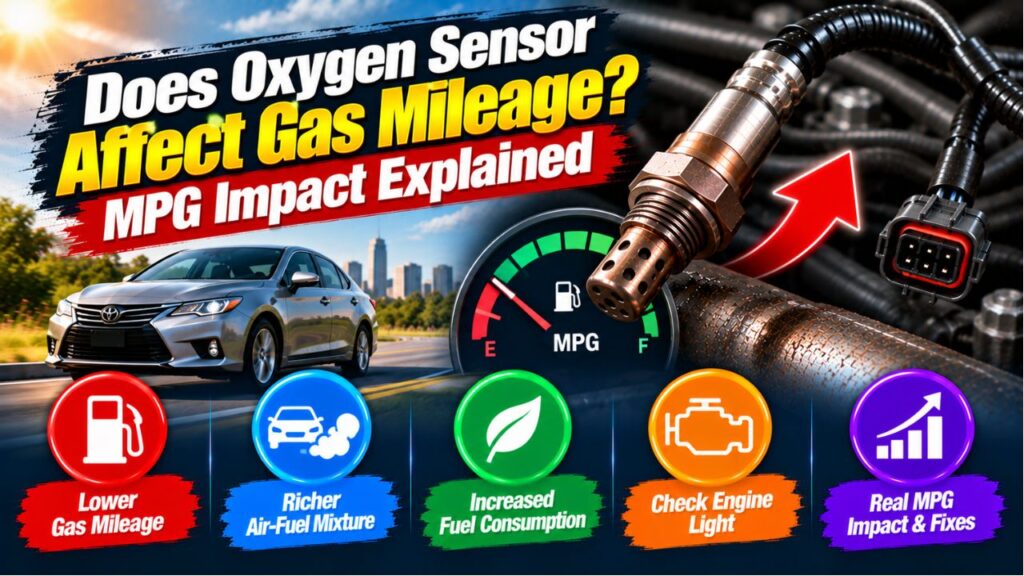
Yes, does oxygen sensor affect gas mileage is an important question because the upstream oxygen sensor is part of the engine’s fuel-control system.
The sensor measures the amount of oxygen remaining in the exhaust. The engine control module, or ECM, uses that information to determine whether combustion is running richer or leaner than intended.
If the oxygen sensor becomes slow, biased, or inaccurate, the ECM may make incorrect fuel adjustments.
For example, if the sensor falsely indicates that the mixture is too lean, the computer may add fuel even though the engine does not actually need it.
That extra fuel can reduce MPG.
The opposite can also happen, although modern engine-management systems use several sensors and diagnostic strategies to keep the engine within a safe operating range.
How an Oxygen Sensor Controls Fuel Mixture
A gasoline engine needs the correct balance of air and fuel for efficient combustion.
The engine computer calculates a base amount of fuel using information from components such as the:
- Mass airflow sensor
- Manifold pressure sensor
- Throttle position
- Engine temperature sensors
Once the oxygen sensor reaches operating temperature, the ECM can use exhaust oxygen information to fine-tune that calculation.
This process is known as closed-loop fuel control.
In closed loop, the ECM constantly makes small adjustments to injector operation based partly on oxygen sensor feedback.
If the sensor’s feedback is wrong, those adjustments may also become wrong.
Upstream vs Downstream Oxygen Sensor and Gas Mileage
The location of the failed sensor matters.
Upstream Oxygen Sensor
The upstream oxygen sensor, also called Sensor 1, is positioned before the catalytic converter.
This sensor is especially important for fuel control.
A faulty upstream sensor can contribute to:
- Rich fuel mixture
- Lean fuel mixture
- Higher fuel consumption
- Poor throttle response
- Rough idle
- Increased emissions
If fuel economy suddenly drops along with an upstream O2 sensor fault, the sensor deserves careful testing.
Downstream Oxygen Sensor
The downstream oxygen sensor, usually called Sensor 2, sits after the catalytic converter.
Its primary job is to monitor how effectively the catalytic converter is working.
On most vehicles, it has much less direct influence over routine fuel mixture adjustments.
Therefore, a failed downstream oxygen sensor may turn on the check engine light without causing a major change in gas mileage.
However, exact control strategies vary by vehicle.
How a Bad Oxygen Sensor Can Lower MPG
A bad oxygen sensor can reduce fuel economy in several ways.
The most common problem is inaccurate feedback that encourages the engine computer to add unnecessary fuel.
Suppose the sensor reports more oxygen in the exhaust than is actually present. The computer interprets that as a lean mixture and responds by increasing injector pulse width.
The engine then burns more gasoline than necessary.
Over hundreds of miles, even a moderate increase in fuel delivery can become noticeable at the gas pump.
Can a Bad Oxygen Sensor Make the Engine Run Rich?
Yes.
A faulty oxygen sensor can contribute to a rich-running condition when its signal causes the ECM to command excessive fuel.
Possible signs of rich operation include:
- Reduced gas mileage
- Strong fuel smell
- Dark exhaust deposits
- Rough running
- Increased emissions
However, an O2 sensor is not the only thing that can make an engine run rich.
Other causes include leaking fuel injectors, high fuel pressure, faulty airflow measurement, and temperature-sensor problems.
That is why proper diagnosis matters.
Can a Bad Oxygen Sensor Make the Engine Run Lean?
Yes, depending on how the sensor fails.
If the sensor falsely reports that the mixture is rich, the ECM may remove too much fuel.
An excessively lean mixture can lead to:
- Hesitation
- Rough idle
- Misfires
- Reduced power
A lean-running engine does not automatically mean better gas mileage.
Poor combustion can reduce efficiency and cause the driver to press the accelerator farther to maintain normal performance.
How Much Can a Bad Oxygen Sensor Reduce Gas Mileage?
There is no fixed percentage that applies to every vehicle.
The effect depends on:
- Sensor failure mode
- Engine design
- Driving conditions
- Number of failed sensors
- Fuel-control strategy
- Whether other engine faults are present
A mildly sluggish sensor may cause little noticeable MPG change.
A severely biased upstream sensor that keeps the engine running rich can cause a more substantial fuel-economy loss.
Rather than expecting a specific MPG number, compare your current fuel economy with the vehicle’s normal long-term average.
Will Replacing an Oxygen Sensor Improve Gas Mileage?
It can if the old sensor was actually causing incorrect fuel control.
After replacement, you may notice:
- MPG returning toward normal
- Smoother idle
- Better throttle response
- Reduced fuel smell
- Improved emissions performance
If the original sensor was working correctly, replacing it will not normally provide a meaningful fuel-economy improvement.
A new oxygen sensor should restore proper operation, not magically make the engine more efficient than its original design.
Can a Slow Oxygen Sensor Hurt MPG?
Yes.
An oxygen sensor does not have to fail completely to affect fuel economy.
As sensors age, some become sluggish.
Instead of responding quickly to changes in exhaust oxygen, the sensor reacts more slowly.
This can make fuel correction less precise.
The result may be slightly richer operation, increased emissions, or reduced fuel economy even before the sensor completely stops working.
Modern engine computers can sometimes detect slow response and store an oxygen-sensor performance code.
Does a Bad O2 Sensor Always Turn On the Check Engine Light?
No.
A sensor may begin deteriorating before its signal falls far enough outside expected limits to trigger a diagnostic trouble code.
You might notice:
- Gradual MPG loss
- Slight hesitation
- Increased fuel consumption
before the check engine light appears.
Eventually, a severe sensor problem will usually be detected.
Still, poor fuel economy without a check engine light does not automatically mean the O2 sensor is bad.
Can an Oxygen Sensor Cause Poor MPG Without Other Symptoms?
Yes, especially during the early stages of sensor deterioration.
The engine may still:
- Start normally
- Idle reasonably well
- Accelerate adequately
while fuel economy slowly declines.
However, many other problems can also lower MPG without dramatic symptoms, including low tire pressure, brake drag, short-trip driving, and cold weather.
Fuel economy by itself is not a reliable oxygen-sensor diagnosis.
Signs an Oxygen Sensor May Be Affecting Fuel Economy
Poor gas mileage becomes more suspicious for an O2 sensor problem when it appears with other symptoms.
Common clues include a check engine light, unusual fuel-trim readings, rough idle, strong exhaust odor, hesitation, or failed emissions testing.
Diagnostic trouble codes may also identify an oxygen-sensor circuit or response problem.
Even then, wiring, exhaust leaks, and engine problems should be checked before replacing the sensor.
Fuel Trims and Oxygen Sensor Problems
Fuel trims show how much the engine computer is adding or subtracting fuel from its base calculation.
Two useful values are:
Short-term fuel trim (STFT), which changes quickly in response to current conditions.
Long-term fuel trim (LTFT), which reflects corrections learned over a longer period.
Abnormal oxygen sensor feedback can influence these values.
However, unusual fuel trims can also result from vacuum leaks, fuel-pressure problems, dirty injectors, or airflow measurement problems.
Fuel-trim data is most useful when evaluated with oxygen sensor live data rather than by itself.
Can an Exhaust Leak Affect O2 Sensor Readings and MPG?
Yes.
An exhaust leak before or near the upstream oxygen sensor can allow outside air into the exhaust stream.
That extra oxygen may make the sensor report a lean condition.
The ECM may respond by adding more fuel.
This can lower gas mileage even though the oxygen sensor itself is working properly.
Before replacing an O2 sensor for a lean reading, inspect the exhaust system for leaks.
Can a Misfire Make the Oxygen Sensor Look Bad?
Yes.
A misfiring cylinder can send unusual amounts of oxygen and unburned fuel into the exhaust.
The oxygen sensor then sees abnormal exhaust composition.
The problem may appear to involve the sensor even though the real cause is:
- Bad spark plug
- Ignition coil failure
- Fuel injector issue
- Compression problem
- Vacuum leak
Replacing the O2 sensor will not correct a misfire caused elsewhere.
Can a Bad Oxygen Sensor Damage the Catalytic Converter?
A faulty oxygen sensor can contribute to conditions that shorten catalytic converter life.
If incorrect sensor feedback causes the engine to run excessively rich, extra fuel may enter the exhaust.
The catalytic converter can become unusually hot while processing that fuel.
Continued rich operation may eventually damage the converter.
This is another reason not to ignore persistent oxygen sensor or fuel-mixture faults.
What Else Can Cause Poor Gas Mileage?
Before blaming the oxygen sensor, consider other common causes of reduced MPG.
Low tire pressure increases rolling resistance. A sticking brake caliper can make the engine work harder. Worn spark plugs or ignition coils may reduce combustion efficiency. Dirty airflow sensors, fuel injector problems, thermostat faults, and aggressive driving can also increase fuel consumption.
Even weather and trip length matter.
Cold-weather driving and frequent short trips generally reduce fuel economy because the engine spends more time warming up.
How to Check If the Oxygen Sensor Is Affecting Gas Mileage
The most reliable approach combines diagnostic trouble codes with live sensor data.
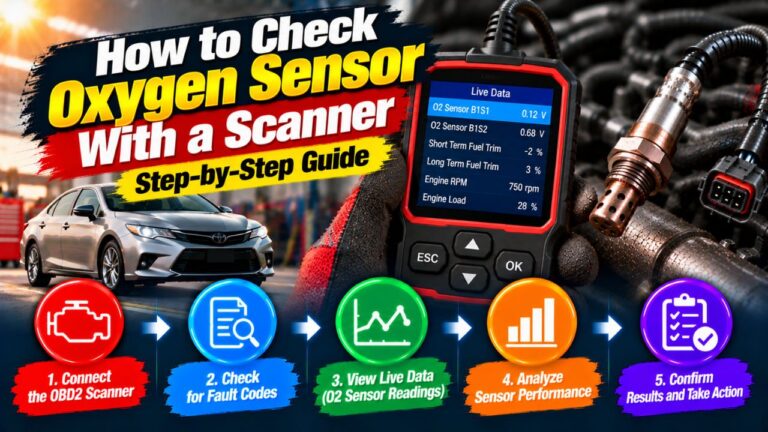
A scan tool can show:
- Oxygen sensor voltage or air-fuel sensor data
- Fuel trims
- Engine temperature
- Misfire information
- Stored trouble codes
A technician can compare these readings with expected behavior.
An upstream narrowband oxygen sensor should normally respond rapidly once the engine is warm and operating in closed loop. Wideband air-fuel sensors work differently and should be evaluated according to manufacturer specifications.
Simply checking whether the sensor has voltage is not always enough.
Should You Replace an Oxygen Sensor Because MPG Dropped?
Not without diagnosis.
Replacing parts based only on poor fuel economy can become expensive quickly.
A better approach is to check:
- Stored trouble codes.
- Fuel trims.
- Oxygen sensor live data.
- Exhaust leaks.
- Engine temperature.
- Ignition and fuel-system condition.
If testing confirms that the oxygen sensor is slow or inaccurate, replacement makes sense.
Does Cleaning an Oxygen Sensor Restore Gas Mileage?
Usually not reliably.
Oxygen sensors are precision components, and contamination often affects the sensing element in ways that external cleaning cannot reverse.
Using solvents, brushes, or chemicals may damage the sensor further.
If the sensor is confirmed faulty, replacement is normally more reliable than attempting to clean it.
More importantly, correct whatever contaminated the sensor in the first place.
How Long Can You Drive With a Bad Oxygen Sensor?
A vehicle may continue to run with a faulty oxygen sensor, but prolonged driving is not ideal.
Possible consequences include:
- Reduced gas mileage
- Increased emissions
- Poor engine performance
- Catalytic converter damage if the engine runs rich
If the check engine light is flashing or the engine is misfiring badly, the problem is more urgent and should be diagnosed promptly.
A steady check engine light still deserves attention, even if the vehicle seems to drive normally.
FAQs About Does Oxygen Sensor Affect Gas Mileage
Can a Bad Oxygen Sensor Cause Poor Gas Mileage?
Yes.
A faulty upstream oxygen sensor can cause incorrect fuel adjustments, particularly if it makes the engine run richer than necessary.
How Much MPG Can You Lose From a Bad O2 Sensor?
There is no universal amount.
A slightly sluggish sensor may have a small effect, while a severely inaccurate sensor can create a much more noticeable fuel-economy loss.
Will a New Oxygen Sensor Increase MPG?
It can restore lost MPG if the old sensor was providing inaccurate fuel-control feedback.
If the existing sensor is healthy, replacing it is unlikely to improve fuel economy.
Which O2 Sensor Affects Gas Mileage More?
The upstream oxygen sensor generally has the greatest effect because it directly contributes to fuel-mixture control.
The downstream sensor primarily monitors catalytic converter operation.
Can a Downstream O2 Sensor Affect Fuel Economy?
Usually much less than the upstream sensor.
On many vehicles, the downstream sensor’s main purpose is catalyst monitoring rather than routine fuel control.
Can a Bad Oxygen Sensor Make a Car Use More Gas?
Yes.
If the sensor causes the ECM to command a richer mixture, the engine may consume more gasoline than necessary.
Can a Bad O2 Sensor Cause Rich Fuel Mixture?
Yes, depending on the failure mode.
However, fuel injectors, airflow sensors, coolant temperature sensors, and fuel-pressure problems can also create a rich condition.
Can You Have Bad Gas Mileage With No O2 Sensor Code?
Yes.
An oxygen sensor may become sluggish before the computer considers its performance bad enough to set a code. Many unrelated problems can also reduce MPG without triggering an O2 sensor code.
Conclusion
The overall verdict on does oxygen sensor affect gas mileage is yes, particularly when the upstream oxygen sensor becomes slow or inaccurate enough to interfere with fuel control. Because the engine computer uses upstream oxygen sensor feedback to fine-tune the air-fuel mixture, a faulty signal can cause unnecessary fuel enrichment and reduce MPG.
However, a drop in gas mileage does not automatically mean the oxygen sensor needs replacement. Exhaust leaks, misfires, fuel-system problems, airflow sensor faults, low tire pressure, brake drag, and normal driving conditions can produce similar results. Downstream oxygen sensor failures also tend to have much less direct effect on fuel economy than upstream sensor failures.
The practical approach is to check trouble codes, fuel trims, oxygen sensor live data, and related engine conditions before replacing parts. If testing confirms that a failing upstream O2 sensor is causing incorrect fuel adjustments, replacing it can restore the fuel economy the vehicle lost rather than creating efficiency beyond the engine’s normal design.