Can You Drive With a Bad Catalytic Converter? Safety and Risks
You may be able to drive for a short period with a failing catalytic converter if the vehicle still runs normally and has no severe exhaust restriction, overheating, misfire, or exhaust leak. Driving becomes risky when the converter is clogged, glowing hot, causing major power loss, or allowing exhaust fumes near the passenger compartment.
A bad converter can fail in several ways. It may simply lose some emissions-cleaning ability, or its internal ceramic substrate may melt, break apart, or become clogged. Those failures do not create the same driving risk.
A vehicle with only a catalyst-efficiency code may continue to accelerate, idle, and cruise normally. A physically blocked converter can make the engine feel weak, limit RPM, cause rough idle, or stall because exhaust gases cannot escape freely.
For qualifying U.S. light-duty vehicles, the catalytic converter is generally included among major emissions components covered for 8 years or 80,000 miles under federal emissions warranty provisions. Checking warranty status before paying for replacement can save a substantial repair bill.
So, can you drive with a bad catalytic converter? Sometimes, but the decision should be based on symptoms rather than a fixed number of days or miles. A steady check engine light with normal drivability is very different from a flashing light, severe misfire, smoke, or major power loss.
A failing converter also deserves diagnosis because another engine problem may have damaged it. Misfires, rich running, oil consumption, coolant contamination, and fuel-system faults can destroy a converter and continue damaging a replacement.
Is It Safe to Drive With a Bad Catalytic Converter?
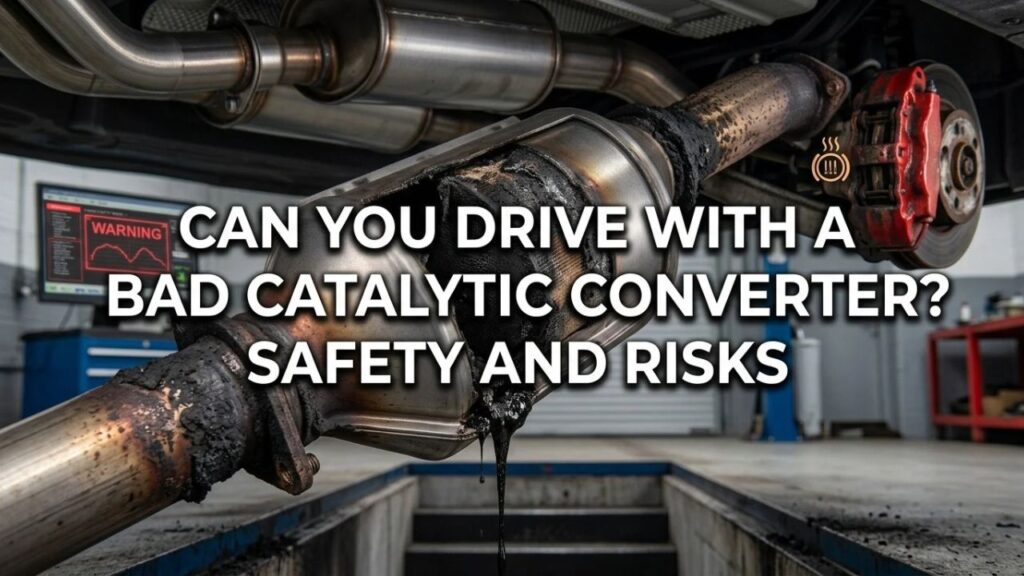
It can be temporarily safe in limited situations, but not every converter failure should be driven on.
A Mild Efficiency Problem May Not Affect Drivability
Some converters gradually lose their ability to process exhaust pollutants.
The vehicle may have:
- A steady check engine light
- P0420 or P0430
- Normal acceleration
- Smooth idle
- Normal engine temperature
- No unusual exhaust smell
- No rattling
A short period of driving while arranging diagnosis may be reasonable in this situation.
The converter may still flow exhaust normally even though its catalyst performance has dropped below the engine computer’s expected level.
A Clogged Converter Is More Serious
A physically restricted converter can trap exhaust gases.
As engine speed increases, exhaust backpressure rises and engine output falls.
Possible symptoms include:
- Very slow acceleration
- Poor hill-climbing ability
- Engine unable to reach higher RPM
- Rough idle
- Stalling
- Hard starting
- Misfires
A vehicle that cannot accelerate normally should not be treated as safe for routine driving.
An Exhaust Leak Adds a Separate Safety Concern
A cracked converter housing or broken exhaust connection can release fumes underneath the vehicle.
Exhaust gases can potentially enter the cabin.
Carbon monoxide cannot be reliably detected by smell, so symptoms such as headache, dizziness, nausea, unusual sleepiness, or confusion while inside the vehicle require immediate attention.
Key Takeaway: A mild catalyst-efficiency fault may allow limited driving, while clogging, exhaust leakage, severe power loss, or overheating makes continued driving far less safe.
Is It Dangerous to Drive With a Bad Catalytic Converter?
It can be.
The danger depends on why the converter is bad.
A Severely Overheated Converter Can Become a Fire Risk
Catalytic converters normally operate at high temperatures.
A misfiring or excessively rich engine can send unburned fuel into the exhaust.
That fuel may burn inside the converter and raise its temperature dramatically.
Warning signs include:
- Strong burning smell
- Smoke beneath the vehicle
- Visible red or orange glow
- Heat damage near the converter
- Flashing check engine light
Do not continue driving with a visibly glowing converter.
Park away from dry grass, leaves, or other combustible material and arrange diagnosis.
A Blocked Converter Can Cause Sudden Power Loss
A partially blocked converter may become more restrictive as it heats or as broken ceramic pieces move inside the housing.
The vehicle may suddenly become unable to:
- Merge safely
- Maintain highway speed
- Accelerate through an intersection
- Climb a hill
- Pass another vehicle
That creates a traffic-safety issue even if the engine continues running.
Exhaust Fumes Can Reach the Passenger Compartment
A broken converter shell or nearby exhaust leak can release fumes beneath the floor.
Driving with cabin exhaust odor should not be treated as a minor inconvenience.
Repair the leak before routine use.
Key Takeaway: A bad converter becomes dangerous when it overheats, restricts acceleration, stalls the engine, or releases exhaust gases near the cabin.
Is It Bad to Drive With a Bad Catalytic Converter?
Yes, especially if the original engine fault is still active.
Continued driving can make the repair more expensive.
A Misfire Can Destroy the Converter Further
A misfire may send unburned gasoline into the exhaust.
The converter can overheat as that fuel burns inside it.
A converter that began with reduced efficiency may eventually develop:
- Melted ceramic material
- Collapsed passages
- Internal rattling
- Exhaust restriction
A flashing check engine light often accompanies a serious active misfire.
Internal Material Can Break Apart
The converter contains a fragile ceramic or metallic substrate.
Overheating or physical impact can crack it.
Broken pieces can move inside the housing and partially cover the outlet.
A vehicle that initially has only rattling may later develop severe power loss.
Engine Performance May Continue Getting Worse
Exhaust restriction can progress from mild to severe.
The sequence may look like:
- Slight hesitation.
- Poor high-RPM acceleration.
- Noticeable power loss.
- Rough idle.
- Stalling.
- Hard starting.
Not every converter follows this exact pattern, but worsening restriction should not be ignored.
Key Takeaway: Driving with a failing converter can turn an emissions problem into a serious exhaust restriction, especially when misfires or overheating are still present.
How Long Can You Drive With a Bad Catalytic Converter?
There is no reliable mileage or time limit.
You cannot safely say that every vehicle can drive another 50, 500, or 5,000 miles.
Some Vehicles May Run Normally for a While
A converter with reduced catalyst efficiency but unrestricted exhaust flow may allow the vehicle to drive normally for days or longer while repairs are arranged.
The main issues may be:
- Check engine light
- Failed emissions inspection
- Higher emissions
That does not mean the fault should be ignored indefinitely.
A Restricted Converter Can Get Worse Quickly
A converter with melted or broken internal material is less predictable.
Loose ceramic pieces may shift position and suddenly block the exhaust.
The vehicle might drive normally one day and struggle to accelerate the next.
Drive Based on Symptoms, Not Mileage
Limited driving may be reasonable when:
- The check engine light is steady
- Acceleration is normal
- The engine does not misfire
- There is no exhaust smell in the cabin
- The converter is not overheating
- The vehicle is not stalling
Avoid further driving when:
- The check engine light flashes
- Power drops severely
- The engine repeatedly stalls
- The converter glows
- Smoke appears
- Exhaust fumes enter the cabin
- The vehicle cannot maintain safe traffic speed
Key Takeaway: There is no universal answer for how long you can drive with a bad catalytic converter; the severity and type of failure matter more than mileage.
What Happens If You Drive With a Bad Catalytic Converter?
The consequences range from increased emissions to complete loss of drivability.
The Check Engine Light May Stay On
A failing catalyst often triggers P0420 or P0430.
The light may remain steady while the vehicle otherwise runs normally.
Do not assume a steady light means the converter is physically clogged.
Acceleration Can Get Worse
A restricted converter limits the amount of exhaust the engine can move.
As load increases, the vehicle may become increasingly sluggish.
Highway acceleration and hill climbing are often where the restriction becomes most obvious.
The Engine Can Misfire
Severe backpressure can interfere with cylinder breathing.
That can contribute to unstable combustion and random misfires.
The opposite failure sequence is common too: the misfire may have damaged the converter first.
The Engine May Stall
A badly restricted converter can prevent the engine from maintaining stable operation.
Stalling may occur:
- At idle
- After hard acceleration
- When the exhaust gets hot
- During heavy engine load
Fuel Economy May Drop
A driver may press the accelerator farther to compensate for reduced power.
The engine problem that damaged the converter may also be wasting fuel.
The Vehicle May Fail an Emissions Inspection
A converter that no longer processes pollutants correctly can cause a catalyst-monitor failure or tailpipe emissions failure, depending on the inspection program.
The Repair Bill Can Increase
Ignoring the original cause can damage:
- The converter
- Oxygen sensors
- Exhaust components
- Nearby heat-sensitive parts
A small ignition or fuel-control problem can become much more expensive after it destroys the catalyst.
Key Takeaway: What happens if you drive with a bad catalytic converter ranges from a persistent warning light to poor acceleration, misfires, stalling, failed emissions testing, and further exhaust damage.
When Should You Stop Driving With a Bad Catalytic Converter?
Several warning signs mean the vehicle should be stopped and inspected rather than driven normally.
Flashing Check Engine Light
A flashing light commonly indicates an active misfire severe enough to threaten the converter.
Continuing to drive can send more unburned fuel into the catalyst.
Severe Loss of Power
If the vehicle cannot accelerate normally or maintain road speed, exhaust restriction may be severe.
Do not attempt highway driving with major power loss.
Glowing Catalytic Converter
A red-hot converter indicates abnormal temperature.
Possible causes include:
- Heavy misfire
- Rich fuel mixture
- Leaking injector
- Ignition failure
Stop the engine and let the vehicle cool in a safe location away from combustible material.
Smoke or Burning Smell
Smoke from the converter area deserves immediate inspection.
A strong burning smell can indicate extreme heat or nearby materials being overheated.
Exhaust Smell Inside the Cabin
Do not continue normal driving if exhaust gases are entering the passenger area.
Move into fresh air and have the exhaust repaired.
Repeated Stalling
A vehicle that repeatedly stalls may leave you without power at an unsafe moment.
A severe converter restriction can be one possible cause.
Key Takeaway: Stop driving for a flashing check engine light, severe power loss, glowing converter, smoke, cabin fumes, or repeated stalling.
Can You Drive With a Clogged Catalytic Converter?
A mildly clogged converter may still allow the vehicle to move, but a serious blockage should be repaired promptly.
Partial Blockage
A partially restricted converter may cause:
- Weak high-RPM power
- Slow acceleration
- Poor hill climbing
- Normal or nearly normal idle
The problem becomes stronger as exhaust volume rises.
Severe Blockage
An advanced restriction may cause:
- Rough idle
- Misfires
- Stalling
- Hard starting
- Major power loss
- Failure to reach normal RPM
At this point, towing may be safer than driving.
Backpressure Testing Can Confirm the Restriction
A technician can measure exhaust pressure through an oxygen-sensor port or another approved test point.
Excessive backpressure ahead of the converter supports a physical blockage diagnosis.
P0420 alone does not prove clogging.
Can You Drive With a Rattling Catalytic Converter?
Rattling should be inspected soon.
The noise may come from a loose external heat shield or broken ceramic material inside the converter.
Loose Heat Shield
A heat shield can corrode or loosen.
This may create a metallic vibration without harming catalyst performance.
Repair may be relatively inexpensive.
Broken Internal Substrate
A deeper rattle can indicate that the converter’s internal core has fractured.
Loose pieces may shift and block exhaust flow.
If power loss appears along with the rattling, internal damage becomes more suspicious.
Key Takeaway: A heat-shield rattle may be minor, while internal catalyst rattling can progress into exhaust restriction.
Can You Drive With a Hole in the Catalytic Converter?
Routine driving is not recommended.
A hole in the housing acts as an exhaust leak.
Possible symptoms include:
- Loud exhaust
- Hissing or ticking
- Black soot around the opening
- Exhaust smell
- Check engine light
The largest concern is exhaust escaping underneath the passenger compartment.
Repair the leak rather than treating a louder exhaust as the only problem.
Can a Bad Catalytic Converter Damage the Engine?
A severely clogged converter can interfere with engine operation.
It Creates Excess Backpressure
The pistons have to push exhaust gases against the restriction.
That wastes engine output.
It Can Reduce Cylinder Filling
Residual exhaust may remain in the cylinders.
Less room is available for fresh air and fuel.
Power falls.
It Can Raise Exhaust Temperature
Restriction combined with rich running or misfire can produce very high exhaust temperatures.
The engine problem that damaged the converter should be repaired before the new catalyst is installed.
Why Does a Catalytic Converter Go Bad?
A converter often fails because another fault exposes it to abnormal heat or contamination.
Engine Misfires
Unburned fuel reaches the exhaust and can burn inside the converter.
Rich Fuel Mixture
Too much fuel may come from:
- Leaking injectors
- Incorrect fuel pressure
- Ignition problems
- Sensor faults
Oil Consumption
Burned oil leaves ash and deposits that can contaminate the catalyst.
Coolant Leaks
Coolant entering the combustion chambers can damage catalyst material.
Road Impact
Rocks, curbs, or road debris can crack the internal ceramic structure.
Normal Aging
Catalyst performance can gradually decrease after years of heat cycles and use even without a dramatic failure.
Key Takeaway: Misfires, excess fuel, oil burning, coolant contamination, impact damage, and age can all contribute to catalytic converter failure.
How Do You Know How Bad the Catalytic Converter Is?
Diagnosis should determine if the converter has lost efficiency, become clogged, or suffered structural damage.
Read the Codes
Common catalyst codes include:
- P0420
- P0430
Also look for:
- P0300-series misfire codes
- Fuel-mixture codes
- Oxygen-sensor codes
- MAF-related codes
Those additional faults may identify why the converter failed.
Check Engine Performance
A converter is more likely to be physically restricted if the vehicle has:
- Poor high-RPM power
- Slow acceleration
- Trouble climbing hills
- Stalling
Inspect for Rattling or Impact Damage
A broken internal substrate may rattle.
A dented outer shell can suggest physical damage.
Test Exhaust Backpressure
Backpressure testing provides stronger evidence of physical restriction than a catalyst-efficiency code alone.
Inspect for Exhaust Leaks
A cracked converter or pipe can affect emissions readings and release fumes.
Key Takeaway: Codes identify emissions faults, while drivability checks, inspection, and backpressure testing determine if the converter is physically restricted or damaged.
Can You Keep Driving With P0420?
Possibly for a short period if the vehicle runs normally.
P0420 generally means catalyst system efficiency on Bank 1 is below the expected threshold.
It does not automatically mean:
- The converter is clogged
- The engine will immediately stop
- The car is unsafe to drive
Check for:
- Misfires
- Exhaust leaks
- Fuel-trim problems
- Oxygen-sensor faults
- Oil consumption
Driving becomes more urgent to stop if the light starts flashing or major drivability symptoms develop.
Will Driving With a Bad Converter Make It Worse?
It can.
Continued driving is most likely to cause additional damage when the engine still has:
- Active misfire
- Rich fuel mixture
- Leaking injector
- Heavy oil burning
- Coolant leakage
Repairing those faults early can prevent further overheating or contamination.
A converter that is only aging chemically may deteriorate more slowly.
How Do You Fix a Bad Catalytic Converter?
The repair depends on the type of failure.
Repair the Original Engine Problem
Before replacing the converter, check for:
- Misfires
- Rich mixture
- Fuel-injector faults
- Oil burning
- Coolant consumption
- Exhaust leaks
Replace a Physically Damaged Converter
Replacement is generally needed when the catalyst is:
- Melted
- Collapsed
- Broken
- Severely clogged
- Structurally rusted
- No longer meeting emissions requirements
Choose a replacement approved for the exact vehicle and emissions certification.
Check Warranty Coverage
For qualifying U.S. vehicles, catalytic converters generally receive federal emissions warranty protection for 8 years or 80,000 miles.
Manufacturer or state coverage may sometimes extend farther.
Key Takeaway: Repair the engine fault first, then replace the converter if testing confirms physical damage, restriction, or catalyst failure.
Conclusion
So, can you drive with a bad catalytic converter? Limited driving may be possible if the vehicle runs normally and the converter only has a catalyst-efficiency problem. That does not mean every bad converter is safe to ignore.
For how long can you drive with a bad catalytic converter, there is no fixed mileage. A chemically weak converter may remain drivable for some time, while a broken or clogged converter can become severe quickly.
If you are asking is it bad to drive with a bad catalytic converter, the answer is yes when the underlying engine problem is still damaging it. Misfires and rich running can turn a relatively minor converter fault into a melted or blocked catalyst.
For is it dangerous to drive with a bad catalytic converter or is it safe to drive with a bad catalytic converter, pay attention to the warning signs. Severe power loss, smoke, glowing metal, cabin fumes, repeated stalling, or a flashing check engine light mean continued driving is a poor choice.
And what happens if you drive with a bad catalytic converter depends on the failure: you may get only a warning light, or you may eventually face weak acceleration, misfires, stalling, extreme heat, exhaust leaks, and a larger repair bill.
FAQs About Driving With a Bad Catalytic Converter
Can I drive 100 miles with a bad catalytic converter?
There is no safe universal mileage limit. A vehicle with only a steady catalyst-efficiency code may drive normally, while one with a clogged converter could lose power or stall much sooner. Base the decision on symptoms rather than distance.
Can I drive for a month with a bad catalytic converter?
It may remain drivable if the converter only has reduced efficiency and no engine fault is actively damaging it. Waiting a month is a poor idea if the vehicle is misfiring, running rich, rattling badly, overheating, or losing power.
Is a bad catalytic converter an emergency?
Not every failure is an emergency. A steady P0420 with normal drivability usually gives you time to arrange diagnosis. A flashing check engine light, glowing converter, smoke, cabin exhaust, major power loss, or repeated stalling requires much faster attention.
Can a bad catalytic converter cause the car to stop while driving?
Yes. A severely blocked converter can create enough exhaust restriction to cause major power loss or stalling. Broken substrate material can also shift inside the housing and make the restriction suddenly worse.
Can you drive with P0420?
Often, yes for a limited period if the engine runs normally and the check engine light is steady. P0420 indicates reduced catalyst efficiency rather than proving physical blockage. Check for misfires, leaks, and other engine faults.
Can driving with a bad catalytic converter damage the engine?
A severely restricted converter can interfere with engine breathing and raise exhaust backpressure. The misfire, rich-running condition, or other fault that damaged the converter may also continue harming the engine or exhaust system.
Should I tow my car if the catalytic converter is bad?
Towing is safer when the vehicle has severe power loss, repeated stalling, a flashing check engine light, smoke, a glowing converter, strong cabin exhaust fumes, or cannot maintain normal traffic speed.
What is the safest thing to do with a bad catalytic converter?
Have the vehicle diagnosed before the symptoms become severe. Confirm if the problem is catalyst efficiency, physical restriction, internal breakage, or an exhaust leak, then repair the engine fault that caused the converter damage before replacing it.