What Causes a Catalytic Converter to Go Bad? Main Failure Causes
Catalytic converters usually fail because another engine problem exposes them to excess fuel, extreme heat, oil, coolant, carbon deposits, or physical damage. Misfires and rich fuel mixtures can overheat and melt the internal catalyst, while oil or coolant can coat the honeycomb and stop it from treating exhaust properly.
A converter is built to handle hot exhaust for a long time, so premature failure often points to a problem somewhere else in the engine. Replacing the converter without finding that problem can result in the new unit failing again.
For what causes a catalytic converter to go bad, the main failure patterns are overheating, contamination, internal breakage, exhaust restriction, and gradual catalyst deterioration. Walker groups converter failures into overheated or broken substrates, coated or oil-fouled substrates, and structural damage.
The problem can start with something as simple as a weak ignition coil, worn spark plug, leaking injector, or oil-burning engine. Those faults alter what reaches the converter and can expose the internal ceramic structure to conditions far beyond what it was designed to handle.
There is also a useful U.S. ownership point. EPA identifies catalytic converters as specified major emissions-control components covered under applicable federal warranty provisions for 8 years or 80,000 miles, whichever comes first, subject to warranty conditions.
A failed converter may trigger P0420 or P0430, produce a sulfur-like smell, reduce acceleration, rattle internally, run unusually hot, or become clogged. The symptom pattern depends on how the converter failed.
The sections below explain the major causes, why misfires are so damaging, how oil and coolant destroy catalyst material, what physical damage looks like, and what should be repaired before installing another converter.
What Causes a Catalytic Converter to Go Bad?
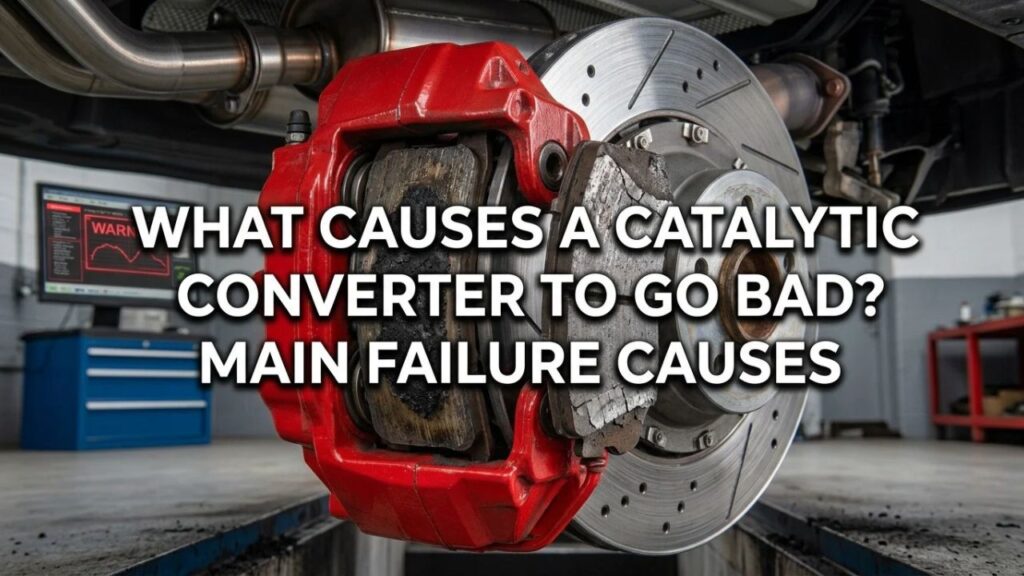
Most converter failures fall into a few main categories: excessive heat, contamination, structural damage, or long-term deterioration.
1. Engine Misfires
Engine misfires are among the most damaging problems for a catalytic converter.
During a normal combustion event, most of the air-fuel mixture burns inside the cylinder.
During a misfire, part of that mixture can leave the cylinder unburned and enter the exhaust.
Once it reaches the hot converter, the remaining fuel can burn inside the catalyst housing instead.
That raises converter temperature rapidly.
Walker identifies misfires, poor spark, low compression, and air-fuel imbalance among major causes of overheated and melted converter substrates.
Common misfire sources include:
- Worn spark plugs
- Weak ignition coils
- Damaged plug wires on older ignition systems
- Leaking or restricted injectors
- Low cylinder compression
- Burned valves
- Incorrect valve timing
A flashing Check Engine Light paired with severe shaking should not be ignored because continued misfiring can damage the converter quickly.
2. Rich Air-Fuel Mixture
An engine running rich receives more fuel than it can burn properly.
Some of that fuel may leave through the exhaust.
The catalytic converter then has to process a much heavier hydrocarbon load than normal.
Possible rich-mixture causes include:
- Leaking fuel injector
- Excessive fuel pressure
- Faulty MAF sensor
- Incorrect MAP sensor data
- Faulty oxygen sensor
- Engine coolant temperature sensor error
- Restricted air intake
- Fuel-control problems
AutoZone notes that prolonged rich operation can overheat the converter, increase carbon buildup, and damage the catalyst.
A rich engine may also show black exhaust smoke, fuel odor, fouled spark plugs, poor fuel economy, or P0172/P0175.
3. Burning Engine Oil
Oil that enters the combustion chambers does not disappear harmlessly.
Some of its ash and residue passes into the exhaust.
Those contaminants can coat the catalyst surface and block the tiny passages inside the converter.
Common causes of oil burning include:
- Worn piston rings
- Worn cylinder walls
- Damaged valve-stem seals
- PCV-system problems
- Turbocharger seal problems on some engines
Walker specifically lists excessive oil consumption as a cause of coated or poisoned catalyst substrates.
If a car regularly needs oil added between changes or produces blue exhaust smoke, that problem should be checked before another converter is installed.
4. Internal Coolant Leaks
Coolant entering the combustion chamber can also damage a catalytic converter.
A failed head gasket, cracked cylinder head, or intake gasket fault on certain engines may allow coolant into one or more cylinders.
The coolant then travels into the exhaust and coats catalyst surfaces.
Walker lists internal coolant leaks as a known cause of catalyst poisoning.
Possible clues include:
- Unexplained coolant loss
- Persistent white exhaust smoke after warm-up
- Sweet exhaust odor
- Engine overheating
- Coolant-contaminated spark plugs
- Cooling-system pressure loss
Installing a new converter without repairing an internal coolant leak can contaminate the replacement.
5. Excessive Converter Temperature
Catalytic converters operate hot during normal driving, but extreme temperature can destroy the internal core.
Walker states that temperatures above roughly 1,600°F may damage catalyst material even without obvious external melting.
Extreme heat can come from:
- Misfires
- Rich fuel mixture
- Poor spark
- Low compression
- Excessive engine load
- Fuel-delivery problems
- Exhaust faults
If the ceramic honeycomb melts, individual exhaust passages can fuse together.
The result may be a partially or fully clogged converter.
6. Faulty Fuel Injectors
A leaking injector can continue delivering fuel when it should be closed.
That cylinder may run excessively rich, misfire, or send raw fuel into the exhaust.
A restricted injector can create the opposite problem and contribute to lean misfire.
Walker recommends checking fuel pressure, injector leakage, and related fuel-system problems during converter diagnosis because incorrect fuel delivery can lead to rapid catalyst failure.
7. Faulty Oxygen, MAF, or MAP Sensor Data
A bad sensor does not always destroy a converter directly.
The damage comes from what incorrect sensor data makes the engine do.
For example, a faulty MAF sensor or oxygen sensor can contribute to incorrect fuel control.
If the engine runs rich for a long period, the converter may overheat or accumulate carbon deposits.
Walker includes O2, MAF, MAP, intake, and fuel-system faults among conditions that should be checked during converter diagnosis.
8. Physical Impact and Structural Damage
The converter is mounted underneath the vehicle on many cars and trucks.
Road debris, rocks, curbs, or off-road impacts can hit the metal shell hard enough to crack the internal ceramic.
Walker lists road impact as the primary source of physical converter damage and also identifies corrosion, thermal shock, metal fatigue, and stress fractures as possible causes.
A broken substrate may:
- Rattle
- Shift inside the housing
- Block part of the exhaust
- Trigger catalyst codes
- Reduce acceleration
Key Takeaway: Misfires, rich mixtures, oil burning, coolant leaks, faulty fuel control, extreme heat, and physical damage are the main reasons catalytic converters fail.
Can a Catalytic Converter Go Bad on Its Own?
Yes, but outright converter failure without another contributing factor is less common than many owners assume.
The catalyst material can gradually lose activity after years of heat cycles and exposure to exhaust gases.
The internal support material can also deteriorate with age.
A high-mileage converter may eventually set P0420 or P0430 even when the engine is currently running well.
Still, Walker notes that converters generally fail as a symptom of another condition, which is why diagnosis should include the engine and fuel system rather than focusing only on the exhaust part.
Age can contribute, but a converter that fails much earlier than expected deserves a search for misfires, oil burning, coolant contamination, mixture faults, or physical damage.
Why Do Catalytic Converters Go Bad From Misfires?
Misfires are especially damaging because they move combustion from the cylinder into the exhaust system.
Unburned Fuel Reaches the Converter
If a cylinder does not fire correctly, its air-fuel charge may pass into the exhaust.
That mixture reaches the converter with fuel still available to burn.
Fuel Burns Inside the Converter
The catalytic reaction and hot exhaust provide an environment where the remaining fuel can oxidize rapidly.
That creates intense localized heat.
Walker states that a misfire can create enough internal heat to melt converter substrate material.
Melted Ceramic Restricts Exhaust Flow
A healthy converter contains many open channels.
After melting, sections of that honeycomb can collapse or fuse.
The converter may then become a physical exhaust restriction.
Symptoms can include:
- Weak acceleration
- Limited high-RPM power
- Rough running
- Hard starting
- Stalling
- High exhaust backpressure
The Failure Can Become a Cycle
A misfire can damage the converter, then the damaged converter can worsen engine operation.
For example:
- Weak ignition causes a misfire.
- Raw fuel overheats the converter.
- Converter substrate begins to melt.
- Exhaust flow becomes restricted.
- Engine breathing gets worse.
- Additional rough running or misfires develop.
Key Takeaway: A misfire can send raw fuel into the converter, where it burns and generates enough heat to melt the internal honeycomb and create exhaust restriction.
What Makes a Catalytic Converter Go Bad From Oil or Coolant?
Oil and coolant usually damage a converter through contamination rather than immediate thermal meltdown.
Oil Coats the Catalyst Surface
Catalyst materials need direct contact with exhaust gases.
Oil ash can build a coating over those surfaces.
Once coated, the catalyst cannot treat HC, CO, and NOx as well as before.
Oil residue can also contribute to plugged passages.
Coolant Can Poison the Catalyst
Coolant contains chemicals that do not belong in the exhaust stream.
If coolant enters the cylinders and reaches the converter, deposits can form across the internal catalyst material.
Walker describes internal coolant leaks as a cause of poisoned converters.
Contamination Often Points to an Engine Repair
If oil or coolant is reaching the converter, replacing the exhaust part alone does not solve the source.
The engine may need work involving:
- Piston rings
- Valve seals
- Head gasket
- Cylinder head
- Intake gasket
- PCV system
- Turbocharger
Key Takeaway: Oil and coolant damage catalytic converters by coating or poisoning catalyst surfaces, so the engine leak must be repaired before a replacement converter is installed.
What Causes Catalytic Converter to Fail Physically?
Not every converter failure starts with fuel or contamination.
The core can also break mechanically.
Road Impact
A hard hit beneath the vehicle can dent the shell or fracture the ceramic brick.
This may produce a metallic rattle soon afterward.
Thermal Shock
A very hot converter can experience sudden cooling if exposed to deep water or snow.
Walker lists thermal shock, sometimes called thermal quenching, among converter failure causes.
Rapid temperature change can stress and crack internal materials.
Corrosion
The converter shell and attached pipes are repeatedly exposed to water, road salt, heat, and temperature cycles.
Long-term corrosion can weaken:
- Welds
- Flanges
- Outer shell
- Exhaust pipe
- Mounting points
Internal Mat Failure
The catalyst brick is held in place by supporting material inside the shell.
If that support deteriorates, the core may move.
Walker notes that shifted internal material can obstruct exhaust flow.
Key Takeaway: Road impacts, corrosion, thermal shock, stress fractures, and failed internal support material can crack or shift the converter substrate even when engine fueling is normal.
Does Old Age Cause a Catalytic Converter to Fail?
Yes, age can contribute.
Catalytic converters experience thousands of hot-and-cold cycles over their service life.
The catalyst coating can slowly lose activity, while the ceramic, support mat, shell, and pipework can deteriorate.
AutoZone lists age and normal wear among possible causes of converter failure, along with misfires, oil or coolant contamination, and impact damage.
There is no universal mileage at which every converter fails.
One car may keep its original converter for well over 100,000 miles, while another can destroy one much sooner because of a persistent misfire or oil-burning problem.
Maintenance history matters more than the odometer alone.
What Are the Signs a Catalytic Converter Is Going Bad?
Converter symptoms change according to the type of failure.
Check Engine Light
P0420 and P0430 are common catalyst-efficiency codes.
P0420 refers to Bank 1.
P0430 refers to Bank 2.
These codes do not automatically prove that the converter is physically clogged.
Poor Acceleration
A melted or shifted core can restrict exhaust flow.
The vehicle may feel weak, mainly at higher RPM or heavier throttle.
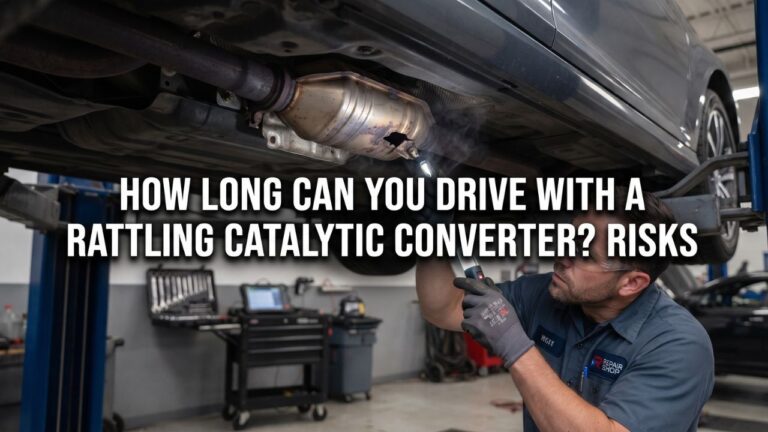
Rattling Noise
A cracked substrate can rattle inside the housing.
The sound may be strongest during:
- Startup
- Idle
- Light acceleration
- Deceleration
Rotten-Egg Smell
A sulfur-like odor can appear with catalyst or fuel-mixture problems.
It should be treated as supporting evidence rather than proof that the converter itself has failed.
Excessive Heat
A converter overloaded with unburned fuel can become much hotter than normal.
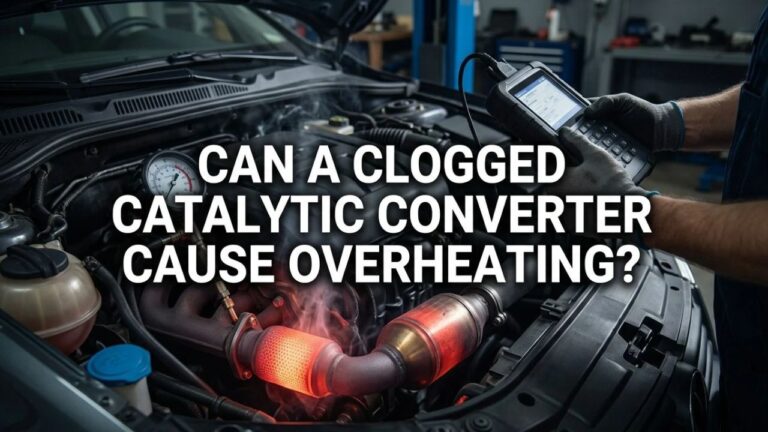
A glowing converter is a serious warning sign.
Failed Emissions Test
A converter that can no longer process pollutants at the required rate may cause an emissions-test failure.
Key Takeaway: Catalyst codes, poor acceleration, rattling, excessive heat, unusual exhaust odor, and emissions-test failure are common signs of converter trouble, but the failure type still needs diagnosis.
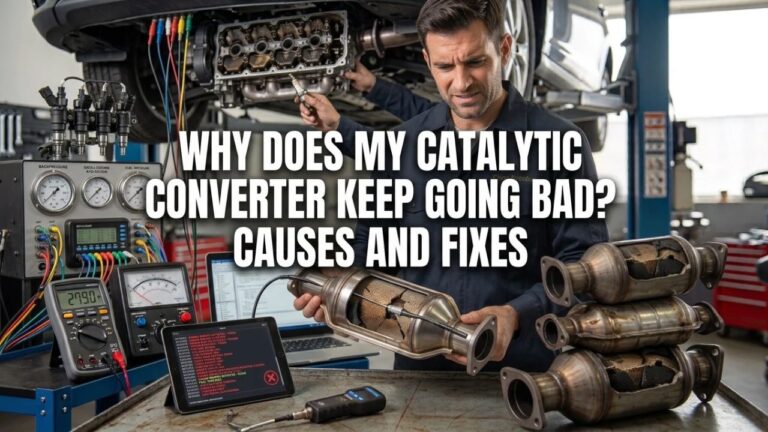
How to Find Out Why the Catalytic Converter Failed
Do not install a new converter before checking the conditions that may have destroyed the original one.
Scan All Trouble Codes
Read stored and pending codes.
Look for:
- P0420/P0430
- P0300-series misfires
- P0171/P0174 lean codes
- P0172/P0175 rich codes
- MAF codes
- Oxygen-sensor codes
- Injector or fuel-system faults
A misfire or mixture code may be more useful than the catalyst code itself.
Check Fuel Trims
Long-term and short-term fuel trims can reveal mixture corrections.
Large positive or negative numbers can point toward:
- Intake leaks
- Fuel-pressure problems
- Injector faults
- Sensor errors
- Exhaust leaks
Inspect Spark Plugs and Coils
Look for evidence of:
- Misfire
- Carbon fouling
- Oil fouling
- Coolant contamination
- Weak ignition
Correct ignition problems before replacing the converter.
Check Oil and Coolant Consumption
Monitor fluid levels.
An engine that regularly loses oil or coolant needs further diagnosis.
Inspect the Exhaust
Look for:
- Impact marks
- Rattling
- Crushed pipes
- Exhaust leaks
- Corrosion
- Loose heat shields
Test Exhaust Backpressure if Power Is Low
A backpressure test can reveal a physically restricted exhaust.
This is more useful for diagnosing a clogged converter than a P0420 code alone.
Key Takeaway: Scan codes, fuel trims, ignition parts, fluid consumption, exhaust condition, and backpressure should be checked before a failed converter is replaced.
How to Prevent a New Catalytic Converter From Going Bad
The best way to protect a new converter is to fix the condition that damaged the old one.
Repair Misfires Quickly
Do not keep driving for long periods with obvious misfires or a flashing Check Engine Light.
Check plugs, coils, injectors, and compression.
Fix Rich Fuel Conditions
A rich mixture can overheat a new converter.
Diagnose fuel pressure, injectors, airflow sensors, oxygen sensors, and engine-temperature data.
Address Oil Burning
If the engine consumes significant oil, determine where it is entering the cylinders.
A new converter can become oil-fouled too.
Repair Internal Coolant Leaks
Do not install another converter while coolant is still entering the exhaust.
Maintain the Air and Fuel Systems
Replace filters according to the vehicle maker’s service schedule and repair intake leaks or fuel-system faults as they appear.
Protect the Exhaust From Impact
Avoid driving over objects that can strike the converter housing or crush the exhaust pipe.
Key Takeaway: A replacement converter lasts longer when misfires, rich running, oil burning, coolant leaks, fuel problems, and physical exhaust damage are corrected first.
Conclusion
For what causes a catalytic converter to go bad, the leading causes are engine misfires, rich fuel mixtures, oil consumption, internal coolant leaks, extreme heat, faulty fuel or sensor control, physical impact, and long-term deterioration.
The converter often fails because it is exposed to conditions created somewhere else in the engine. A new converter may fail again if the original ignition, fuel, compression, oil, or cooling-system fault remains.
If P0420 or P0430 appears, do not automatically order a new converter. Check engine codes, fuel trims, misfires, exhaust leaks, sensor data, fluid consumption, and exhaust backpressure first.
When converter failure is confirmed, fix the root cause before installing the replacement. That protects the new catalyst and reduces the chance of paying for the same repair twice.
FAQs About Why Catalytic Converters Go Bad
Why Do Catalytic Converters Go Bad So Quickly?
A converter that fails unusually fast often has an upstream engine problem.
Persistent misfires, rich fuel delivery, oil burning, coolant leaks, or incorrect sensor data can expose the converter to extreme heat or contamination and shorten its life dramatically.
Can a Catalytic Converter Go Bad Without a Check Engine Light?
Yes.
A converter can begin rattling, developing internal damage, or becoming partially restricted before the computer stores a catalyst-efficiency code.
A Check Engine Light is common but not guaranteed during every stage of failure.
What Makes a Catalytic Converter Go Bad From Overheating?
Unburned fuel reaching the exhaust is a major source of converter overheating.
Misfires, leaking injectors, rich mixtures, weak spark, and some compression problems can send fuel into the catalyst, where it burns and raises internal temperature.
What Causes Catalytic Converter to Fail at Low Mileage?
Premature failure often points toward misfire, incorrect fuel mixture, oil contamination, coolant contamination, physical impact, or an engine-management fault.
A converter that fails early should not simply be replaced without checking why it failed.
Can Bad Spark Plugs Ruin a Catalytic Converter?
Yes.
Badly worn or fouled spark plugs can cause incomplete combustion or misfires.
Unburned fuel may then enter the converter and burn inside it, creating enough heat to damage the catalyst.
Can a Bad Fuel Injector Damage a Catalytic Converter?
Yes.
A leaking injector can make one cylinder excessively rich and send extra fuel into the exhaust.
A restricted injector can contribute to lean misfires.
Both conditions can place stress on the converter if allowed to continue.
Can Burning Oil Ruin a Catalytic Converter?
Yes.
Oil ash and residue can coat the catalyst material and restrict internal passages.
Heavy oil consumption should be repaired before a new converter is installed.
Can a Bad Head Gasket Damage the Catalytic Converter?
Yes.
A head-gasket leak that allows coolant into a cylinder can send coolant contamination into the exhaust.
Those deposits can poison the catalyst and shorten converter life.