Does a Bad Catalytic Converter Make Noise? Sounds and Causes
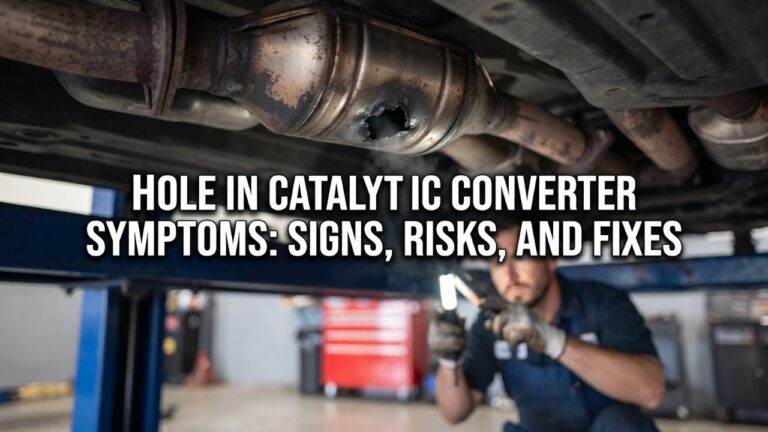
Yes, a failing catalytic converter can make noise, most often a metallic rattle or clattering sound from underneath the vehicle. The usual cause is a cracked or loose internal honeycomb substrate moving inside the converter shell. A loose heat shield can create a similar noise, so a rattle alone does not prove the converter has failed.
Ignoring the sound can lead to more than an annoying exhaust rattle. Broken pieces of catalyst material may shift, restrict exhaust flow, or travel farther down the exhaust system. A restricted converter may cause poor acceleration, loss of power, hard starting, or stalling.
Finding the actual noise source before replacing parts can save a costly misdiagnosis. Heat shields, exhaust hangers, clamps, mufflers, and nearby pipes can all rattle close enough to the converter that the sound seems to come from the same area.
In the United States, the EPA classifies the catalytic converter as a major emissions-control component. Federal emissions warranty coverage for specified major components on eligible light-duty vehicles extends to 8 years or 80,000 miles, whichever comes first, subject to the applicable warranty conditions.
If you are asking does a bad catalytic converter make noise, listen most closely for a loose metallic rattle that changes with engine RPM. A converter can also fail without making any unusual sound, especially when the main problem is poor catalyst operation or an early restriction rather than a broken internal substrate.
I’d pay special attention when a new rattle appears together with a check-engine light, sluggish acceleration, excess exhaust heat, a sulfur-like odor, or repeated engine misfires. Those combined symptoms give much more diagnostic information than sound alone.
The sections below explain what a failing converter sounds like, why it rattles, how to separate converter noise from a loose heat shield, which symptoms point toward restriction, and when the vehicle should be inspected before more driving.
Does a Bad Catalytic Converter Make Noise When It Fails?
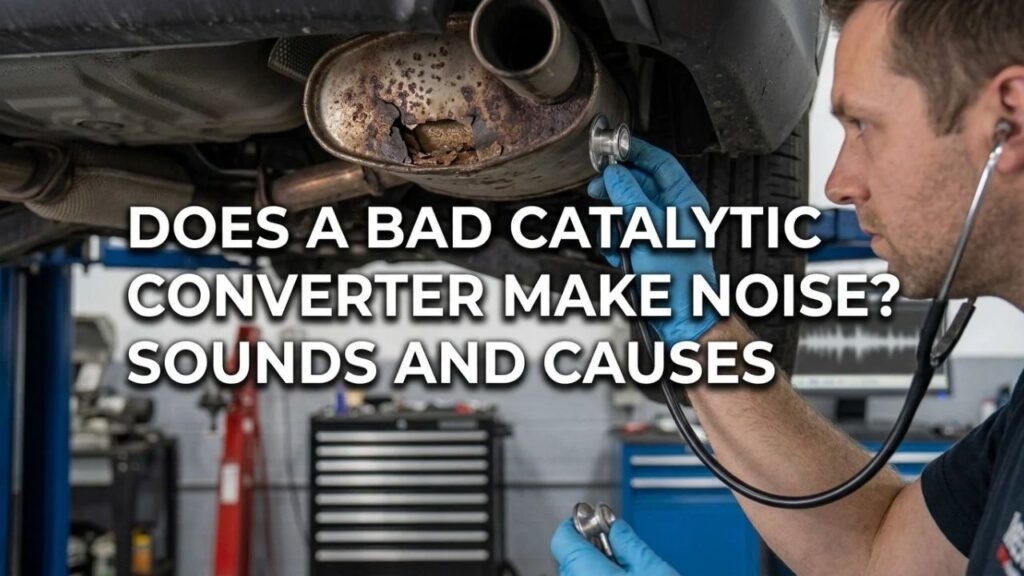
It can. The classic sound is a metallic rattle from the exhaust area caused by internal catalyst material breaking loose.
The converter may also become louder if its internal structure has deteriorated, though many converter failures remain nearly silent.
Rattling From a Broken Internal Substrate
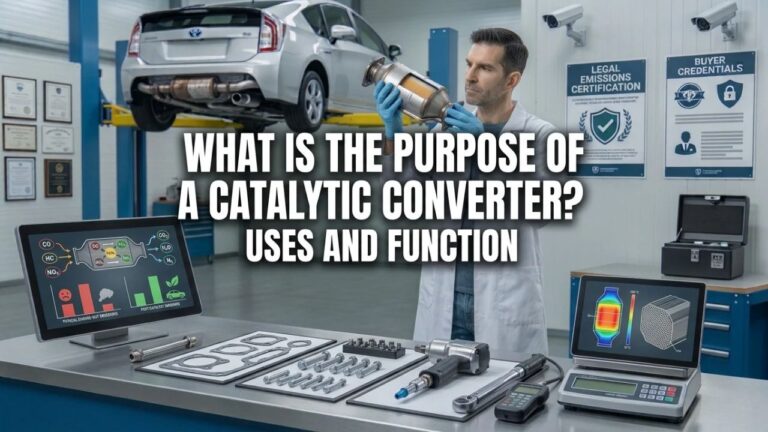
Inside many catalytic converters is a ceramic honeycomb coated with catalyst materials. The honeycomb needs to remain secured inside the metal housing while exhaust gases pass through its small channels.
Heat damage, impact, thermal stress, or another engine problem can crack that substrate. Once pieces become loose, they can shake inside the housing as the engine vibrates.
RepairPal identifies rattling beneath the vehicle as a symptom of converter failure and notes that broken catalyst material can move farther into the muffler or resonator. Walker also identifies loose or broken substrate as a converter failure mode.
The sound may resemble:
- Small stones shaking inside a metal can
- A metallic clatter
- A coarse vibration
- A loose internal component
- A rattle that changes as engine RPM rises or falls
Louder Exhaust Noise
A damaged converter can sometimes alter exhaust sound.
Walker states that a damaged or missing internal honeycomb can increase exhaust noise because the internal material no longer absorbs sound in the same way.
A dramatically louder exhaust is more commonly associated with an exhaust leak, broken pipe, damaged flex section, or muffler failure. Do not assume increased exhaust volume means the converter itself is bad.
A Bad Converter Can Be Completely Quiet
Noise is not required for catalytic converter failure.
A converter can become chemically degraded, contaminated, partially melted, or restricted without producing a noticeable rattle.
A quiet converter may still cause:
- P0420 or P0430 codes
- Poor acceleration
- Reduced engine power
- Hard starting
- Stalling
- High exhaust-system temperatures
- Failed emissions testing
- Sulfur or rotten-egg odor
Walker advises diagnosing engine codes, exhaust leaks, oxygen-sensor behavior, converter temperature, and backpressure rather than identifying converter failure from one symptom.
Key Takeaway: A broken converter often rattles, but a converter can fail silently. Sound is one diagnostic clue rather than proof by itself.
What Does a Bad Catalytic Converter Sound Like?
A failing converter usually produces a metallic sound rather than a deep engine knock or high-pitched bearing whine.
The exact noise depends on what has failed.
Metallic Rattle at Idle
A rattle that is easy to hear while the engine idles can come from loose substrate inside the converter.
Engine vibration shakes the exhaust system even while the vehicle is stationary. Broken ceramic material can move against the converter shell and create a loose clattering sound.
The rattle may change if engine speed is raised slightly.
A loose external heat shield can behave almost the same way, so the sound still needs to be isolated before buying a converter.
Rattle During Acceleration
Acceleration increases exhaust flow and changes engine movement. That can make broken internal material shift or vibrate more strongly.
If the rattle occurs during acceleration along with a clear loss of engine power, converter restriction moves higher on the list of possible causes.
AutoZone lists rattling, reduced acceleration, hard starting, stalling, and poor engine performance among symptoms that can occur with a damaged or clogged converter.
Noise During Startup
A brief metallic sound on cold startup may come from the converter area, but a loose heat shield is another common possibility.
Cold exhaust components contract. As the exhaust warms, metal expands, changing the tension in shields, brackets, pipes, and fasteners.
If a thin metallic buzz disappears after warm-up, inspect the heat shields and exhaust hardware before assuming the internal catalyst has broken.
Buzzing or Tinny Vibration
A light, thin buzz is often more consistent with an external shield than a broken ceramic core.
Catalytic converters operate at high temperatures, so metal shields are installed around or near them to protect surrounding components and the vehicle floor.
Corrosion can loosen a shield around a mounting point. AutoZone notes that converter heat shields can deteriorate and create rattling even when the converter core itself is not the noise source.
Key Takeaway: A coarse internal rattle raises suspicion of broken catalyst material, while a lighter tinny buzz often points toward a loose heat shield or nearby exhaust hardware.
Bad Catalytic Converter Noise vs Other Exhaust Noises
Sound travels through exhaust tubing and the vehicle body. A noise that appears to come from the converter may start several inches or even several feet away.
A simple comparison can narrow the possibilities.
| Sound | Possible Source | Other Clues |
| Loose metallic rattle | Broken converter substrate | May change with RPM |
| Thin tinny buzz | Loose heat shield | Often strongest at idle or certain RPM |
| Ticking | Exhaust manifold or gasket leak | Often changes as the engine warms |
| Deep exhaust roar | Broken pipe, muffler, or exhaust leak | Exhaust becomes much louder |
| Clunk over bumps | Loose hanger or exhaust contact | Often related to road movement |
| Rattle plus low power | Restricted or damaged converter | May include check-engine light |
| Popping from exhaust | Misfire or combustion problem | May occur during acceleration or deceleration |
Loose Heat Shield
A heat shield is one of the first parts to inspect when a converter-area rattle develops.
Rust can enlarge mounting holes, break welds, or loosen clamps. The shield then vibrates against the converter, exhaust pipe, or vehicle body.
This can sound surprisingly similar to a damaged internal substrate.
Repairing a loose shield is very different from replacing a catalytic converter, so confirming the source matters.
Exhaust Hangers and Brackets
Rubber hangers and metal brackets support the exhaust system while still permitting some movement.
A broken hanger can let a pipe, muffler, or converter contact the vehicle body.
Walker recommends checking for broken hangers, insulators, loose joints, and contact between the exhaust system and underbody when diagnosing exhaust noise.
A noise that appears mainly over bumps may be more consistent with loose exhaust mounting than an internal converter failure.
Exhaust Leak
A leak tends to create ticking, hissing, puffing, or a louder exhaust tone rather than a can-of-rocks rattle.
Cracks can develop at:
- Exhaust manifolds
- Flanges
- Gaskets
- Welds
- Flex pipes
- Pipe joints
- Converter seams
Walker states that exhaust leaks can alter oxygen-sensor readings and should be corrected before converter-related codes are diagnosed.
Muffler or Resonator Damage
Mufflers and resonators contain internal chambers, tubes, or baffles.
If an internal weld breaks, the component can rattle much like a converter.
Walker lists rattling or knocking from a muffler as a sign that an internal weld may have failed.
Key Takeaway: Heat shields, hangers, exhaust leaks, mufflers, and resonators can imitate converter noise, so locate the sound before replacing the catalytic converter.
Why Does a Catalytic Converter Start Rattling?
Internal converter material normally does not break apart without a reason.
Finding the cause matters because the same fault can damage the replacement converter.
Engine Misfires
A persistent misfire can send unburned fuel and oxygen into the exhaust.
Fuel may then burn inside the converter, raising substrate temperature far beyond its normal operating range.
Walker lists misfires, poor spark, low compression, and air-fuel imbalance among conditions that can overheat and damage a converter. It states that temperatures above about 1,600°F can damage catalyst material and that very high heat can destroy the substrate or retaining mat.
A flashing check-engine light associated with an active misfire deserves prompt attention because continued driving may damage the converter.
Rich Air-Fuel Mixture
An engine running too rich sends excess fuel into the exhaust.
That increases the work and heat inside the converter.
Possible causes include fuel-delivery faults, sensor problems, or engine-control issues. The underlying fuel problem needs to be corrected before a new converter is installed.
Oil Burning
Engine oil entering the combustion chamber can reach the converter through the exhaust.
Walker identifies oil fouling as a source of converter contamination. Oil can coat the catalyst surface and reduce its ability to process exhaust gases.
Blue exhaust smoke or high oil consumption can provide another clue.
Coolant Entering the Exhaust
An internal coolant leak can contaminate converter material.
Head-gasket trouble, a cracked cylinder head, or another internal engine leak may allow coolant to enter the combustion chamber and then travel into the exhaust.
Replacing the converter without repairing the coolant leak risks damaging the new unit.
Physical Impact
The converter sits underneath many vehicles and can be damaged by road debris, deep potholes, rocks, or contact with another object.
A hard impact may crack the ceramic substrate even if the outer shell does not look badly damaged.
MagnaFlow identifies physical damage as one reason ceramic substrate can become loose or cracked.
Extreme Heat Cycling
Repeated heating and cooling places stress on the converter shell, internal mat, welds, and substrate.
A converter built for normal exhaust temperatures can tolerate ordinary heat cycling. Repeated overheating caused by engine faults is different and may eventually break or melt the internal structure.
Key Takeaway: Misfires, excess fuel, oil or coolant contamination, impact damage, and severe overheating can break the internal catalyst and create a rattle.
Can a Clogged Catalytic Converter Make Noise?
Yes, but clogging itself does not always create sound.
A clogged converter may be almost silent while causing major engine-performance symptoms.
Restricted Flow Can Follow Internal Breakup
If the honeycomb breaks apart, loose pieces can shift and partially block exhaust passages.
That gives you two problems at once:
- Rattling from loose substrate
- Increased exhaust backpressure from restricted flow
The engine then has difficulty pushing exhaust gases out of the cylinders.
Possible symptoms include sluggish acceleration, reduced power, hard starting, and stalling.
A Melted Converter May Not Rattle
High temperatures can melt the substrate into a distorted or solid mass.
That type of failure may create serious restriction without leaving loose pieces that rattle.
Walker states that a melted substrate can obstruct exhaust flow and cause a vehicle to feel sluggish.
This is why lack of noise cannot rule out a clogged converter.
Backpressure Testing Can Confirm Restriction
A technician can test exhaust backpressure to check for a restriction.
Walker gives a general diagnostic reference of less than 1.5 psi at idle and less than 3 psi at 2,000 RPM, while noting that specifications vary by application. High pressure ahead of the converter can point toward converter restriction.
Vehicle-specific service information should take priority over a general pressure reference.
Key Takeaway: A broken converter may rattle and clog at the same time, while a melted converter can restrict exhaust flow with little or no noise.
Does a Rattling Catalytic Converter Mean It Needs Replacement?
If the internal catalyst substrate is broken and rattling inside the housing, replacement is generally the repair.
A heat-shield rattle is different.
Broken Internal Material
The honeycomb is part of the converter itself.
Once the substrate has physically fractured, a clamp or external repair cannot restore the internal structure.
RepairPal warns that broken catalyst pieces may move farther into the exhaust system.
Replacing the converter should be paired with diagnosis of the reason it failed.
Loose External Heat Shield
A loose shield may be repairable without replacing the converter.
The repair may involve the approved replacement of a fastener, clamp, shield, or associated hardware.
Do not simply remove heat shielding because it rattles. Shields are installed to control heat exposure to surrounding components and the vehicle body.
Rusted Converter Shell or Exhaust Leak
If the converter housing or its pipe connections have rusted through, the noise may be caused by an exhaust leak rather than loose substrate.
The repair depends on the location and condition of the damage.
Federal and state emissions rules also affect catalytic converter replacement, so use a converter approved for the specific vehicle and location.
Key Takeaway: A broken internal substrate normally means converter replacement, while an external heat-shield or mounting rattle may be repairable without replacing the converter.
How to Check a Catalytic Converter Noise
The goal is to confirm the location and type of noise without touching hot exhaust parts or working beneath an unsupported vehicle.
Listen From Outside the Vehicle
Park outdoors or in a properly ventilated area.
Listen at:
- Cold startup
- Warm idle
- Light throttle
- Gentle acceleration
- Deceleration
Notice if the noise changes with engine RPM.
Avoid running a vehicle for diagnosis inside an enclosed garage because exhaust contains carbon monoxide.
Let the Exhaust Cool Before Inspection
A catalytic converter becomes extremely hot.
Walker states that many converters begin catalyst activity around 350°F and are fully active around 500°F, with temperatures becoming much higher during fault conditions.
Do not grab, tap, loosen, or work around the converter until the exhaust has cooled.
Inspect Heat Shields and Hangers
Once the vehicle is cool and safely supported, inspect the nearby:
- Heat shields
- Exhaust hangers
- Clamps
- Flanges
- Brackets
- Flex pipe
- Muffler
- Resonator
Look for shiny contact marks where one exhaust part has been striking another component.
Scan for Trouble Codes
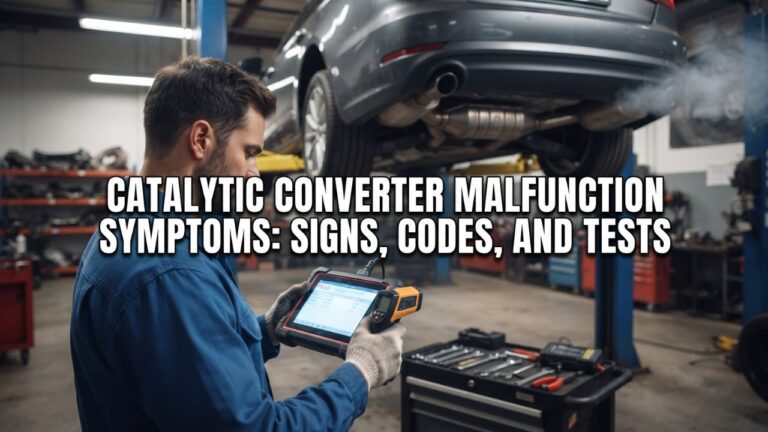
Catalyst-system codes such as P0420 and P0430 can support the diagnosis, but they do not prove the converter itself is bad.
Walker recommends correcting other engine codes and exhaust leaks before condemning the converter because faults elsewhere can affect catalyst monitoring.
A misfire code deserves extra attention because unresolved misfires can damage a replacement converter.
Test the Converter if the Cause Is Still Unclear
A shop may use:
- Backpressure testing
- Oxygen-sensor data
- Exhaust-gas analysis
- Temperature testing
- Inspection for exhaust leaks
- Manufacturer diagnostic procedures
I would confirm the cause before purchasing a converter, especially if the only symptom is a light rattle.
Key Takeaway: Locate the noise, let the exhaust cool, inspect shields and mounts, scan for related codes, and test exhaust restriction before blaming the converter.
Can You Keep Driving With a Noisy Catalytic Converter?
A light rattle from a loose external shield is different from a converter that has broken internally.
If the internal substrate is breaking apart, continued driving can allow debris to shift and restrict exhaust flow.
Stop normal driving and arrange inspection sooner if the noise appears with:
- Major power loss
- Stalling
- Hard starting
- Flashing check-engine light
- Active misfire
- Severe heat under the vehicle
- Burning smell
- Glowing exhaust components
- Heavy rattling that is rapidly getting worse
A flashing check-engine light often points toward a misfire severe enough to threaten catalyst damage. The vehicle’s owner’s manual should be followed for the warning-light behavior on that model.
If the vehicle runs normally and the sound appears to come from a shield or hanger, diagnosis may reveal a much smaller repair. Do not assume the converter needs replacement from the sound alone.
Conclusion
Yes, does a bad catalytic converter make noise has a clear answer: it can. A broken internal honeycomb commonly creates a metallic rattle or clatter that may change with engine speed. Some damaged converters also make the exhaust louder.
A light tinny buzz may come from the converter’s heat shield rather than the catalyst itself. Exhaust hangers, pipe joints, mufflers, resonators, and leaks can produce similar sounds, so isolating the source is an important first step.
A bad converter can also remain silent. Power loss, P0420 or P0430 codes, stalling, sulfur odor, high exhaust temperature, and failed emissions testing may appear without any obvious rattle.
I would have the system diagnosed before replacing the converter and make sure any misfire, fuel-control problem, oil burning, coolant leak, or exhaust fault is repaired first. Installing a new converter without correcting the cause can damage the replacement.
FAQs About Bad Catalytic Converter Noise
What does a bad catalytic converter sound like?
The classic sound is a loose metallic rattle from beneath the vehicle. It may resemble broken ceramic pieces or small stones moving inside a metal housing. The sound can change with idle speed, acceleration, or deceleration. A thin metallic buzz may come from an external heat shield instead.
Does a bad catalytic converter rattle at idle?
It can. Engine vibration at idle may shake broken substrate inside the converter and make the rattle easy to hear. A loose heat shield can also rattle at idle, so the location and cause should be confirmed before the converter is replaced.
Can a bad catalytic converter make noise when accelerating?
Yes. Acceleration changes engine vibration and exhaust flow, which may make loose internal material rattle more strongly. Rattling paired with sluggish acceleration or loss of power raises more concern about a damaged or restricted converter.
Can a catalytic converter be bad without making noise?
Yes. A converter may lose catalyst function, become contaminated, or develop a melted restriction without loose parts inside the shell. In that case, the main signs may be a check-engine light, poor acceleration, emissions-test failure, high exhaust temperature, or stalling.
Is a rattling catalytic converter always bad?
No. The apparent converter rattle may actually come from a loose heat shield, clamp, hanger, muffler, or another exhaust component. If the internal substrate itself is rattling, the converter is physically damaged and normally needs replacement.
Will a bad catalytic converter cause a check-engine light?
It often can. Catalyst-system efficiency codes commonly include P0420 for Bank 1 and P0430 for Bank 2. Those codes do not prove the converter is faulty because exhaust leaks, sensor problems, misfires, and other engine faults can affect catalyst-monitor results.
Can a loose catalytic converter heat shield sound like a bad converter?
Yes. A rusted or loose heat shield can create a thin metallic buzz or rattle near the converter. The noise may be strongest at idle, startup, or a narrow RPM range. Confirm the shield condition before replacing the converter.
Can a clogged catalytic converter make a rattling noise?
It can if the restriction is caused by broken substrate moving inside the housing. A converter that has melted into a solid restriction may produce little or no rattle. In that case, loss of power, hard starting, stalling, or high backpressure may be more noticeable than noise.