What Does a Bad Catalytic Converter Smell Like? Signs and Causes
A failing catalytic converter often creates a sharp sulfur or rotten-egg odor from the exhaust. The smell is linked to hydrogen sulfide and usually points to a converter that is being overwhelmed, contaminated, or affected by an engine problem such as an overly rich air-fuel mixture.
A persistent sulfur smell should not be treated as proof that the converter itself needs replacement. A rich-running engine, misfire, faulty fuel injector, sensor problem, or another upstream fault can send abnormal exhaust into the converter and create the same odor. Replacing the converter without correcting that cause may damage the new part too.
Finding the source early may prevent overheating, poor acceleration, increased fuel consumption, converter damage, and a larger repair bill. The location of the odor also matters: sulfur at the tailpipe points toward the exhaust or fuel system, while a strong rotten-egg smell under the hood can come from an overheating or overcharged battery.
The sulfur connection is real even though modern U.S. gasoline contains much less sulfur than fuel did decades ago. The U.S. Environmental Protection Agency’s Tier 3 program lowered the annual-average gasoline sulfur standard to 10 parts per million beginning in 2017, in part because sulfur interferes with vehicle emission-control systems.
So, what does a bad catalytic converter smell like in normal driving? The classic description is rotten eggs, sulfur, or a sharp burnt-sulfur odor near the tailpipe. EPA material also documents rotten-egg exhaust odor associated with hydrogen sulfide under vehicle malfunction conditions.
The smell becomes more useful as a diagnostic clue when it appears with other symptoms such as a Check Engine light, sluggish acceleration, reduced fuel economy, excessive exhaust heat, hard starting, or rattling from underneath the vehicle. The sections below explain why the odor develops, how to separate converter trouble from other smells, which faults can create it, and what to check before replacing anything.
What Does a Bad Catalytic Converter Smell Like?
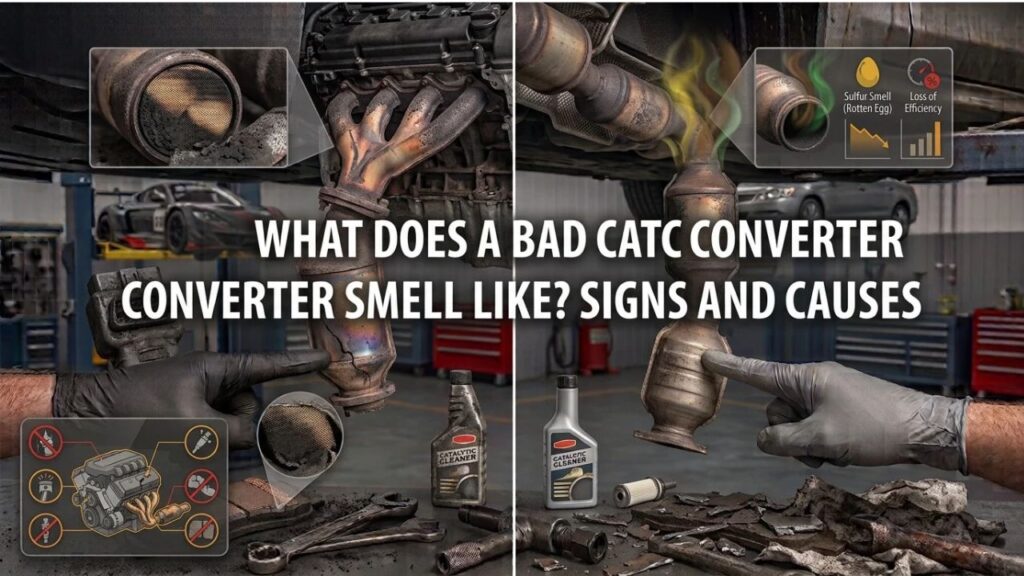
A troubled catalytic converter most often smells like rotten eggs or sulfur.
The odor may be noticed:
- Behind the car near the tailpipe
- While idling
- During or after hard acceleration
- After climbing a steep grade
- Shortly after parking a hot vehicle
- Inside the cabin if exhaust gases are entering through a leak
EPA documentation identifies hydrogen sulfide as a probable cause of the characteristic rotten-egg exhaust odor found in some malfunctioning catalyst-equipped vehicles.
Rotten Eggs
Rotten eggs are the description drivers use most often.
Hydrogen sulfide, written chemically as H₂S, has a distinct sulfur-like odor. Under certain abnormal operating conditions, sulfur compounds in the exhaust can lead to hydrogen sulfide leaving the tailpipe.
A strong odor does not tell you how badly damaged the converter is. It tells you that the exhaust chemistry is abnormal enough to deserve diagnosis.
Burnt Sulfur
Some drivers describe the smell as burnt sulfur rather than rotten eggs.
Those descriptions can refer to the same general exhaust problem. The intensity can change with engine temperature, fuel mixture, load, and how close you are to the exhaust outlet.
Acrid Exhaust Odor
A malfunctioning emissions system may also produce an unusually sharp or unpleasant exhaust smell that does not perfectly resemble eggs.
If the odor comes with rough running, dark exhaust, hesitation, or poor fuel economy, check the engine’s fuel and ignition operation rather than focusing only on the converter.
Key Takeaway: Rotten eggs or sulfur is the classic catalytic-converter odor, but smell alone cannot confirm that the converter itself has failed.
Why Does a Catalytic Converter Smell Like Rotten Eggs?
The odor comes from sulfur chemistry inside the exhaust system.
Gasoline contains small amounts of sulfur. Combustion and catalyst reactions change those sulfur compounds as exhaust moves from the engine through the converter.
Hydrogen Sulfide Creates the Smell
Hydrogen sulfide is strongly associated with the rotten-egg odor.
EPA reports on catalyst-equipped vehicles describe hydrogen sulfide formation under certain malfunction or rich-mixture conditions. One EPA investigation recorded a pungent rotten-egg odor and linked the condition to an engine that was running excessively rich.
The human nose can detect hydrogen sulfide at low concentrations, so a noticeable smell does not automatically mean the gas concentration is extremely high.
You still should not intentionally breathe exhaust fumes.
A Rich Air-Fuel Mixture Can Trigger It
An engine runs rich when too much fuel enters relative to the available air.
Possible causes include:
- Faulty fuel injector
- High fuel pressure
- Incorrect sensor data
- Ignition misfire
- Air-intake restriction
- Engine-management fault
The extra fuel changes exhaust chemistry and can place far more heat into the converter.
EPA historical testing found rotten-egg odor under rich operating conditions, and modern repair guidance still lists excessive fuel delivery among the causes that can create sulfur odor and converter damage.
The Converter May Be Contaminated or Damaged
Oil, coolant, excessive fuel, overheating, and long-term deterioration can reduce catalyst activity.
Once the converter can no longer process exhaust normally, odors and emissions may change.
A converter can also become restricted if its internal ceramic substrate melts, collapses, or becomes contaminated. That type of failure commonly produces drivability symptoms in addition to smell.
Key Takeaway: The rotten-egg odor is associated with hydrogen sulfide, and a rich-running or malfunctioning engine can create the conditions that produce it or damage the converter.
Does a Rotten-Egg Smell Always Mean a Bad Catalytic Converter?
No.
A sulfur odor is a strong clue, but several other automotive problems can produce a similar smell.
Rich Fuel Mixture
The engine may be creating the odor before the converter itself has failed.
A leaking injector, incorrect fuel pressure, faulty sensor, or misfire can send too much fuel into the exhaust.
If the converter is replaced but the rich-running condition remains, the new converter may overheat and fail too.
Overcharged or Damaged Battery
Lead-acid batteries can produce a sulfur-like rotten-egg odor if they overheat or are overcharged.
A battery-related smell is usually strongest under the hood rather than at the tailpipe.
Other warning signs may include:
- Swollen battery case
- Battery too hot to touch safely
- Charging-system problems
- Fluid leakage
- Electrical issues
AutoZone lists an overcharged battery as another common source of rotten-egg odor around a vehicle.
Do not lean directly over a battery that is hot, swollen, leaking, or venting gas.
Gear Oil
Some gear lubricants contain sulfur compounds and can have a strong sulfur-like odor.
A leaking differential or transmission-related lubricant may therefore smell somewhat like rotten eggs.
The location of the odor and evidence of an oil leak help separate this from tailpipe exhaust.
Fuel Quality
Fuel composition can influence exhaust odor.
A sulfur smell that begins immediately after filling the tank and disappears after the fuel is used may be fuel-related, though persistent odor still deserves inspection.
Key Takeaway: Rotten eggs can point toward the converter, but rich fueling, battery trouble, gear oil, or fuel quality can create similar odors. Locate the source before replacing parts.
Other Symptoms That Support a Bad Catalytic Converter Diagnosis
Smell becomes much more meaningful when it appears with additional converter symptoms.
Check Engine Light
A failing catalyst can trigger the Check Engine light.
Common catalyst-efficiency codes include P0420 and P0430, though a stored code is not automatic proof that the converter needs replacement.
Oxygen-sensor faults, exhaust leaks, engine misfires, and fueling problems can affect catalyst monitoring too.
I would read the stored codes and diagnostic data before ordering a converter.
Sluggish Acceleration
A physically restricted converter can limit exhaust flow.
The engine then has difficulty moving exhaust gases out of the cylinders, which may cause:
- Weak acceleration
- Reduced high-RPM performance
- Hesitation
- Difficulty climbing hills
- Engine feeling unable to breathe
AutoZone lists sluggish acceleration and reduced engine output among common signs of a clogged converter.
Poor Fuel Economy
Converter trouble can appear alongside reduced fuel economy, especially when the root problem involves incorrect fueling or restricted exhaust flow.
A drop in mileage by itself has many possible causes, so it should be combined with scan data and other symptoms.
Excessive Heat
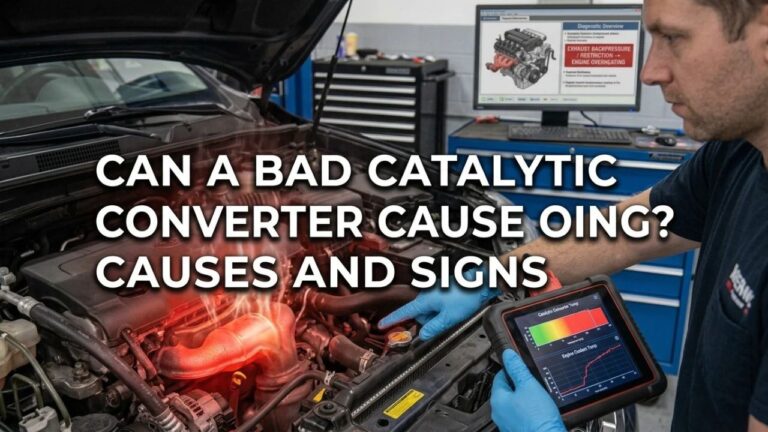
A converter can become extremely hot if unburned fuel reaches it.
One cause is an ignition misfire, where fuel enters the exhaust without burning properly inside the cylinder.
AutoZone notes that an inefficient or contaminated converter can experience very high internal temperatures, and visible red heat underneath the vehicle deserves immediate attention.
Safety Tip: Do not park a vehicle with an overheating exhaust system over dry grass, leaves, or other combustible material.
Rattling Underneath the Vehicle
The converter contains a ceramic substrate inside its metal shell.
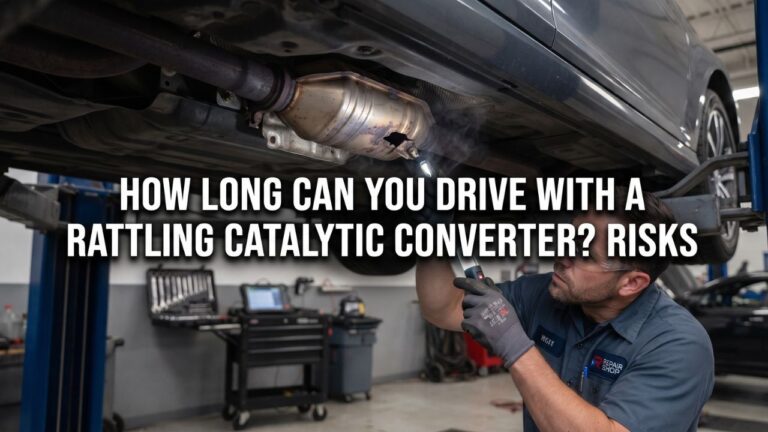
If that internal structure breaks apart, loose pieces may rattle when the engine starts, idles, or changes speed.
A rattle does not create the sulfur smell itself, but sulfur odor plus a converter-area rattle gives you two separate reasons to inspect the unit.
Hard Starting or Stalling
A badly restricted converter can create enough exhaust backpressure to interfere with engine operation.
Severe restriction may produce hard starting, weak running, or stalling.
Key Takeaway: Sulfur odor paired with catalyst codes, poor acceleration, heat, rattling, reduced fuel economy, or starting trouble makes converter or upstream engine trouble more likely.
How to Tell Where the Rotten-Egg Smell Is Coming From
Start by locating the odor without touching hot components or breathing exhaust intentionally.
Smell Is Strongest at the Tailpipe
A sulfur smell that clearly exits the tailpipe points toward combustion, fueling, or catalyst chemistry.
Check for:
- Check Engine light
- Misfire
- Rough idle
- Dark exhaust
- Poor fuel economy
- Weak acceleration
- Catalyst codes
The converter may be the damaged component, or it may be reacting to an upstream engine fault.
Smell Is Strongest Under the Hood
A strong egg smell near the battery deserves immediate attention to the charging system.
Turn the vehicle off and avoid sparks, flames, cigarettes, or actions that could ignite battery gases.
A visibly swollen or leaking battery should be handled according to battery-safety procedures rather than treated as a converter problem.
Smell Is Strongest Inside the Cabin
Exhaust odor inside the passenger compartment deserves prompt inspection.
The cause may be:
- Exhaust leak
- Damaged exhaust joint
- Leaking flex pipe
- Body opening allowing exhaust entry
- Ventilation-system intake pulling fumes inside
Firestone warns that exhaust fumes entering the cabin can pose a serious safety risk.
If strong exhaust fumes are entering the cabin, stop using the vehicle until the leak is addressed.
Smell Is Near a Wheel or Axle
A sulfur-like lubricant smell around an axle or differential may point to gear oil rather than the converter.
Look for wet areas around seals, the differential housing, or nearby components.
Key Takeaway: Tailpipe sulfur points toward combustion or catalyst trouble, under-hood sulfur may involve the battery, and cabin exhaust odor calls for immediate exhaust-leak inspection.
Can a Bad Catalytic Converter Smell Like Gas?
It can be associated with a fuel-like exhaust smell, but raw gasoline odor often points more directly toward an overly rich mixture, unburned fuel, or a fuel leak.
A converter that is being flooded with excess fuel may overheat and lose catalyst activity.
Possible causes of excess fuel entering the exhaust include:
- Misfiring cylinder
- Leaking injector
- Ignition failure
- Faulty engine sensor
- Excessive fuel pressure
Raw gasoline outside the exhaust system deserves special attention because liquid fuel or vapor can create a fire hazard.
Do not assume a strong gas smell is normal converter odor.
Can a Bad Catalytic Converter Smell Like Burning?
A failed converter may produce intense heat, so drivers sometimes report a hot or burning smell around the exhaust area.
A burning odor is less specific than sulfur.
It can also come from:
- Oil leaking onto hot exhaust
- Plastic touching the exhaust
- Overheated brakes
- Electrical wiring
- Transmission-fluid leak
- Belt or hose damage
If you see smoke or a converter glowing red, shut the vehicle off in a safe location and arrange diagnosis.
Do not crawl underneath a recently driven vehicle to inspect a hot converter.
Can You Drive With a Rotten-Egg Smell From the Exhaust?
A brief faint odor is different from a strong smell that continues every time the vehicle runs.
Persistent sulfur odor deserves diagnosis soon because the underlying issue may damage the converter or indicate an engine fault.
Stop Driving if the Converter Is Glowing
A red-hot converter can indicate extreme exhaust temperature.
Continuing to drive may damage surrounding components or create a fire risk.
Stop if the Engine Is Misfiring Badly
A flashing Check Engine light commonly signals a severe misfire that can send unburned fuel into the exhaust.
Continuing to drive under those conditions can rapidly overheat the converter.
Stop if Exhaust Is Entering the Cabin
Do not continue normal driving with strong exhaust fumes inside the passenger compartment.
Move to fresh air and have the exhaust system inspected.
Mild Odor With Normal Operation
If the smell is light, there are no major drivability symptoms, and no flashing warning light is present, arrange diagnosis rather than trying to judge converter condition from smell alone.
A scan can reveal engine codes that point toward the cause.
How Is a Smelly Catalytic Converter Diagnosed?
Good diagnosis starts upstream of the converter.
Replacing the converter before checking the engine is one of the costlier mistakes in emissions-system repair.
Read Diagnostic Trouble Codes
Use an OBD-II scanner to check stored and pending codes.
Relevant groups may include:
- P0420 or P0430 catalyst-efficiency codes
- P0300-series misfire codes
- Oxygen-sensor codes
- Fuel-trim codes
- Air-fuel sensor codes
Do not erase the codes before recording them.
Freeze-frame data can show operating conditions at the time the fault was detected.
Check Fuel Trim
Fuel-trim data shows how the engine computer is adjusting fueling.
Large abnormal corrections can point toward intake leaks, fuel-delivery faults, sensor problems, or another issue that can affect the converter.
Diagnose Any Misfires First
A converter is not the first part I would replace on an engine with an active misfire.
Check the ignition, injector operation, compression, and related engine controls first.
A converter damaged by a misfire can fail again if the misfire remains.
Inspect for Exhaust Leaks
A leak before or near an oxygen sensor may affect sensor readings and catalyst diagnostics.
Inspect exhaust connections, flex sections, gaskets, manifolds, and damaged piping as appropriate.
Test for Restriction
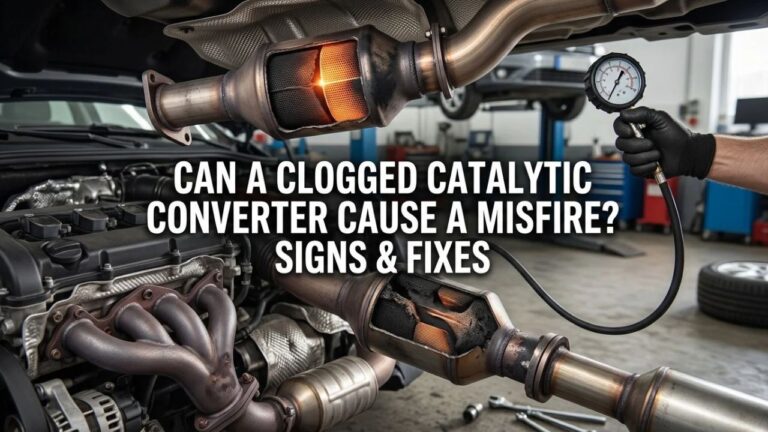
If the vehicle has severe power loss, a technician may test exhaust backpressure, engine vacuum behavior, temperature patterns, or other manufacturer-specified parameters.
Do not diagnose a clogged converter solely from a sulfur odor.
Key Takeaway: Scan codes, fuel mixture, misfires, oxygen-sensor data, exhaust leaks, and restriction should be checked before condemning the converter.
Will Replacing the Catalytic Converter Remove the Smell?
It can if the converter itself is damaged and the original cause has also been corrected.
The second part is critical.
If a leaking injector, misfire, oil consumption problem, coolant contamination, or incorrect fuel mixture killed the old converter, installing a new converter without repairing that fault may reproduce the smell and damage.
The repair sequence should be:
- Identify the source of the abnormal exhaust condition.
- Repair the engine, fueling, ignition, or sensor fault.
- Confirm the converter is actually damaged or below required performance.
- Replace the converter if needed.
- Recheck codes and engine operation.
A replacement converter should not be used as a substitute for diagnosis.
Conclusion
If you are asking what does a bad catalytic converter smell like, the classic odor is rotten eggs or sulfur. Hydrogen sulfide is closely associated with that smell, and abnormal catalyst operation or an overly rich engine condition can allow the odor to become noticeable at the exhaust.
The smell alone does not prove the converter needs replacement. Rich fueling, ignition misfires, injectors, sensor faults, battery problems, gear oil, and fuel quality can create similar clues or contribute to converter trouble. Check where the odor is strongest and look for related symptoms such as codes, weak acceleration, excessive heat, or rattling.
I would diagnose the engine before replacing the converter. An upstream fault can destroy a new converter just as it damaged the old one, turning one repair into two.
Strong exhaust inside the cabin, a flashing Check Engine light, severe loss of power, or a glowing converter calls for faster attention. Those symptoms go beyond an unpleasant smell and may indicate a condition that should not be driven normally.
FAQs About Bad Catalytic Converter Smells
Does a Bad Catalytic Converter Always Smell Like Rotten Eggs?
No. Some failed converters create no obvious smell at all.
A converter can lose catalyst activity, become restricted, or develop a broken internal substrate without producing a strong sulfur odor. Codes, poor acceleration, rattling, excess heat, or a failed emissions test may appear instead.
Why Does My Exhaust Smell Like Sulfur?
Sulfur odor can occur when hydrogen sulfide is present in the exhaust.
A rich fuel mixture, misfire, catalyst problem, or another engine-management fault may create the conditions. Check scan codes and engine operation before assuming the converter is the only failed part.
Can a Bad Oxygen Sensor Cause a Rotten-Egg Smell?
It can contribute indirectly.
An oxygen or air-fuel sensor that sends incorrect information may cause improper fuel control in some failure modes. An overly rich engine can then send abnormal exhaust and excess fuel toward the converter, producing sulfur odor and heat.
Can a Misfire Make the Catalytic Converter Smell?
Yes. A misfire may allow unburned fuel to enter the exhaust.
That fuel can react inside the converter, raising its temperature and changing exhaust odor. A flashing Check Engine light with a strong sulfur smell should be treated as a reason to stop hard driving and diagnose the misfire.
Can a New Catalytic Converter Smell?
Some new converters may produce an odor during an initial break-in period.
A General Motors service bulletin for certain low-mileage vehicles described converter odor that could remain until the unit had gone through its normal heat-conditioning period. A persistent rotten-egg smell paired with engine faults still deserves diagnosis.
Is Rotten-Egg Smell From a Car Dangerous?
The odor may indicate hydrogen sulfide or another sulfur compound, while exhaust itself can contain harmful gases such as carbon monoxide.
Avoid intentionally breathing the fumes. Strong exhaust entering the passenger compartment should be treated as an exhaust-leak problem and repaired before normal driving resumes.
Can a Clogged Catalytic Converter Cause a Sulfur Smell?
Yes. Sulfur or rotten-egg odor can appear with a converter that is becoming restricted, especially when the restriction is related to overheating, contamination, or abnormal engine operation.
A clogged converter often produces other symptoms too, including poor acceleration, hard starting, reduced fuel economy, excessive heat, or stalling.