How to Pass Emissions Test With Bad Catalytic Converter Legally
If the catalytic converter has genuinely failed, there is no reliable legal trick that turns it into a passing converter. The proper route is to confirm the failure, repair any engine problem that damaged it, install a compliant replacement when needed, complete the required OBD drive cycle, and retest after the emissions monitors report ready.
Trying to hide a failed catalyst can create another problem. Modern inspections may check the Check Engine Light, diagnostic trouble codes, OBD readiness monitors, catalyst condition, and emissions equipment, so simply making the warning light disappear does not mean the vehicle is ready to pass.
A proper diagnosis can also save money. P0420 or P0430 does not prove by itself that the catalytic converter needs replacement. Exhaust leaks, misfires, incorrect fuel mixture, oxygen-sensor faults, oil burning, and other engine problems can produce catalyst-related trouble codes or damage a working converter.
There is also a useful U.S. warranty rule to check before paying for a converter. EPA states that catalytic converters are among the specified major emissions components covered for 8 years or 80,000 miles, whichever occurs first, under applicable federal emissions warranty provisions. Used vehicles can also remain covered during that period when the warranty conditions are met.
For anyone asking how to pass emissions test with bad catalytic converter, the safest path is to make the emissions system pass its own diagnostic checks rather than trying to bypass them. EPA says state Inspection and Maintenance programs are intended to identify high-emitting vehicles, have faults repaired, and verify them through retesting. Testing requirements differ across states and local areas.
Do not disconnect the battery or erase a catalyst code immediately before testing in an attempt to hide it. That normally resets OBD readiness monitors, and an inspection can reject the vehicle because the required self-tests have not finished.
The steps below cover catalyst diagnosis, P0420 and P0430, readiness monitors, legal converter replacement, common pretest mistakes, repair assistance, and what to do when replacement cost is the main obstacle.
How to Pass Emissions Test With Bad Catalytic Converter Legally
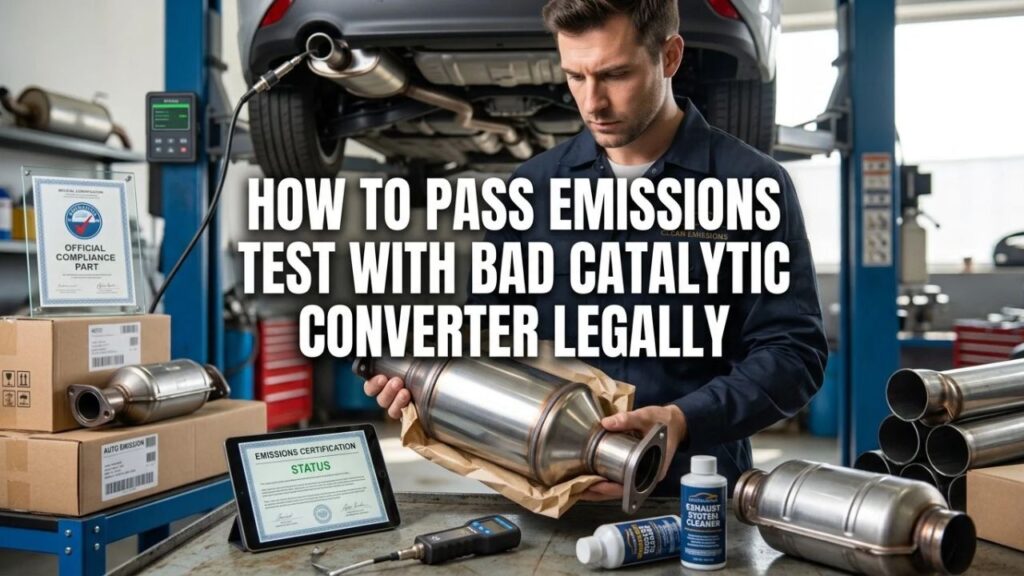
If testing confirms that the catalytic converter itself has failed, repair or replacement is usually needed before the vehicle can legitimately pass an emissions inspection.
Start by finding the actual reason for the failure rather than immediately ordering a converter.
A sensible sequence is:
- Scan the vehicle for stored and pending trouble codes.
- Diagnose P0420, P0430, misfire, fuel-trim, and oxygen-sensor faults.
- Check for exhaust leaks.
- Repair engine problems that could damage the converter.
- Confirm catalyst failure before replacing it.
- Install the correct compliant converter if replacement is required.
- Complete the vehicle’s required drive cycle.
- Verify that required OBD monitors show ready.
- Confirm that the Check Engine Light stays off.
- Return for the emissions retest.
That process costs more effort than clearing codes, but it addresses what the inspection system is trying to detect.
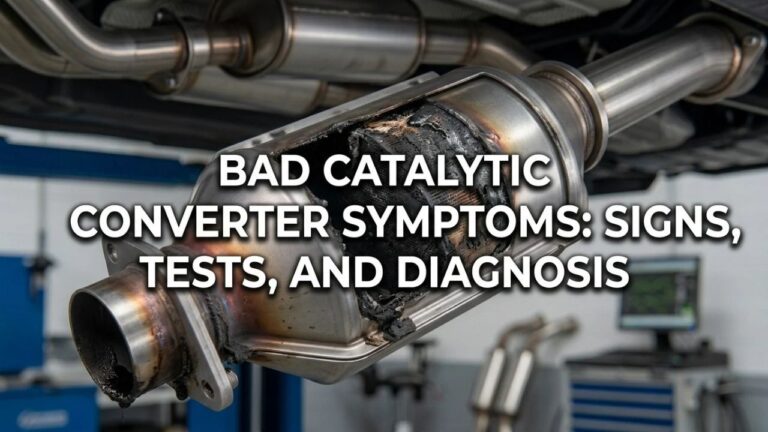
Why a Bad Catalytic Converter Fails an Emissions Test
A catalytic converter converts several harmful exhaust pollutants into less harmful compounds before exhaust leaves the tailpipe.
If catalyst activity falls too far, the vehicle’s computer may detect the reduction in conversion efficiency.
OBD-II Can Detect Catalyst Efficiency Problems
Most modern gasoline vehicles use oxygen sensors before and after the converter.
The engine computer compares sensor activity to evaluate how well the converter is storing oxygen and processing exhaust gases.
A common result of poor catalyst operation is:
P0420 — Catalyst System Efficiency Below Threshold, Bank 1
Engines with two banks may also set:
P0430 — Catalyst System Efficiency Below Threshold, Bank 2
If the Check Engine Light is commanded on because of an emissions fault, many OBD-based inspection programs will fail the vehicle.
EPA OBD inspection procedures state that an illuminated or commanded-on malfunction indicator light during the test requires repair.
Tailpipe Emissions May Be Too High
Some inspection programs use tailpipe testing, mainly on certain older vehicles.
A worn catalyst may allow too much:
- Hydrocarbon (HC)
- Carbon monoxide (CO)
- Oxides of nitrogen (NOx)
to leave the exhaust.
An engine problem upstream of the converter can also raise these emissions, which is another reason not to blame the catalyst before testing the rest of the engine.
Visual Inspection Can Find Converter Problems
Some programs inspect emissions equipment visually.
The converter may need to be present, installed correctly, and approved for that particular vehicle.
California, for example, checks converter presence and identification on affected vehicles and can fail a vehicle when the installed aftermarket converter is not approved for the application.
Key Takeaway: A failed converter can trigger an OBD fault, produce excessive tailpipe emissions, or fail a visual inspection, so hiding only one symptom does not repair the emissions system.
Diagnose P0420 or P0430 Before Replacing the Converter
A catalyst-efficiency code tells you that the computer sees inadequate catalyst operation. It does not tell you why.
Replacing the converter without finding the cause can waste money.
Check for Misfires First
Misfires can send unburned fuel into the exhaust.
That fuel may burn inside the converter, creating enough heat to damage or melt the catalyst substrate.
Look for P0300 or cylinder-specific codes such as P0301, P0302, P0303, and P0304.
Common causes include bad spark plugs, weak ignition coils, injector faults, compression problems, and intake leaks.
Repair an active misfire before installing a new converter.
Check Fuel Trim and Mixture Problems
A rich-running engine can overload the converter with fuel.
A lean-running engine can create combustion and emissions problems of its own.
Possible causes include:
- Faulty MAF sensor
- Vacuum leak
- Fuel-pressure problem
- Leaking injector
- Oxygen-sensor fault
- Intake leak
- Exhaust leak
- Incorrect engine temperature information
Scan-tool fuel-trim data can point toward a mixture problem that needs repair.
Check Exhaust Leaks
A leak near an oxygen sensor can draw outside air into the exhaust stream.
That extra oxygen may alter sensor readings and interfere with catalyst diagnosis.
Inspect manifolds, gaskets, flex sections, flanges, and sensor mounting areas.
Check Oxygen-Sensor Operation
Do not replace oxygen sensors simply because a P0420 or P0430 appears.
Use scan data to check the upstream and downstream sensors and compare their behavior with manufacturer diagnostic information.
A faulty sensor can create misleading data, while a working downstream sensor may simply be reporting that the converter has actually failed.
Key Takeaway: P0420 or P0430 should trigger diagnosis of misfires, mixture faults, exhaust leaks, sensor operation, and catalyst condition before the converter is condemned.
Why Clearing the Check Engine Light Usually Does Not Work
Erasing a trouble code can turn off the Check Engine Light temporarily.
It does not repair the condition that set the code.
Clearing Codes Resets Readiness Monitors
OBD-II vehicles perform self-tests called readiness monitors.
Common monitors include:
- Catalyst
- Oxygen sensor
- Oxygen-sensor heater
- EVAP
- EGR or related systems
- Secondary air injection on equipped vehicles
Disconnecting the battery or clearing codes often changes non-continuous monitors back to not ready.
EPA inspection guidance says readiness monitors must complete before many OBD inspections can pass, with permitted incomplete-monitor counts controlled by the applicable inspection program.
The Catalyst Code May Return
Once the catalyst monitor runs again, the computer evaluates the converter.
If the converter is still below its required efficiency threshold, P0420 or P0430 can return.
Clearing the code therefore creates a short period when the warning light is gone but the emissions system has not yet completed its tests.
State Rules Are Not Identical
Readiness requirements vary by inspection program.
California’s Bureau of Automotive Repair, for example, publishes specific readiness standards and notes that monitor completion can require exact speed, temperature, pressure, and engine-load conditions. A vehicle with a fault preventing the monitor from running may need diagnosis and repair before readiness can complete.
Key Takeaway: Clearing codes usually replaces an emissions fault with incomplete readiness monitors; once the catalyst test runs again, an unresolved converter problem can return.
Complete OBD Readiness After the Repair
After repairing an emissions fault, the vehicle’s computer needs time to run its self-tests again.
This is normal.
Check Readiness With a Scan Tool
Before returning to the inspection station, connect an OBD-II scanner and check I/M readiness status.
You want the required monitors for your location and vehicle to report ready or complete.
Do not rely only on the Check Engine Light being off.
A scanner may show:
- Ready
- Not ready
- Complete
- Incomplete
- Unsupported
The exact terminology changes by scan tool.
Follow the Vehicle’s Drive Cycle
Each manufacturer can use different conditions for monitor completion.
A catalyst monitor may require a particular combination of:
- Cold start
- Coolant temperature
- Ambient temperature
- Fuel level
- Steady cruising
- Acceleration
- Deceleration
- Engine load
- Time at a set road speed
Use the drive-cycle procedure for the exact vehicle when available.
Do not attempt unsafe acceleration or deceleration solely to run a monitor. Normal driving over several trips may complete the tests.
Verify Codes Again Before Retesting
Once the required monitors show ready, scan the vehicle again.
Check for:
- Stored codes
- Pending codes
- Check Engine Light status
- Catalyst monitor status
- Misfire data
If P0420 or P0430 returns after readiness completes, the underlying catalyst problem has not been resolved.
Key Takeaway: After repairs, verify OBD readiness with a scanner and allow the vehicle to complete its required self-tests before paying for another inspection.
Do Catalytic Converter Cleaners Help Pass Emissions?
A bottle of cleaner cannot rebuild melted, broken, or chemically exhausted catalyst material.
That distinction matters.
Cleaner May Address Deposits Elsewhere
A fuel-system cleaner intended for your vehicle may clean certain injector or combustion deposits when used according to its label.
That could improve engine operation if deposits were part of the emissions problem.
It does not restore missing catalyst coating or repair a collapsed honeycomb.
A Melted Converter Needs Physical Repair
A converter can be damaged internally by:
- Prolonged misfires
- Rich fuel mixture
- Oil contamination
- Coolant contamination
- Severe overheating
- Physical impact
Once the substrate has melted, broken, or deteriorated beyond its operating threshold, an additive cannot reverse that damage.
Do Not Rely on Guaranteed-Pass Claims
An emissions additive might change combustion or deposits in some conditions, but it cannot guarantee a legal inspection result.
If the vehicle has a confirmed P0420 or P0430 caused by a worn catalyst, the underlying converter problem remains.
I would put the money toward diagnosis before purchasing several bottles of products hoping one hides the fault.
Key Takeaway: Fuel-system products may address certain deposit-related engine issues, but they cannot rebuild a physically or chemically failed catalytic converter.
Why O2 Sensor Spacers and Simulators Are Not the Answer
Some online advice recommends moving the downstream oxygen sensor away from the exhaust stream or altering its signal.
That attempts to change what the diagnostic system sees rather than repair the failed emissions component.
O2 Spacers Can Mask Catalyst Information
The downstream oxygen sensor exists partly so the vehicle can evaluate catalyst operation.
Moving the sensor out of its intended position can alter the exhaust sample reaching it.
That can interfere with the emissions-monitoring system rather than restore converter function.
Electronic Simulators Alter the Monitoring Signal
Electronic devices may be sold to imitate the signal expected from a working catalyst.
They do not reduce the pollutants coming from a failed converter.
EPA states that the Clean Air Act prohibits tampering that removes or renders emissions-control devices inoperative, and it also prohibits aftermarket defeat devices whose purpose is to bypass or defeat emissions controls.
Removing the Converter Is Not a Legal Shortcut
Replacing a converter with a straight pipe also does not solve the inspection problem.
EPA states that federal law prohibits removing a catalytic converter and replacing it with a converter-replacement pipe on a road vehicle subject to the requirement.
Key Takeaway: Spacers, simulators, straight pipes, and other bypass methods change or defeat emissions monitoring rather than repair the catalyst and can violate federal or state rules.
Can a Car Pass Emissions With P0420?
In an OBD-based emissions program, a current P0420 that commands the Check Engine Light on will normally lead to failure.
An inspection is checking the emissions system, not simply the appearance of the dashboard.
A stored catalyst fault also signals that the converter or related system needs diagnosis.
If P0420 is caused by an exhaust leak, sensor issue, misfire, or another repairable fault rather than the converter itself, correcting that fault may allow the monitor to pass after the drive cycle.
If testing confirms that the converter cannot meet the efficiency threshold, replacement is normally the repair.
Do not clear P0420 immediately before the inspection and expect that alone to solve the problem. The monitor may show incomplete, and the code can return once the self-test runs.
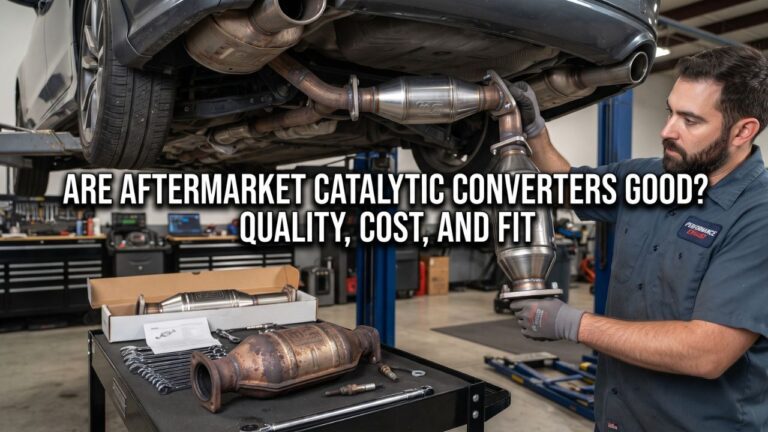
Choosing a Legal Replacement Catalytic Converter
If replacement is required, use a converter approved for the exact vehicle and jurisdiction.
Fitment is based on more than pipe diameter.
Match the Exact Vehicle Application
Check:
- Model year
- Make
- Model
- Engine
- Emissions certification
- Exhaust configuration
- Converter location
- Federal or California emissions specification
Installing the wrong converter can produce another catalyst code or fail a visual inspection.
Federal and California Requirements Can Differ
California has stricter aftermarket converter requirements for affected vehicles.
The Bureau of Automotive Repair states that a replacement converter must be OEM or a California Air Resources Board-approved aftermarket unit that matches the vehicle application.
Vehicles outside California may follow federal and applicable state requirements.
Check the emissions label under the hood and the rules where the vehicle is registered.
Repair the Cause of the Old Converter Failure
Before fitting the new unit, correct any condition that may have killed the old one.
Examples include:
- Misfire
- Oil burning
- Coolant entering the cylinders
- Rich fuel mixture
- Failed injector
- Ignition problem
A new converter exposed to the same problem can fail again.
Key Takeaway: Install a converter approved for the exact vehicle and location, and repair the engine fault that damaged the old catalyst before the replacement goes into service.
Check the Federal Catalytic Converter Warranty
Converter replacement can be expensive, so check warranty coverage before paying for the repair.
Federal Coverage May Be 8 Years or 80,000 Miles
EPA identifies the catalytic converter as one of the specified major emissions-control components covered for 8 years or 80,000 miles, whichever occurs first, under applicable federal warranty provisions.
Coverage conditions still matter.
Failure caused by improper maintenance, misuse, or another excluded condition may not be covered.
Used Vehicles Can Still Have Coverage
EPA states that the federal emissions warranties can apply to used vehicles during the applicable warranty period.
Coverage begins from the vehicle’s original sale date, not the date you bought it used.
Check the owner’s warranty booklet and contact an authorized dealer before authorizing an expensive replacement elsewhere.
Some Vehicles Have Longer Coverage
Manufacturer recalls, emissions warranty extensions, or state-specific coverage can sometimes provide extra protection.
Check the vehicle identification number for open recalls and emissions campaigns.
Key Takeaway: Before buying a converter, check the 8-year/80,000-mile federal coverage, the vehicle’s warranty booklet, and any manufacturer emissions extensions or recalls.
What If You Cannot Afford a Catalytic Converter?
Do not assume bypassing the converter is your only option.
Some emissions-testing regions offer legal alternatives for qualifying owners.
Look for Repair Assistance
EPA notes that some state and local inspection programs fund vehicle repair or replacement assistance for qualifying motorists who cannot easily pay for emissions repairs.
California’s Consumer Assistance Program, for example, currently lists emissions-repair assistance of up to $1,450 for qualifying 1996-and-newer vehicles and up to $1,100 for qualifying 1976–1995 vehicles, subject to program eligibility.
Programs and funding change, so check the current rules in the location where the vehicle is registered.
Check for a Repair or Hardship Waiver
Some inspection programs allow repair-cost or hardship waivers after a vehicle fails and the owner meets specified conditions.
EPA notes that state programs may offer such options, but qualifications vary.
A waiver is not the same thing as secretly bypassing the catalyst. It is an official process administered under the inspection program.
Ask for a Diagnostic Estimate Before Replacement
If the only evidence is P0420 or P0430, pay for diagnosis before authorizing an expensive converter.
A less costly engine or exhaust fault may be producing the code.
How to Prepare for the Retest After Catalytic Converter Repair
Once the fault has been repaired, a few checks reduce the chance of another wasted inspection fee.
Confirm the Check Engine Light Is Off
Start the engine and verify that the malfunction light is not commanded on.
The light should still illuminate during the normal key-on bulb check before the engine starts.
A missing or disabled warning light can itself be an inspection problem.
Check Readiness Monitors
Use an OBD-II scanner.
Confirm that the required monitors have completed according to your state’s rules.
The catalyst monitor deserves special attention after a P0420 or P0430 repair.
Check for Pending Codes
A pending catalyst or misfire code may indicate that the problem is returning before the Check Engine Light has fully illuminated.
Diagnose it rather than rushing straight to the inspection station.
Make Sure the Exhaust Is Complete
Check for leaks, loose connections, damaged sensor wiring, and the correct converter installation.
A visual inspection may catch an incorrect or modified converter even when the dashboard looks normal.
Bring Failure Documentation When Required
If you are seeking a warranty repair, assistance program, waiver, or state-authorized retest, keep the inspection report and repair receipts.
Those documents may be required to show what failed and what work was performed.
Key Takeaway: Before retesting, verify the warning-light operation, required readiness monitors, pending codes, exhaust installation, and any paperwork required by the local inspection program.
Conclusion
The lawful answer to how to pass emissions test with bad catalytic converter is to diagnose why the catalyst system is failing, repair the root cause, and replace the converter if testing proves it can no longer meet the required standard.
Do not assume P0420 or P0430 automatically means the converter is dead. Misfires, mixture faults, exhaust leaks, and oxygen-sensor problems should be checked first. If the converter has actually failed, code clearing, additives, O2-sensor spacers, or straight pipes do not restore its emissions-cleaning ability.
After the repair, let the OBD system complete its drive cycle and check readiness with a scanner before returning for inspection. State rules differ, so verify the requirements where the vehicle is registered.
I would also check warranty and assistance options before paying out of pocket. A converter may still fall under federal emissions coverage, and some state programs offer repair assistance or an official waiver process for qualifying owners.
FAQs About Passing Emissions With a Bad Catalytic Converter
Can I Pass an Emissions Test With a Bad Catalytic Converter?
A genuinely failed converter usually needs repair or replacement for the vehicle to pass legally. OBD testing may detect poor catalyst efficiency, while other programs can use tailpipe or visual inspection.
If the converter is not actually bad and another fault is causing the catalyst code, repairing that fault may restore normal monitor operation.
Will P0420 Fail an Emissions Test?
A current P0420 that commands the Check Engine Light on will normally cause an OBD-based emissions inspection to fail.
Clearing it immediately before the inspection is not a repair because readiness monitors can reset to incomplete and the code may return after the catalyst self-test runs.
Can I Clear the Check Engine Light Before an Emissions Test?
You can erase codes with a scan tool, but doing so usually resets emissions readiness monitors.
An inspection may reject the vehicle until required monitors complete. If the original fault remains, the code can return once the computer runs its self-tests again.
Will Catalytic Converter Cleaner Make My Car Pass?
A cleaner cannot repair melted substrate, missing catalyst material, or a converter that has permanently lost conversion capacity.
If deposits elsewhere in the engine are contributing to poor combustion, an approved fuel-system product may address those deposits, but it should not be treated as a replacement for diagnosis or converter repair.
How Long Should I Drive After Replacing a Catalytic Converter Before Testing?
There is no single mileage that works for every vehicle.
Drive until the required OBD readiness monitors report complete. Some vehicles finish their monitors over several normal trips, while others require a manufacturer-specific drive cycle with certain temperature, speed, load, and fuel-level conditions.
Can an O2 Sensor Cause a Catalytic Converter Emissions Failure?
Yes, an oxygen-sensor fault can affect catalyst diagnosis or fuel control.
Do not replace the sensor solely because a catalyst code appears. Check live data, wiring, exhaust leaks, fuel trims, and manufacturer diagnostic procedures before deciding which part has failed.
Is It Legal to Use an O2 Sensor Spacer to Pass Emissions?
Using a device to defeat or interfere with the intended emissions-monitoring function can fall under federal anti-tampering and defeat-device rules.
The compliant repair is to correct the emissions fault rather than alter the downstream sensor signal. State rules can add further restrictions.
What Should I Do if I Cannot Afford a New Catalytic Converter?
Check federal emissions warranty coverage first, especially if the vehicle is still within the applicable 8-year/80,000-mile major-component period.
Then check your state or local inspection program for repair assistance, manufacturer warranty extensions, recalls, or an official hardship or repair-cost waiver. Those routes address the cost problem without defeating the vehicle’s emissions system.