Does a Bad Catalytic Converter Affect Acceleration? Signs & Fixes
Yes. A failing catalytic converter can make a car accelerate slowly when its internal honeycomb becomes restricted or collapses and blocks exhaust flow. The engine then struggles to push exhaust gases out, so power may fall sharply during hard acceleration, hill climbing, highway merging, or operation at higher RPM.
This distinction matters because not every failed converter reduces engine power. A converter can lose its emissions-cleaning ability, set a P0420 or P0430 code, and still flow freely enough for the car to accelerate normally.
A restricted converter is different. Increasing engine speed creates more exhaust volume, and the blockage causes exhaust backpressure to rise. O’Reilly Auto Parts lists lack of power and reduced ability to accelerate quickly among common symptoms of a clogged converter.
Catalytic converters also receive special U.S. emissions-warranty treatment. EPA states that catalytic converters are among the specified major emissions components covered for 8 years or 80,000 miles, subject to federal warranty conditions. Checking warranty status before paying for an expensive replacement can therefore save a substantial repair bill.
So, does a bad catalytic converter affect acceleration every time it fails? No. Acceleration usually suffers when the converter restricts exhaust flow, while an efficiency-only failure may cause little or no noticeable drivability change.
I would pay closest attention to a car that feels fairly normal at low speed but becomes increasingly weak as throttle opening and RPM rise. That pattern fits an exhaust restriction better than a converter that has simply lost catalyst efficiency.
The sections below explain how a restricted converter reduces acceleration, what the car may feel like, how to separate converter trouble from fuel and ignition faults, which tests confirm a restriction, and why the cause of converter failure should be repaired before a replacement is installed.
Does a Bad Catalytic Converter Affect Acceleration?
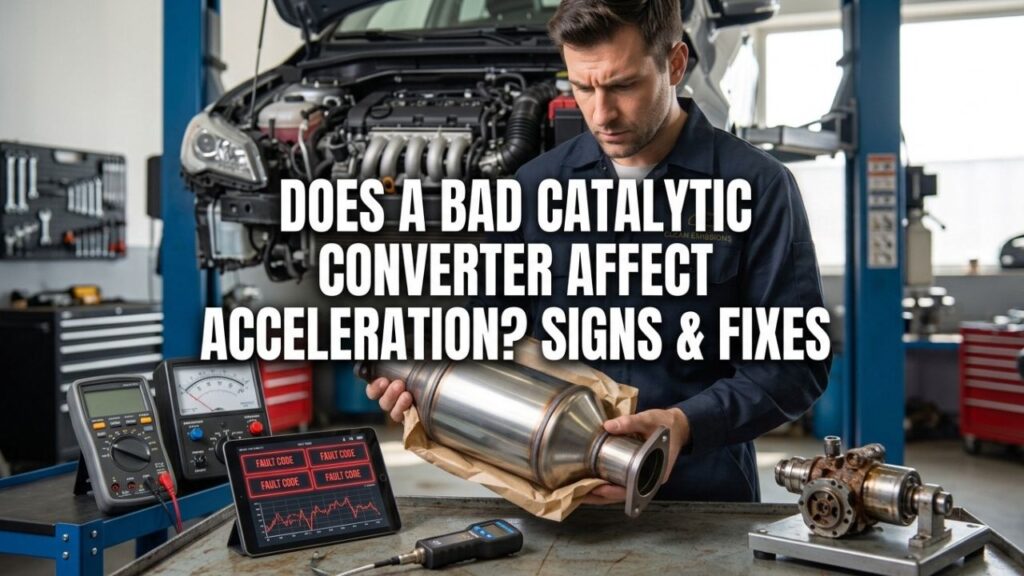
Yes, a bad catalytic converter can reduce acceleration if it creates enough exhaust restriction.
A catalytic converter contains a ceramic or metallic substrate filled with small passages. Exhaust gases pass through those channels while catalyst materials promote chemical reactions that reduce harmful emissions.
A Clogged Converter Restricts Exhaust Flow
If the substrate melts, collapses, breaks apart, or becomes heavily restricted, exhaust gases cannot leave the engine freely.
Pressure then builds upstream of the blockage. The pistons must work harder to push exhaust gases out during the exhaust stroke, leaving less usable engine output for moving the vehicle.
Walker states that excessive backpressure ahead of the converter points toward a restricted converter and can adversely affect engine operation.
Acceleration Loss Often Gets Worse as RPM Rises
An engine produces much more exhaust at high load than at idle.
A partially clogged converter may therefore let the engine idle fairly well while choking flow during heavy throttle. The driver may notice acceptable low-speed operation followed by weak acceleration as the engine tries to rev higher.
Underhood Service notes that converter restriction can range from a barely noticeable acceleration loss to restriction severe enough to stall the engine.
A Bad Converter Does Not Always Restrict Exhaust
Catalytic-converter failure has two broad forms:
- Efficiency failure: the catalyst no longer cleans exhaust gases well enough.
- Flow restriction: the converter physically blocks exhaust movement.
The first type may turn on the check engine light without causing obvious acceleration trouble. The second type is the one most likely to make a vehicle feel slow.
Key Takeaway: A catalytic converter hurts acceleration mainly when internal damage restricts exhaust flow and raises backpressure, not simply because catalyst efficiency has dropped.
What Does Poor Acceleration From a Bad Converter Feel Like?
Converter restriction often produces a load-related loss of power rather than one perfectly consistent symptom.
Slow Acceleration From a Stop
A badly restricted converter may make the car feel heavy or sluggish when leaving a stop.
Pressing the accelerator farther may increase engine noise without producing the expected increase in speed. The vehicle may feel as though the engine cannot breathe once demand rises.
Car Loses Power at Higher RPM
This is one of the stronger clues.
The engine may pull normally at first, then flatten out as RPM increases. In severe cases, it may refuse to rev past a certain point under load.
A documented diagnostic case reported low power during acceleration from a severely restricted exhaust system; replacing the catalytic converter restored acceleration.
Weak Highway Merging
A partially blocked converter may be easiest to notice when merging onto a highway.
At light throttle around town, exhaust flow may remain low enough that the restriction causes little trouble. A hard acceleration request creates much more exhaust, exposing the blockage.
Loss of Power Going Uphill
Climbing a hill places the engine under sustained load.
If exhaust cannot escape quickly enough, power may fall progressively as the engine works harder. This can resemble a fuel-delivery or ignition problem, so further testing is needed before buying a converter.
Acceleration May Become Jerky
O’Reilly notes that a clogged converter may cause inconsistent acceleration and jerking.
Jerking alone is not a specific converter symptom. Misfires, transmission faults, fuel-pressure problems, dirty injectors, and sensor failures can produce similar behavior.
Key Takeaway: Restricted converters often cause weak acceleration that becomes more obvious at high RPM, heavy throttle, highway speed, or uphill load.
Other Signs That Point Toward a Bad Catalytic Converter
Acceleration loss becomes more meaningful when it appears with other converter-related symptoms.
Check Engine Light
The most familiar catalyst codes are:
- P0420 — Catalyst System Efficiency Below Threshold, Bank 1
- P0430 — Catalyst System Efficiency Below Threshold, Bank 2
These codes indicate that the engine computer sees catalyst performance below its expected threshold.
They do not prove that the converter is clogged. A converter can set an efficiency code while still flowing normally, and a restricted converter does not always set P0420 or P0430. Underhood Service specifically notes that a restricted converter may exist without those codes.
Rotten-Egg or Sulfur Smell
Some converter problems are associated with a sulfur or rotten-egg odor from the exhaust.
O’Reilly lists this smell among possible converter symptoms.
The smell is not enough for diagnosis because fuel composition and engine air-fuel faults can also affect exhaust odor.
Rattling Under the Vehicle
A converter contains a rigid internal substrate.
If that material cracks or breaks loose, it may rattle inside the metal housing. The noise can be most noticeable during startup, idle changes, or when engine speed rises.
Loose pieces can sometimes shift and partly block exhaust flow, making acceleration problems intermittent.
Excessive Converter Heat
A converter receiving unburned fuel from a misfire can become extremely hot.
Walker states that properly running converters typically remain below about 1,200°F, while sustained temperatures above roughly 1,600°F can harm the catalyst coating and temperatures above about 1,700°F can damage the substrate or matting.
Extreme heat can eventually melt the internal passages and create a restriction.
Poor Fuel Economy
A restricted exhaust system may force the engine to work harder and alter engine-management behavior.
AutoZone lists poor fuel economy among the possible symptoms of a clogged converter.
Fuel economy can fall for dozens of other reasons, so this clue carries more weight when it appears with power loss and restriction test results.
Key Takeaway: Check-engine codes, rattling, sulfur odor, excess heat, and poor fuel economy strengthen the suspicion of converter trouble, but none proves a restriction by itself.
How a Clogged Catalytic Converter Reduces Engine Power
An internal blockage affects the engine because exhaust flow is part of the combustion cycle.
Backpressure Builds Before the Converter
During the exhaust stroke, the piston pushes burned gases through the exhaust valve and into the exhaust system.
If the converter cannot pass that gas volume, pressure rises between the engine and blockage.
Instead of clearing the cylinder freely, the engine must push against that pressure.
The Engine Cannot Move Air Normally
Engine output depends on moving air into the cylinders and exhaust gases out.
Restriction on the exhaust side interferes with that process. The problem becomes more severe as RPM and load increase because the engine is trying to move more gas every second.
This is why a clogged converter may create a pattern of:
- Acceptable idle
- Fair low-speed response
- Increasing weakness under load
- Severe power loss at higher RPM
Severe Restriction Can Cause Stalling
If the blockage becomes extreme, the engine may eventually struggle even at low speed.
O’Reilly notes that severe exhaust-pressure buildup from a clogged converter can cause stalling.
A badly blocked vehicle may also become hard to start after running because exhaust flow is so restricted.
Key Takeaway: Converter restriction reduces acceleration because the engine must push exhaust against rising backpressure, and the problem becomes stronger as exhaust volume increases.
How to Test if the Catalytic Converter Is Causing Slow Acceleration
Do not replace a converter from acceleration symptoms alone.
Several tests can narrow the diagnosis.
Scan for Trouble Codes
Start with an OBD-II scanner.
Look for P0420 or P0430, but also check for:
- Misfire codes
- Oxygen-sensor codes
- Fuel-trim codes
- Airflow sensor faults
- Throttle-related faults
Misfires and rich-running conditions are especially relevant because they can overheat and damage a converter.
Perform an Exhaust Backpressure Test
A backpressure test is one of the strongest ways to confirm a restriction.
A low-pressure gauge can be connected through an upstream oxygen-sensor port or another approved test point.
Walker gives general reference values of less than 1.5 psi at idle and less than 3 psi at 2,000 RPM, while some service information uses slightly different limits. Vehicle-specific specifications should take priority.
High pressure ahead of the converter with normal pressure behind it points toward the converter as the restriction.
Check Intake Vacuum
A vacuum gauge can provide another clue.
A restricted exhaust may allow normal vacuum at idle, followed by a gradual drop when engine speed is held above idle.
This test indicates possible exhaust restriction but does not tell you exactly where the restriction sits.
Compare Converter Temperatures
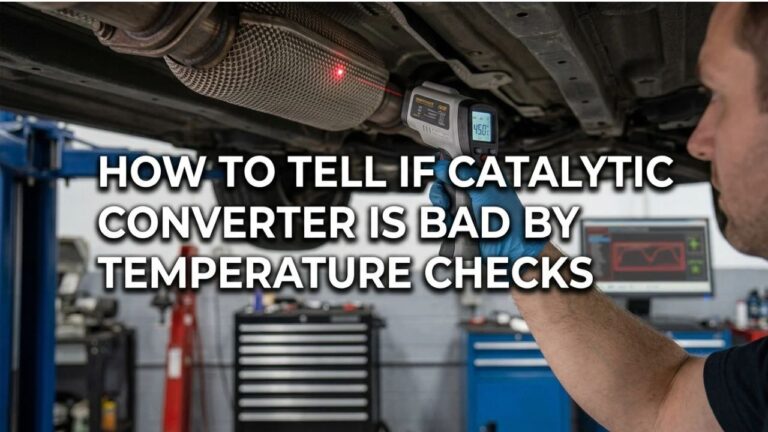
An infrared thermometer can compare temperatures before and after the converter.
A working catalyst often shows some heat rise once fully warmed, but temperature alone cannot reliably confirm a blockage.
Use temperature as supporting evidence rather than the main restriction test.
Inspect for Internal Rattle
A loose internal substrate may rattle.
With the exhaust completely cool, a technician may check the housing for signs of broken internal material. Walker describes checking for loose substrate material during converter diagnosis.
Physical damage plus power loss makes restriction more plausible.
Key Takeaway: Backpressure testing gives stronger evidence of a clogged converter than acceleration symptoms, temperature readings, or catalyst codes alone.
Bad Catalytic Converter vs Other Causes of Slow Acceleration
Poor acceleration has many possible causes. Testing prevents an expensive wrong diagnosis.
| Possible fault | Typical clues |
| Restricted catalytic converter | Power falls more as RPM/load rises, high exhaust backpressure |
| Weak fuel pump | Low fuel pressure, hesitation under load, lean condition |
| Ignition misfire | P0300-series codes, shaking, flashing check-engine light |
| Dirty or faulty MAF sensor | Incorrect airflow readings, poor throttle response |
| Restricted air filter | Reduced airflow, broad power loss |
| Transmission problem | Engine revs but vehicle speed does not rise normally |
| Turbocharger fault | Low boost, underboost codes, weak acceleration |
| Throttle-body problem | Poor response, throttle-related codes |
| Exhaust pipe or muffler restriction | High backpressure with converter not necessarily at fault |
Fuel Delivery Problems
A weak pump or restricted fuel system can make an engine starve under heavy load.
The symptoms may appear at the same time a clogged converter would show itself: hard acceleration, hills, and higher engine speed.
Fuel-pressure testing separates the two.
Ignition Misfires
A failing coil, worn spark plug, or injector fault can cause hesitation and weak acceleration.
Misfires also matter because unburned fuel can overheat the catalytic converter. Fixing only the converter without correcting the misfire can damage the new part.
Transmission Problems
If engine RPM rises rapidly but vehicle speed does not increase proportionally, transmission or clutch slip may be more likely than exhaust restriction.
A clogged converter tends to prevent the engine from producing or reaching normal power rather than letting the engine rev freely.
Airflow and Sensor Problems
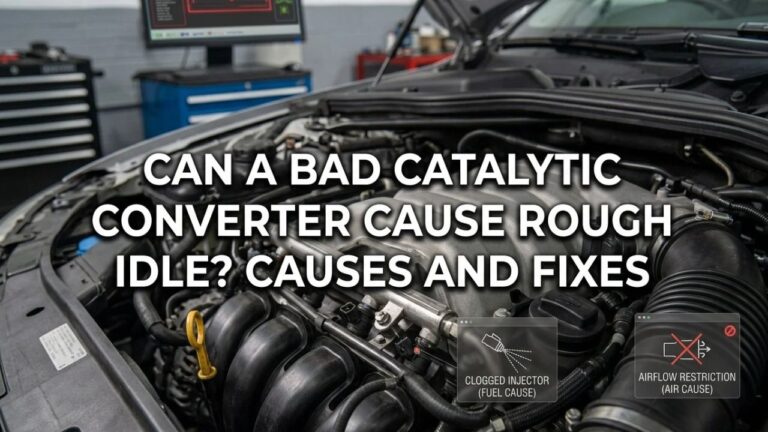
Mass-airflow sensors, throttle-position data, boost control, intake leaks, and other engine-management faults can all cause weak response.
Scan data is useful because it lets a technician compare commanded and actual engine behavior before replacing parts.
Key Takeaway: Converter restriction is only one cause of slow acceleration; fuel, ignition, intake, sensor, turbo, transmission, and other exhaust faults can feel similar.
Can a Bad Catalytic Converter Cause Acceleration Problems Without a Code?
Yes.
A converter can become physically restricted without setting P0420 or P0430.
The catalyst-efficiency monitor mainly evaluates emissions-cleaning behavior through oxygen-sensor data. It does not directly measure exhaust backpressure.
Underhood Service states that a restricted converter may fail to store a P0420 or P0430 code.
This means a car can have:
- No catalyst code
- Noticeable power loss
- Normal-looking converter exterior
- High exhaust backpressure
That combination is one reason mechanical testing remains useful even on OBD-II vehicles.
If the engine loses power under load and no obvious fuel, ignition, or transmission cause appears, an exhaust restriction test is reasonable.
Will Removing or Gutting the Converter Restore Acceleration?
A restricted converter can reduce engine power, so removing a restriction may make the engine run differently. That does not make removing emissions equipment a proper repair.
EPA treats replacing a functioning catalyst with a straight pipe or otherwise defeating required emissions equipment as tampering under federal law.
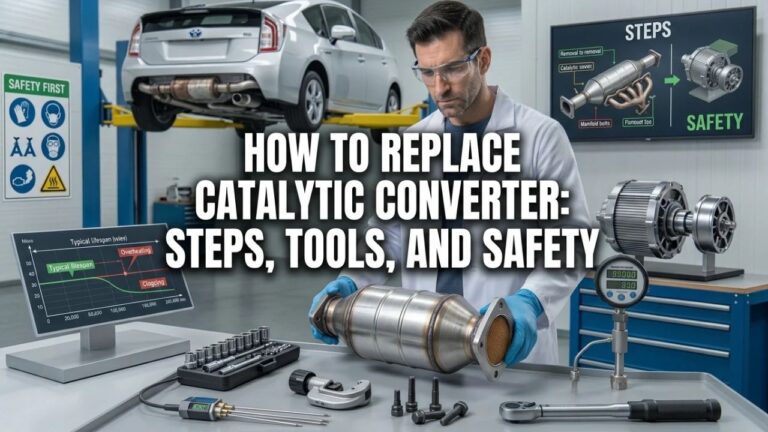
The correct repair is to identify why the original converter failed and install a legal replacement suited to the vehicle.
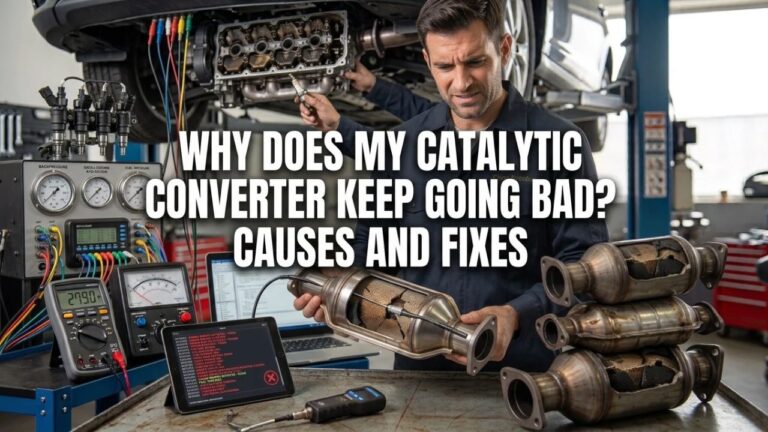
Common converter-damaging faults include:
- Persistent misfires
- Rich fuel mixture
- Oil burning
- Coolant entering the combustion chamber
- Physical impact
- Severe overheating
If that root problem remains, a new converter can fail again.
Should You Keep Driving With Poor Acceleration From a Bad Converter?
Minor catalyst-efficiency failure without restriction may not change drivability, but a vehicle suffering clear power loss deserves prompt diagnosis.
A restriction can become worse as internal material melts, collapses, or shifts.
Stop driving and arrange inspection if you notice:
- Severe loss of power
- Stalling
- A flashing check-engine light
- Converter glowing red
- Strong burning smell
- Smoke beneath the car
- Extreme floor or exhaust heat
A flashing check-engine light often signals an active misfire capable of damaging the catalyst.
If the car still accelerates reasonably but has a catalyst-efficiency code, diagnosis is less urgent than a glowing or severely restricted converter, but the fault should still be checked.
Conclusion
Yes, does a bad catalytic converter affect acceleration has a clear answer when the converter is restricted: it can substantially reduce acceleration because exhaust gases cannot leave the engine freely.
The strongest pattern is a vehicle that runs reasonably at idle or low load, then becomes weak as throttle, RPM, speed, or hill load increases. High exhaust backpressure, rattling substrate, unusual heat, catalyst codes, and other symptoms can strengthen the diagnosis.
I would confirm the restriction before buying a converter. Check codes, rule out ignition and fuel problems, measure exhaust backpressure, and repair any engine fault that damaged the original catalyst. Also check federal emissions-warranty eligibility if the vehicle is still within the applicable 8-year/80,000-mile period.
FAQs About Bad Catalytic Converters and Acceleration
Can a catalytic converter make a car accelerate slowly?
Yes. A clogged converter can restrict exhaust flow and create high backpressure. The engine may feel sluggish during hard acceleration, highway merging, hill climbing, or higher-RPM driving. A converter that has only lost emissions efficiency may not cause noticeable power loss.
Does a P0420 code mean the catalytic converter is clogged?
No. P0420 indicates catalyst efficiency below the expected threshold on Bank 1. It does not directly measure exhaust restriction. A converter can set P0420 and still flow freely, while a restricted converter may reduce acceleration without storing P0420.
Why does a clogged catalytic converter cause more power loss at high RPM?
Higher RPM creates more exhaust gas. A partially blocked converter may pass enough gas at idle but cannot handle the much greater flow produced under heavy load. Backpressure rises, reducing the engine’s ability to clear its cylinders and produce normal power.
Can a bad catalytic converter make a car jerk during acceleration?
Yes, a severely restricted converter can contribute to inconsistent acceleration or jerking. Ignition misfires, fuel-pressure problems, injectors, transmission faults, and sensor issues can cause the same symptom, so jerking alone does not confirm a converter problem.
How do I confirm that the catalytic converter is restricting acceleration?
An exhaust-backpressure test is one of the strongest checks. General diagnostic references commonly expect low pressure at idle and under held RPM, though the exact limit varies by vehicle. High pressure ahead of the converter supports a restriction diagnosis.
Can a bad catalytic converter affect acceleration without a check engine light?
Yes. Physical exhaust restriction can occur without a catalyst-efficiency code. If the car loses power as RPM rises but has no P0420 or P0430, backpressure testing can still reveal a blocked converter or another exhaust restriction.
Will replacing a clogged catalytic converter restore acceleration?
If converter restriction is the true cause of the power loss, replacing the blocked converter can restore normal exhaust flow and acceleration. The fault that damaged the converter should also be repaired, since misfires, rich running, oil burning, coolant contamination, or overheating can damage the replacement.