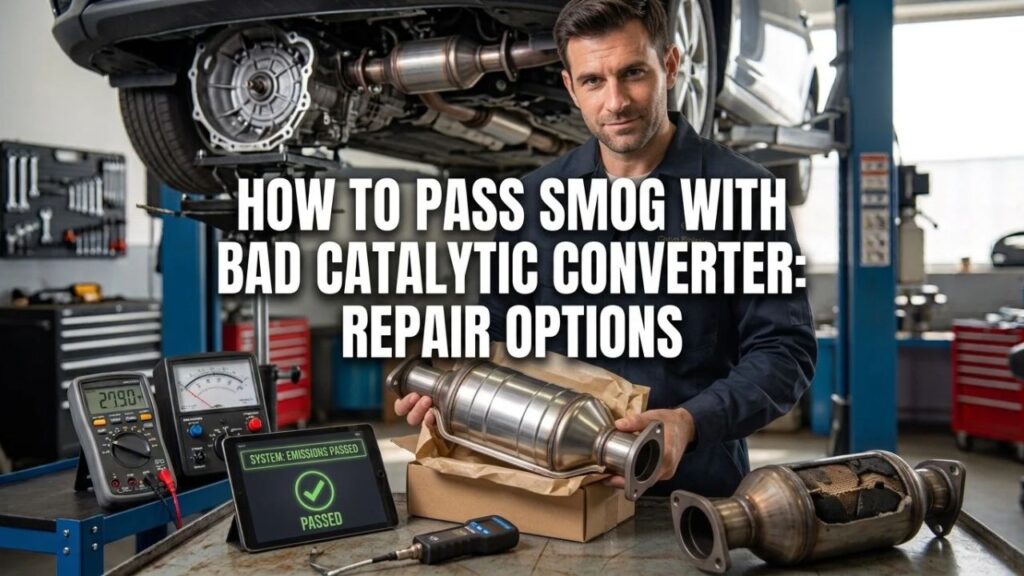
How to Pass Smog With Bad Catalytic Converter: Repair Options
If the catalytic converter has truly failed, the reliable way to pass an emissions inspection is to diagnose why it failed, repair that underlying fault, install a legal replacement converter when needed, complete the vehicle’s OBD readiness checks, and retest. Clearing codes, disconnecting the battery, or hiding the fault does not repair the emissions system.
A converter-related smog failure does not always mean the converter itself needs immediate replacement. A P0420 or P0430 code can also appear with exhaust leaks, misfires, fuel-control problems, sensor faults, oil consumption, or other conditions that interfere with catalyst operation.
Correct diagnosis can therefore save money. If another engine fault is causing the catalyst code, repairing that fault first may prevent an unnecessary converter replacement. If the catalyst is physically damaged or no longer meets the required efficiency threshold, replacement may be the proper repair.
For a U.S. example, California’s Bureau of Automotive Repair states that a vehicle will not pass a Smog Check with the check-engine light illuminated. The inspection can also include an OBD test, visual inspection of emissions equipment, and other checks based on vehicle type and model year.
The lawful answer to how to pass smog with bad catalytic converter is to correct the emissions fault rather than bypass the converter or inspection system. Federal law prohibits removing or rendering required emissions-control equipment inoperative, and EPA rules apply to vehicle owners as well as repair businesses.
California has another detail worth checking before paying for a replacement: an aftermarket catalytic converter must have a CARB Executive Order approval for the specific vehicle application when California rules apply. A converter that physically fits is not automatically legal for a California-registered vehicle.
The sections below cover catalyst codes, diagnosis, converter replacement, OBD readiness, emissions warranties, California repair assistance, retesting, and the shortcuts that do not solve a failed converter.
Can You Pass Smog With a Bad Catalytic Converter?
If the converter is genuinely below the required emissions standard, you normally need to repair the cause and restore the emissions system before the vehicle can pass.
There is an important difference between a catalyst code and a confirmed failed converter.
A P0420 or P0430 Code Does Not Prove the Converter Is Bad
P0420 means catalyst-system efficiency is below the expected threshold on Bank 1. P0430 refers to a similar condition on Bank 2.
Those codes tell the engine computer that catalyst performance appears incorrect. They do not identify the failed part with complete certainty.
Walker recommends diagnosing other engine codes first, especially cylinder-misfire faults, before replacing the converter. Exhaust leaks, cylinder imbalance, fueling problems, and other faults can change the gases entering the converter or interfere with sensor readings.
A converter replacement made before those problems are corrected may not clear the fault permanently.
A Check-Engine Light Can Cause an Automatic Smog Failure
In California, BAR tells drivers to repair an illuminated check-engine light before a Smog Check because a vehicle will not pass with the light on.
That means a car with an active P0420 or P0430 and an illuminated malfunction indicator lamp is not ready for the official test.
Turning the light off temporarily does not correct the underlying diagnostic condition.
A Missing or Tampered Converter Creates Another Problem
Removing the converter, hollowing it out, installing a bypass pipe, disabling oxygen-sensor monitoring, or using software intended to defeat emissions controls is not a legitimate repair.
EPA states that federal law prohibits removing or rendering emissions-control equipment inoperative and prohibits defeat devices that bypass emissions controls.
A visual inspection can also reveal missing or modified emissions hardware.
Key Takeaway: A catalyst trouble code should be diagnosed before the converter is condemned. If the converter has actually failed, repair or legal replacement is the proper path to passing an emissions test.
Diagnose the Cause Before Replacing the Catalytic Converter
Catalytic converters often fail because another engine problem damages them.
Replacing the converter without repairing that problem can lead to another catalyst failure.
Check for Misfires First
Misfires are especially damaging because unburned fuel and oxygen can enter the exhaust.
That mixture can burn inside the converter and push catalyst temperature high enough to melt the internal substrate.
Walker specifically recommends resolving P0300-series misfire codes before addressing a P0420 catalyst code. Possible misfire causes include ignition problems, injector faults, compression problems, and fuel contamination.
If the check-engine light is flashing, avoid continuing to drive hard. A flashing light commonly accompanies a misfire severe enough to threaten the converter.
Inspect for Exhaust Leaks
An exhaust leak ahead of or near an oxygen sensor can alter sensor readings.
A leak can introduce outside air into the exhaust stream and make catalyst-monitor data misleading.
Inspect manifolds, gaskets, flex sections, pipes, sensor mounting points, and converter connections as part of the diagnosis.
Walker places exhaust-leak inspection early in its P0420 diagnostic sequence.
Check Fuel Control and Sensor Data
A rich-running engine can send excess fuel toward the converter. A lean condition, failing oxygen sensor, air-fuel sensor fault, or incorrect fuel trim can also interfere with catalyst monitoring.
Useful scan-tool information can include:
- Short-term fuel trim
- Long-term fuel trim
- Upstream oxygen or air-fuel sensor data
- Downstream oxygen-sensor activity
- Misfire counts
- Coolant temperature
- Stored and pending trouble codes
Replacing the rear oxygen sensor simply because P0420 appears is not a sound diagnosis.
Likewise, replacing the converter only because P0420 appears can waste money if the engine is feeding the catalyst the wrong exhaust mixture.
Check Oil and Coolant Consumption
Burning oil can contaminate a converter with ash and deposits.
An internal coolant leak can poison catalyst surfaces.
Walker lists excessive oil consumption and internal coolant leakage among conditions that can contaminate and damage catalytic converters.
If a vehicle is consuming large amounts of oil or coolant, repair that problem before installing a new converter.
Key Takeaway: Diagnose misfires, exhaust leaks, fuel-control faults, sensor problems, oil burning, and coolant leakage before buying a converter. These faults can trigger catalyst codes or destroy a replacement converter.
When the Catalytic Converter Really Needs Replacement
Once other faults have been corrected, testing can determine if the converter itself has lost its ability to store oxygen and process exhaust gases.
A converter may need replacement if its catalyst coating has deteriorated, the substrate has melted, the internal brick has broken apart, or contamination has permanently reduced its activity.
Physical Damage
A damaged converter may rattle because the ceramic substrate has cracked or broken loose.
A melted converter may also restrict exhaust flow, causing:
- Weak acceleration
- Power loss at higher RPM
- Excessive exhaust heat
- Hard starting
- Stalling
- Poor fuel economy
A converter with this type of internal damage is not restored by clearing the computer.
Confirmed Low Catalyst Efficiency
Technicians can use scan data, emissions testing, oxygen-storage testing, exhaust-gas analysis, and other diagnostic procedures to assess catalyst function.
Walker notes that P0420 diagnosis should include correction of other engine problems before converter performance is tested.
If engine operation is correct and the converter still cannot meet the expected catalyst threshold, replacement becomes much more likely.
Install the Correct Replacement
The converter must match the vehicle’s emissions configuration.
Vehicle details may include:
- Model year
- Make and model
- Engine size
- Emissions certification
- Engine family or test group
- Federal or California emissions specification
- Converter location
California requires aftermarket converters to receive a CARB exemption before they can legally be sold and installed for covered applications. CARB says the correct converter depends on the exact vehicle and engine-family information.
Do not select a converter from pipe diameter alone.
Key Takeaway: Replace a converter after diagnosis confirms that catalyst performance or physical condition has failed. Match the replacement to the vehicle’s exact emissions certification.
Why Clearing the Check-Engine Light Does Not Make the Car Ready
Clearing codes can temporarily turn off the check-engine light, but it also resets diagnostic information.
That creates another inspection problem.
OBD Readiness Monitors Reset
Modern vehicles perform internal emissions self-tests called readiness monitors.
The catalyst monitor is one of these tests.
After codes are cleared, the battery is disconnected, or certain repairs are performed, some monitors return to a “not ready” state.
California BAR states that readiness monitors must rerun after repair activity such as battery disconnection or emissions-component replacement. The number of incomplete monitors permitted during an inspection depends on applicable BAR standards and vehicle configuration.
A scanner may show no current trouble code immediately after a reset, yet the catalyst test may simply not have run.
The Code Can Return
Once the vehicle completes the conditions required for the catalyst monitor, the computer checks converter operation again.
If the underlying fault remains, P0420 or P0430 may return.
That is why clearing a fault shortly before a test is not a repair strategy.
Complete the Required Drive Cycle After Repair
After the real problem has been fixed, drive the vehicle long enough for the required OBD monitors to complete.
There is no single universal drive cycle for every model.
The computer may require combinations of:
- Cold starting
- Warm-up
- Steady-speed cruising
- Acceleration
- Deceleration
- Idling
- Specific fuel levels
- Specific ambient or coolant temperatures
Check the service information for the exact vehicle if a monitor refuses to complete.
BAR also advises drivers who recently disconnected or replaced a battery to drive the vehicle before the Smog Check so readiness monitors have time to reset.
Key Takeaway: Clearing codes resets emissions self-tests. Make the repair first, then complete the required readiness monitors before returning for inspection.
How to Get the Car Ready for a Smog Retest
Once the emissions fault has been repaired, confirm that the vehicle is actually ready before paying for another inspection.
Scan for Current and Pending Codes
Connect an OBD-II scanner and check for:
- Current DTCs
- Pending DTCs
- Permanent DTCs where supported
- Readiness-monitor status
- Check-engine-light command status
A pending catalyst or misfire code can warn that the repair is not finished even before the warning light comes back.
Confirm the Check-Engine Light Works Normally
When the ignition is switched on before starting the engine, the malfunction indicator lamp normally performs a bulb check.
After the engine starts, it should turn off if no condition requires it to remain illuminated.
A missing, disabled, or altered warning lamp is not a substitute for repairing the fault.
Verify the Emissions Equipment Is Present
Inspect the exhaust and engine bay for required emissions components.
This is especially relevant if the vehicle was purchased used or modified by a previous owner.
BAR says a California Smog Check may include a visual inspection of emissions-control equipment.
Check Readiness
Do not assume that several days of driving means the monitors are complete.
Use a scanner to check status.
If a particular monitor remains incomplete, find the required vehicle-specific drive-cycle conditions or diagnose a fault preventing that monitor from running.
Consider a Pretest
California BAR notes that some stations offer a pretest or pre-inspection, which may identify problems before the official Smog Check.
That can be useful after a major emissions repair when you want another check before the official result is recorded.
Key Takeaway: Before retesting, confirm that the warning light is off for the right reason, no relevant codes remain, required emissions equipment is present, and OBD readiness meets the inspection standard.
Can You Use Catalytic Converter Cleaner to Pass Smog?
Do not rely on a bottle of cleaner to repair a failed catalyst.
A fuel-system or catalyst cleaner cannot rebuild melted ceramic, replace missing catalyst coating, repair a broken substrate, or correct a severely restricted converter.
If deposits are contributing to poor operation, cleaning products may have limited effects in certain cases, but they are not substitutes for diagnosis.
More importantly, common causes of catalyst failure—misfires, rich running, oil burning, coolant contamination, exhaust leaks, and physical damage—require actual repair.
If a product appears to turn off a catalyst code temporarily while the mechanical problem remains, the vehicle may fail again after the OBD monitor reruns.
I would spend money on diagnosis before spending it on additives advertised as a way around converter replacement.
Can an Oxygen Sensor Fix a Smog Failure Instead of the Converter?
Yes, if the oxygen sensor is actually faulty. No, if the converter itself has failed.
The upstream sensor helps the engine computer manage fuel mixture. The downstream sensor is used in part to monitor catalyst behavior.
A slow, biased, damaged, or electrically faulty sensor can affect diagnostic data.
That still does not justify replacing sensors at random.
A technician can evaluate sensor response, heater operation, wiring, fuel trim, exhaust leaks, and catalyst data before choosing a part.
If the converter’s oxygen-storage capacity is truly below threshold, installing a new oxygen sensor will not restore the catalyst.
Check the Federal Catalytic Converter Warranty Before Paying
Some owners may have coverage that makes converter replacement much less expensive.
EPA states that specified major emissions components—including the catalytic converter—are covered by the federal emissions warranty for 8 years or 80,000 miles, whichever comes first, subject to the warranty terms. The coverage applies to eligible used vehicles as well because the warranty follows the vehicle.
If your car is inside that age and mileage range:
- Check the emissions-warranty section of the owner’s manual.
- Keep the failed emissions-test report.
- Contact an authorized dealer for the vehicle manufacturer.
- Ask specifically about federal emissions warranty coverage for the catalytic converter.
Do this before authorizing an expensive aftermarket repair.
State emissions warranties can provide other coverage in some cases, so vehicle-specific warranty documentation matters.
California Repair Assistance If the Converter Is Too Expensive
California owners who fail a biennial Smog Check may have financial-assistance options.
BAR’s current Consumer Assistance Program states that eligible owners of 1996 or newer vehicles may qualify for up to $1,450 toward emissions-related repairs, subject to income, registration, inspection, and program requirements.
A failed catalytic converter falls within the type of exhaust-emissions repair that may be considered when the program’s requirements are met.
BAR also directs some owners who cannot complete repairs through normal assistance to the Smog Check Referee, where a one-time repair-cost waiver may be available in qualifying circumstances.
These are official programs, not ways to alter the vehicle or fool an inspection.
Key Takeaway: Check federal emissions warranty coverage before paying for a converter. California owners who qualify may also have repair assistance or Referee options after a failed Smog Check.
Smog-Test Shortcuts That Do Not Fix a Bad Converter
A failed catalytic converter can be expensive, so shortcuts are tempting. Several common ideas either fail once the OBD system retests itself or involve emissions tampering.
Disconnecting the Battery
This may erase some stored information and reset monitors.
It also leaves OBD readiness incomplete. Once the catalyst monitor runs again, the original code can return if the fault remains.
Clearing P0420 or P0430 Right Before the Test
The same problem applies.
The check-engine light may turn off for a short period, but the catalyst monitor has not proven that the system is functioning correctly.
An emissions inspection can check monitor status.
Oxygen-Sensor Spacers or Electronic Simulators
Devices intended to prevent the computer from correctly monitoring catalyst operation can cross into emissions-control defeat or tampering.
EPA prohibits devices and modifications that bypass or render required emissions controls inoperative.
Repair the cause instead.
Removing or Hollowing Out the Converter
Federal law prohibits removing a required converter and replacing it with a bypass pipe or otherwise rendering it inoperative.
A missing or altered converter can also be caught during a visual inspection.
Installing the Wrong Aftermarket Converter
A universal converter that fits the exhaust pipe is not automatically legal for every vehicle.
In California, aftermarket converters need CARB approval for the applicable vehicle.
Buying the wrong converter can leave you with another inspection problem after paying for the repair.
A Practical Smog-Pass Repair Sequence
The cleanest path from a catalyst failure to a legal retest is straightforward.
- Read all diagnostic trouble codes.
Do not focus only on P0420 or P0430. - Repair misfire, fuel, air, mechanical, and exhaust-leak faults first.
These problems can damage the catalyst or distort catalyst-monitor results. - Test converter operation.
Use scan data and proper diagnostic methods to confirm the catalyst is actually weak or restricted. - Check warranty coverage.
A catalytic converter may still fall under the federal 8-year/80,000-mile emissions warranty. - Install the correct converter if replacement is required.
Follow federal requirements and any state-specific rules such as California CARB approval. - Clear codes only after repairs are complete.
This starts a fresh OBD evaluation. - Complete the required readiness monitors.
Use the correct drive cycle if a monitor remains incomplete. - Scan the vehicle again.
Verify that catalyst and other required monitors have completed and no fault has returned. - Get the official retest.
In California, use a STAR station if the DMV notice requires one.
Following this order reduces the chance of buying an unnecessary converter or returning for inspection before the computer has completed its self-tests.
Conclusion
The legal answer to how to pass smog with bad catalytic converter is to diagnose the emissions fault, repair the condition that caused it, replace the converter if testing confirms failure, complete the OBD readiness process, and then retest.
Do not assume P0420 or P0430 automatically means the converter is dead. Misfires, exhaust leaks, sensor faults, rich running, oil consumption, and coolant contamination should be checked first because they can either imitate converter trouble or damage the catalyst.
If the converter really has failed, check the federal 8-year/80,000-mile emissions warranty before paying for replacement. California drivers should also verify CARB converter compatibility and look into BAR repair assistance if repair cost is the main obstacle.
FAQs About Passing Smog With a Bad Catalytic Converter
Will My Car Pass Smog With a P0420 Code?
A vehicle with P0420 that has turned on the check-engine light will not pass a California Smog Check. BAR specifically states that a vehicle does not pass with the check-engine light illuminated.
Diagnose the cause before replacing the converter because P0420 does not prove by itself that the converter is physically bad.
Can I Clear the Check-Engine Light and Pass Smog?
Clearing codes may turn the warning light off temporarily, but it also resets OBD readiness monitors.
The car then needs to run its emissions self-tests again. If the underlying fault remains, the trouble code can return. BAR checks OBD readiness as part of applicable California inspections.
Will Disconnecting the Battery Help a Car Pass Smog?
No. Battery disconnection does not repair a failed converter.
It can reset readiness monitors, which must run again before the vehicle is ready for an OBD-based emissions test. BAR advises drivers to allow time for monitors to reset after battery disconnection or replacement.
Can a New Oxygen Sensor Make a Car Pass Smog?
It can if a failed oxygen sensor is the real cause of the emissions problem.
A new sensor cannot restore a converter with degraded catalyst material, melted substrate, or physical damage. Test sensor operation before replacing either component.
Do I Have to Replace the Catalytic Converter for P0420?
Not automatically.
Walker recommends correcting other trouble codes, exhaust leaks, misfires, and engine-performance faults before condemning the converter. If those problems are corrected and testing still shows poor catalyst performance, replacement may then be justified.
Can I Use a Used Catalytic Converter to Pass Smog?
Replacement-converter rules vary by jurisdiction and vehicle.
For California applications, aftermarket converter selection is tightly controlled, and the replacement needs the proper CARB approval for the vehicle. Check the current rules before buying a converter solely because it physically fits.
Is a Catalytic Converter Covered Under Warranty?
It may be.
EPA states that catalytic converters are among the specified major emissions components covered by the federal emissions warranty for 8 years or 80,000 miles, whichever comes first, subject to warranty conditions.
What Should I Do If I Cannot Afford a Catalytic Converter?
Check warranty coverage first. If the vehicle is registered in California and has failed its required biennial inspection, BAR’s Consumer Assistance Program may provide eligible owners of 1996-or-newer vehicles with up to $1,450 toward emissions-related repairs.
BAR also lists vehicle-retirement and Smog Check Referee options for qualifying situations.