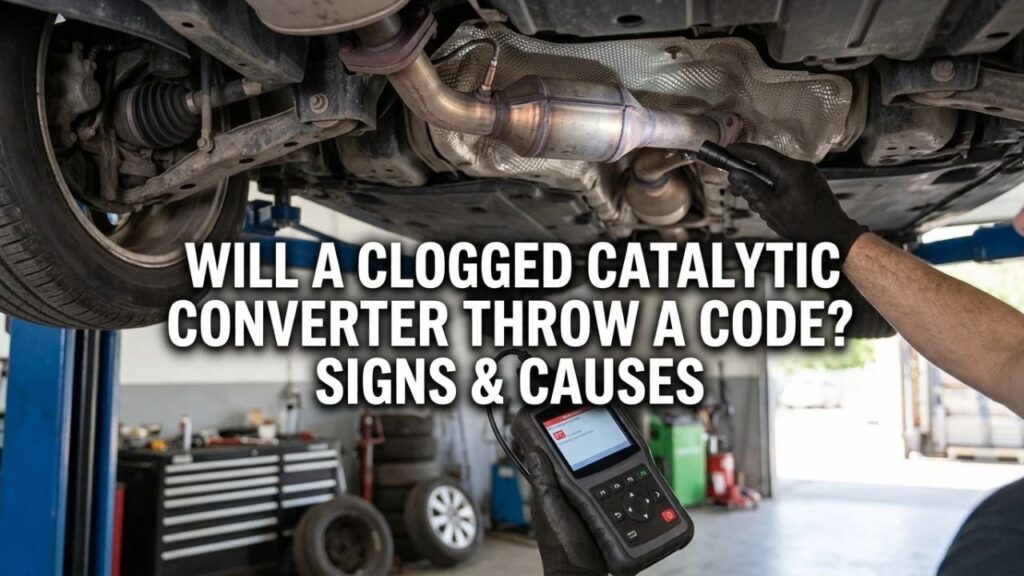
Will a Clogged Catalytic Converter Throw a Code? Signs & Causes
Yes, a clogged catalytic converter can turn on the check-engine light and store a catalyst-related trouble code, but it does not happen every time. P0420 or P0430 may appear if the computer detects poor catalyst operation, while a converter with a physical exhaust restriction can sometimes cause major power loss before the catalyst monitor sets either code.
That difference matters because an OBD-II code reports what the vehicle computer detected, not a direct measurement of how open or blocked the converter passages are. A driver can have weak acceleration, hard starting, or high exhaust backpressure and still find no catalyst code stored.
Catching the problem correctly can prevent unnecessary oxygen-sensor replacement, repeated converter failure, or a missed engine problem. Misfires, excess fuel, oil consumption, and coolant contamination can damage a converter, so the fault that caused the converter problem also needs attention.
For U.S. vehicles, EPA guidance states that 1996 and newer light-duty cars and trucks use OBD-II systems that monitor emissions-related operation and illuminate the malfunction indicator light when a qualifying fault is detected. Catalyst monitoring is part of that emissions-diagnostic system on applicable vehicles.
The key point behind will a clogged catalytic converter throw a code is that catalyst efficiency and exhaust restriction are related but not identical conditions. A converter can lose its emissions-cleaning ability without being badly clogged, and a physically damaged converter can restrict flow before the monitor decides catalyst efficiency has crossed its fault threshold. I’d treat a catalyst code as a diagnostic clue, not a direct measurement of blockage.
If the vehicle has a P0420 or P0430 code plus poor acceleration, stalling, rattling, or high backpressure, converter testing makes sense. If there is no code but the engine feels choked under load, the exhaust system still deserves inspection. The sections below explain which codes appear, why a clog can exist without a code, and how to confirm the cause.
Will a Clogged Catalytic Converter Throw a Code Every Time?
No. A clogged converter may store a catalyst-related code, but the presence or absence of a code does not confirm or rule out a physical blockage.
The powertrain control module relies on sensor data and programmed monitor criteria. It does not have a sensor that directly reports how badly the converter passages are blocked.
A Restricted Converter May Set P0420 or P0430
The most familiar catalyst codes are P0420 and P0430.
P0420 means the catalyst system efficiency is below threshold on Bank 1. P0430 carries the same basic meaning for Bank 2 on engines that use two banks.
The computer usually evaluates catalyst operation by comparing upstream and downstream oxygen-sensor behavior. If the downstream signal begins to look too much like the upstream signal under the required test conditions, the control module may judge catalyst oxygen-storage performance to be below its calibrated limit.
A converter that has broken down internally may be both inefficient and restricted, so a clog and a P0420 or P0430 can occur together.
A Severe Restriction Can Exist Without a Catalyst Code
A physical clog changes exhaust flow. The catalyst monitor is primarily designed to judge emissions-conversion performance, not directly measure exhaust backpressure.
That means a melted or collapsed section can restrict flow while the monitor has not yet met the exact conditions needed to set P0420 or P0430. The driver may notice poor acceleration, hard starting, or stalling first.
AutoZone lists reduced power, hard starting, stalling, excess heat, and check-engine-light activity among possible signs of a clogged converter, but the symptoms do not all need to occur together.
A Catalyst Code Can Appear Without a Physical Clog
The reverse is also true.
A converter may flow exhaust normally yet store P0420 or P0430 because its catalyst material can no longer store oxygen and process exhaust gases as expected. Exhaust leaks, oxygen-sensor faults, misfires, and engine mixture problems can also influence catalyst-monitor results.
P0420 should therefore be read as a catalyst-efficiency diagnosis starting point, not as proof that exhaust flow is blocked. RepairPal and Walker both describe the need to check engine faults and sensor behavior before condemning the converter.
Key Takeaway: A clogged converter can set P0420 or P0430, but restriction and catalyst efficiency are not the same measurement, so either condition can exist without the other.
What Codes Can Appear With a Catalytic Converter Problem?
Catalyst codes are grouped around converter performance, but the exact code depends on vehicle design, bank location, monitor strategy, and the fault detected.
P0420: Catalyst System Efficiency Below Threshold, Bank 1
P0420 is the code most drivers associate with a bad catalytic converter.
It means the computer believes the Bank 1 catalyst is operating below its calibrated efficiency threshold. Bank 1 is the engine bank containing cylinder No. 1.
A P0420 does not say “clogged converter.” The converter may be worn out chemically, contaminated, damaged internally, or affected by another engine or exhaust fault.
P0430: Catalyst System Efficiency Below Threshold, Bank 2
P0430 applies to Bank 2 on engines with two cylinder banks and separate catalyst monitoring.
The diagnostic logic is similar to P0420, but the code points toward the other bank.
If a V6 or V8 stores P0420 on one bank and not P0430 on the other, comparing oxygen-sensor data and exhaust behavior between banks can provide a useful diagnostic clue.
P0421, P0431, and Related Catalyst Codes
Some vehicles can store warm-up catalyst or other catalyst-monitor codes. EPA inspection material groups catalytic-converter DTCs in the P0420 through P0439 range for OBD inspection purposes.
The exact definition should always be read with a scan tool or service information for the vehicle.
Other codes may appear beside a catalyst code because the converter often fails after another engine problem. A P0300-series misfire code, fuel-control fault, or oxygen-sensor code may point toward the condition that damaged the converter rather than a second unrelated problem.
Key Takeaway: P0420 and P0430 are the common catalyst-efficiency codes, but related catalyst, misfire, fuel, or oxygen-sensor codes may provide the clue that explains why the converter failed.
Why a Clogged Converter May Not Turn On the Check-Engine Light
A converter can be restricted without immediately illuminating the dashboard warning light. Several OBD-II conditions can explain that result.
The Catalyst Monitor Does Not Measure Backpressure Directly
The catalyst monitor evaluates how well the converter is processing exhaust based largely on sensor behavior.
A backpressure gauge measures something different: resistance to exhaust flow.
A converter can therefore have an airflow problem that produces a strong drivability complaint while its oxygen-sensor pattern has not yet triggered the catalyst monitor.
This distinction is one reason a scan for codes should not be the only test when the engine loses power badly under load.
The Catalyst Monitor May Be Not Ready
OBD-II systems use readiness monitors that need certain operating conditions before a self-test can complete.
If the battery was disconnected, codes were recently cleared, or the required drive conditions have not occurred, the catalyst monitor may display Not Ready.
EPA inspection guidance recognizes readiness status as part of OBD testing, and catalyst monitoring is one of the non-continuous monitors that may need a drive cycle before it can report a result.
A scan tool showing no catalyst code while the catalyst monitor is Not Ready provides less reassurance than a completed monitor with no fault.
The Fault Has Not Crossed the Calibrated Threshold
OBD monitors use programmed limits.
A partially blocked converter may reduce performance without yet producing sensor data severe enough, or persistent enough, to satisfy the code-setting logic.
Some faults also begin as pending codes before they mature into confirmed codes and command the check-engine light.
The Vehicle May Have Another Fault Masking the Main Complaint
A vehicle with a severe misfire, fuel-delivery fault, airflow problem, or ignition fault can have poor power that feels similar to a clogged converter.
That is why the full code list, freeze-frame information, live data, and physical testing matter.
If the engine has no catalyst code, do not jump straight from low power to a clogged converter. Confirm the restriction.
Key Takeaway: No check-engine light does not clear the converter; monitor readiness, code thresholds, sensor strategy, and other engine faults can all affect what the OBD system reports.
Symptoms of a Clogged Catalytic Converter With or Without a Code
A physical restriction tends to become more obvious as exhaust flow demand rises.
That is why many clogged converters feel worse during acceleration than at idle.
Loss of Power Under Load
Poor acceleration is one of the strongest complaints linked with severe exhaust restriction.
The engine may idle acceptably yet feel as if it cannot breathe when you press the accelerator. Highway merging, hill climbing, towing, or higher-RPM operation may expose the problem quickly.
A blockage creates backpressure that makes it harder for exhaust gases to leave the cylinders. The next intake charge cannot fill the cylinders normally, so engine output drops.
Hard Starting or Stalling
A badly restricted exhaust can trap enough pressure to make starting difficult.
In severe cases, the engine may start and then stall because it cannot keep moving exhaust through the system.
This symptom is not exclusive to the catalytic converter. Fuel, ignition, airflow, and timing faults can also cause hard starting or stalling.
Excess Heat Around the Converter
A converter that is overloaded by unburned fuel can become extremely hot.
Excessive heat may damage the substrate and lead to melting or collapse, which can then create a restriction.
If the converter or exhaust becomes visibly red hot, stop driving and diagnose the cause. A glowing converter can point toward a serious misfire or rich-running problem feeding excess fuel into the exhaust.
Rattling From Broken Substrate
The ceramic honeycomb inside a converter can crack and break into pieces.
Loose pieces may rattle inside the shell. They can also shift and partially block exhaust flow.
A loose heat shield can make a similar sound, so a rattle should be localized before the converter is replaced.
Poor Fuel Economy and Weak Throttle Response
A restricted engine may require more accelerator input to produce the same vehicle speed.
Fuel economy can drop, and throttle response may feel dull.
Those symptoms are broad, so they become more meaningful when they appear alongside high backpressure, converter codes, rattling, or a clear loss of high-load power.
Key Takeaway: A clogged converter often shows itself through weak high-load acceleration, hard starting, stalling, excess heat, or rattling, and those symptoms can appear even without P0420 or P0430.
How to Confirm a Clogged Catalytic Converter
A scan tool is a starting point, not the final answer.
The most useful diagnosis combines code data with a direct test for exhaust restriction.
Check Codes, Pending Codes, and Readiness Monitors
Start by scanning all stored and pending codes.
Record:
- P0420 or P0430
- Related catalyst codes
- Misfire codes
- Oxygen-sensor codes
- Fuel-control codes
- Freeze-frame data
- Catalyst monitor status
Do not clear the codes before recording the information. Clearing them removes freeze-frame data and resets readiness monitors, which can make diagnosis harder.
If the catalyst monitor says Not Ready, drive-cycle requirements may need to be met before the monitor can judge converter performance.
Measure Exhaust Backpressure
A backpressure test directly checks for exhaust restriction.
Walker gives a general diagnostic reference of less than about 1.5 psi at idle and less than 3 psi at 2,000 RPM, while stressing that readings can vary by application. Vehicle-specific service specifications take priority.
Pressure that rises too high upstream of the converter points toward a restriction downstream of the test point.
The location of the test matters. A restriction in a muffler or crushed pipe can mimic a clogged converter, so the technician may need more than one measurement.
Check Engine Vacuum Under Steady RPM
A vacuum gauge can provide another clue.
On many gasoline engines, manifold vacuum may drop briefly when RPM rises and then stabilize. Vacuum that keeps falling while RPM is held can support the suspicion of an exhaust restriction.
Vacuum testing is not specific to the converter. Valve timing and other engine faults can change the reading.
Review Oxygen-Sensor Data
Upstream and downstream oxygen-sensor patterns can show how the catalyst monitor is seeing the converter.
A healthy catalyst normally changes the downstream signal relative to the upstream sensor because it stores oxygen and processes exhaust gases. When downstream activity closely follows upstream activity under the correct conditions, the computer may set P0420 or P0430.
That test speaks more directly to catalyst performance than to physical exhaust flow.
Inspect for the Fault That Damaged the Converter
Do not stop once the converter is identified as bad.
Check for:
- Persistent misfires
- Rich air-fuel operation
- Leaking injectors
- Oil consumption
- Coolant entering the cylinders
- Ignition faults
- Physical impact damage
A converter often fails because another problem sends too much fuel, oil, coolant, or heat into it. Installing a replacement without correcting the cause can damage the new unit.
Key Takeaway: Confirm a suspected clog with scan data plus a direct restriction test, then find the engine or exhaust fault that caused the converter damage before replacement.
Does P0420 Mean the Catalytic Converter Is Clogged?
No.
P0420 means Catalyst System Efficiency Below Threshold, Bank 1. It describes catalyst performance as judged by the vehicle’s monitor.
A clogged converter may set P0420, but an inefficient converter that still flows exhaust freely can set the same code.
A damaged oxygen sensor, exhaust leak, misfire, or fuel problem may also influence catalyst-monitor results. RepairPal lists converter problems, oxygen-sensor faults, and misfires among common causes associated with P0420.
If P0420 appears without power loss or other restriction symptoms, test catalyst performance and related systems before assuming the converter is blocked.
If P0420 appears with severe power loss under load, a backpressure test becomes more useful because it answers the flow question directly.
Can a Clogged Converter Throw Misfire Codes?
It is possible for a severe exhaust restriction to disturb engine operation enough to contribute to rough running, but misfire codes require careful interpretation.
More often, an existing misfire is the problem that overheats and damages the catalytic converter.
Unburned fuel from a misfiring cylinder can burn inside the converter, raising internal temperature and damaging the substrate. That failure path means a P0300-series code found beside P0420 should not automatically be blamed on the converter.
Diagnose the misfire first.
If the misfire continues after a new converter is installed, the replacement converter can be damaged again.
A flashing check-engine light deserves fast attention because EPA consumer guidance identifies flashing MIL operation as a warning of a severe engine problem such as a catalyst-damaging misfire.
Can You Drive With a Clogged Catalytic Converter and No Code?
A lack of a code does not make severe exhaust restriction safe to ignore.
If the car still accelerates normally, shows no excess heat, and has only a mild suspicion of converter trouble, diagnosis can usually be arranged without treating the car as an emergency.
Stop normal driving sooner if you notice severe power loss, repeated stalling, a glowing converter, a strong burning smell, or a flashing check-engine light.
A severely restricted converter can make merging, passing, and climbing hills difficult because engine output may fall sharply under load.
Do not continue forcing the engine at high throttle just to see if it will clear out. A melted or collapsed substrate does not repair itself through hard driving.
What Usually Causes a Catalytic Converter to Clog?
Converters often fail after another problem has been present for some time.
The root cause matters because replacing the converter alone may produce another failure.
Misfires and Excess Fuel
A misfire can send unburned fuel into the exhaust.
That fuel may burn inside the converter and create enough heat to damage or melt the substrate.
A rich-running engine can create a similar thermal problem by sending excess fuel downstream.
Oil or Coolant Contamination
Oil burning can coat catalyst surfaces with deposits.
Coolant entering the combustion chamber can also contaminate the converter.
Either fault may reduce catalyst performance and contribute to internal buildup or damage.
Physical Breakup of the Substrate
Age, impact, overheating, or thermal stress can crack the ceramic honeycomb.
Broken pieces can move and restrict passages or travel farther into the exhaust.
A rattle from the converter area can be a clue, though loose heat shields and exhaust hardware should be checked first.
Key Takeaway: Misfires, rich operation, oil or coolant contamination, and internal substrate damage are common paths toward converter failure, so the cause needs repair along with the converter.
Conclusion
The answer to will a clogged catalytic converter throw a code is sometimes, but not always. P0420 or P0430 may appear if catalyst operation falls below the monitor threshold, yet a physical restriction can create major power loss before either code is stored.
P0420 and P0430 describe catalyst efficiency, not the exact amount of exhaust blockage. A scan tool should therefore be paired with symptoms, monitor status, oxygen-sensor data, and a direct backpressure test when restriction is suspected.
If the vehicle loses power badly under load, stalls, overheats the converter, or shows a flashing check-engine light, avoid treating the absence of a catalyst code as proof that the exhaust is clear. Confirm the restriction and repair any misfire, fuel, oil, coolant, or engine problem that damaged the converter.
My recommendation is to diagnose the converter rather than replace it from one code alone. A backpressure test answers the clogging question far more directly than P0420 by itself.
FAQs About Clogged Catalytic Converter Codes
Can a clogged catalytic converter cause P0420?
Yes. A clogged or damaged converter can set P0420 if the Bank 1 catalyst monitor also detects efficiency below its calibrated threshold. P0420 does not specifically mean “clogged,” so exhaust flow should be tested if restriction is the concern.
Can a clogged catalytic converter cause P0430?
Yes. P0430 is the Bank 2 counterpart to P0420 on vehicles with two monitored engine banks. A damaged or restricted Bank 2 converter may set the code, but sensor faults, exhaust leaks, and engine problems also need to be ruled out.
Can a catalytic converter be clogged with no check-engine light?
Yes. A physical restriction may exist before the catalyst monitor sets a code, and the monitor may also be Not Ready after a battery disconnect or code clear. Weak high-load acceleration, hard starting, stalling, and high backpressure can justify converter testing even with no warning light.
Will a bad catalytic converter always set P0420?
No. The converter can fail in several ways. A physically damaged converter may restrict flow without immediately crossing the catalyst-efficiency threshold, and some failures can produce another catalyst code. P0420 is common, but it is not guaranteed.
Does P0420 always mean I need a new catalytic converter?
No. P0420 can be associated with a worn converter, oxygen-sensor problems, exhaust leaks, misfires, or other engine faults. Diagnose those conditions before replacing the converter. If the converter itself fails the proper tests, replacement may then be justified.
What code does a clogged catalytic converter usually give?
P0420 on Bank 1 and P0430 on Bank 2 are the codes most commonly associated with catalyst problems. A clog can still exist without either code because these DTCs monitor catalyst efficiency rather than directly measuring exhaust backpressure.
How do I test a catalytic converter if there is no code?
Check for power loss under load, scan readiness monitors and live data, inspect the exhaust, and measure exhaust backpressure. A direct pressure test is one of the clearest ways to confirm a physical restriction. Vehicle-specific pressure specifications should be used when available.
Can clearing the check-engine light hide a catalytic converter problem?
Temporarily, yes. Clearing codes also resets readiness monitors. The catalyst monitor may show Not Ready until the vehicle completes the required drive conditions. If the fault remains, the code can return after the monitor runs again.