How Many Catalytic Converters Does a Car Have? Count by Engine
Most gasoline-powered passenger cars have one or two catalytic converters, but the exact count can range from one to four or more. A four-cylinder car often uses one, while many V6 and V8 vehicles have separate converters for the two exhaust banks. Some models add secondary converters farther down the exhaust system.
The count matters when diagnosing a catalyst code or buying replacement exhaust parts. Assuming a car has only one converter can lead you to inspect or replace the wrong part, especially on V-type engines with separate Bank 1 and Bank 2 exhaust paths.
Identifying the complete layout also makes codes such as P0420 and P0430 easier to interpret. You can determine which converter the computer is monitoring and which upstream and downstream oxygen sensors belong to that exhaust bank.
The U.S. EPA states that catalytic converters have been installed on most cars and trucks manufactured since 1975. It also classifies catalytic converters as specified major emissions-control components covered under the federal 8-year/80,000-mile emissions warranty on qualifying vehicles, subject to warranty terms.
If you’re asking how many catalytic converters does a car have, I’d start with the engine configuration and exhaust layout rather than the vehicle’s physical size. Many inline engines route exhaust through one path, while V6 and V8 engines commonly begin with two separate exhaust banks. AutoZone and CarParts both note that one converter is common, while V-type and dual-exhaust systems frequently use multiple units.
A quick count by engine type gives you a useful starting point, but the VIN, emissions label, factory parts diagram, or service information provides the final answer. The sections below explain common one-, two-, three-, and four-converter layouts and how to identify the setup on your own car.
How Many Catalytic Converters Does a Car Have by Engine Type?
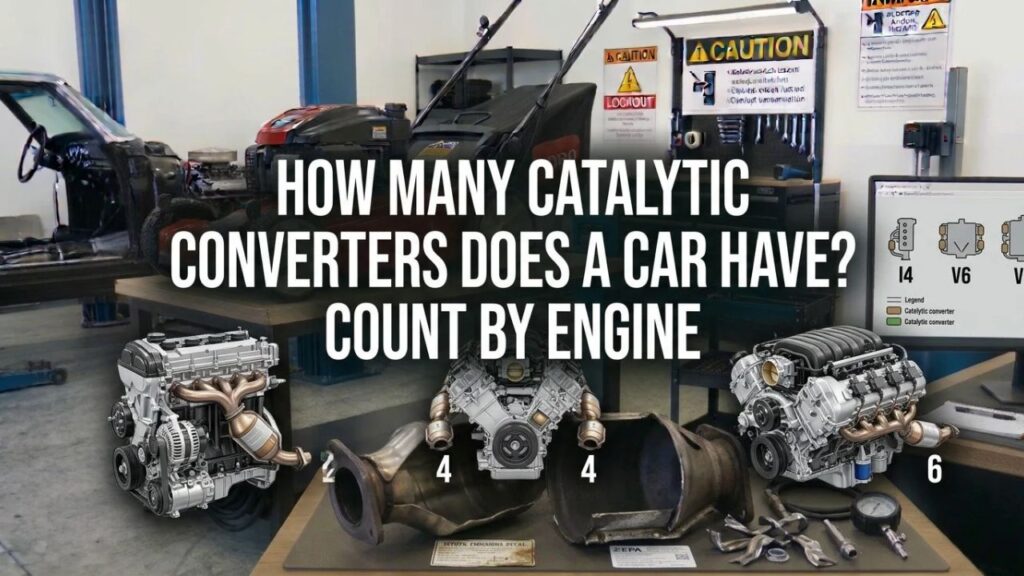
Engine layout strongly influences converter count because it determines how exhaust leaves the cylinders and how many separate exhaust streams exist before the pipes merge.
Four-Cylinder Engines
Many inline four-cylinder gasoline cars use one main catalytic converter because all four cylinders feed into a single exhaust manifold and exhaust path.
Modern designs may place that converter very close to the exhaust manifold. This is called a close-coupled converter because placing the catalyst near the engine lets it heat rapidly after a cold start.
Some four-cylinder vehicles use more than one catalyst assembly. A smaller close-coupled unit may sit near the engine with another converter farther downstream.
That means “four-cylinder equals one converter” is a good starting assumption, not a rule for every model.
V6 Engines
A V6 has two cylinder banks.
Many V6 exhaust systems keep those banks separate near the engine, which commonly leads to two catalytic converters, one associated with each bank.
One side is Bank 1 and the other is Bank 2. Bank 1 is always the bank containing cylinder No. 1; its physical location differs among engines.
Some V6 designs merge both exhaust streams farther downstream and add another catalyst. A vehicle with this arrangement may have three converter assemblies.
V8 Engines
V8 engines also have two cylinder banks and frequently use at least two converters.
Trucks, SUVs, performance cars, and luxury vehicles can have two primary converters near the engine plus secondary units downstream. That can produce a total of three or four depending on the exhaust design.
Do not assume every V8 has four. Plenty of V8 systems use only one converter for each bank.
Hybrid Cars
A gasoline-electric hybrid still has an internal-combustion engine and therefore normally has an emissions aftertreatment system that includes catalytic material.
The converter count varies by vehicle just as it does on a conventional gasoline car.
The hybrid drivetrain itself does not determine the number. Engine design, exhaust routing, warm-up strategy, and emissions certification do.
Battery-Electric Cars
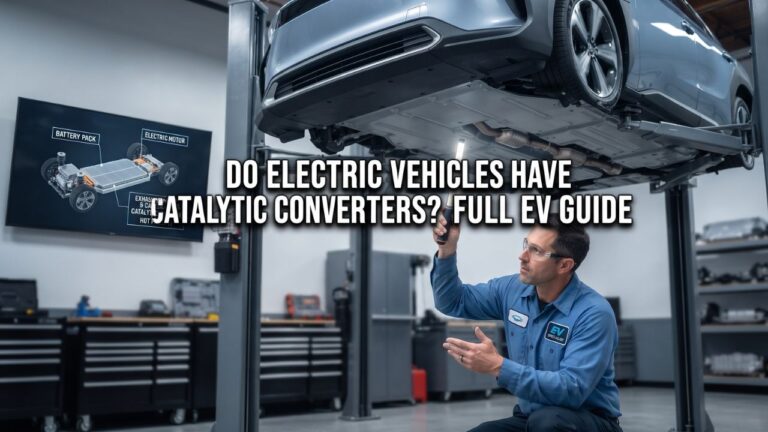
A battery-electric vehicle has zero catalytic converters because it has no internal-combustion exhaust stream.
There is no exhaust manifold, tailpipe emissions system, or combustion catalyst to service.
This does not apply to plug-in hybrids. A plug-in hybrid still has a gasoline engine, so it can have one or more catalytic converters.
Diesel Cars
Diesel emissions systems differ from gasoline three-way catalyst systems.
A modern diesel may use a diesel oxidation catalyst (DOC) along with devices such as a diesel particulate filter and selective catalytic reduction system. Some components may be packaged together in one aftertreatment assembly.
For that reason, counting “catalytic converters” on a diesel from the outside can be misleading. Use the emissions diagram for that diesel model to identify each aftertreatment component.
Key Takeaway: Four-cylinder cars commonly have one converter, V6 and V8 vehicles often have two or more, hybrids still use catalysts when they have a gasoline engine, and battery-electric vehicles have none.
Typical Catalytic Converter Count by Vehicle Layout
The following numbers are general patterns rather than fixed rules.
| Vehicle or Engine Layout | Typical Converter Count | Common Layout |
| Inline 4-cylinder gasoline car | 1 | One exhaust path and one main converter |
| Inline engine with secondary catalyst | 2 | Close-coupled plus underfloor converter |
| V6 gasoline engine | 2 | One primary converter per bank |
| V6 with secondary catalyst | 3 or more | Two bank converters plus downstream catalyst |
| V8 gasoline engine | 2 | One converter per bank |
| V8 with multi-stage exhaust treatment | 3–4 | Primary and secondary converters |
| Gasoline hybrid | 1 or more | Varies with engine and emissions design |
| Battery-electric vehicle | 0 | No combustion exhaust |
| Modern diesel | Varies | DOC plus other aftertreatment components |
CarParts reports that most cars use one converter, with multiple units common in V-type and dual-exhaust layouts. Modern emissions designs can also use several catalyst stages rather than one canister under the center of the car.
Why Do Some Cars Have Multiple Catalytic Converters?
Multiple converters are not installed simply because a vehicle is expensive or has a large engine. Their placement usually follows exhaust routing and emissions-control requirements.
Separate Exhaust Banks
A V6 or V8 begins with two sets of cylinders.
If each bank has its own exhaust manifold and pipe, placing one catalytic converter in each path lets both exhaust streams receive treatment before they merge.
This layout also permits separate oxygen-sensor monitoring for each bank.
A typical dual-bank setup may look like this:
Engine Bank 1 → Converter 1 → Exhaust
Engine Bank 2 → Converter 2 → Exhaust
The two paths may merge farther back or remain separate.
Close-Coupled Converters
Catalysts need heat to perform their emissions-control reactions.
Manufacturers often place a converter very close to the exhaust manifold so it reaches operating temperature quickly after startup.
These units may be built directly into an exhaust manifold assembly. AutoZone lists manifold catalytic converters as a distinct replacement configuration in which the manifold and catalyst form one assembly.
A vehicle may then have another catalyst farther downstream.
Secondary or Underfloor Converters
Some exhaust systems use another catalyst under the vehicle after the close-coupled converter.
This secondary unit gives the exhaust another catalyst stage before it exits the tailpipe.
That is how a vehicle with one engine bank can still end up with two catalysts, or a two-bank engine can end up with three or four.
Key Takeaway: Cars use multiple converters mainly because of separate exhaust banks and multi-stage emissions treatment, including close-coupled and downstream catalyst assemblies.
Does Dual Exhaust Mean a Car Has Two Catalytic Converters?
Not always.
A true dual exhaust that keeps each engine bank separate may use one converter in each exhaust path. That arrangement is common on V6 and V8 vehicles.
Some systems only look like dual exhaust from the rear.
A single exhaust pipe can pass through one converter and then split into two pipes or mufflers near the rear of the vehicle. In that setup, two tailpipes do not mean two catalytic converters.
The reverse can occur too. Two converter assemblies near the engine may feed into one pipe farther downstream.
Count the exhaust paths near the engine and converters, not the number of visible exhaust tips.
How Can You Tell How Many Catalytic Converters Your Car Has?
The most dependable method is to identify the exact year, make, model, engine, and emissions package.
Visual inspection can help, but modern converters are sometimes hidden under heat shields or incorporated into the exhaust manifold.
Check the VIN and Parts Catalog
The VIN identifies the vehicle configuration and can help narrow down the correct engine and emissions package.
An OEM or reputable replacement-parts catalog can then show each converter position separately.
Common descriptions include:
- Front converter
- Rear converter
- Left converter
- Right converter
- Bank 1 converter
- Bank 2 converter
- Manifold converter
- Underfloor converter
Do not assume two catalog listings mean both fit your car. A catalog may list alternative parts for different engines, emissions certifications, or build dates.
Look at the Emissions Label
Check the emissions-control information label under the hood.
The label can identify the emissions family and equipment installed on the vehicle. Exact labeling varies by manufacturer.
This information is useful when two visually similar versions of the same car use different exhaust systems.
Follow the Exhaust From the Engine
On a cool vehicle that is safely supported, trace the exhaust path from the engine toward the muffler.
A converter usually looks like an enlarged metal housing in the exhaust pipe and often has heat shielding around it. Modern close-coupled converters may be tucked high in the engine compartment near the exhaust manifold. AutoZone notes that converter location varies by drivetrain and that many modern units are mounted close to the engine.
Never crawl under a vehicle supported only by a jack.
Use Oxygen Sensors as Clues, Not as the Final Count
Modern gasoline vehicles commonly use sensors before and after monitored catalysts.
An upstream sensor normally sits before a converter and helps manage the air-fuel mixture. A downstream sensor helps monitor catalyst behavior.
A V engine may have Sensor 1 and Sensor 2 for both Bank 1 and Bank 2.
That layout can provide useful clues, but counting oxygen sensors does not always give the exact number of catalyst assemblies. Some systems contain several catalyst bricks or stages monitored as one system.
Check Factory Service Information
A factory exhaust diagram is the cleanest way to settle a confusing layout.
It shows the position of each converter, oxygen sensor, manifold, pipe, resonator, and muffler.
I’d use this method before ordering an expensive converter, especially on a V6, V8, turbocharged, hybrid, or California-emissions vehicle.
Key Takeaway: Use the VIN, emissions label, exhaust diagram, and physical exhaust path to confirm converter count; oxygen-sensor positions are useful clues but do not always equal the number of converters.
What Are Primary and Secondary Catalytic Converters?
The terms describe converter position or role within a multi-catalyst exhaust system.
A primary converter is commonly the catalyst closest to the engine. It may also be called a close-coupled, front, manifold, or warm-up converter.
A secondary converter sits farther downstream.
The primary unit heats quickly because it is exposed to hotter exhaust gas near the engine. A downstream unit can provide another catalyst stage after the exhaust leaves the first converter.
Parts catalogs may use “front” and “rear” instead of “primary” and “secondary.”
This terminology can make one vehicle look as though it has different converter counts depending on the source. One catalog might sell a manifold-and-catalyst assembly as one part, while another diagram may describe catalyst sections separately.
For replacement work, use the vehicle maker’s assembly layout rather than counting individual honeycomb sections inside one metal housing.
Do Bank 1 and Bank 2 Mean There Are Two Catalytic Converters?
Not automatically, though the terms often appear on vehicles with two monitored exhaust banks.
Bank 1 is the side of the engine containing cylinder No. 1.
Bank 2 is the opposite bank.
Inline engines generally have only Bank 1 because all cylinders are arranged in one line. V6 and V8 engines normally have both Bank 1 and Bank 2.
A P0420 code refers to catalyst efficiency on Bank 1, while P0430 refers to Bank 2 on applications that monitor both banks separately.
Two bank-specific catalyst codes strongly suggest a system with separate catalyst monitoring for each bank, but they still do not tell you the vehicle’s total physical converter count. Secondary converters may exist farther downstream.
Can One Catalytic Converter Housing Contain More Than One Catalyst?
Yes.
A single metal housing can contain more than one catalyst section or substrate brick.
From a replacement standpoint, that may still be sold and serviced as one catalytic converter assembly.
This distinction explains why converter counts sometimes differ among diagrams, articles, and parts listings. One source may discuss catalyst stages, while another counts complete replaceable housings.
If your goal is buying parts, count replaceable assemblies.
If your goal is studying the emissions design, the system may contain several catalyst sections inside fewer housings.
Why Does the Number of Catalytic Converters Matter?
Converter count becomes most useful during diagnosis and repair.
If a vehicle has several catalysts, a single fault does not automatically mean all of them need replacement.
For example, a V6 may set a Bank 1 catalyst code while the Bank 2 system remains within specification. Diagnosis should focus on the affected bank and also check for engine problems capable of damaging that catalyst.
The count also affects:
- Replacement-parts identification
- Exhaust repair planning
- Oxygen-sensor location
- P0420 and P0430 diagnosis
- Exhaust-leak diagnosis
- Emissions-system inspection
- Repair cost
Before paying for a converter, check the federal emissions warranty if the vehicle may still qualify. The EPA states that specified major emissions components, including catalytic converters, receive federal coverage for 8 years or 80,000 miles, subject to the applicable terms.
Can a Car Run With One Bad Converter if It Has Two?
The engine may still run, but driving condition depends on how the converter failed.
A converter that has lost catalyst efficiency but still flows freely may cause little noticeable change beyond a check-engine light or failed emissions test.
A converter that has melted or collapsed internally can restrict one bank’s exhaust flow. That may cause loss of power, misfires, excess heat, poor acceleration, or other drivability problems.
Do not replace both converters automatically just because one has failed.
Diagnose both banks and find the reason for the failure. Misfires, rich operation, oil burning, coolant contamination, and physical damage can harm a converter and may damage the replacement if left unfixed.
Do All Cars Have a Catalytic Converter?
No.
Battery-electric cars do not have catalytic converters because they do not burn gasoline or diesel and have no engine exhaust.
Most gasoline-powered U.S. passenger vehicles on the road today do have catalytic converters. EPA material states that converters have been installed on most cars and trucks manufactured since 1975.
Older vehicles built before widespread catalyst use may not have one from the factory.
A vehicle originally equipped with a catalytic converter should not have that emissions equipment removed. EPA OBD guidance describes replacing a catalyst with a straight pipe as emissions-system tampering.
Conclusion
The answer to how many catalytic converters does a car have is usually one or two, but there is no fixed number for every vehicle. Some four-cylinder cars use one converter, many V6 and V8 models use two, and multi-stage emissions systems can use three, four, or more catalyst assemblies.
Engine layout provides the quickest estimate. One exhaust bank often means one primary converter, while separate banks commonly use separate converters. Close-coupled and secondary catalysts can raise the total beyond the basic bank count.
Do not count tailpipes or oxygen sensors and assume you have the answer. Check the VIN, emissions label, factory exhaust diagram, and converter positions for the exact year, engine, and emissions package.
I’d confirm the exact layout before ordering parts or diagnosing a catalyst code. Converter assemblies can be expensive, and identifying Bank 1, Bank 2, front, rear, or manifold-mounted units first can prevent replacing the wrong component.
FAQs About Catalytic Converter Count
How many catalytic converters does a 4-cylinder car have?
Many four-cylinder gasoline cars have one catalytic converter because all cylinders feed a single exhaust path. Some use a close-coupled converter near the engine plus another catalyst farther downstream, giving them two. Check the exhaust diagram for the exact model.
How many catalytic converters does a V6 have?
Many V6 vehicles use two primary catalytic converters, one for each cylinder bank. Some add another downstream catalyst, so the total can be three or more. Engine design and emissions certification determine the exact layout.
How many catalytic converters does a V8 have?
A V8 commonly has two converters because it has two exhaust banks. Certain trucks, SUVs, luxury cars, and performance vehicles use secondary catalysts as well, raising the total to three or four. The number of exhaust tips does not establish the count.
Can a car have four catalytic converters?
Yes. Some vehicles use a primary converter for each engine bank plus secondary converters downstream. This can produce four separate catalyst assemblies. Multi-stage designs are more common where the exhaust system keeps two banks separate for a substantial distance.
Does a car with dual exhaust have two catalytic converters?
It can, but not always. Two separate exhaust paths from a V engine often use separate converters. A system can also use one exhaust path through the catalyst and split into two tailpipes farther back, leaving the vehicle with one primary converter despite two exhaust tips.
How do I find out exactly how many catalytic converters my car has?
Use the year, make, model, engine, VIN, and emissions package to check an OEM parts diagram or factory service information. You can also inspect the exhaust system once it is cool and the vehicle is safely supported. Do not rely only on tailpipe or oxygen-sensor count.
Do hybrid cars have catalytic converters?
Gasoline-electric hybrids do because they still operate an internal-combustion engine. Their converter layout varies by engine and emissions system. A battery-electric vehicle has no catalytic converter because it has no combustion exhaust.
Are Bank 1 and Bank 2 catalytic converters different?
They may be physically different because they fit opposite exhaust banks, even when their basic job is the same. Bank 1 is the side containing cylinder No. 1, and Bank 2 is the other side. Always match replacement parts to the correct bank and vehicle configuration.