What Are Catalytic Converters Made Of? Metals, Parts, and Design
Most automotive catalytic converters combine a stainless-steel outer shell, a ceramic or metallic honeycomb core, a heat-resistant washcoat, and tiny amounts of catalyst metals. Platinum, palladium, and rhodium are the best-known metals inside, but they form only a thin catalytic layer rather than the bulk of the converter.
That distinction matters because the phrase “precious metals inside a catalytic converter” can create the impression that the entire honeycomb is made from platinum or palladium. It is not. Most of the internal volume is a lightweight substrate containing thousands of small exhaust passages.
Each material has a separate job. The steel case survives road exposure and exhaust heat, the honeycomb creates a large surface area without blocking exhaust flow, and the washcoat gives the catalyst metals an enormous area on which exhaust-gas reactions can occur.
The U.S. Geological Survey reported that about 50,000 kilograms of palladium and 8,600 kilograms of platinum were recovered from automobile catalytic converters in the United States during 2025. It also identified catalytic converters as the leading domestic use for platinum-group metals.
So, what are catalytic converters made of at the material level? A modern gasoline converter commonly contains a stainless-steel housing, a cordierite ceramic or metallic substrate, an aluminum-oxide-based washcoat with oxygen-storage materials, and microscopic quantities of platinum-group metals such as platinum, palladium, and rhodium.
The exact recipe changes with engine type, emissions certification, converter position, vehicle model, and manufacturer. A gasoline three-way catalyst, diesel oxidation catalyst, and other emissions devices may use different catalyst combinations even though their housings look similar from outside.
The sections below explain the shell, honeycomb, washcoat, catalyst metals, ceramic and metallic cores, diesel variations, recycling value, and why such small amounts of precious metal can perform such a large emissions-control job.
What Are Catalytic Converters Made Of?
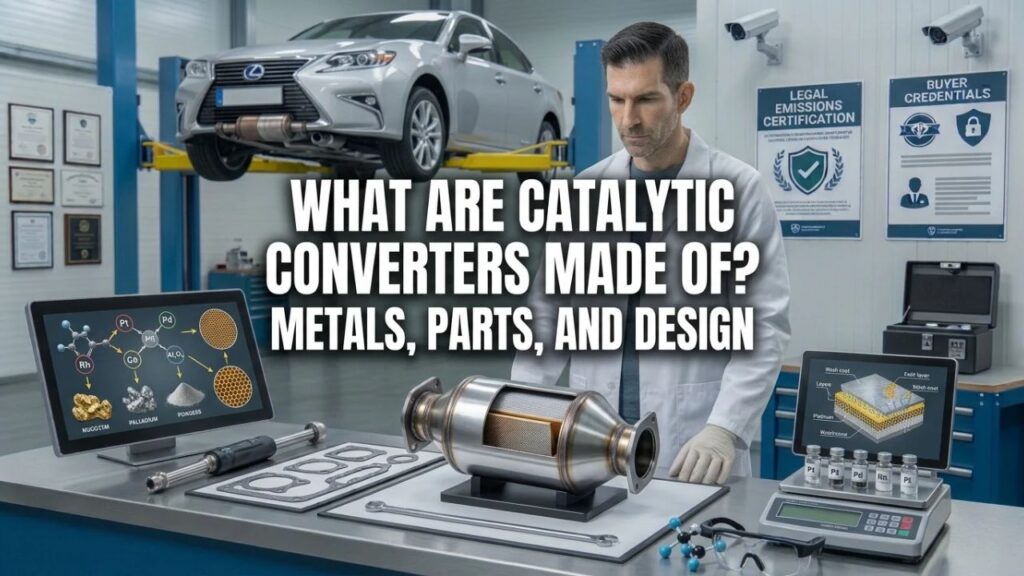
A catalytic converter is a layered component rather than one solid material. Its main construction normally includes an outer metal housing, an internal substrate, a retaining mat, a washcoat, and catalyst materials.
Stainless-Steel Outer Shell
The visible exterior is normally made from stainless steel or another corrosion-resistant exhaust-grade steel.
The shell must handle:
- High exhaust temperatures
- Water and road splash
- Road salt
- Repeated heating and cooling
- Vibration
- Exhaust pressure
- Physical impacts from road debris
Walker describes the converter body as stainless steel and notes that its shape is built to limit expansion and distortion while protecting the material surrounding the catalyst core.
The inlet and outlet pipes are welded into this shell so exhaust gases are forced through the catalyst rather than around it.
Some converters also carry an external heat shield. The shield reduces radiant heat reaching the vehicle floor and nearby parts.
Ceramic or Metallic Honeycomb Substrate
Inside the shell sits the substrate, sometimes called the monolith or catalyst brick.
Most passenger-car converters traditionally use a ceramic honeycomb. Cordierite is a common ceramic substrate material because it tolerates repeated temperature changes with very little dimensional change.
Corning describes synthetic automotive cordierite as a material based on magnesium, aluminum, and silicon. Its thermal-shock resistance made it suitable for thin honeycomb structures exposed to rapidly changing exhaust temperatures.
The honeycomb may contain hundreds or thousands of tiny parallel passages.
That shape accomplishes two things:
- It gives exhaust gases a very large internal surface to contact.
- It leaves enough open passage area for exhaust to move through without creating excessive restriction.
Some converters use a metallic substrate instead. These cores are formed from thin metal foil arranged into many small channels.
Metal substrates can be made thin and can tolerate demanding heat conditions, but ceramic remains common in automotive emissions systems.
Cushioning and Retaining Mat
A ceramic catalyst brick cannot simply sit loose inside a steel shell.
A heat-resistant cushioning mat surrounds the substrate and holds it securely in position. Walker lists this mat as a main converter component and explains that it accommodates differences in thermal expansion between the converter body and catalyst core.
That matters because the steel shell and ceramic core do not expand at exactly the same rate when they become hot.
The mat also protects the brittle ceramic substrate from vibration and road shock.
Key Takeaway: Most of a converter is steel, ceramic or metallic substrate, and support material. The precious metals are present as a very thin catalytic coating rather than a solid precious-metal core.
Which Precious Metals Are Inside a Catalytic Converter?
The three metals most strongly associated with automotive catalytic converters are:
- Platinum (Pt)
- Palladium (Pd)
- Rhodium (Rh)
All three belong to the platinum-group metals, or PGMs.
The U.S. Geological Survey identifies platinum, palladium, and rhodium as metals used in automotive catalytic converters because of their strong catalytic properties.
Platinum
Platinum is used to promote oxidation reactions.
In automotive exhaust treatment, oxidation reactions turn pollutants such as carbon monoxide and unburned hydrocarbons into compounds such as carbon dioxide and water.
Platinum tolerates the high-temperature exhaust environment and remains chemically active over a long service period when the engine is operating correctly.
It is used heavily in some diesel catalyst systems and may also appear in gasoline converter formulations.
Palladium
Palladium is another major oxidation catalyst.
Modern gasoline converters often use palladium because it works well in the conditions created by gasoline engines and can support oxidation of hydrocarbons and carbon monoxide.
The amount used changes with vehicle emissions requirements, engine design, catalyst technology, and metal pricing.
Manufacturers can adjust the ratio of platinum and palladium instead of using one fixed recipe across every converter.
Rhodium
Rhodium is strongly associated with reducing nitrogen oxides, commonly written as NOx.
In a three-way gasoline catalyst, rhodium supports reactions that separate nitrogen from oxygen in nitrogen-oxide compounds.
BASF describes modern three-way catalysts as using materials such as palladium for oxidation reactions and rhodium for NOx conversion.
Rhodium is normally present in much smaller quantities than the bulk structural materials of the converter. Its high market price is one reason even small amounts receive so much attention.
Key Takeaway: Platinum and palladium are strongly associated with oxidation reactions, while rhodium is especially useful for controlling nitrogen oxides in gasoline three-way converters.
What Is the Washcoat Made Of?
The catalyst metals are not normally applied directly to bare ceramic as a simple smooth metal film.
A porous layer called the washcoat sits on the substrate first.
Aluminum Oxide Provides Surface Area
A common washcoat base is aluminum oxide, often called alumina.
Its microscopic porous structure gives the coating far more surface area than the smooth honeycomb wall would provide by itself.
This lets a tiny amount of catalyst metal contact a large volume of exhaust gas.
MagnaFlow describes modern converter bricks as ceramic or metallic monoliths coated with a washcoat containing precious metals and oxygen-storage compounds on an alumina base.
Ceria and Other Oxygen-Storage Materials
Gasoline three-way catalysts need to handle tiny changes between rich and lean exhaust conditions.
Materials containing ceria, or cerium oxide, can store oxygen when excess oxygen is present and release it when the exhaust mixture changes.
Zirconium compounds may also be blended with ceria to change thermal stability and oxygen-storage behavior.
EPA catalyst documentation lists active and supporting materials that can include platinum, palladium, rhodium, cerium, zirconium, nickel, and other compounds depending on the catalyst design.
Precious Metals Are Dispersed Across the Washcoat
The precious metals are distributed through the high-surface-area washcoat in extremely small particles.
This arrangement is more useful than forming the entire core from precious metal.
A large ceramic honeycomb provides physical shape and gas flow. The porous washcoat multiplies available surface area. The platinum-group metals then occupy that surface where they can contact exhaust molecules.
Key Takeaway: The washcoat commonly uses alumina plus oxygen-storage materials such as ceria, creating a huge microscopic surface on which platinum, palladium, and rhodium can be dispersed.
Ceramic vs. Metallic Catalytic Converter Cores
Both substrate types create many small channels, but their construction differs.
| Feature | Ceramic Substrate | Metallic Substrate |
| Common base | Cordierite-type ceramic | Thin metal foil |
| Structure | Extruded honeycomb | Corrugated or layered metal channels |
| Heat behavior | Strong thermal-shock resistance | Fast heat transfer |
| Weight | Lightweight | Thin construction possible |
| Impact behavior | Brittle if struck hard | Less brittle |
| Common use | Very common in passenger vehicles | Used in selected automotive applications |
| Catalyst coating | Washcoat plus catalyst metals | Washcoat plus catalyst metals |
A ceramic core does not mean the converter contains no metal internally. It still carries catalyst metals and sits inside a metal shell.
Likewise, a metallic substrate does not mean the core is solid platinum, palladium, or rhodium. The structural foil and the catalyst coating serve separate purposes.
For normal vehicle ownership, substrate type is usually selected by the vehicle and converter manufacturer rather than by the driver.
How the Materials Convert Exhaust Pollutants
A three-way catalytic converter is named for the three main pollutant-control tasks it performs.
Carbon Monoxide Oxidation
Carbon monoxide, or CO, is produced when fuel does not burn completely.
Platinum and palladium can promote reactions that combine carbon monoxide with oxygen, producing carbon dioxide.
Hydrocarbon Oxidation
Unburned hydrocarbons are fuel compounds that escape combustion.
The oxidation section of the catalyst promotes reactions that convert these hydrocarbons mainly into carbon dioxide and water.
Nitrogen Oxide Reduction
Combustion temperatures can cause nitrogen and oxygen to form nitrogen oxides.
Rhodium supports reactions that remove oxygen from NOx compounds, leaving nitrogen.
BASF reports that modern three-way catalysts can remove more than 95% of targeted unwanted substances under suitable operating conditions.
The catalyst metals participate in these reactions without being consumed like ordinary fuel. They can still become damaged or contaminated by overheating, oil ash, coolant, lead, silicone, phosphorus, or physical failure.
Key Takeaway: The metals are catalysts rather than filters; they promote chemical reactions that change CO, hydrocarbons, and NOx into less harmful exhaust products.
Do Diesel Catalytic Converters Use the Same Materials?
Diesel emissions systems share some materials with gasoline converters, but the entire system is different.
Diesel Oxidation Catalysts
A diesel oxidation catalyst, or DOC, commonly uses platinum and palladium.
Its job focuses mainly on oxidation reactions involving carbon monoxide and hydrocarbons.
Diesel exhaust usually contains more oxygen than gasoline exhaust, so the chemistry differs from a gasoline three-way catalyst.
Diesel Particulate Filters
A diesel particulate filter, or DPF, traps soot particles.
Many DPF substrates are made from heat-resistant ceramics such as cordierite or silicon carbide. Some systems use catalytic coatings to support soot oxidation.
A DPF is not simply another name for the catalytic converter even though several emissions components can be packaged close together.
SCR Catalysts
Many newer diesel vehicles also use selective catalytic reduction, or SCR.
SCR systems commonly use catalyst materials based on metal-containing zeolites or other formulations rather than relying only on the platinum-palladium-rhodium combination associated with gasoline three-way converters.
This is why asking how much platinum or rhodium a “diesel catalytic converter” contains can be difficult without identifying the exact emissions component.
Key Takeaway: Diesel systems may use platinum and palladium in oxidation catalysts, while DPF and SCR components can use other ceramics and catalyst chemistries.
Why Are Catalytic Converters Worth Money?
Most of a used converter’s scrap interest comes from the catalyst metals rather than the stainless-steel shell.
The Precious Metals Are Scarce
Platinum-group metals are mined in relatively few regions.
USGS reports high U.S. dependence on imported platinum-group metals and identifies automotive catalysts as their leading domestic use.
That combination of limited supply and industrial demand gives recovered catalyst material a resale market.
A Converter Contains Only a Small Amount
A catalytic converter does not contain a large chunk of rhodium or platinum that can be removed by opening the case.
The metals are spread in tiny particles throughout the washcoat across a large honeycomb surface.
The amount varies substantially between converters.
Factors include:
- Vehicle size
- Engine displacement
- Emissions standard
- Gasoline or diesel engine
- Converter location
- OEM or aftermarket design
- Model year
- Catalyst formulation
I would not use a generic “grams per converter” figure to value an unknown part because the loading can differ sharply between applications.
Recycling Recovers the Metals
Specialized recyclers process catalyst material chemically and metallurgically to recover platinum-group metals.
The USGS 2026 Mineral Commodity Summary reported recovery of about 58,600 kilograms of palladium and platinum combined from U.S. automobile catalytic converters in 2025.
That recycling reduces the need for some newly mined material and explains why spent converters can retain scrap value even after their service life ends.
Key Takeaway: Scrap value comes mainly from recoverable platinum-group metals dispersed through the washcoat, not from the steel casing or ceramic brick itself.
Can You See the Platinum, Palladium, or Rhodium?
Normally, no.
If you look into an intact converter, you usually see small honeycomb openings rather than shiny precious metal.
The catalyst particles are extremely small and distributed through the washcoat.
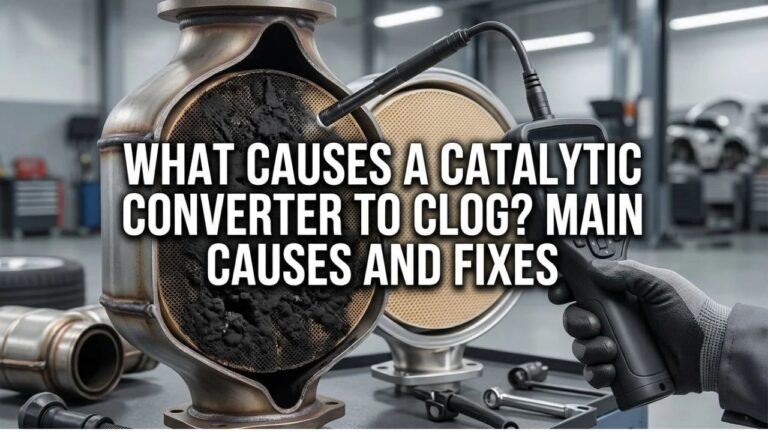
A cut-open converter may show a light, gray, tan, or darker ceramic surface depending on its design and condition, but appearance cannot tell you how much precious metal is present.
A laboratory assay is needed for accurate metal-content measurement.
The honeycomb should also not be handled casually. Used catalyst material may contain exhaust deposits and fine ceramic dust, so cutting or crushing converters outside a proper recycling process is a poor way to investigate their contents.
Are Aftermarket and OEM Catalytic Converters Made From the Same Materials?
They use the same broad construction idea, but material quantities and catalyst formulations can differ.
Both can contain:
- Steel shell
- Ceramic or metallic substrate
- Retaining mat
- Washcoat
- Platinum-group catalyst metals
The differences can include substrate size, cell density, washcoat chemistry, precious-metal loading, durability targets, and emissions certification.
An OEM converter is designed around the original vehicle’s emissions system.
Aftermarket converters must meet the emissions requirements that apply to their intended market and vehicle application. Some U.S. states require CARB-compliant replacement converters, while many others permit federally compliant units.
A physically fitting converter is therefore not automatically the correct replacement. Emissions certification and exact vehicle application matter alongside construction material.
Conclusion
What are catalytic converters made of? Most contain a stainless-steel housing, a ceramic or metallic honeycomb substrate, a heat-resistant retaining mat, a porous washcoat, and very small quantities of catalyst metals such as platinum, palladium, and rhodium.
The ceramic or metal core creates the exhaust passages, while alumina and oxygen-storage compounds in the washcoat provide a large reactive surface. Platinum, palladium, and rhodium sit across that surface and promote the reactions that reduce carbon monoxide, hydrocarbons, and nitrogen oxides.
The precious-metal layer gets most of the attention because those metals are scarce and recyclable, but the converter depends on every layer working together. Damage to the shell, substrate, washcoat, or catalyst coating can reduce emissions performance or restrict exhaust flow.
FAQs About Catalytic Converter Materials
Are catalytic converters made of platinum?
They contain platinum in many applications, but a converter is not made primarily from platinum. The main structure consists of a steel casing and ceramic or metallic honeycomb. Platinum may be dispersed through the washcoat in small quantities along with palladium, rhodium, or other catalyst materials.
What is the honeycomb inside a catalytic converter made of?
Many automotive honeycombs are made from a heat-resistant ceramic called cordierite. Some converters use thin metallic substrates instead. The honeycomb is coated with a porous washcoat and catalyst materials rather than being made from precious metal itself.
Why is rhodium used in catalytic converters?
Rhodium is well suited to reactions that reduce nitrogen oxides in gasoline three-way catalysts. It supports the conversion of NOx compounds into nitrogen while platinum and palladium are strongly associated with oxidation of carbon monoxide and hydrocarbons.
Do all catalytic converters contain platinum, palladium, and rhodium?
No. Catalyst formulation changes with vehicle type, engine, emissions system, and manufacturer. A gasoline three-way catalyst may contain all three, while some applications rely more heavily on palladium or platinum. Diesel oxidation catalysts and other emissions devices can use different combinations.
How much precious metal is in a catalytic converter?
There is no single amount that applies to every converter. Loading changes with vehicle size, engine type, emissions certification, catalyst design, converter position, and manufacturer. Accurate content for a used converter normally requires model-specific data or laboratory analysis.
Is the ceramic inside a catalytic converter worth money?
The ceramic itself has far less scrap interest than the catalyst coating on it. Recyclers process the ceramic because its washcoat carries recoverable platinum-group metals. The value comes mainly from those catalyst metals rather than the cordierite substrate.
Why are catalytic converters stolen if they contain only small amounts of precious metal?
Platinum, palladium, and rhodium can carry high commodity values, and a converter concentrates small amounts of these metals in one removable exhaust component. Scrap prices vary sharply by converter model because precious-metal loading is not the same across vehicles.