How Hot Do Catalytic Converters Get? Normal vs Dangerous Heat
A catalytic converter commonly reaches several hundred degrees Fahrenheit during normal driving and can approach 1,000–1,200°F during heavy engine load. Internal temperatures can rise far higher during a severe misfire or rich fuel condition, and extreme heat can damage or melt the catalyst substrate.
Those numbers need context because converter temperature changes with engine load, exhaust flow, vehicle design, converter location, and where the measurement is taken. An infrared thermometer aimed at the outer shell does not show the exact temperature inside the catalyst core.
Normal heat is necessary. The catalyst has to become hot enough to convert hydrocarbons, carbon monoxide, and nitrogen oxides in the exhaust. A converter that remains too cold may not perform its emissions function correctly.
A U.S. EPA fact sheet republished by the Texas Commission on Environmental Quality reports that converter shell temperatures can approach 800–1,000°F under extremely high engine load. With an ignition fault that sends unburned fuel into the exhaust, surface temperatures may reach roughly 1,200–1,400°F.
For how hot do catalytic converters get, a useful modern reference comes from Walker: most converters begin light-off around 350°F, are fully active around 500°F, and normally stay below about 1,200°F on a properly running engine. Temperatures far above that range deserve investigation.
A converter that becomes extremely hot is often reacting to another engine problem rather than failing on its own. Misfires, excessive fuel, oil consumption, coolant contamination, and abnormal exhaust conditions can all damage the catalyst if the underlying fault remains.
The temperature ranges, warning levels, causes, testing methods, and fire risks below explain what is normal and what should make you stop driving and diagnose the engine.
How Hot Do Catalytic Converters Get During Normal Driving?
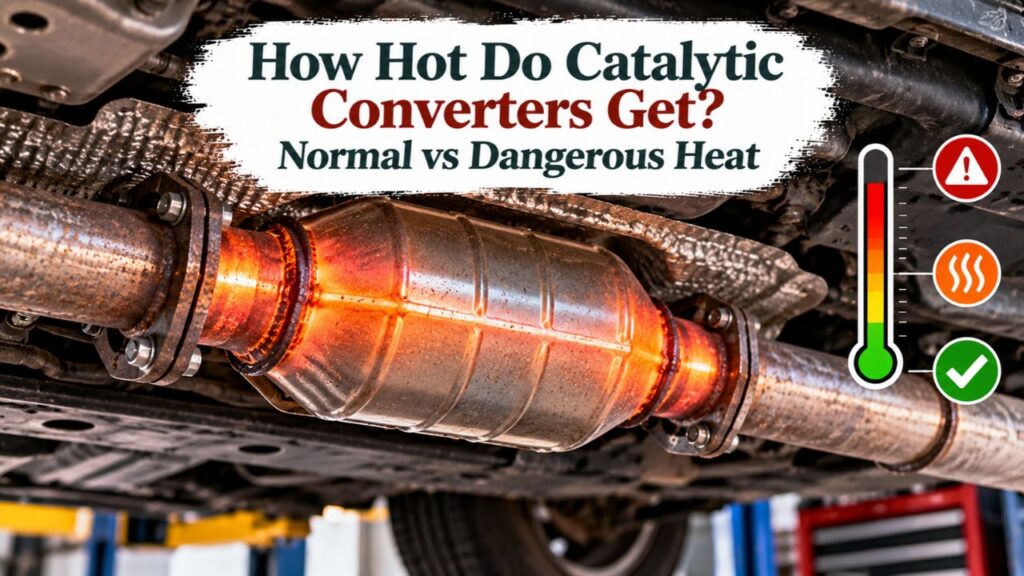
Catalytic converter temperature rises quickly after the engine starts and continues changing as load and exhaust flow change.
A converter on a fully warmed vehicle is normally much hotter than the surrounding exhaust pipes, floor pan, and other underbody parts.
Light-Off Temperature
Light-off is the point where the catalyst becomes hot enough to start converting pollutants at a useful rate.
Walker states that many converters begin to light off at roughly 350°F and become fully active near 500°F.
MagnaFlow gives a broader working range, stating that catalyst operation can occur from roughly 500°F to 1,200°F, depending on vehicle operation and catalyst design.
Modern engines try to heat the converter quickly after a cold start because the catalyst does much less emissions work while cold.
That is one reason many modern converters sit close to the exhaust manifold.
Normal Warmed-Up Temperature
Walker lists roughly 500–800°F as a normal converter operating range in its technical Q&A.
The exact number you see with an infrared thermometer can differ because you may be measuring:
- Converter inlet
- Converter outlet
- Center of the shell
- Weld ring
- Exhaust pipe
- Heat shield
Vehicle speed, engine load, ambient temperature, airflow beneath the car, and recent driving also change the reading.
Temperature Under Heavy Load
A converter can become much hotter while:
- Climbing a long hill
- Accelerating hard
- Carrying a heavy load
- Towing
- Driving at sustained high speed
- Operating the engine near high load
Walker states that converter temperature can reach roughly 1,200°F under heavy load without automatically indicating a failed catalyst.
The U.S. EPA material republished by TCEQ also reports outer-shell temperatures approaching 800–1,000°F during extreme engine loading.
Key Takeaway: A warmed catalytic converter commonly operates in the hundreds of degrees Fahrenheit, with roughly 500–800°F being common and temperatures approaching 1,200°F possible under heavy load.
Catalytic Converter Shell Temperature vs Internal Temperature
The temperature on the outside of a converter can be much lower than the temperature inside the catalyst substrate.
This distinction explains why different sources sometimes publish different “normal” converter temperatures.
Outer Shell Temperature
An infrared thermometer measures surface temperature.
It cannot see directly into the ceramic or metallic catalyst structure inside the housing.
Air moving under the vehicle also cools the outer shell while hot exhaust gases continue flowing through the center.
Older EPA vehicle-emissions training material documented shell temperatures around 600–800°F while internal catalyst temperatures could run much higher.
Modern designs vary, so those figures should be treated as useful context rather than specifications for every current vehicle.
Internal Catalyst Temperature
The internal substrate is where the chemical reactions occur.
Those reactions release heat, so internal temperatures can be substantially greater than an infrared reading taken from the shell.
This also means a converter may be suffering internal heat damage before the outside housing appears dramatically abnormal.
Inlet vs Outlet Temperature
A functioning converter generates heat while processing exhaust gases.
Walker recommends measuring the front and rear weld-ring temperatures when using temperature as a diagnostic clue. Under suitable test conditions, the rear may be up to about 150°F hotter than the front.
A large temperature difference does not automatically prove the converter is good or bad.
Fuel mixture, engine load, catalyst activity, pipe thickness, airflow, and corrosion can all influence surface readings.
Key Takeaway: Infrared thermometers measure the converter’s outer surface, not its hottest internal point. Compare readings from consistent locations rather than treating one surface temperature as the complete diagnosis.
How Hot Is Too Hot for a Catalytic Converter?
A converter reaching 900°F during demanding driving is very different from one reaching extreme temperatures because raw fuel is burning inside it.
Temperature becomes more concerning once it rises beyond the range expected from normal engine operation.
Around 1,200°F
Walker states that a correctly running engine can bring a converter up to roughly 1,200°F, especially under substantial load.
A brief high reading near this range does not automatically mean the converter is damaged.
Context matters.
A converter running near that temperature during mild cruising or idling deserves more attention than one measured directly after prolonged heavy-load driving.
Above 1,600°F
Walker warns that repeated operation above roughly 1,600°F can damage the precious-metal coating on the substrate and shorten converter life.
This is no longer ordinary operating heat.
The cause should be diagnosed before continued driving damages the catalyst further.
Around 1,700°F and Higher
Walker’s diagnostic material states that damaged catalyst matting and melted substrate commonly appear above roughly 1,700°F.
Another Walker technical Q&A places full substrate melting above roughly 2,000°F, which shows that the exact failure point depends on converter construction and where temperature is measured.
At these temperatures, the internal honeycomb can:
- Melt
- Collapse
- Crack
- Shift
- Block exhaust passages
The damaged converter may then become a physical exhaust restriction.
What Temperature Makes a Converter Glow Red?
Visible red heat generally means the exhaust component is far hotter than normal street-driving conditions.
A glowing converter commonly points to raw fuel burning inside it.
Walker states that a converter becomes red hot when excess fuel enters the catalyst with enough oxygen to burn.
Do not treat a glowing converter as normal after a hard drive.
A misfire or fuel-control fault needs attention.
Key Takeaway: Temperatures near 1,200°F can occur under heavy load, while repeated operation around 1,600°F and above can damage the catalyst. Extreme internal heat around 1,700–2,000°F can destroy the substrate.
Why Does a Catalytic Converter Get Too Hot?
A converter normally becomes dangerously hot because the engine sends something into the exhaust that should have been burned or controlled before reaching the catalyst.
The converter is often the victim of another fault.
Engine Misfire
A misfiring cylinder may send unburned fuel and oxygen into the exhaust.
The converter then tries to oxidize that fuel.
This can produce intense internal heat.
Walker identifies misfires and poor spark among major causes of overheated and melted converters.
Possible misfire causes include:
- Bad spark plug
- Faulty ignition coil
- Damaged plug wire
- Injector problem
- Low compression
- Incorrect air-fuel mixture
A flashing check-engine light commonly points to a severe active misfire and should be taken seriously.
Rich Air-Fuel Mixture
A rich engine receives more fuel than it can burn correctly.
Excess fuel can pass into the exhaust and burn inside the converter.
Possible sources include:
- Leaking injector
- Excessive fuel pressure
- Faulty sensor input
- Ignition fault
- Fuel-control problem
The hotter the converter gets, the greater the risk of damaging the substrate.
Oil Burning
Engine oil entering the combustion chambers can leave deposits on the catalyst.
Over time, oil contamination may reduce catalyst activity and contribute to overheating or blockage.
Oil can enter the cylinders through worn piston rings, valve seals, turbocharger faults, or other internal engine problems.
Coolant Entering the Exhaust
Coolant from an internal engine leak can contaminate the catalyst.
A head-gasket problem, cracked cylinder head, or other internal leak may send coolant through the combustion chamber and into the exhaust.
A new converter should not be installed until the source of contamination is repaired.
Excessive Exhaust Backpressure
A restricted converter, muffler, or exhaust pipe can hold heat upstream.
Walker recommends backpressure testing when exhaust restriction is suspected and lists typical reference pressure below about 1.5 psi at idle and 3 psi at 2,000 RPM, while vehicle-specific service data should take priority.
Key Takeaway: Misfires and rich fuel mixtures are major causes of extreme converter heat. Oil, coolant, and exhaust restrictions can also damage the catalyst or create abnormal temperatures.
Signs a Catalytic Converter Is Running Too Hot
Temperature is only one clue.
Several other symptoms may appear when a converter is overheating or beginning to suffer internal damage.
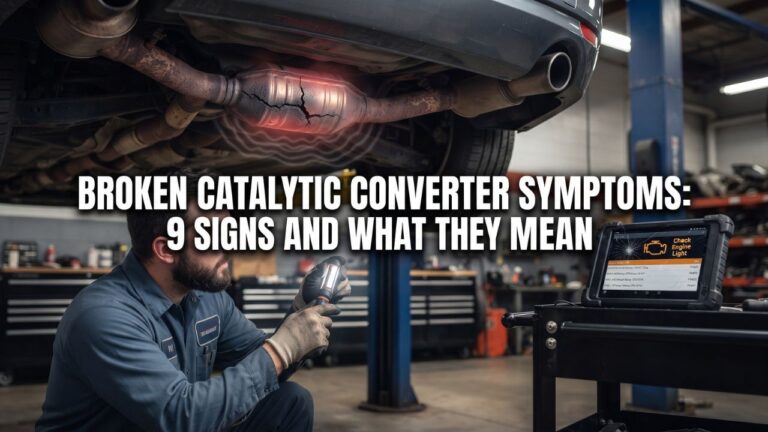
Converter Glows Red
A visible red or orange glow is a major warning sign.
Do not continue normal driving while trying to see if the glow disappears.
The converter may be receiving unburned fuel from an active misfire or rich mixture.
Burning Smell or Excessive Underbody Heat
You may notice strong radiant heat, burning odors, or unusually hot flooring around the converter area.
The converter should never have combustible material touching it.
A plastic bag, dry grass, road debris, or leaking fluid near an excessively hot exhaust creates added risk.
Blue or Bronze Converter Shell
Walker states that bronze or blue rainbow discoloration on the converter housing can indicate exposure to excessive temperature.
Discoloration does not reveal the exact cause, but it is a clue that the exhaust system should be inspected.
Power Loss
If excessive heat melts the honeycomb, exhaust passages can become blocked.
The driver may then notice:
- Slow acceleration
- Loss of high-RPM power
- Hard starting
- Stalling
- Poor fuel economy
MagnaFlow notes that severe converter restriction can interfere directly with engine operation and create hard-start or no-start conditions.
Check-Engine Light
Converter overheating may occur alongside codes for:
- Misfires
- Rich mixture
- Oxygen sensors
- Catalyst efficiency
- Airflow faults
P0420 or P0430 alone does not prove that the converter is overheating.
The stored codes need to be interpreted with engine data and physical testing.
Key Takeaway: A glowing shell, heat discoloration, burning smell, extreme underbody heat, power loss, or active misfire provides stronger evidence of a serious heat problem than a single infrared reading.
How to Measure Catalytic Converter Temperature Safely
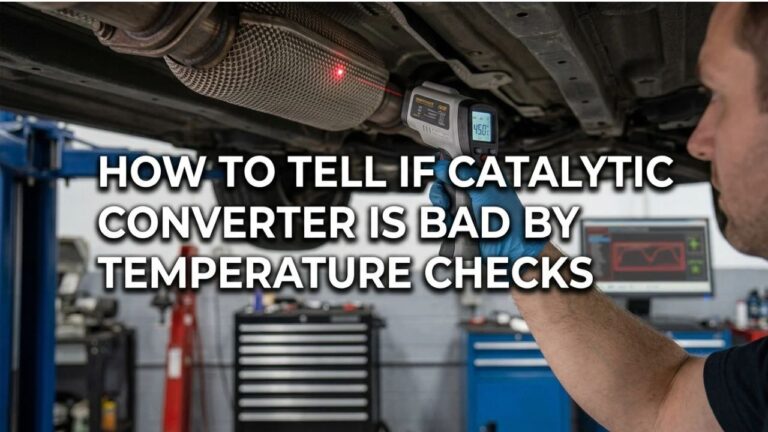
An infrared thermometer is the simplest way to check converter surface temperature without touching the exhaust.
The test should be done only when the vehicle can be inspected safely.
Warm the Engine First
A cold converter tells you little about normal catalyst operation.
Drive or run the vehicle long enough for the engine and exhaust system to reach operating temperature.
Walker recommends making temperature checks after the converter has reached light-off conditions.
Measure Consistent Locations
For a useful comparison, take readings near:
- The front weld ring or inlet area
- The rear weld ring or outlet area
Avoid comparing the center of the converter shell with a thin exhaust pipe several inches away. Different materials and wall thicknesses can produce misleading comparisons.
Do Not Touch the Converter
Even a normally operating converter can cause severe burns.
Use an infrared thermometer and keep skin, clothing, wiring, and tools away from the hot exhaust.
Never crawl beneath a vehicle supported only by a jack.
Use proper lifting equipment and stands if the vehicle has to be raised.
Do Not Diagnose From Temperature Difference Alone
A warmer outlet can support evidence that the catalyst is active.
Walker also cautions that pipe thickness, corrosion, heat transfer, and other conditions can influence the measurement.
If restriction is suspected, combine temperature readings with:
- Diagnostic trouble codes
- Fuel-trim data
- Misfire counts
- Exhaust backpressure
- Engine vacuum
- Physical inspection
Key Takeaway: Use an infrared thermometer at consistent inlet and outlet locations after warm-up, but combine temperature data with other tests before condemning a converter.
How Long Does a Catalytic Converter Stay Hot?
A catalytic converter can remain dangerously hot long after the engine is turned off.
The exact cooling time depends on:
- Converter mass
- Starting temperature
- Ambient temperature
- Vehicle airflow
- Heat shielding
- Recent engine load
The U.S. EPA material republished by TCEQ notes that converters can cool more slowly than other exhaust components because of their greater mass.
Do not assume the converter is safe to touch because the engine has been shut down for several minutes.
For service work, allow the exhaust system to cool fully.
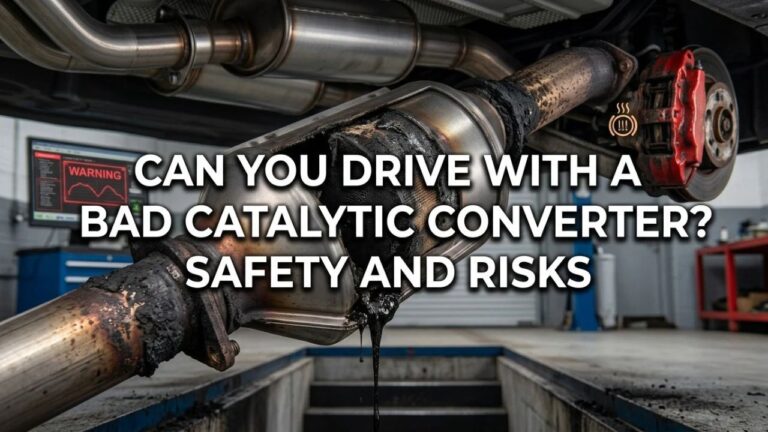
Can a Hot Catalytic Converter Start a Fire?
Yes, under the wrong conditions.
A properly operating converter is already hot enough to ignite some combustible material that contacts it, and an overheated converter presents a greater risk.
The U.S. EPA has documented vehicle and vegetation fires in cases involving catalyst-equipped vehicles, with poorly running engines and ignition faults appearing in reported incidents.
Avoid parking a vehicle with an exhaust or misfire problem over:
- Dry grass
- Leaves
- Paper
- Cardboard
- Fuel-soaked material
- Other combustible debris
If the converter is visibly glowing, smoke is coming from beneath the vehicle, or the engine is misfiring badly, shut the vehicle down in a safe location and arrange diagnosis rather than continuing the trip.
Conclusion
For how hot do catalytic converters get, normal surface and operating temperatures commonly fall in the several-hundred-degree range, with roughly 500–800°F being a useful general reference and temperatures approaching 1,200°F possible during heavy load.
Temperature becomes far more concerning around 1,600°F and above. Walker warns that sustained heat in that range can damage catalyst material, while internal temperatures around 1,700–2,000°F can damage or melt the converter substrate.
A red-hot converter should lead you toward the engine first. Misfires and rich fuel mixtures are common causes because they send unburned fuel into the exhaust, where it burns inside the catalyst.
If I saw a glowing converter, severe misfire, major loss of power, or strong burning smell, I would stop driving and diagnose the engine before replacing the catalyst. Fixing the fault that caused the heat is the best way to protect the replacement converter.
FAQs About Catalytic Converter Temperature
What Is a Normal Catalytic Converter Temperature?
Walker lists roughly 500–800°F as a normal operating range, with temperatures up to about 1,200°F under heavy load.
Measured temperature changes with converter location, engine load, airflow, vehicle design, and the exact point where the thermometer is aimed.
At What Temperature Does a Catalytic Converter Start Working?
Many converters begin light-off around 350°F and are fully active near 500°F, according to Walker’s current diagnostic guidance.
The exact light-off temperature varies with catalyst formulation and exhaust conditions.
Is 1,000°F Too Hot for a Catalytic Converter?
Not necessarily.
The U.S. EPA has reported shell temperatures approaching 800–1,000°F during extremely high engine loading, and Walker states that a converter can reach about 1,200°F under heavy load.
A 1,000°F reading during light driving or idling deserves more investigation than the same reading after hard operation.
At What Temperature Does a Catalytic Converter Melt?
Walker states that substrate and matting damage commonly occurs above roughly 1,700°F, while another Walker technical reference says internal temperatures must exceed roughly 2,000°F for substrate melting.
Converter construction and measurement location affect the exact threshold.
Why Is My Catalytic Converter Glowing Red?
A glowing converter often means unburned fuel is burning inside it.
Common causes include an active misfire, rich mixture, ignition fault, or fuel-delivery problem. Walker specifically identifies excess fuel entering the catalyst as a cause of red-hot converter operation.
Can a Catalytic Converter Get Hot Enough to Start a Fire?
Yes.
Converters naturally run at high temperature, and abnormal engine operation can push surface temperatures much higher. The U.S. EPA has documented fire concerns involving catalyst-equipped vehicles, especially when engine faults supply excess fuel to the catalyst.
How Can I Check Catalytic Converter Temperature?
Use an infrared thermometer after the engine and exhaust are fully warmed.
Measure consistent points near the converter inlet and outlet without touching the exhaust. Temperature readings should be combined with engine codes, fuel data, backpressure testing, and other checks if converter failure is suspected.
Should the Outlet of a Catalytic Converter Be Hotter Than the Inlet?
Often, yes, because the chemical reactions inside the catalyst generate heat.
Walker states that under normal test conditions the rear weld ring may be as much as about 150°F hotter than the front. A temperature difference alone cannot confirm converter condition because engine mixture, exhaust flow, pipe construction, and measurement location affect the result.