Does a Bigger Throttle Body Increase Power? Gains and Tradeoffs
Yes, a bigger throttle body can increase engine power, but only when the original throttle body restricts airflow. On a stock gasoline engine, installing a larger throttle body often produces little or no measurable horsepower gain. Modified engines that need more air are more likely to benefit from the upgrade.
A larger throttle body has a wider opening that allows more air to pass through under the right conditions. More available air can support additional fuel combustion and engine power. But the engine must actually need that airflow. If the factory throttle body already supplies enough air, increasing its size won’t accomplish much.
This explains why some drivers notice stronger acceleration after upgrading, while others report almost no difference. A more sensitive gas pedal can also make the vehicle feel faster without increasing its actual horsepower.
Before spending money on a performance throttle body, you should know whether your engine has an airflow restriction. This guide explains how throttle body size affects horsepower, which engines benefit most, possible drawbacks, and how to choose an upgrade that makes sense.
Does a Bigger Throttle Body Increase Horsepower?
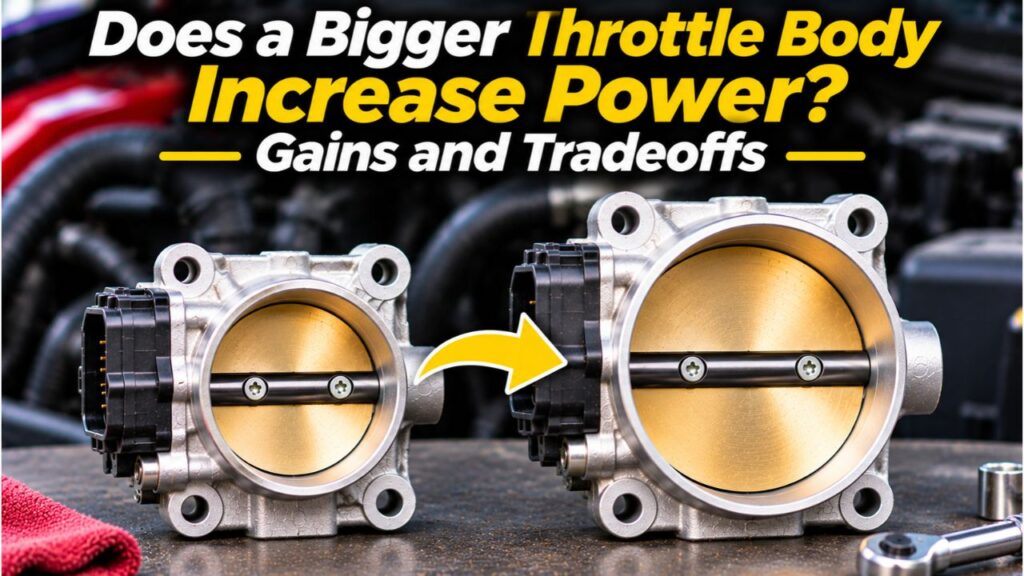
A bigger throttle body increases horsepower when it reduces an existing restriction in the engine’s intake system. If the original throttle body already supplies enough air at full power, a larger opening may provide little benefit. Engine modifications, airflow demand, and intake design determine the actual results.
Why More Air Can Produce More Power
A gasoline engine produces power by burning a mixture of air and fuel.
The throttle body regulates the air entering the intake manifold, which distributes that air to the engine cylinders.
When the throttle plate opens, airflow restriction decreases.
If the engine can use additional air, its fuel injection system can supply the appropriate amount of gasoline to support greater combustion energy.
But a larger opening doesn’t force extra air into cylinders that cannot use it.
For example, a standard four-cylinder engine may already receive enough air through its factory throttle body. Replacing it with a larger unit might change pedal response without increasing peak horsepower.
Why a Bigger Opening Doesn’t Guarantee More Power
The throttle body is only one part of the intake system.
Air must also pass through the filter, intake tubing, manifold, cylinder head ports, and intake valves.
If another component limits airflow, enlarging the throttle body may not increase the amount of air entering the cylinders.
The technical explanation of throttle body sizing describes why the ideal opening depends on engine airflow demand and the surrounding intake components.
The key takeaway is simple: A larger throttle body adds power only when the engine can benefit from the extra flow capacity.
How Does Throttle Body Size Affect Engine Airflow?
Throttle body size affects the maximum area available for incoming air and the restriction created as air passes through the valve. A larger bore can reduce pressure loss at high airflow demand. Actual airflow also depends on the throttle plate, shaft, housing shape, and the rest of the intake system.
Throttle Bore Diameter
The throttle bore is the circular opening inside the throttle body.
Manufacturers commonly specify throttle body diameter in millimeters, including in the US aftermarket.
A larger diameter provides a greater theoretical opening area.
Consider these two sizes:
| Measurement | Smaller throttle body | Larger throttle body |
| Bore diameter | 2.76 inches (70 mm) | 3.15 inches (80 mm) |
| Approximate circular area | 5.96 square inches | 7.79 square inches |
| Relative opening area | Baseline | About 31% larger |
| Guaranteed horsepower increase | None | None |
An increase from 70 mm to 80 mm produces roughly 31% more theoretical circular area.
That is a substantial geometric difference.
But 31% more opening area does not mean 31% more horsepower.
The engine’s airflow requirement and the pressure difference across the throttle body determine whether that added area matters.
Why the Throttle Plate Matters
The throttle plate is a circular disc that rotates inside the bore.
At smaller openings, it blocks much of the passage.
As the plate opens farther, the available flow area increases.
A larger throttle body may allow more air through at the same plate angle than a smaller one.
This can make the accelerator feel more responsive.
Still, throttle response and maximum engine power are two different measurements.
When Does a Bigger Throttle Body Actually Add Power?
A bigger throttle body is most likely to increase power when an engine has been modified to consume more air than its original intake system can deliver efficiently. High-output naturally aspirated engines, certain supercharged setups, and heavily modified turbocharged engines may benefit when the existing throttle body becomes restrictive.
Modified Naturally Aspirated Engines
A naturally aspirated engine draws air into its cylinders without a turbocharger or supercharger.
Performance modifications can increase its airflow demand.
Examples include improved cylinder heads, a different camshaft, an upgraded intake manifold, and increased engine displacement.
A camshaft controls when the engine’s valves open and close.
A performance camshaft may allow the engine to move more air at higher RPM, depending on its design.
For example, a modified V8 built to produce power at high engine speeds may eventually exceed the airflow capacity of its original throttle body.
In that situation, a larger unit could reduce restriction and increase peak power.
Supercharged Engines
A supercharger compresses incoming air and supplies it to the engine.
Certain supercharged combinations can place substantial airflow demands on the throttle body, particularly when it sits before the supercharger inlet.
A larger throttle body may reduce restriction when the factory unit limits the supercharger’s incoming air supply.
For example, a V8 fitted with a larger supercharger may benefit from a throttle body matched to the new inlet and airflow requirements.
The exact improvement depends on the complete engine setup.
Turbocharged Engines
Turbocharged engines can also benefit from a larger throttle body, but the need depends on the intake arrangement.
The turbocharger compresses air before it reaches the cylinders.
On many gasoline engines, the throttle body sits after the intercooler and before the intake manifold.
If the throttle body creates a significant pressure drop at high airflow, a larger unit may reduce that restriction.
But if the charge pipes or intake manifold are already limiting airflow, a much larger throttle body may accomplish little.
The upgrade makes sense when airflow measurements identify the throttle body as a restriction.
Will a Bigger Throttle Body Help a Stock Engine?
A bigger throttle body usually produces limited horsepower gains on a stock engine because the factory intake system is designed around its original airflow requirements. Manufacturers balance throttle size with engine output, emissions, fuel control, and drivability. A larger aftermarket unit may change pedal response without improving peak power.
Why Factory Throttle Bodies Are Often Large Enough
A factory throttle body must support the engine’s intended airflow demand.
Engine designers also account for idle control, part-throttle driving, and electronic throttle response.
For example, a family sedan designed for daily commuting may already have enough throttle opening to support its factory-rated horsepower.
Installing a larger unit doesn’t automatically make the engine draw more air.
Why the Car May Feel Faster
A larger throttle body can change how much airflow passes at a given throttle plate angle.
Suppose your original throttle body needs a larger plate opening to deliver a certain amount of air.
A bigger unit may deliver similar airflow with less opening.
That can make the car respond more sharply to small accelerator movements.
You might notice a quicker response when leaving a stoplight.
But the engine may still produce the same maximum horsepower.
This is where seat-of-the-pants impressions can be misleading.
What About a Cold Air Intake?
Adding a cold air intake doesn’t automatically make a larger throttle body necessary.
Some intake systems reduce restriction, while others mainly change sound or appearance.
The combination only adds meaningful power when it improves airflow that the engine can actually use.
For an otherwise stock daily driver, the factory throttle body is often a sensible choice.
Can a Throttle Body Be Too Big for an Engine?
Yes. An excessively large throttle body can make airflow harder to control at small openings and may create compatibility or calibration problems. It doesn’t automatically reduce low-RPM torque, but the accelerator can become overly sensitive. Poorly matched components may also cause idle issues or unpredictable throttle response.
Sensitive Accelerator Response
A large throttle bore can allow substantial airflow with relatively little plate movement.
That may make the accelerator feel touchy.
For example, imagine slowly pulling into a tight parking space.
A small pedal movement could produce a more noticeable engine response than you expect.
That doesn’t necessarily mean the vehicle has gained horsepower.
It may simply be responding differently to pedal input.
Low-Speed Drivability
Throttle control matters during parking, traffic, and gentle acceleration.
A well-matched throttle body allows smooth changes in airflow.
An oversized unit can make small adjustments more difficult, particularly when the electronic calibration doesn’t suit the new part.
The professional discussion of throttle body selection explains why increasing size beyond the engine’s airflow needs can create throttle control problems without adding power.
Intake Manifold Mismatch
A larger throttle body may have an opening wider than the intake manifold entrance.
If the manifold remains significantly smaller, the transition can create unwanted airflow restriction.
You may also encounter different mounting bolts, connector shapes, or throttle plate clearance requirements.
For example, installing a large throttle body against a smaller manifold opening doesn’t automatically create a larger intake passage.
The rest of the airflow path still matters.
Electronic Throttle Problems
Modern throttle bodies contain electric motors and position sensors.
A replacement unit must be compatible with the engine’s electronic control system.
An incorrect unit may cause warning lights, unstable idle, or reduced engine power.
Bigger isn’t automatically better when fitment and electronic control are involved.
How Do You Choose the Right Throttle Body Size?
Choose throttle body size based on the engine’s airflow requirements, intake manifold opening, and electronic compatibility. A stock engine often needs no increase, while modified engines may benefit from a carefully matched larger unit. Comparing engine-specific performance data is more useful than choosing the largest diameter available.
Match the Size to Your Engine Setup
| Engine setup | Throttle body approach | Reason |
| Completely stock daily driver | Keep factory size unless testing supports an upgrade | Factory airflow capacity is often sufficient |
| Mildly modified naturally aspirated engine | Check engine-specific performance results | Benefits may be small |
| Heavily modified high-RPM engine | Consider a larger matched unit | Increased airflow demand may justify it |
| Upgraded supercharged engine | Match the supercharger inlet and engine requirements | Inlet restriction may limit performance |
| Modified turbocharged engine | Check pressure drop and charge-pipe sizing | Extra area helps only if the throttle is restrictive |
| Track or race engine | Size for measured airflow and usable control | Both peak power and throttle precision matter |
Check the Intake Manifold Opening
The throttle body and intake manifold should work together.
A large throttle body feeding a much smaller opening may provide limited benefit.
Check the manifold’s inlet diameter, mounting pattern, and any manufacturer-approved adapter requirements.
Don’t assume an adapter automatically produces smooth airflow.
Check Electronic Compatibility
On an electronic throttle system, verify:
- Electrical connector compatibility
- Throttle actuator specifications
- Position sensor compatibility
- Mounting pattern and gasket design
- Throttle plate clearance
- ECU calibration or relearn requirements
A unit that physically bolts into place may still be electronically unsuitable.
Consider Your Driving Needs
A daily driver needs smooth part-throttle response during traffic and parking.
A dedicated race engine may place greater emphasis on high-RPM airflow.
For example, a car used for commuting five days a week may benefit more from predictable throttle behavior than from a small peak-power improvement available only near redline.
A useful rule of thumb is to choose the smallest throttle body that can meet the engine’s actual airflow demand without excessive restriction.
How Can You Tell If Your Current Throttle Body Restricts Power?
You can identify possible throttle body restriction by measuring intake pressure changes under high engine load and comparing performance before and after a properly matched upgrade. A significant pressure drop across the throttle body may indicate a restriction. Measurements must account for the engine’s operating conditions and other intake components.
Check Intake Pressure
A technician can use appropriate sensors or diagnostic equipment to measure pressure in the intake system.
On a naturally aspirated engine, manifold absolute pressure often approaches atmospheric pressure at wide-open throttle.
A significant remaining pressure difference may suggest intake restriction.
But that doesn’t automatically identify the throttle body as the cause.
The air filter, ducting, and manifold can also restrict flow.
On a turbocharged engine, comparing pressure before and after the throttle body can help identify a pressure loss at high airflow.
Compare Dyno Results
A dynamometer, commonly called a dyno, measures engine or wheel power under controlled conditions.
A useful before-and-after test should account for:
- The same vehicle and engine setup
- Similar engine temperatures
- Comparable air and weather conditions
- Consistent fuel and test procedures
- The same tuning configuration, unless calibration is part of the tested upgrade
- Multiple repeatable test runs
For example, if two runs produce slightly different peak horsepower numbers, that difference may reflect testing variation rather than a real improvement.
A single dyno result isn’t enough to prove that the throttle body caused the gain.
Does a Bigger Throttle Body Need a Tune?
A larger throttle body may require ECU calibration or an idle relearn, depending on its size, design, and the vehicle’s electronic controls. Some compatible upgrades operate with factory programming, while substantial changes may affect throttle response and airflow calculations. The manufacturer’s installation requirements should determine the procedure.
Electronic Throttle Calibration
Modern engine computers manage throttle opening using electronic commands.
The controller monitors the throttle plate’s position and adjusts it to meet the requested engine torque.
The technical overview of electronic air management describes how throttle control responds to accelerator input and other engine requirements.
A larger throttle body changes the relationship between plate angle and available airflow.
Some engine computers can compensate for certain changes, while others require calibration.
Idle Relearn After Installation
Replacing an electronic throttle body may change idle airflow.
Some vehicles require a relearn procedure that allows the computer to establish the correct throttle settings.
Others adapt automatically.
A car that idles too high after installation may have a calibration issue, intake leak, or incorrect part.
Don’t assume that removing the battery cable will complete the required procedure.
Check Emissions Compatibility
Before installing an aftermarket throttle body on a street-driven vehicle, confirm that the part complies with applicable emissions requirements.
Rules and approved parts vary by jurisdiction and vehicle application.
The manufacturer should provide the correct fitment and emissions information.
For street use, a compatible and properly calibrated part is more valuable than an oversized unit that creates warning lights or drivability problems.
Frequently Asked Questions
How Much Horsepower Does a Bigger Throttle Body Add?
There is no guaranteed horsepower increase from a bigger throttle body. Stock engines may gain little or nothing, while modified engines with a restrictive factory throttle can benefit. The actual result depends on airflow demand, intake manifold design, and tuning. Controlled before-and-after dyno testing provides a better answer than advertised claims.
Does a Bigger Throttle Body Make Acceleration Faster?
It can improve acceleration if the original throttle body restricts the engine’s available power. A larger unit may also change pedal sensitivity, making the car feel more responsive without increasing horsepower. To confirm a genuine improvement, compare acceleration or dyno results under similar conditions rather than relying on pedal feel alone.
Does a Bigger Throttle Body Increase Torque?
A larger throttle body can increase torque when it removes an airflow restriction that limits cylinder filling. If the original throttle body already supplies enough air, a larger unit may provide no meaningful gain. Changes in low-speed pedal response shouldn’t automatically be confused with increased engine torque.
Does a Bigger Throttle Body Increase Gas Mileage?
A bigger throttle body doesn’t automatically improve gas mileage. Fuel economy depends on driving habits, engine efficiency, airflow control, and operating conditions. A poorly matched upgrade may make throttle control less predictable. If the original throttle body works correctly and isn’t restrictive, replacing it usually offers little reason to expect fuel savings.
Is a 90 mm Throttle Body Better Than an 80 mm Throttle Body?
Not necessarily. A 90 mm throttle body has a larger theoretical opening than an 80 mm unit, but the engine must need the extra airflow. Intake manifold size, electronic compatibility, engine modifications, and operating speed all matter. An 80 mm unit may be the better choice for an engine with lower airflow demand.
Is a Ported Throttle Body Better Than a Bigger Replacement?
A ported throttle body modifies the existing housing to improve airflow, while a larger replacement increases the bore size. Neither approach guarantees additional power. A properly developed ported unit may retain factory compatibility more easily, but results depend on its design and the engine’s needs. Compare verified testing before choosing either option.
Choose Airflow Capacity Based on Your Engine’s Needs
A bigger throttle body can increase horsepower, but only when the existing unit creates a meaningful airflow restriction. On many stock gasoline engines, the factory throttle body already provides enough airflow for the engine’s designed power output.
Modified engines are a different story. Performance cylinder heads, camshafts, larger superchargers, and other upgrades may increase airflow requirements enough to justify a larger opening.
Remember that sharper accelerator response isn’t proof of additional horsepower. An oversized throttle body may also make low-speed driving less predictable or create electronic compatibility problems.
Before spending money, compare the throttle body with the intake manifold and the engine’s actual airflow needs. Don’t rely on bore diameter or advertised horsepower claims alone.
Your next step: Check your engine’s existing throttle body size, modification level, and available performance test results. If measurements show a real airflow restriction, choose a compatible upgrade and verify the results with controlled testing.