Where Is the Throttle Body Sensor Located? 6 Steps to Find It
The throttle body sensor, commonly called the throttle position sensor (TPS), is located on the throttle body, usually at one end of the throttle plate shaft. On older vehicles, it’s often a small, removable component with an electrical connector. On modern electronic throttle bodies, the sensor is usually built inside the assembly.
Finding it can be tricky if you’ve never worked around an engine’s air intake system. The throttle body itself may sit beneath a plastic engine cover, behind an air intake hose, or near the side of the intake manifold. Its exact position depends on your vehicle’s engine design.
The sensor has an important job. It tells the engine computer how far the throttle plate is open, helping the computer manage engine operation. If the sensor fails, your car may hesitate, idle roughly, or respond poorly when you press the accelerator.
Whether you’re trying to locate a faulty sensor or simply identify the correct component, a few visual clues can point you in the right direction. This guide explains where to look, how to recognize different sensor designs, and what to check before removing or replacing anything.
Where Is the Throttle Body Sensor Located on a Car?
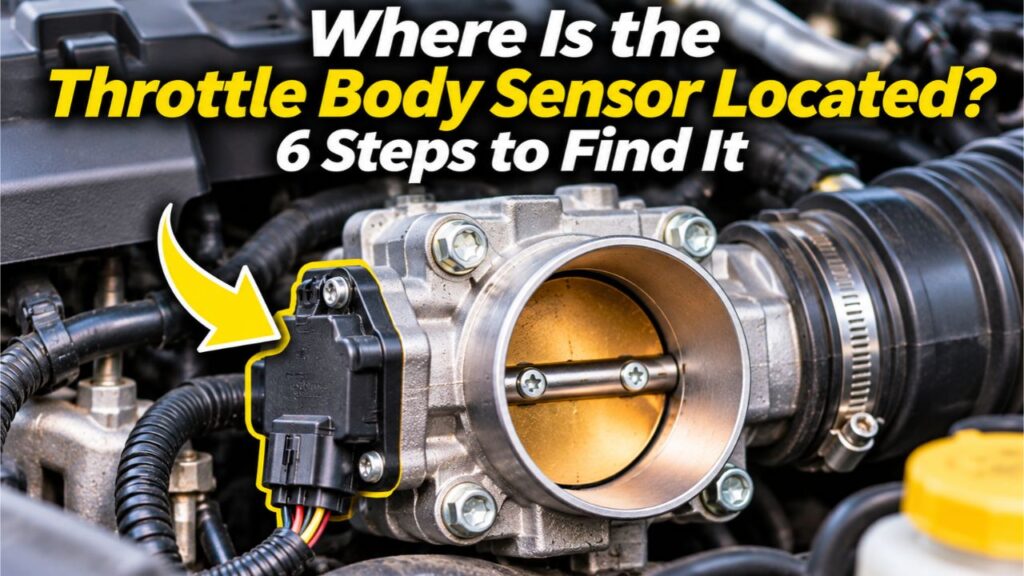
The throttle position sensor is normally mounted directly on the throttle body, where it can monitor the rotation of the throttle plate shaft. On cable-operated systems, it’s often attached to the outside with small screws. On electronic systems, the sensor is usually integrated into the throttle body housing.
Location on Older Cable-Operated Throttle Bodies
Older gasoline engines commonly use a mechanical throttle cable connected to the accelerator pedal.
The cable operates a lever attached to the throttle plate shaft.
A separate TPS is normally mounted at one end of that shaft.
Look for a small plastic component with an electrical connector and mounting screws.
It may sit beside the throttle linkage or on the opposite side of the throttle body.
For example, a 1990s gasoline engine may have a visible throttle cable pulley on one side and a position sensor attached to the other.
The throttle position sensor mounting and operating details explain how the sensor attaches to the throttle shaft and reports its opening angle.
Location on Modern Electronic Throttle Bodies
Most modern gasoline vehicles use electronic throttle control instead of a direct accelerator cable.
An electric motor moves the throttle plate based on commands from the engine computer.
The throttle position sensors are commonly built into the throttle body assembly.
You may notice a larger plastic housing containing the motor, sensors, and electrical connections.
The sensor may not be visible or removable as a separate part.
For example, if your vehicle has a single throttle body assembly with a large electrical connector, its position sensors may be hidden inside the housing.
The integrated throttle position sensor design describes how modern sensors operate within electronic throttle systems.
Throttle Position Sensor Location by Design
| Throttle Body Design | Typical Sensor Location | Separately Replaceable? |
| Older cable-operated | Outside of throttle body, attached to shaft | Often yes |
| Mechanical throttle with combined sensors | Side of throttle body housing | Depends on design |
| Electronic throttle body | Inside or beneath actuator housing | Often no |
| Electronic throttle with separate serviceable TPS | Mounted on throttle body shaft | Depends on manufacturer |
The sensor location follows the throttle body design, not simply the vehicle’s age.
How to Find the Throttle Body Sensor in 6 Steps
To find your throttle body sensor, locate the engine’s air intake duct and follow it toward the intake manifold. Identify the throttle body at the end of that duct, then inspect its housing for a position sensor or electrical connector. Confirm the location using vehicle-specific service information.
Step 1: Turn Off the Engine and Open the Hood
Park on level ground and engage the parking brake.
Switch off the engine and allow it to cool before inspecting the intake system.
Keep your hands away from moving belts, cooling fans, and electrical throttle mechanisms.
You don’t need to run the engine to locate the sensor.
A flashlight can help you inspect areas beneath the intake tubing.
Safety Note: Electronic throttle plates can move unexpectedly when the vehicle’s electrical system is active. Don’t place your fingers inside the throttle opening.
Step 2: Locate the Air Filter Housing
Find the engine’s air filter housing.
It’s usually a plastic box connected to a large intake duct.
The air filter removes dust and debris before air enters the engine.
On many vehicles, the intake duct extends from this housing toward the throttle body.
For example, you may notice a black plastic or rubber hose running across the upper engine compartment.
Follow that hose toward the engine.
Step 3: Follow the Intake Duct to the Throttle Body
The throttle body is generally located where the intake duct connects to the engine’s intake manifold.
The intake manifold distributes incoming air to the engine’s cylinders.
On a typical naturally aspirated gasoline engine, the airflow path is:
- Air enters through the air filter.
- Air passes through the intake duct.
- Air reaches the throttle body.
- Air flows into the intake manifold.
- Air enters the engine cylinders.
Turbocharged engines may have additional tubing and components between the air filter and throttle body.
The rule of thumb is to follow the main air path toward the intake manifold.
Step 4: Identify the Throttle Body Housing
Look for a metal or plastic housing connected to the intake duct.
Some throttle bodies are round, while others have a more complex exterior shape.
Older designs often have a visible throttle cable, return spring, and rotating lever.
Modern designs commonly have a plastic motor housing and electrical connector.
If your engine has a large plastic cover, the throttle body may be partially hidden.
Consult the service instructions before removing covers or intake components.
Step 5: Look for the Throttle Position Sensor
On a cable-operated throttle body, inspect both ends of the throttle plate shaft.
The sensor is often a small black plastic component secured with screws.
You’ll usually find an electrical connector attached to it.
On an electronic throttle body, look for the larger actuator housing. The TPS may be integrated inside it.
Don’t assume every connector on the throttle body belongs to a separately removable sensor.
For example, an electronic unit may have one connector serving the actuator motor and multiple position sensor circuits.
Step 6: Confirm the Sensor With a Wiring Diagram
Before disconnecting anything, verify the component using the correct wiring diagram or parts information.
You’ll need the vehicle’s:
- Year
- Make
- Model
- Engine size and engine code, if available
- Throttle control system type
These details matter because the same vehicle model may use different engines.
A sensor that appears removable on one engine may be integrated into the throttle body on another.
Don’t remove parts based on appearance alone.
Confirming the sensor’s identity prevents damaged connectors and unnecessary repairs.
What Does a Throttle Body Sensor Look Like?
A throttle position sensor is generally a compact electrical component attached to the throttle body shaft or built into the throttle body housing. Older sensors often have a small plastic body, a multipin connector, and mounting screws. Modern integrated sensors may have no separate visible housing.
Physical Features of a Typical TPS
| Feature | What to Look For |
| Sensor body | Small plastic housing, often black |
| Electrical connector | Commonly three pins on older standalone designs |
| Mounting | One or more screws or molded housing |
| Position | At the end of the throttle plate shaft |
| Shaft connection | Internal rotating mechanism on many older types |
| Modern design | Sensor incorporated into electronic throttle assembly |
The shape isn’t universal.
Some sensors are round, while others are rectangular or irregular.
For example, one older throttle body might use a small circular sensor, while another uses a flat plastic housing with an angled connector.
The connector pin count alone doesn’t reliably identify the sensor.
How to Avoid Confusing the TPS With Other Sensors
Several engine sensors sit near the air intake system.
They may look similar, but their functions differ.
| Sensor | Typical Location | Main Function |
| Throttle Position Sensor (TPS) | On or inside throttle body | Measures throttle plate position |
| Mass Airflow Sensor (MAF) | Air intake duct, typically upstream of throttle body | Measures incoming air mass |
| Manifold Absolute Pressure Sensor (MAP) | Intake manifold or connected pressure passage | Measures intake pressure |
| Accelerator Pedal Position Sensor (APP) | Accelerator pedal assembly | Measures pedal movement |
| Intake Air Temperature Sensor (IAT) | Intake duct or integrated into another sensor | Measures incoming air temperature |
The accelerator pedal sensor is a particularly common source of confusion.
On electronic throttle systems, the pedal sensor and TPS perform different jobs.
The pedal sensor reports driver input. The TPS reports the throttle plate’s actual position.
The accelerator pedal sensor’s separate function and location helps explain the distinction.
Is the Throttle Body Sensor Removable or Built In?
A throttle body sensor may be removable or integrated, depending on the vehicle’s design. Older cable-operated throttle bodies often have a separately serviceable TPS. Modern electronic throttle bodies commonly contain built-in position sensors, and many manufacturers specify replacing the assembly if an internal sensor fails.
Removable Throttle Position Sensors
A separate TPS usually attaches to the throttle shaft with small screws.
Some designs allow the sensor to be replaced without removing the complete throttle body.
Certain sensors require alignment or adjustment during installation.
For example, an older mechanical throttle body may have a sensor with slotted mounting holes that allow its position to be adjusted.
Incorrect installation can produce inaccurate throttle readings.
Follow the manufacturer’s adjustment procedure rather than guessing.
Integrated Throttle Position Sensors
Electronic throttle bodies commonly combine the motor, plate, and position sensors inside one assembly.
The sensor may be inaccessible without opening a sealed housing.
Even if the cover can physically be removed, that doesn’t mean the internal sensor is serviceable.
Opening the unit may damage its seals or actuator components.
Some manufacturers supply only a complete throttle body as the replacement part.
Check whether the TPS is sold separately for your exact engine before attempting removal.
What Are the Symptoms of a Bad Throttle Body Sensor?
A faulty throttle position sensor may cause rough idle, hesitation, poor acceleration, unstable engine speed, and a check engine light. In electronic throttle systems, incorrect position feedback can also trigger reduced-power mode. These symptoms overlap with other engine problems, so they don’t prove the TPS has failed.
Common Symptoms
| Symptom | Possible TPS-Related Problem |
| Rough idle | Incorrect throttle position feedback |
| Hesitation | Inconsistent sensor signal |
| Poor acceleration | Incorrect throttle information or protective power limitation |
| Fluctuating RPM | Unstable throttle control |
| Check engine light | Sensor circuit or correlation fault |
| Reduced-power mode | Electronic throttle control safety response |
| Stalling | Incorrect airflow control or related system fault |
Why Does a Bad TPS Affect Acceleration?
The engine computer uses throttle position information when controlling engine operation.
If the TPS reports an inaccurate position, the computer may receive conflicting information about airflow demand.
For example, you might press the accelerator smoothly but notice that the engine hesitates instead of responding normally.
This can occur when a sensor signal drops out or changes unexpectedly.
Electronic throttle systems may also limit power when sensor readings disagree.
That response is intended to reduce the risk of unintended throttle operation.
Can a Dirty Throttle Body Cause Similar Symptoms?
Yes. Carbon deposits around the throttle plate may cause rough idling, hesitation, or stalling without any electrical sensor failure.
A dirty throttle body may need cleaning rather than replacement.
However, cleaning won’t repair a damaged TPS or failed actuator motor.
Before spending money, identify which problem is actually present.
How Can You Check the Throttle Position Sensor?
You can check a throttle position sensor by reading diagnostic trouble codes, inspecting its connector, and monitoring throttle position data with a compatible scan tool. Some older sensors also support resistance or voltage testing. The correct procedure depends on whether the TPS is separate or integrated.
Check for Diagnostic Trouble Codes
Connect an OBD-II scanner and retrieve stored and pending codes.
Common codes associated with throttle position problems include:
| Trouble Code | General Description |
| P0120 | Throttle/Pedal Position Sensor A circuit |
| P0121 | Throttle/Pedal Position Sensor A range or performance |
| P0122 | Throttle/Pedal Position Sensor A circuit low |
| P0123 | Throttle/Pedal Position Sensor A circuit high |
| P2135 | Throttle/Pedal Position Sensor A/B voltage correlation |
For example, P0122 indicates that a designated position sensor circuit has a low signal condition.
That doesn’t automatically mean the sensor itself has failed.
Damaged wiring, connector problems, or other circuit faults may also cause the code.
Monitor the Sensor With a Scan Tool
A scan tool with live-data capability can display throttle position information.
Depending on the vehicle, available readings may include commanded throttle position, actual throttle position, and accelerator pedal position.
During a manufacturer-approved test, watch for signals that change smoothly.
Sudden dropouts or unexpected readings may indicate a fault.
Don’t expect the displayed throttle percentage to match pedal movement exactly. Modern engine computers control throttle movement according to several operating conditions.
Inspect the Sensor Connector
With the ignition off, examine the accessible sensor or throttle body connector.
Look for corrosion, damaged wiring, loose terminals, or broken locking tabs.
A poor electrical connection can produce symptoms similar to a failed sensor.
Don’t jump the gun and order a replacement throttle body before checking these basic problems.
For older sensors, a technician may also use a multimeter to check the specified electrical signals.
Never apply battery voltage directly to unknown sensor terminals or force an electronic throttle plate to move.
What Should You Do if You Can’t Find the Sensor?
If you can’t find a separate throttle position sensor, your vehicle may have an electronic throttle body with integrated sensors. In that case, the sensor won’t appear as an individual external component. Check the engine’s parts diagram and service information before assuming something is missing.
Check the Engine and Throttle Body Design
Look up the exact throttle body assembly for your vehicle.
Pay attention to whether the parts listing identifies a separate TPS or a complete electronic throttle body.
For example, a parts diagram may display one throttle body assembly that includes its actuator motor and position sensors.
That usually means you won’t find a separate sensor attached to the outside.
Don’t Replace the Assembly Without Testing
A throttle position fault code doesn’t automatically justify replacing the complete throttle body.
The actual cause may be a damaged connector, wiring problem, or another throttle control component.
If the sensor is integrated and testing confirms internal failure, replacement may be necessary.
Some vehicles also require a throttle relearn, which allows the engine computer to establish correct throttle or idle settings after repairs.
Without the proper procedure, the engine may idle poorly even after a new assembly is installed.
If accelerator response is unreliable or the vehicle enters reduced-power mode, arrange professional diagnosis before driving further.
Frequently Asked Questions
Throttle position sensor locations vary between older mechanical and modern electronic throttle systems. The most common confusion involves whether the sensor is visible, whether it can be replaced independently, and how it differs from the accelerator pedal sensor. These answers cover the practical questions drivers face while locating the component.
Is the Throttle Position Sensor Always on the Throttle Body?
On typical gasoline engines, the throttle position sensor is attached to or integrated into the throttle body because it measures throttle plate movement. Some vehicle designs use different sensor arrangements, so the exact location depends on the engine. Check the manufacturer’s parts diagram before identifying a separate component.
Is the Throttle Body Sensor on the Driver’s Side or Passenger’s Side?
There isn’t a universal driver’s-side or passenger’s-side location. The throttle body may sit in different areas depending on engine orientation, intake manifold design, and vehicle packaging. Locate the main intake duct and follow it toward the engine. Then inspect the throttle body for its sensor or electrical connector.
Is the Throttle Position Sensor the Same as the Accelerator Pedal Sensor?
No. The throttle position sensor measures throttle plate movement, while the accelerator pedal position sensor measures how far the driver presses the pedal. Modern electronic throttle systems use information from both. The pedal sensor is usually located at the accelerator pedal assembly, not on the throttle body.
Can You Replace Just the Throttle Body Sensor?
Sometimes. Older cable-operated throttle bodies often use a removable TPS that can be replaced separately. Many modern electronic throttle bodies contain integrated sensors that aren’t individually serviceable. Check the vehicle’s service manual and replacement parts information before removing the sensor or ordering a complete throttle body.
Can You Drive With a Bad Throttle Position Sensor?
A faulty TPS can cause hesitation, unstable idle, reduced engine power, or unpredictable accelerator response. Driving may become unsafe if the engine stalls or doesn’t respond normally. If these symptoms occur, stop safely and arrange diagnosis. A trouble code alone doesn’t prove the sensor has failed.
Can a Bad Throttle Position Sensor Stop a Car From Starting?
A serious throttle position or electronic throttle control fault can contribute to starting problems on some vehicles. However, a no-start condition has many other possible causes, including battery, ignition, fuel delivery, and engine sensor faults. Confirm the problem through diagnostic testing rather than replacing the TPS based only on starting symptoms.
Find the Correct Sensor Before Starting Repairs
The throttle body sensor, usually called the throttle position sensor, is located on or inside the throttle body. Its job is to report throttle plate position to the engine computer.
On older cable-operated engines, it’s often a small plastic component attached to the throttle shaft with screws. On modern electronic throttle bodies, the position sensors are commonly integrated into the assembly.
To locate the sensor, follow the main air intake duct toward the engine. Identify the throttle body, inspect its electrical connections, and compare the parts with your vehicle’s service diagram.
Don’t confuse the TPS with the accelerator pedal sensor, mass airflow sensor, or manifold pressure sensor. Each performs a different job.
If you’re diagnosing a fault, check the wiring and scan data before buying replacement parts.
Your next step: Find the throttle body parts diagram for your vehicle’s exact year, make, model, and engine. It will show whether the TPS is externally mounted, integrated, or separately serviceable.