What Type of Catalytic Converter Do I Have? Identification Guide
Most modern gasoline cars use a three-way catalytic converter, while diesel vehicles commonly use a diesel oxidation catalyst as part of a larger emissions system. Your vehicle may also have a manifold-mounted, close-coupled, or underfloor converter, and some engines use two or more converters.
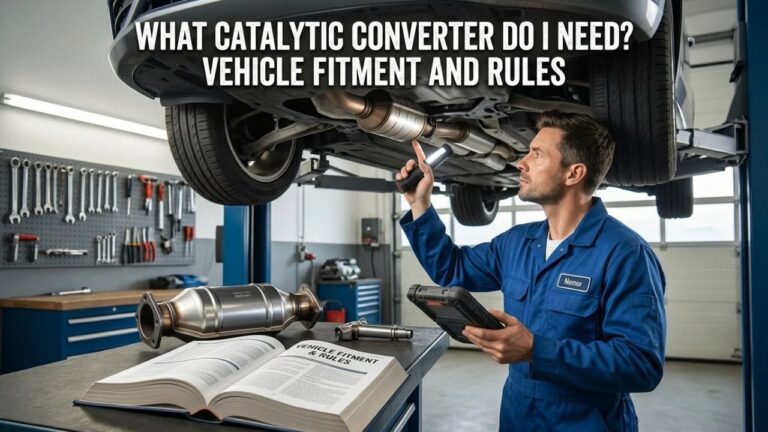
The easiest way to identify yours is to start with the vehicle’s year, make, model, engine, and fuel type. Those details narrow the possibilities much faster than judging the converter by shape alone.
Next, check the emissions label under the hood. It can tell you if the vehicle was certified to federal emissions standards or California emissions standards, which matters when selecting a replacement converter in the United States.
Physical location gives another clue. A converter attached directly to the exhaust manifold is different from one positioned farther underneath the vehicle, even though both may use the same basic catalyst chemistry.
For what type of catalytic converter do i have, it helps to separate three different meanings of “type”: how the converter treats exhaust gases, how it is mounted, and which emissions certification it must meet.
Part numbers, VIN-based parts catalogs, oxygen-sensor locations, and the number of exhaust banks can then confirm the exact converter you have before you order a replacement.
What Type of Catalytic Converter Do I Have?
Most gasoline-powered passenger vehicles from the last several decades use a three-way catalytic converter, commonly shortened to TWC.
Older gasoline vehicles may use an oxidation converter or an older dual-bed design. Diesel engines use a different emissions setup and may have a diesel oxidation catalyst combined with a particulate filter and selective catalytic reduction system.
Your converter can also be classified by its physical design:
- Manifold catalytic converter
- Direct-fit underbody converter
- Universal replacement converter
- Close-coupled converter
- Underfloor converter
A vehicle may fit more than one description.
For example, a gasoline SUV could have a three-way converter chemically and a manifold converter physically. Those terms describe different aspects of the same part.
Gasoline Vehicles Usually Have Three-Way Converters
A three-way catalyst reduces three major groups of regulated exhaust pollutants:
- Hydrocarbons
- Carbon monoxide
- Nitrogen oxides
Three-way converters became standard on most gasoline passenger vehicles decades ago as electronic fuel control and oxygen sensors became common.
If you have a modern gasoline-powered car, SUV, van, or light truck, a three-way catalyst is the most likely answer.
Diesel Vehicles Use a Different System
A diesel vehicle may have a diesel oxidation catalyst, or DOC.
The DOC primarily treats hydrocarbons and carbon monoxide and can also support other emissions components.
Modern diesel exhaust systems may include:
- Diesel oxidation catalyst
- Diesel particulate filter
- Selective catalytic reduction catalyst
- Ammonia slip catalyst
- Diesel exhaust fluid injection system
These components can sit close together in one large exhaust assembly, which can make them look like one giant catalytic converter.
Older Vehicles May Use Oxidation Converters
Early catalytic-converter systems often used an oxidation catalyst.
These converters primarily reduced hydrocarbons and carbon monoxide.
Some older vehicles also used dual-bed arrangements containing more than one catalyst section inside a single housing.
If your vehicle is from the 1970s or early 1980s, year-specific emissions information becomes especially useful because designs changed quickly during that period.
Key Takeaway: Most modern gasoline vehicles use three-way catalysts, while diesel vehicles commonly use a diesel oxidation catalyst as part of a multi-component emissions system.
Catalytic Converter Types by Exhaust Function
The chemistry inside the converter is one way to classify the part.
This is different from describing its shape or installation method.
Two-Way Oxidation Catalytic Converter
A two-way oxidation converter reduces:
- Hydrocarbons
- Carbon monoxide
It does not perform the same nitrogen-oxide reduction function as a modern three-way converter.
These designs are mainly associated with older gasoline vehicles and some diesel applications with different catalyst formulations.
You are unlikely to have a basic two-way gasoline converter on a late-model passenger car.
Three-Way Catalytic Converter
The three-way converter is the common gasoline-vehicle design.
It reduces:
- Hydrocarbons
- Carbon monoxide
- Nitrogen oxides
The engine control system keeps the air-fuel mixture close to the correct range so the catalyst can perform all three reactions.
Upstream and downstream oxygen sensors are commonly used to control fuel mixture and monitor catalyst performance.
If your gasoline car is from the 1990s or newer, this is very likely the catalyst chemistry it uses.
Three-Way Plus Oxidation Converter
Some older systems combined a three-way catalyst and a separate oxidation section.
They may be called:
- Dual-bed converters
- Three-way-plus-oxidation converters
- TWC plus oxidation catalysts
An air-injection system may be involved between catalyst sections on certain older designs.
This type is much less common on newer vehicles.
Diesel Oxidation Catalyst
A diesel oxidation catalyst treats gases from a diesel engine differently from a gasoline three-way converter.
It oxidizes hydrocarbons and carbon monoxide and can also assist particulate-filter regeneration by altering exhaust chemistry.
A modern diesel vehicle may have a DOC very close to the turbocharger so exhaust heat reaches the catalyst quickly.
Key Takeaway: Fuel type and vehicle age provide strong clues. Modern gasoline vehicles usually use three-way chemistry, while diesel vehicles often begin their aftertreatment system with a diesel oxidation catalyst.
Manifold, Close-Coupled, and Underfloor Catalytic Converters
Converter location is another way to identify what is installed on your vehicle.
Modern vehicles may have more than one location.
Manifold Catalytic Converter
A manifold converter is integrated into or closely attached to the exhaust manifold.
The exhaust manifold collects exhaust gases directly from the cylinders, so this converter sits very close to the engine.
Advantages of this location include rapid warm-up after startup.
You may see the converter:
- At the front of a transverse engine
- At the rear of the engine near the firewall
- On each side of a V6 or V8
- Built into a cast or tubular exhaust manifold assembly
These converters are often expensive because replacing the catalyst may require replacing much of the manifold assembly.
Close-Coupled Catalytic Converter
A close-coupled converter sits near the exhaust manifold but may not be physically built into it.
The short distance from the exhaust ports means it warms rapidly.
On some vehicles, people refer to both manifold and close-coupled units as “front cats” or “primary cats.”
Service information gives the more exact designation.
Underfloor Catalytic Converter
An underfloor converter sits farther downstream beneath the vehicle.
You will usually find it in the exhaust tunnel between the engine and muffler.
It may appear as an oval, round, or flattened stainless-steel housing.
Some vehicles use an underfloor unit as the main converter. Others use it as a second catalyst after a close-coupled converter.
Primary and Secondary Converters
Vehicles with more than one converter may use terms such as:
- Primary catalytic converter
- Secondary catalytic converter
- Front converter
- Rear converter
- Warm-up catalyst
- Main catalyst
The exact terms differ by manufacturer.
Do not order a “front” or “rear” converter until you confirm which exhaust bank and position the parts catalog means.
Key Takeaway: A converter beside the engine is usually manifold-mounted or close-coupled, while a larger unit farther under the vehicle is an underfloor converter. Some vehicles have both.
How to Identify Your Catalytic Converter Step by Step
You can usually identify the correct type without removing anything.
Start with vehicle information, then work toward the physical converter.
1. Identify the Fuel Type
First determine if the vehicle uses:
- Gasoline
- Diesel
- Gasoline-electric hybrid
- Another fuel system
A conventional gasoline or gasoline-hybrid vehicle normally uses three-way catalyst technology.
A modern diesel is more likely to have a DOC, DPF, and SCR system.
Do not mistake a diesel particulate filter for a normal gasoline catalytic converter.
2. Write Down the Year, Make, Model, and Engine
Use the complete vehicle specification.
For example:
2018 Toyota Camry 2.5L gasoline
is much more useful than:
2018 Toyota Camry.
The same model can use different converter assemblies depending on:
- Engine size
- Engine code
- Drivetrain
- Emissions package
- Production date
3. Check the VIN
The 17-character VIN identifies the vehicle configuration and is one of the best references for parts lookup.
You can find it:
- At the bottom of the windshield
- On the driver’s door label
- On vehicle registration documents
A dealer or reputable parts supplier can use the VIN to narrow converter choices.
The VIN alone may not display every emissions detail to the vehicle owner, but it greatly reduces fitment mistakes.
4. Read the Underhood Emissions Label
Open the hood and look for the Vehicle Emission Control Information label.
It is commonly attached to:
- Hood underside
- Radiator support
- Engine compartment panel
The label may list:
- Engine family
- Emissions standard
- Catalyst information
- California certification
- Federal certification
- Engine displacement
- Model year
This label is especially useful when purchasing an aftermarket converter.
5. Look at the Converter Location
With the exhaust completely cool, visually follow the exhaust from the engine toward the rear of the vehicle.
Do not crawl beneath a vehicle supported only by a jack.
A bulged stainless-steel housing near the engine may be a close-coupled converter.
Another larger housing farther downstream may be a secondary or underfloor unit.
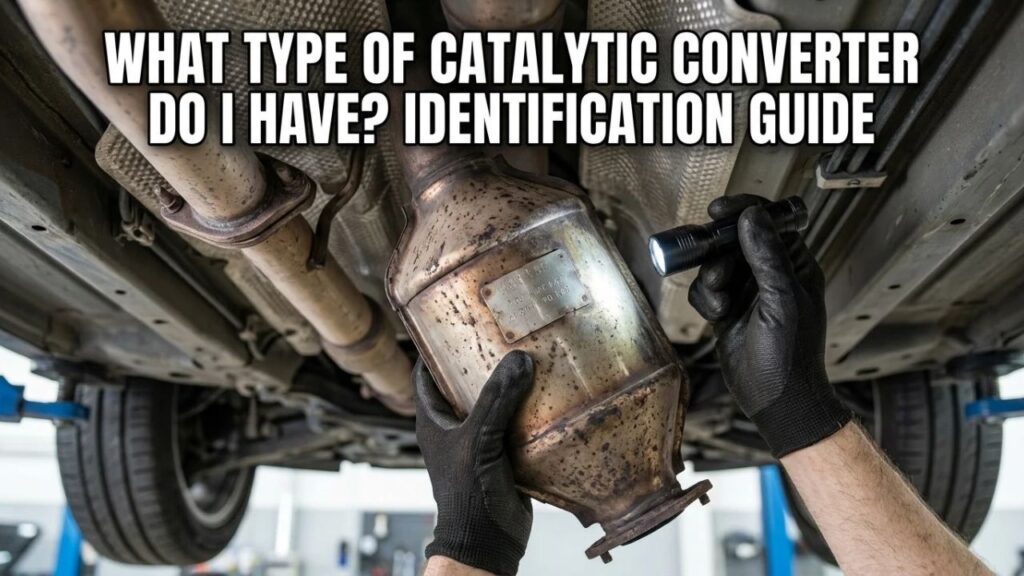
6. Find the Part Number or Identification Stamp
OEM converters often carry stamped, etched, or engraved identification markings.
The number may be located on:
- Converter shell
- Heat shield
- Flange
- Attached identification plate
Road dirt and corrosion can make the marking difficult to see.
Do not use aggressive grinding to expose the number because damaging the shell is unnecessary.
7. Check Oxygen-Sensor Locations
Gasoline OBD-II vehicles commonly have an oxygen sensor before the catalyst and another after it.
The upstream sensor monitors exhaust mixture, while the downstream sensor helps monitor catalyst behavior.
On a V-type engine, there may be separate upstream and downstream sensors for each bank.
Sensor placement can help determine where one catalyst ends and another begins.
8. Use a VIN-Based Parts Catalog
Once you have the VIN, engine information, emissions label, and converter location, check a manufacturer or reputable parts catalog.
This is usually the safest way to establish:
- Number of converters
- Left or right bank
- Front or rear position
- Manifold or underfloor design
- Federal or California emissions application
- Direct-fit replacement part
Key Takeaway: The fastest identification method combines fuel type, year, engine, VIN, emissions label, converter location, and part number instead of relying on appearance alone.
How to Tell If You Have Federal or California Emissions
This matters when replacing a converter in the United States.
A converter approved for one emissions application may not be approved for another.
Check the Emissions Label
The underhood emissions label may contain wording indicating that the vehicle conforms to:
- U.S. EPA regulations
- California regulations
- Both federal and California requirements
Do not assume a car has California emissions simply because it was once sold or driven in California.
Check the certification label and current replacement requirements.
Registration State Also Matters
Aftermarket converter rules depend partly on where the vehicle is registered and operated.
Some states apply federal EPA replacement rules, while others have adopted California-style requirements for aftermarket catalytic converters.
Those requirements can change, so verify current state regulations before buying a replacement part.
CARB-Approved Replacement Converter
A California-approved aftermarket converter normally has an identifying Executive Order number or other required marking.
The approval applies to specified vehicle applications.
A CARB-approved converter for one engine family should not be treated as universally approved for every vehicle just because the pipe size matches.
Federal EPA Replacement Converter
Vehicles subject to federal replacement rules use converters designed and labeled for applicable federal requirements.
Again, the replacement has to match the vehicle application.
Emissions certification is separate from physical installation style. A converter can be both:
- CARB compliant and direct-fit
- Federal compliant and direct-fit
- CARB compliant and universal
- Federal compliant and universal
Key Takeaway: Read the underhood emissions label and check the rules for the vehicle’s registration state before choosing between a federal or California-approved replacement.
Direct-Fit vs Universal Catalytic Converter
These terms mainly describe replacement construction rather than the catalyst chemistry already on the car.
Direct-Fit Converter
A direct-fit converter is designed around a specific vehicle application.
It may include:
- Correct pipe bends
- Flanges
- Sensor ports
- Brackets
- Heat shields
- Hangers
Installation commonly requires little or no cutting and welding.
If you are replacing the factory converter and want an assembly shaped like the original, direct-fit is usually the closest aftermarket category.
Universal Converter
A universal converter can fit multiple applications when the exhaust dimensions, emissions rating, and vehicle specifications match.
Installation usually requires:
- Cutting exhaust pipe
- Welding
- Fabrication
- Measuring converter orientation and location
A universal unit is not automatically appropriate just because its inlet and outlet diameter match the exhaust.
Catalyst loading and emissions application matter too.
Manifold Replacement Converter
A manifold converter combines the catalyst with the exhaust-manifold assembly.
These are highly vehicle-specific.
A universal converter generally cannot replace the catalyst portion cleanly if the original unit is physically built into the manifold.
Key Takeaway: Direct-fit and universal describe how a replacement installs. They do not tell you if the catalyst is a two-way, three-way, or diesel oxidation design.
How Many Catalytic Converters Does Your Vehicle Have?
One converter is not universal.
The number depends on engine layout and emissions design.
Inline Four-Cylinder Engines
Many four-cylinder vehicles have:
- One close-coupled converter
- One underfloor converter
or just one main catalyst assembly.
Some have multiple catalyst bricks inside what looks like one assembly.
V6 and V8 Engines
A V engine has two cylinder banks.
Each bank may have its own converter.
A vehicle could therefore use:
- Bank 1 converter
- Bank 2 converter
- Secondary downstream converter
Some V8 trucks and SUVs use several catalyst units.
Hybrid Vehicles
A gasoline-electric hybrid still has a gasoline engine that produces exhaust whenever it runs.
It normally uses catalytic-converter technology similar to other gasoline vehicles, though the exhaust system may be designed to retain heat because the engine frequently shuts off.
Diesel Vehicles
Counting visible “cans” on a diesel can be misleading.
One assembly may contain several emissions devices, including:
- DOC
- DPF
- SCR catalyst
Use service information or a VIN-based parts diagram to identify each component.
Key Takeaway: Four-cylinder cars may use one or two catalyst locations, V6 and V8 vehicles may have separate converters for each bank, and diesel assemblies can contain several different emissions devices.
What Do Bank 1 and Bank 2 Mean?
Bank numbers matter on engines with two cylinder banks.
Bank 1
Bank 1 is the side of the engine containing cylinder number 1.
It is not always the driver’s side or passenger’s side.
Engine design determines the location.
Bank 2
Bank 2 is the opposite cylinder bank.
If a vehicle has separate converters for each bank, a diagnostic code may specify which side has the catalyst problem.
For example:
- P0420 normally refers to catalyst efficiency below threshold on Bank 1.
- P0430 normally refers to catalyst efficiency below threshold on Bank 2.
Do not buy a left-side or right-side converter from the code alone unless you first identify where cylinder number 1 is located on that engine.
Sensor 1 and Sensor 2
On many OBD-II descriptions:
- Sensor 1 is upstream of the converter.
- Sensor 2 is downstream of the converter.
A label such as Bank 1 Sensor 2 normally points to the downstream oxygen sensor on the Bank 1 exhaust path.
This terminology can help map the converter layout.
Key Takeaway: Bank 1 is the cylinder bank containing cylinder number 1, and Bank 2 is the opposite bank. Do not assume bank number from driver/passenger position.
Can You Identify a Converter by Its Shape?
Shape can provide clues, but it is not reliable enough for exact identification.
Converters come in many designs:
- Round
- Oval
- Flat
- Rectangular
- Manifold-integrated
- Long cylindrical
- Multi-chamber
Two converters that look almost identical may have completely different catalyst loading and emissions approvals.
Likewise, two converters approved for the same type of vehicle may use different outer shell shapes.
Part number and application data are much more reliable than appearance.
Conclusion
For what type of catalytic converter do i have, start with the vehicle’s fuel type, year, make, model, engine, VIN, and emissions label. Most modern gasoline vehicles use a three-way catalyst, while modern diesels commonly use a diesel oxidation catalyst alongside other aftertreatment components.
Next, determine where the catalyst sits. A unit built into the exhaust manifold is a manifold converter, one mounted close to the engine is close-coupled, and one farther underneath the vehicle is an underfloor converter.
Do not confuse chemical type, installation style, and emissions certification. Your vehicle can simultaneously have a three-way catalyst, a direct-fit physical design, and California emissions certification.
Before buying a replacement, use a VIN-based parts lookup and verify the engine family, converter position, exhaust bank, and emissions standard. That is far more reliable than choosing a part by size or appearance.
FAQs About Identifying Your Catalytic Converter
How Do I Find Out Exactly Which Catalytic Converter My Car Has?
Use the year, make, model, engine, VIN, and underhood emissions label.
Then compare those details with an OEM or reputable aftermarket parts catalog. If several converters are listed, confirm bank and physical location before ordering.
Do Most Gasoline Cars Have a Three-Way Catalytic Converter?
Yes. Three-way catalytic converters have been widely used on gasoline passenger vehicles for decades.
They control hydrocarbons, carbon monoxide, and nitrogen oxides while working with the engine’s electronic fuel-control system.
How Do I Know if My Catalytic Converter Is Federal or California Emissions?
Read the Vehicle Emission Control Information label under the hood.
It normally states which emissions regulations the vehicle was built to meet. Also check the current replacement requirements for the state where the vehicle is registered.
How Do I Know if I Have a Manifold Catalytic Converter?
Look near the engine’s exhaust ports.
If the large catalyst housing is built into or directly attached to the exhaust manifold, it is a manifold or close-coupled design. A VIN-based parts diagram can confirm the exact assembly.
Can My Car Have More Than One Catalytic Converter?
Yes.
Some four-cylinder vehicles have a close-coupled and an underfloor catalyst. V6 and V8 engines may use separate converters for each bank, and some vehicles have additional downstream catalyst sections.
What Type of Catalytic Converter Does a Diesel Have?
A modern diesel commonly uses a diesel oxidation catalyst.
The complete aftertreatment system may also contain a diesel particulate filter and SCR catalyst, so not every emissions component that looks like a converter serves the same purpose.
Is a Direct-Fit Converter the Same as a Three-Way Converter?
No.
“Direct-fit” describes how the replacement part installs. “Three-way” describes what the catalyst does chemically.
A replacement converter can be both direct-fit and three-way.
Can I Use the Number Stamped on My Catalytic Converter to Identify It?
Often, yes.
OEM and aftermarket converters may carry part numbers, manufacturing codes, or certification markings. Clean the area gently, write down the full marking, and cross-reference it with reliable parts information.
Can I Tell Which Converter I Need From P0420 or P0430?
The code can identify a catalyst bank, but it does not provide the complete replacement part number.
P0420 generally relates to Bank 1, while P0430 generally relates to Bank 2. You still need the VIN, engine, emissions certification, and converter position to choose the correct unit.