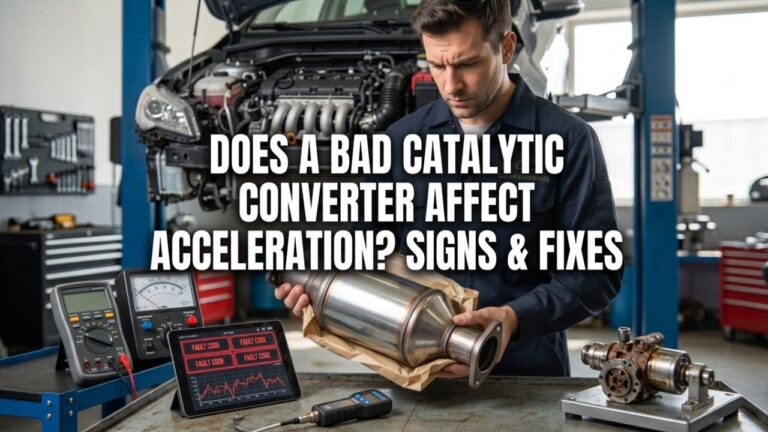
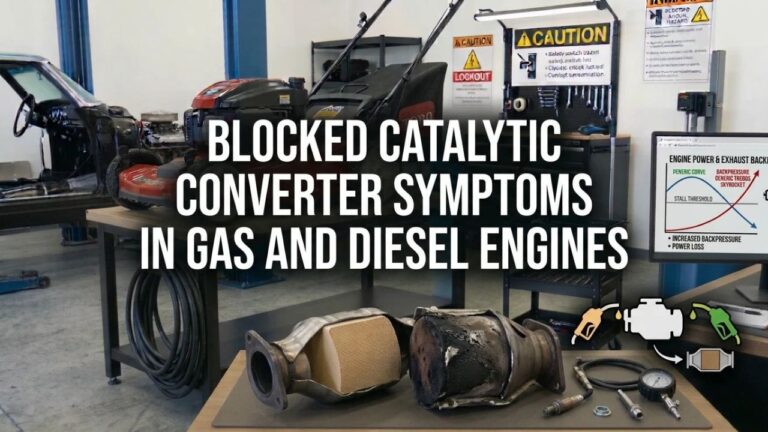
How to Know if You Need a New Catalytic Converter: Key Signs
You may need a new catalytic converter if testing shows the catalyst can no longer clean exhaust gases, the internal substrate is melted or broken, or the converter is restricting exhaust flow. A check-engine light alone is not enough. Confirm the failure and rule out misfires, exhaust leaks, sensor faults, and fuel-control problems before replacement.
Catalytic converters are expensive, and several faults can imitate a bad one. A P0420 or P0430 code may point toward low catalyst performance, but an exhaust leak, misfire, oxygen-sensor issue, or fuel problem can affect the same monitor.
The best time to diagnose the problem is before severe restriction develops. A converter that is starting to lose catalyst activity may cause an emissions code with little change in driving. A melted or collapsed converter can cause weak acceleration, high exhaust backpressure, hard starting, or stalling.
For U.S. owners, there is also a cost reason to verify the diagnosis before buying a part. The EPA states that catalytic converters are among the specified major emissions components covered for 8 years or 80,000 miles on qualifying light-duty vehicles under the federal emissions warranty.
If you are trying to work out how to know if you need a new catalytic converter, look for a combination of symptoms and test results rather than one warning sign. Physical damage, failed catalyst monitoring, excessive backpressure, and an emissions-test failure are stronger evidence than odor or poor fuel economy by themselves.
The sections below cover the main replacement signs, what P0420 and P0430 really mean, how a shop checks a converter, what can damage a new one, and the situations where replacement is not yet justified.
How to Know if You Need a New Catalytic Converter
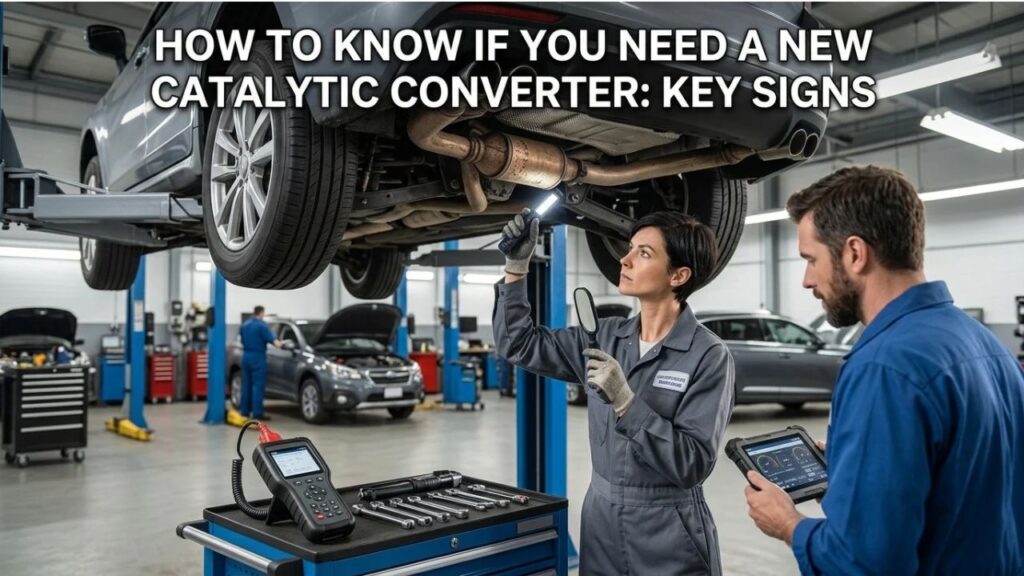
A converter needs replacement when it can no longer perform its emissions job or when internal damage blocks exhaust flow.
1. P0420 or P0430 Keeps Returning After Other Faults Are Fixed
P0420 and P0430 are common catalyst-efficiency codes. They indicate that the vehicle’s computer sees catalyst performance below the expected threshold for one bank of the engine.
These codes do not prove the converter is physically clogged. AutoZone lists misfires, oil contamination, high fuel pressure, leaking injectors, coolant-sensor faults, exhaust leaks, and oxygen-sensor concerns among items that should be checked before replacing the catalyst.
A converter becomes a stronger replacement candidate when the code returns after related faults and exhaust leaks have been corrected and scan data still supports low catalyst activity.
2. The Car Fails an Emissions Test Because of Catalyst Performance
A failed emissions inspection can be a direct sign that the converter is no longer treating exhaust as required, especially when catalyst codes and scan data point to the same failure.
MagnaFlow lists emissions-test failure as a common sign of a bad converter.
Do not replace the converter solely because the car failed an inspection. Read the report and identify the exact reason for failure first.
3. The Engine Loses Power as RPM Rises
A converter with a melted, collapsed, or heavily blocked substrate can restrict exhaust flow.
The car may idle fairly well but feel weak when you accelerate, climb a hill, or try to reach higher RPM. RepairPal notes that a plugged converter can severely reduce engine power and may eventually block exhaust flow enough that the engine will not run.
This symptom calls for an exhaust backpressure test rather than an immediate parts order.
4. Exhaust Backpressure Is Too High Ahead of the Converter
Backpressure testing is one of the clearest ways to confirm a physical restriction.
Walker gives general reference values of less than about 1.5 psi at idle and 3 psi at 2,000 RPM, while stressing that exact limits vary by vehicle. High pressure ahead of the converter points toward a restricted converter; high pressure farther downstream can point toward a muffler or resonator blockage instead.
Use vehicle-specific specifications when available.
5. The Converter Rattles From Broken Internal Material
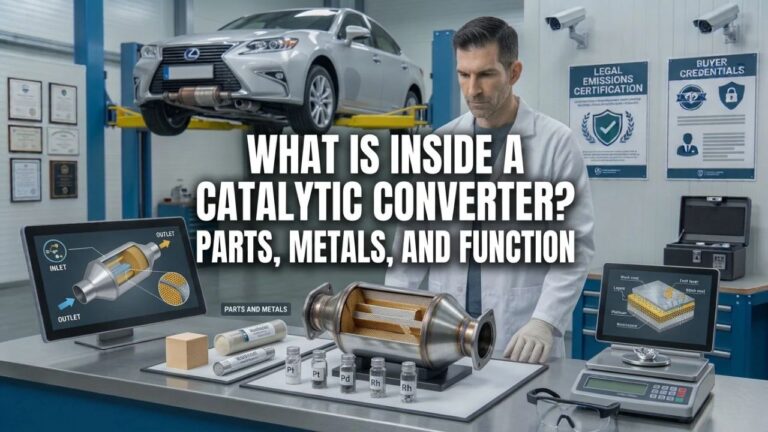
The catalyst substrate is a fragile honeycomb-like structure inside a metal shell.
Overheating, impact, or age-related damage can break it apart. A rattle from inside the converter can mean pieces of substrate are loose. Those pieces may also move into a position that partly blocks exhaust flow.
RepairPal lists rattling as a sign of internal catalyst breakage and warns that loose pieces can move farther into the exhaust.
A confirmed broken substrate cannot be repaired inside the housing. Replacement is the normal fix.
6. The Converter Has Melted or Collapsed Internally
This is a definite replacement condition.
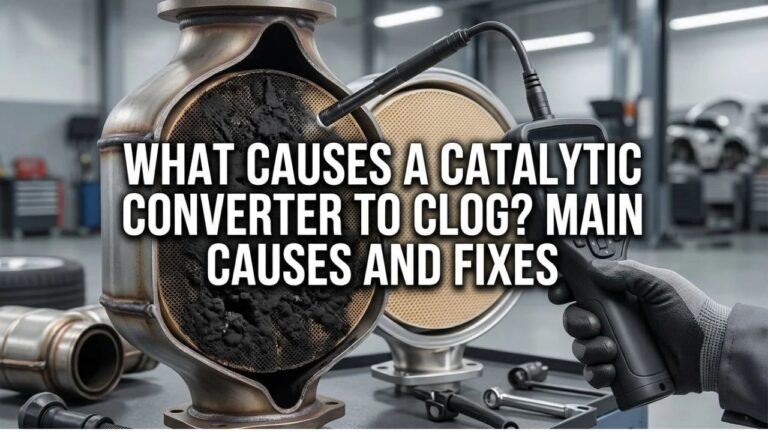
Walker states that excessive heat can damage the catalyst coating, matting, and substrate, with melted material often occurring at temperatures above roughly 1,700°F. The substrate may look normal at the ends while being melted deeper inside.
Once the passages have fused or collapsed, cleaning products cannot restore the original structure.
7. The Converter Is Physically Damaged
Road debris, curb impacts, corrosion, or improper lifting can damage the shell, flanges, or internal substrate.
Cars.com lists physical damage, contamination, and clogging among reasons a converter may require replacement.
A dented shell does not always mean the catalyst has failed, but cracked housings, broken internals, severe leaks, or crushed passages need close inspection.
Key Takeaway: Replacement is justified when testing confirms poor catalyst operation, excessive restriction, melted or broken substrate, or physical damage that prevents the converter from doing its job.
Does a Check Engine Light Mean You Need a New Converter?
No. A check-engine light is a reason to diagnose the emissions system, not proof that the converter should be replaced.
P0420 and P0430 Are Monitor Codes, Not a Visual Diagnosis
The engine computer monitors catalyst behavior through exhaust-sensor data.
If catalyst performance falls below the programmed threshold, it may set P0420 for Bank 1 or P0430 for Bank 2.
AutoZone recommends checking for exhaust leaks and downstream oxygen-sensor operation before condemning the converter.
That matters because a leak can introduce outside oxygen and distort the readings used by the catalyst monitor.
Misfires Can Trigger Converter Problems and Damage the Part
A misfire sends poorly burned or unburned fuel into the exhaust.
That fuel can react inside the converter and create extreme heat. Walker lists misfires, poor spark, fuel-delivery faults, oxygen-sensor problems, and excessive backpressure among conditions tied to converter overheating or failure.
If the check-engine light is flashing, treat the active misfire as the immediate problem.
Sensor Faults Need to Be Checked Before Replacement
A bad oxygen sensor can produce inaccurate information or contribute to poor fuel control.
The sensor itself should be tested rather than replaced simply because a catalyst code is present. The same rule applies to the converter: diagnose first, replace second.
Key Takeaway: A catalyst code raises suspicion, but exhaust leaks, misfires, sensor faults, and fuel-control problems should be checked before a new converter is installed.
Symptoms That Make Converter Replacement More Likely
Some symptoms are weak evidence on their own but become more meaningful when they appear together.
Sluggish Acceleration
A restricted converter can make the engine feel strangled as exhaust volume rises.
The car may need more throttle than usual, accelerate slowly, or lose speed on hills.
MagnaFlow lists sluggish acceleration among common bad-converter symptoms, while RepairPal ties major power loss to a plugged exhaust path.
Hard Starting or Starting Then Dying
Severe exhaust restriction can interfere with engine operation from the moment it starts.
MagnaFlow lists hard-start and no-start conditions among signs that may appear with major restriction.
Fuel-pressure faults, crankshaft-sensor failure, ignition trouble, and battery or charging issues can produce similar symptoms, so backpressure testing still matters.
Rotten-Egg or Sulfur Smell
A sulfur odor may appear when catalyst operation or fuel mixture is abnormal.
Cars.com and RepairPal both list a rotten-egg smell among possible converter-related symptoms.
Odor does not prove the converter needs replacement. Rich running and other fuel problems can create the same complaint.
Excessive Heat or Discoloration
An overheated converter may develop blue, bronze, or rainbow discoloration.
A glowing-red housing is a severe warning sign. Walker links shell discoloration and substrate damage with excessive converter temperatures.
Stop normal driving if the converter is glowing or the engine is misfiring badly.
Repeated Emissions Failure
A converter that repeatedly fails catalyst monitoring after related engine and exhaust faults are corrected may have lost enough catalyst activity to require replacement.
Cars.com notes that converters are not routine maintenance items and should be replaced when they are clogged or damaged and no longer function properly.
Key Takeaway: Power loss, hard starting, abnormal heat, odor, and repeated emissions failure are stronger evidence when diagnostic testing also points to the converter.
How a Mechanic Confirms You Need a New Catalytic Converter
A proper diagnosis usually combines several checks rather than relying on one test.
Scan All Stored and Pending Codes
The technician should look beyond catalyst codes.
Misfire, fuel-trim, injector, oxygen-sensor, airflow, coolant-temperature, and ignition codes may reveal a fault that is damaging the converter or confusing the catalyst monitor.
Walker recommends repairing other diagnostic trouble codes before replacing a converter.
Inspect the Exhaust for Leaks
Leaks ahead of or near oxygen sensors can alter exhaust readings.
A cracked manifold, failed gasket, rusted pipe, or leaking flange should be corrected before the converter is condemned.
Walker includes exhaust-leak inspection as a pre-replacement step.
Review Upstream and Downstream Sensor Data
On many OBD-II gasoline vehicles, the upstream sensor changes rapidly as fuel control adjusts.
A healthy catalyst normally dampens much of that activity before exhaust reaches the downstream sensor. If downstream behavior begins to resemble upstream behavior too closely, the catalyst monitor may judge conversion activity too low.
Sensor health, exhaust leaks, engine operating temperature, and fuel control must also be checked.
Measure Backpressure if the Car Has Power Loss
A catalyst-efficiency failure and a clogged converter are not the same condition.
Backpressure testing is most useful when the complaint includes weak acceleration, limited RPM, hard starting, or stalling. RepairPal specifically identifies a backpressure test as a diagnostic step when power loss suggests a clog.
Inspect for Rattle, Melting, or Contamination
Physical inspection can reveal a broken substrate, heat-damaged shell, crushed housing, or signs of oil and coolant contamination.
Walker divides common converter failures into overheated or broken units, coated or oil-fouled substrates, and structural damage.
Key Takeaway: A sound diagnosis combines codes, leak checks, sensor data, backpressure testing, and physical inspection before replacement is approved.
When You Probably Do Not Need a New Catalytic Converter Yet
Several situations look like converter failure but may have another repair path.
You Have Only One Catalyst Code and No Testing Has Been Done
A single P0420 or P0430 does not justify replacing an expensive part immediately.
Start with codes, leaks, misfires, fuel control, and sensor operation.
The Engine Has an Active Misfire
Fix the misfire first.
A new converter installed behind an unresolved misfire may overheat and fail again. RepairPal and Walker both identify engine faults as common causes behind converter damage.
An Exhaust Leak Is Affecting Sensor Readings
Repair the leak and rerun the diagnostic process.
Replacing the converter while leaving the leak in place can leave the same warning light on.
The Car Has Normal Backpressure and the Catalyst Monitor Has Not Been Verified
Normal exhaust flow does not prove catalyst chemistry is healthy, but it does tell you that a severe physical blockage is less likely.
The catalyst monitor and emissions performance still need separate evaluation.
Someone Suggested Replacement Based Only on Mileage
Catalytic converters do not have a routine replacement interval like spark plugs or engine oil.
Cars.com states that they often last 10 years or longer and should be replaced only when needed.
Key Takeaway: Do not replace the converter solely because of mileage, one trouble code, or vague symptoms when basic engine and exhaust testing has not been completed.
Why You Must Fix the Cause Before Installing a New Converter
A converter often fails because another problem damages it.
Installing a new unit without fixing that problem can lead to another expensive failure.
Rich Running Can Overheat the Catalyst
Too much fuel entering the exhaust raises converter temperature.
Leaking injectors, excessive fuel pressure, ignition faults, and incorrect sensor inputs can all contribute.
Oil Burning Can Coat the Substrate
Worn rings, valve seals, turbocharger problems, or other engine faults can send oil residue through the exhaust.
That contamination can reduce catalyst activity and eventually restrict passages.
Coolant Leaks Can Contaminate the Catalyst
Internal coolant leakage can poison or coat catalyst material.
A vehicle that is losing coolant, producing abnormal white exhaust, or showing signs of an internal engine leak needs that fault addressed before converter replacement.
Misfires Can Destroy a New Converter Quickly
Unburned fuel from a misfiring cylinder can ignite inside the converter.
Walker states that converter failure is commonly a symptom of a larger problem and advises repairing the root cause before fitting a new unit.
Key Takeaway: Repair misfires, rich running, oil consumption, coolant leaks, and other engine faults before a new converter is installed.
Check Warranty Coverage Before Paying for Replacement
Catalytic-converter replacement can be expensive, so check coverage before authorizing customer-pay work.
The EPA says specified major emissions components, including catalytic converters, are covered under the federal emissions warranty for 8 years or 80,000 miles, whichever comes first, on qualifying light-duty vehicles. The coverage applies to used vehicles too, subject to the warranty conditions.
The manufacturer’s warranty booklet may provide more coverage for certain vehicles or states.
If the car is close to the time or mileage limit, contact an authorized dealer with the VIN before paying an independent shop to replace the converter.
Conclusion
For how to know if you need a new catalytic converter, look for confirmed evidence rather than relying on one symptom. A recurring catalyst-efficiency code after other faults are repaired, failed emissions testing, excessive exhaust backpressure, a melted substrate, broken internal material, or serious physical damage can justify replacement.
A P0420 or P0430 code by itself does not prove the converter is bad. Exhaust leaks, oxygen-sensor faults, misfires, rich fuel operation, and other engine problems need to be checked first.
If the car has severe power loss, hard starting, stalling, rattling, or extreme converter heat, get the exhaust tested soon. Backpressure testing is especially useful when the symptoms point to a physical blockage.
Before buying the part, check the federal 8-year/80,000-mile emissions warranty and repair the fault that damaged the old converter. That reduces the chance of paying for a replacement that was not needed or damaging the new converter soon after installation.
FAQs About Needing a New Catalytic Converter
How Do I Know for Sure My Catalytic Converter Is Bad?
A firm diagnosis usually combines scan codes, oxygen-sensor data, exhaust-leak checks, backpressure testing, and physical inspection. Melted or broken substrate and confirmed low catalyst activity after other faults are corrected are strong reasons for replacement.
Does P0420 Always Mean I Need a New Catalytic Converter?
No. P0420 means catalyst-system efficiency on Bank 1 is below the expected threshold. Misfires, exhaust leaks, oxygen-sensor issues, fuel-control faults, and contamination can contribute. Diagnose those items before replacing the converter.
Can a Bad Oxygen Sensor Make Me Think the Converter Is Bad?
Yes. Sensor faults or exhaust leaks can affect the data used to monitor catalyst operation. The sensor should be tested rather than changed automatically, and the converter should not be condemned from a code alone.
Can a Clogged Catalytic Converter Be Cleaned Instead of Replaced?
Minor deposits are different from structural damage. A melted, collapsed, or broken substrate cannot be restored by a fuel additive or cleaning product. A confirmed mechanical blockage normally requires replacement after the cause is repaired.
Do Catalytic Converters Need Routine Replacement?
No. They are not routine maintenance parts with a fixed replacement interval. They should be replaced when diagnosis confirms that the catalyst no longer performs correctly or the unit is physically damaged or restricted.
Can I Keep Driving if the Catalytic Converter Is Going Bad?
A vehicle with only an efficiency code may still drive normally, but severe power loss, repeated stalling, a flashing check-engine light, or a glowing converter calls for stopping normal driving and getting the vehicle checked. Those symptoms can indicate an active engine fault or major restriction.
How Long Does a Catalytic Converter Usually Last?
There is no fixed lifespan. Cars.com notes that converters often last 10 years or longer, and they are normally replaced only after a confirmed failure. Engine condition, oil or coolant contamination, misfires, impact damage, and operating conditions affect service life.
Is Catalytic Converter Replacement Covered by Warranty?
It may be. The EPA identifies catalytic converters as specified major emissions components covered for 8 years or 80,000 miles on qualifying light-duty vehicles under the federal emissions warranty. Check the vehicle’s warranty booklet and VIN-specific coverage before paying for replacement.