Are High Flow Catalytic Converters Legal? U.S. Rules Explained
High-flow catalytic converters can be street legal in the United States, but the words “high flow” do not make a converter legal. The part must satisfy the emissions requirements that apply to the vehicle and cannot illegally remove, bypass, or render the original emissions-control system ineffective. State rules can be stricter than federal requirements.
That distinction matters because high-flow converters are sold for several very different uses. Some are approved street-replacement catalysts, while others are marketed strictly for racing or off-road vehicles. Two converters can look nearly identical yet have very different legal status.
Federal law also prohibits simply removing a required catalytic converter and replacing it with a straight pipe. The EPA treats removal or disabling of required emissions equipment as tampering under the Clean Air Act.
California adds another layer. An aftermarket converter used on a California-regulated vehicle must be approved by the California Air Resources Board for the specific application and carry an applicable Executive Order identification. Several other states also enforce stricter emissions requirements, so registration location matters.
For are high flow catalytic converters legal, the practical answer is yes only when the converter is approved for the vehicle and its emissions configuration. A generic “49-state,” “race,” or “high-performance” label should never be treated as proof that the part is legal where the vehicle is registered.
EPA enforcement also shows that emissions modifications are taken seriously. From fiscal years 2020 through 2023, the agency reported 172 civil enforcement cases involving aftermarket defeat devices and tampering, with civil penalties totaling $55.5 million. Those cases cover a much broader category than high-flow converters, but they show why emissions compliance deserves attention when modifying an exhaust system.
Below, you will find the federal rules, California requirements, how to verify a high-flow converter before buying it, inspection concerns, check-engine-light issues, and the difference between a legal performance converter and an illegal catalyst delete.
Are High Flow Catalytic Converters Legal Under Federal Law?
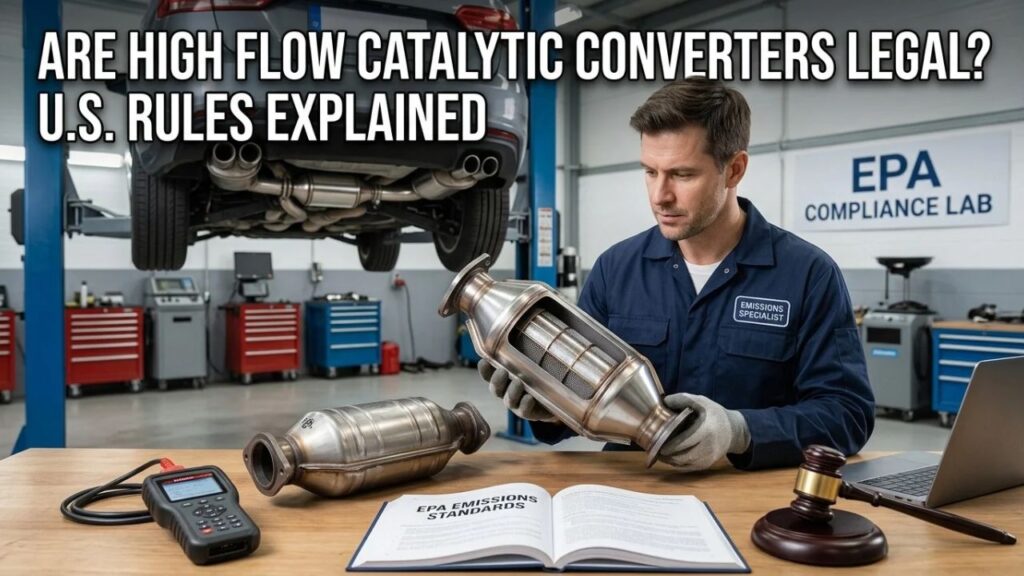
A high-flow converter can be legal for street use if its installation does not violate federal emissions requirements.
The key issue is emissions compliance, not how freely the converter flows.
Federal Law Prohibits Emissions Tampering
Section 203 of the federal Clean Air Act prohibits removing or rendering required emissions-control equipment inoperative.
That includes catalytic converters.
Illegal modifications can include:
- Removing the converter
- Gutting the converter internally
- Replacing it with straight pipe
- Installing a part that defeats catalyst operation
- Using software specifically to hide the effects of removed emissions hardware
A converter housing that has been emptied of its catalyst material does not become legal merely because the housing is still visible beneath the car.
A High-Flow Converter Is Not Automatically a Defeat Device
A properly designed performance converter can increase exhaust flow while continuing to treat emissions.
That is the basic idea behind a street-oriented high-flow catalyst.
Such a converter normally uses:
- A lower-density catalyst substrate
- Larger or differently shaped passages
- Performance-oriented internal construction
- Catalyst material appropriate for the application
If it still meets the applicable emissions requirements and is legal for that vehicle, increased flow by itself is not prohibited.
“High Flow” Is a Marketing Description
There is no broad federal rule stating that every product labeled “high-flow catalytic converter” is legal.
The term describes performance characteristics rather than regulatory certification.
One high-flow converter may be a compliant replacement for a specific vehicle, while another may carry warnings such as:
- Off-road use only
- Competition use only
- Not legal for sale or use on pollution-controlled vehicles
- Not legal for use on public highways
Read those statements before buying.
Key Takeaway: Federal law does not ban a converter simply because it flows more exhaust. The legal issue is if the part preserves required emissions control and satisfies the rules that apply to the vehicle.
California Rules for High-Flow Catalytic Converters
California applies tighter aftermarket-converter requirements than the basic federal system.
A high-flow converter intended for a California street vehicle needs more than physical compatibility.
The Converter Needs CARB Approval
The California Air Resources Board requires legal aftermarket catalytic converters to receive an exemption from the state’s anti-tampering rules.
Approved converters receive an Executive Order, commonly called a CARB EO.
The approval applies to specific vehicles and engine families.
CARB uses details such as:
- Model year
- Manufacturer
- Vehicle model
- Engine size
- Test group or engine family
- Converter location
A CARB-approved converter for one vehicle is not automatically approved for another vehicle.
Look for the Executive Order Number
A legal California aftermarket converter should have the required identification markings.
Before purchasing one, compare its EO information with the exact vehicle application.
California’s Bureau of Automotive Repair states that replacement converters must be either:
- Original equipment manufacturer units, or
- CARB-approved aftermarket converters assigned to the exact vehicle application
A performance converter without the proper approval can cause a Smog Check failure even if the engine runs cleanly.
California Smog Inspection Includes Visual Checks
Passing an OBD test does not automatically make an unapproved converter legal.
Smog technicians can inspect the emissions hardware and identifying information.
A converter may create a problem during inspection if:
- Required markings are missing
- The EO does not match the vehicle
- The converter is installed in the wrong location
- Required catalysts have been removed
- The converter has been modified
- The vehicle’s emissions configuration has been altered
This is one reason a check-engine-light-free car can still fail an emissions inspection.
Key Takeaway: For a California street vehicle, use an OEM converter or a CARB-approved aftermarket converter listed for the exact vehicle and catalyst position.
What Does “49-State Legal” Mean on a High-Flow Converter?
Performance exhaust manufacturers sometimes describe a converter as “49-state legal” or “federal emissions compliant.”
That wording needs careful interpretation.
It Usually Excludes California
Historically, “49-state” has commonly meant the part meets applicable federal requirements but does not carry California approval.
Do not assume the phrase remains legally sufficient in every state outside California.
States can adopt additional emissions requirements, and regulations can change.
Registration Location Matters
A vehicle physically located in one state may be registered in another.
Use the rules governing the vehicle and the jurisdiction where it must pass inspection rather than relying only on where the part is purchased.
Some states use California-style requirements for aftermarket catalysts or apply their own emissions inspection rules.
If the vehicle moves between states, verify the requirements in the new registration state before modifying the exhaust.
Online Listings Can Be Misleading
A marketplace listing may say:
- EPA approved
- Federal compliant
- Street legal
- High-flow street converter
- 49-state compliant
Those statements are not substitutes for part-specific documentation.
Confirm the manufacturer’s application data and certification information.
Key Takeaway: A “49-state” label does not guarantee legality everywhere outside California. Verify the exact converter against current rules for the vehicle and registration state.
How to Tell if a High-Flow Catalytic Converter Is Legal
You can reduce the chance of buying the wrong converter by checking a few details before ordering.
1. Identify Your Vehicle’s Emissions Certification
Look at the Vehicle Emission Control Information label under the hood.
It can identify if the vehicle was certified to:
- Federal emissions standards
- California emissions standards
- Both sets of requirements
The label may also provide the engine family or test group needed for converter lookup.
2. Use the Full Vehicle Information
Record:
- Model year
- Make
- Model
- Engine size
- Engine code when applicable
- VIN
- Emissions certification
A converter that fits a 3-inch exhaust pipe is not necessarily appropriate for every vehicle with a 3-inch exhaust.
3. Check the Manufacturer’s Application List
A legitimate street converter should have clear application information.
The listing should identify the vehicles or emissions configurations the converter was designed to serve.
Avoid choosing solely by:
- Pipe diameter
- Converter length
- Horsepower claim
- Cell count
- Price
Physical fit and legal fit are different.
4. Check CARB EO Information When Required
For California applications, verify the converter’s Executive Order and vehicle listing.
A statement that a brand “offers CARB products” does not mean every converter from that brand is CARB approved.
Approval is tied to specific parts and applications.
5. Read the Fine Print
Look for language stating:
- Street use
- Federal emissions compliance
- CARB approval
- Competition use only
- Off-road use only
“Race use only” is a strong sign that the product is not intended as a legal street replacement.
6. Confirm the Converter Position
A vehicle may have several converters.
Replacing the rear catalyst with an approved high-flow unit does not give permission to remove a front catalyst.
Check if the part is intended for:
- Bank 1
- Bank 2
- Front position
- Rear position
- Manifold position
- Underfloor position
Key Takeaway: Vehicle certification, exact application, converter position, manufacturer documentation, and CARB EO status where required provide much better proof of legality than the words “high flow.”
Is a High-Flow Cat Legal if It Passes an Emissions Test?
Not necessarily.
Passing a tailpipe or OBD inspection does not automatically make an unapproved modification legal.
Emissions Performance Is Only One Part of Compliance
A vehicle might produce exhaust readings below inspection limits while still having emissions equipment installed in a configuration that violates applicable anti-tampering rules.
Legal compliance can include:
- Correct converter
- Correct quantity of converters
- Correct location
- Required certification
- No tampering
- Functional OBD system
A clean tailpipe reading cannot erase an illegal catalyst delete.
Visual Inspection Can Still Cause Failure
Inspection programs may check the exhaust system visually.
If a required converter is absent or an aftermarket unit lacks the required approval information, the vehicle may fail even when there are no trouble codes.
Readiness Monitors Matter
OBD-II vehicles run catalyst and other emissions monitors.
After clearing trouble codes or disconnecting the battery, these monitors may show “not ready.”
Inspection programs may reject a vehicle until the required monitors run.
A high-flow converter that cannot keep catalyst efficiency within the expected range can also cause the catalyst monitor to fail and eventually trigger P0420 or P0430.
Key Takeaway: Passing an emissions reading does not automatically legalize an unapproved exhaust modification. Hardware, certification, visual inspection, and OBD status may also matter.
Can a High-Flow Catalytic Converter Cause a Check-Engine Light?
Yes, some can.
A performance converter may have less catalyst volume or a lower cell density than the factory unit.
If the downstream oxygen sensor detects too much similarity between the upstream and downstream exhaust signals, the engine computer may store:
- P0420 for Bank 1
- P0430 for Bank 2
A Legal High-Flow Converter Should Match Its Application
A quality street-approved converter should be designed to provide enough catalyst activity for the vehicle application.
Problems become more likely if the converter is:
- Too small
- Poorly matched
- Cheaply constructed
- Installed too far downstream
- Designed for another engine
- Missing enough catalyst material to satisfy OBD monitoring
Do Not Disable the Rear Oxygen Sensor to Hide the Code
Oxygen-sensor spacers, electronic simulators, or tuning intended solely to prevent the vehicle from detecting reduced catalyst performance can create emissions compliance issues.
Fix the cause of the code rather than hiding the monitor.
P0420 Does Not Always Mean the New Converter Is Bad
Other causes include:
- Exhaust leaks
- Misfires
- Rich fuel mixture
- Faulty oxygen sensors
- Oil consumption
- Coolant contamination
- Incorrect fuel control
Diagnose the engine before blaming the high-flow converter.
Key Takeaway: A poorly matched high-flow converter can trigger P0420 or P0430. Do not defeat the OBD monitor to hide the problem; use a converter approved and sized for the vehicle.
Is Removing the Catalytic Converter Legal if You Want More Flow?
Not for a normal street vehicle that was originally required to have the converter.
Federal law prohibits removing or rendering required emissions-control devices inoperative.
A Straight Pipe Is Not a High-Flow Converter
A straight pipe contains no catalyst.
It may reduce exhaust restriction, but it also eliminates the emissions function of the converter.
Installing one in place of a required catalyst is emissions tampering.
Gutting the Converter Is Also a Delete
Some people remove the substrate from the original housing so the vehicle still appears to have a catalytic converter.
That does not preserve catalyst function.
A hollow converter is effectively a catalyst delete.
“Off-Road Use Only” Does Not Turn a Street Car Into a Race Car
Products sold for legitimate competition vehicles can have different use restrictions.
Putting an off-road-only component on a road-driven emissions-controlled vehicle does not make the modification legal merely because the package contains a racing disclaimer.
A street vehicle should retain compliant emissions equipment.
Key Takeaway: Removing the catalyst, installing straight pipe, or hollowing out the converter is not the same as fitting a legal high-flow catalytic converter.
Are High-Flow Catalytic Converters Worth It for Performance?
They can make sense on some modified vehicles, but the performance improvement depends on how restrictive the original exhaust system is.
A Healthy Factory Converter May Flow Quite Well
Modern OEM converters are designed to handle the exhaust volume of the original engine.
On an otherwise stock engine, replacing a healthy factory catalyst with a high-flow version may produce a small difference compared with changes such as tires, gearing, or forced-induction upgrades.
The gains can become more relevant on engines with:
- Turbo upgrades
- Superchargers
- Increased displacement
- High-flow cylinder heads
- Major camshaft changes
- High exhaust output
The converter still needs to satisfy applicable emissions rules for street use.
High Flow Does Not Mean No Restriction
Every catalyst creates some resistance because exhaust has to pass through a substrate.
A high-flow design reduces restriction while retaining catalyst material.
That compromise separates a street performance converter from a straight pipe.
Sound Can Change Too
A higher-flow converter may make the exhaust:
- Louder
- Sharper
- More aggressive
- More noticeable during acceleration
Changing the converter can also alter exhaust odor, especially if catalyst efficiency is lower.
Local noise laws still apply independently of emissions rules.
Key Takeaway: A high-flow catalyst can reduce exhaust restriction on a modified engine, but a street vehicle still needs a legally compliant converter. Removing the catalyst entirely is not required for a performance exhaust.
When Is It Legal to Replace the Original Converter?
A failing or missing converter can legitimately need replacement.
Typical reasons include:
- Internal blockage
- Melted substrate
- Physical damage
- Broken catalyst
- Unrepairable converter-related exhaust damage
- Failed catalyst efficiency after proper diagnosis
- Theft
Replacement should use a converter that meets the applicable legal requirements.
Do Not Replace a Good Converter Just to Bypass Emissions Controls
Federal aftermarket-converter guidance is intended around legitimate replacement needs rather than removing properly functioning emissions hardware simply to reduce restriction.
If performance modification is the goal, select an approved solution that preserves required emissions control.
Check the Federal Emissions Warranty
On qualifying U.S. light-duty vehicles, the original catalytic converter is generally one of the major emissions components covered under the federal emissions defect warranty for:
8 years or 80,000 miles, whichever comes first.
Check warranty coverage before replacing a relatively new original converter.
Key Takeaway: A failed, stolen, damaged, or legitimately defective converter can be replaced, but the replacement needs to meet the emissions requirements applicable to the vehicle.
Conclusion
For are high flow catalytic converters legal, the answer is yes in some applications, but legality depends on the exact converter, vehicle, emissions certification, and state requirements.
A street-oriented high-flow converter can reduce exhaust restriction while retaining catalyst function. That is very different from a straight pipe, gutted converter, race-only catalyst, or an undersized generic unit that does not meet the vehicle’s emissions requirements.
California drivers need to pay special attention to CARB approval and the Executive Order assigned to the exact vehicle application. Drivers elsewhere should still verify federal compliance and current state rules rather than relying on a “49-state” marketing label.
Before ordering a high-flow converter, check the emissions label, VIN, engine, converter position, manufacturer application information, and required certification. That small amount of verification can prevent a check-engine light, failed inspection, wasted money, or an illegal exhaust setup.
FAQs About High-Flow Catalytic Converter Legality
Are High-Flow Cats Street Legal?
Some are.
A high-flow converter can be street legal when it meets the applicable emissions rules and is approved for the vehicle. Products labeled race-only or off-road-only should not be treated as street-legal replacements.
Are High-Flow Catalytic Converters Legal in California?
Only approved applications are legal.
California requires an OEM replacement or a CARB-approved aftermarket converter with an Executive Order covering the exact vehicle and catalyst application.
Will a High-Flow Catalytic Converter Pass Smog?
A properly approved converter on a correctly running vehicle may pass, but passing depends on the inspection program, OBD status, emissions performance, installation, and converter certification.
An unapproved converter can fail a visual inspection even if the engine has no check-engine light.
Is a 200-Cell Catalytic Converter Legal?
Cell count alone does not determine legality.
A 200-cell converter may be legal for a particular application if it has the required approval and emissions performance. Another 200-cell converter may be sold only for competition use.
Check the part’s certification rather than relying on cell count.
Are 100-Cell High-Flow Cats Street Legal?
A 100-cell converter should not be assumed street legal.
Low-cell-count products are frequently aimed at motorsport applications. Legal status depends on certification, vehicle application, emissions performance, and local rules.
Does a High-Flow Cat Need a CARB Number?
For a California aftermarket converter application, CARB approval and the applicable Executive Order are required.
Federal-only applications follow different requirements, but current state rules should still be checked before purchasing the part.
Can a High-Flow Cat Cause P0420?
Yes.
If catalyst activity is too low for the vehicle’s OBD monitoring strategy, the downstream oxygen-sensor signal may cause P0420 or P0430.
A correctly approved converter designed for the exact vehicle reduces this risk.
Is It Legal to Remove a Catalytic Converter and Use a Straight Pipe?
No for a normal U.S. street vehicle that is required to have a catalytic converter.
Federal anti-tampering law prohibits removing or rendering required emissions equipment inoperative. A straight pipe does not perform the function of a catalytic converter.