What Happens If You Don’t Replace Catalytic Converter? Risks
A failed catalytic converter does not always stop a car immediately, but ignoring it can lead to worsening problems. A converter that has only lost emissions performance may mainly trigger a warning light, while a clogged, melted, or broken converter can cause power loss, excessive heat, hard starting, stalling, and eventually leave the car unable to run normally.
The condition inside the converter matters more than the age of the part. A chemically worn converter may still allow exhaust to flow freely. A converter with collapsed or melted internal passages can restrict the engine every time exhaust gases try to leave the cylinders.
That restriction can make a car feel weak during acceleration or at higher RPM. As blockage increases, the engine may struggle to breathe, run hotter, stall under load, or become difficult to restart.
For U.S. vehicle owners, catalytic converters are among the major emissions components that can receive federal warranty coverage for 8 years or 80,000 miles on qualifying light-duty vehicles, subject to warranty conditions. Checking warranty status before paying for replacement can therefore be worthwhile.
The practical answer to what happens if you don’t replace catalytic converter is that delaying a confirmed failure may range from living with a check-engine light to dealing with a serious exhaust restriction. There is no single timeline because converter failures do not all progress in the same way.
Another concern is what damaged the converter in the first place. Misfires, rich fuel mixtures, excessive oil consumption, coolant entering the exhaust, and physical damage can all ruin the catalyst. Replacing the converter without correcting those faults can damage the new one too.
What Happens If You Don’t Replace Catalytic Converter?
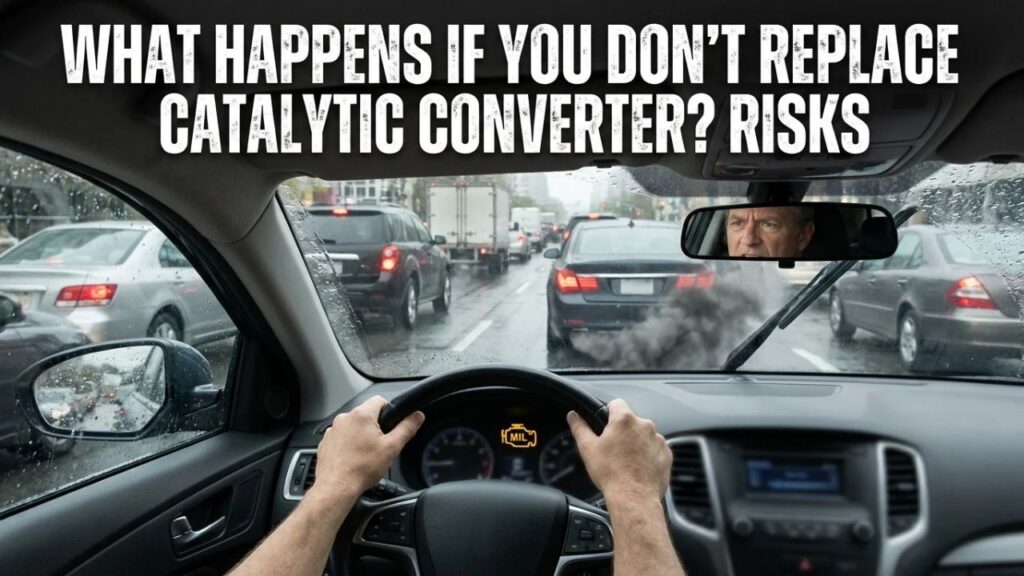
Several problems can develop when a failed converter remains in the exhaust system. The severity depends on whether the converter still flows exhaust normally or has started breaking apart or plugging up.
The Check-Engine Light May Stay On
Modern vehicles monitor catalytic-converter performance through the OBD system and oxygen sensors.
When catalyst performance falls below the computer’s expected threshold, common codes include:
- P0420 — Catalyst System Efficiency Below Threshold, Bank 1
- P0430 — Catalyst System Efficiency Below Threshold, Bank 2
A vehicle can have one of these codes and still feel completely normal.
That does not prove the converter is clogged.
P0420 or P0430 can also appear when other engine or exhaust problems interfere with catalyst operation. Walker notes that low catalyst-efficiency codes do not always mean the converter itself must be replaced.
Exhaust Restriction Can Get Worse
A converter contains many small passages inside its substrate.
Severe overheating can melt those passages together. Broken internal material can also shift and block exhaust flow.
Once that happens, the engine has to push exhaust against increasing pressure.
The car may begin to show:
- Weak acceleration
- Poor high-RPM performance
- Reduced hill-climbing power
- Slow throttle response
- Hard starting
- Stalling
- Excessive exhaust heat
Walker identifies melted substrate, broken material, and shifted internal components as causes of converter restriction and loss of power.
The Car May Eventually Become Hard to Drive
A mild restriction may be noticeable only during hard acceleration.
As blockage becomes more severe, the engine can struggle during ordinary driving.
It may idle normally yet fall flat when you press the accelerator because exhaust volume increases under load.
A nearly plugged converter can make the engine:
- Refuse to rev freely
- Stall after warming up
- Crank longer before starting
- Restart poorly after a stall
- Lose enough power to make highway driving difficult
At that point, the converter problem is no longer just an emissions concern.
Key Takeaway: Leaving a failed converter in place can range from a persistent warning light to severe exhaust restriction. Melted or broken internal material creates the greatest drivability risk.
How Long Can You Drive Without Replacing a Bad Converter?
There is no dependable number of days or miles.
A car with a weak but unrestricted catalyst can sometimes continue running normally for a long period. A physically damaged converter may deteriorate much faster.
If the Car Has Normal Power
A steady check-engine light combined with normal acceleration, normal engine temperature, and no unusual exhaust noises usually creates less immediate mechanical concern than a clogged converter.
You should still arrange diagnosis.
A catalyst code can come from:
- Exhaust leaks
- Misfires
- Fuel-control problems
- Oxygen-sensor faults
- Oil consumption
- Internal coolant leakage
- A worn converter
Diagnosis before replacement can prevent unnecessary parts spending.
If the Car Has Started Losing Power
Power loss moves the problem into a higher-risk category.
If acceleration becomes weaker as RPM rises, exhaust restriction should be considered.
A plugged converter can create enough backpressure to cause delayed acceleration, hard starting, loss of power, and stalling.
I would avoid planning long trips with a car that is already showing these symptoms.
If the Car Is Stalling or Overheating
Repeated stalling, extreme exhaust heat, smoke, or an engine that barely accelerates is a reason to stop routine driving.
A severe restriction can worsen quickly if internal converter material shifts.
The vehicle may run during one trip and become far less driveable during the next.
Key Takeaway: A low-efficiency converter may give you time to schedule diagnosis. A converter causing power loss, stalling, or abnormal heat should be repaired much sooner.
Can a Bad Catalytic Converter Damage Your Engine?
A failed converter does not automatically destroy an engine.
The main risk appears when exhaust becomes severely restricted or heat rises far above normal.
Backpressure Interferes With Engine Breathing
The engine must push burned gases out of each cylinder during the exhaust stroke.
A clogged converter makes this harder.
The more blocked the exhaust becomes, the more pressure remains upstream of the converter.
That can reduce engine output because cylinders cannot clear exhaust gases normally before the next combustion cycle.
Symptoms may include:
- Sluggish acceleration
- Reduced torque
- Rough running
- Poor high-RPM power
- Stalling
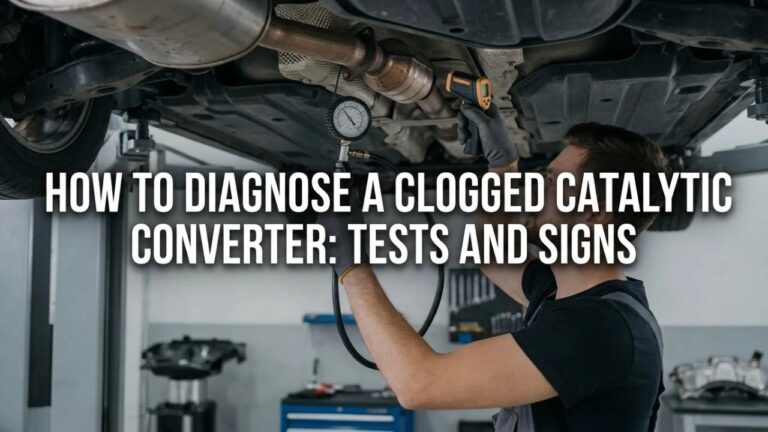
Backpressure testing is commonly used to verify this type of restriction. Walker’s diagnostic guidance notes that excessive pressure ahead of the converter can point toward a blocked converter.
Heat Can Build Up
A restricted or overloaded converter can become extremely hot.
Excess heat can affect the converter itself along with nearby exhaust parts, sensors, wiring, and shields.
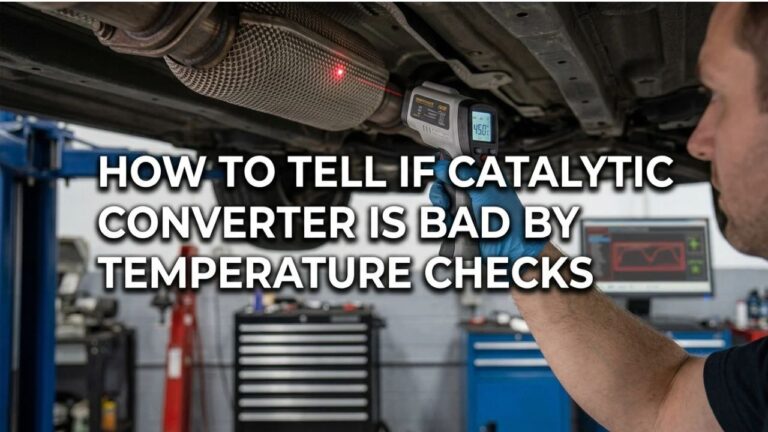
Walker states that converter temperatures above roughly 1,600°F can damage catalyst material. Severe overheating can melt the substrate and turn it into a solid restriction.
A glowing converter should never be treated as a normal symptom.
The Original Engine Fault May Be More Dangerous
Many converter failures begin with an engine problem.
For example, an ignition misfire can send unburned fuel and oxygen into the exhaust. That material can burn inside the converter and generate destructive heat.
The converter then becomes damaged, but the misfire remains.
This creates two problems instead of one.
Key Takeaway: A severely blocked converter can stress the engine through backpressure and heat, but the engine problem that damaged the converter may also need immediate repair.
Why a Failed Converter Can Cause Power Loss and Stalling
A converter does not create engine power, but it sits directly in the path exhaust gases must travel.
A blockage acts like a restriction in that path.
At idle, the engine produces relatively little exhaust. A partially blocked converter may still pass enough gas for the engine to run.
During acceleration, the engine produces far more exhaust.
The restriction then becomes much more noticeable.
This explains why a car with a clogged converter may:
- Start normally.
- Idle reasonably well.
- Drive acceptably at low speed.
- Lose power during acceleration.
- Struggle at higher RPM.
- Stall when restriction becomes severe.
Walker lists delayed acceleration, hard starting, power loss, and stalling among problems associated with a failing converter.
If the vehicle feels as though the engine cannot breathe when the accelerator is pressed, exhaust restriction should be tested rather than guessed.
What Happens to Fuel Economy?
Fuel economy can drop when a converter problem affects engine operation.
A restricted exhaust can make the engine work harder to produce the same vehicle speed.
Drivers may also press the accelerator farther to compensate for weak performance.
The original engine problem may consume extra fuel too.
Examples include:
- Rich fuel mixture
- Leaking injector
- Misfire
- Faulty airflow measurement
- Oxygen-sensor problems
Poor gas mileage therefore does not prove that the converter is the only problem.
If fuel consumption rises alongside P0420, P0430, weak acceleration, or stalling, the full engine and exhaust system should be checked.
Will the Car Fail an Emissions Test?
A bad catalytic converter can cause an emissions-test failure.
The converter’s purpose is to reduce pollutants in the exhaust. Once catalyst performance falls too far, tailpipe emissions may rise above the applicable limit.
OBD-based programs may also inspect:
- Check-engine-light status
- Stored emissions codes
- Catalyst monitor status
- Readiness monitors
Clearing the check-engine light shortly before inspection does not repair the problem.
It can also reset emissions monitors.
Once the vehicle completes its self-tests again, the catalyst code may return if the underlying problem remains.
What If You Ignore P0420 or P0430?
These codes should be diagnosed, but neither automatically means “buy a converter.”
A catalyst-efficiency code tells you that the computer is not seeing the expected converter performance.
It does not prove that the converter is physically clogged.
Other Faults Can Trigger Catalyst Codes
Possible causes include:
- Exhaust leak
- Engine misfire
- Incorrect fuel mixture
- Aging oxygen sensor
- Oil consumption
- Coolant contamination
- Actual converter deterioration
Walker recommends correcting other engine and emissions faults before installing a new converter because unresolved problems can cause the same code to return or damage the replacement.
Ignoring Other Codes Can Cost More
Suppose the vehicle has P0420 plus a cylinder misfire.
Replacing only the converter leaves the misfire untouched.
The replacement catalyst may then overheat for the same reason as the old one.
A complete code scan is therefore a better starting point than treating P0420 as a converter replacement command.
Key Takeaway: P0420 and P0430 need diagnosis, not automatic converter replacement. Other faults should be repaired before the catalyst is condemned.
Why Catalytic Converters Fail in the First Place
Converters are designed to work with an engine that is running correctly.
When abnormal combustion products repeatedly enter the exhaust, the converter can become overheated or contaminated.
Misfires Can Melt the Converter
A misfire leaves some of the air-fuel mixture unburned.
That mixture travels into the exhaust.
When it reaches the hot converter, combustion can continue inside the converter and produce extreme temperatures.
Walker identifies misfire as a major cause of melted converter substrate.
Possible misfire sources include:
- Worn spark plugs
- Bad ignition coils
- Injector problems
- Low compression
- Wiring faults
A flashing check-engine light commonly accompanies a serious active misfire and should not be ignored.
Excess Fuel Can Overheat the Catalyst
An engine running too rich sends more fuel into the exhaust than the converter is meant to handle.
Possible causes include:
- Leaking injector
- Fuel-pressure fault
- Ignition failure
- Sensor problem
- Air-fuel imbalance
Excess fuel can burn inside the converter and damage the internal honeycomb.
Oil Can Contaminate the Substrate
An engine that burns oil can send ash and deposits through the exhaust.
Over time, those deposits can coat catalyst surfaces.
Walker lists excessive oil consumption as a common source of converter contamination.
Coolant Can Poison the Converter
An internal coolant leak can contaminate the catalyst as well.
Potential sources include a head-gasket leak, cracked cylinder head, or another internal cooling-system fault.
Unexplained coolant loss deserves investigation before a replacement converter is fitted.
Key Takeaway: Misfires, rich running, oil consumption, and coolant leaks can destroy a converter. Repairing the cause protects the replacement from the same damage.
What Happens If the Catalytic Converter Is Rattling?
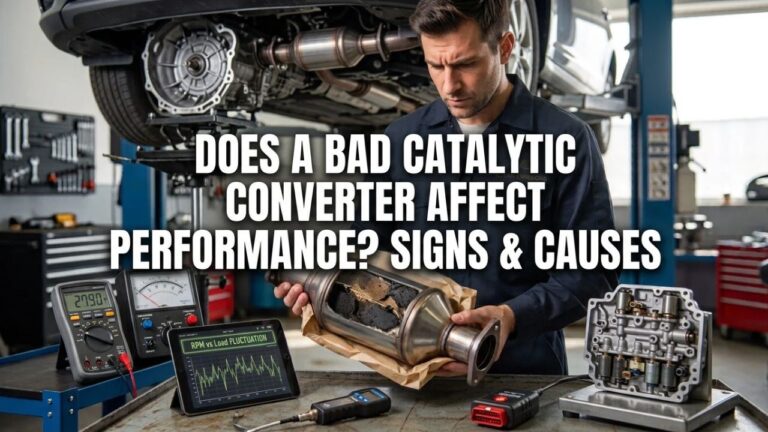
A rattle can mean the internal ceramic material has cracked or broken loose.
This may sound like pebbles moving inside a metal container.
A loose heat shield can make a similar noise, so the source should be confirmed.
If the substrate itself has broken, loose pieces can shift inside the converter.
That can change a noisy converter into a restricted converter.
Watch for a rattle paired with:
- Loss of acceleration
- Engine struggling at higher RPM
- Stalling
- Hard starting
- Excessive heat
A broken internal substrate cannot repair itself. Once physical damage is confirmed, replacement is normally required.
What Happens If the Converter Is Clogged but You Keep Driving?
Continued driving with a confirmed clog can make engine performance progressively worse.
The vehicle may first feel weak only under heavy throttle.
Later, the same restriction may appear during normal acceleration.
A severe clog can leave the engine unable to move enough exhaust even at modest speed.
The sequence can progress from:
Reduced acceleration → major power loss → rough running → stalling → hard starting or no-start
This progression is not guaranteed, and there is no fixed mileage at which each stage occurs.
If a car is already losing significant power, do not count on it completing another long trip.
Can Catalytic Converter Cleaner Prevent Replacement?
A cleaner cannot repair physical converter damage.
It cannot rebuild:
- Melted ceramic passages
- Broken substrate
- Collapsed honeycomb
- Severe structural damage
A chemical product also cannot correct an active misfire, leaking injector, oil-burning engine, or internal coolant leak.
If the converter is simply contaminated and still structurally sound, the real engine fault still needs diagnosis.
Once testing confirms that catalyst material has deteriorated or melted, replacement is usually the proper repair.
What to Check Before Replacing the Catalytic Converter
Replacing the converter should come after confirming the failure and checking the engine.
Scan All Trouble Codes
Do not read only P0420 or P0430.
Look for related faults involving:
- Misfires
- Fuel mixture
- Oxygen sensors
- Mass airflow
- Coolant temperature
- Fuel pressure
Other codes may explain why the converter stopped working.
Check for Exhaust Restriction
If the car has lost power, test for exhaust backpressure.
This helps separate a clogged converter from a restricted muffler or another exhaust problem.
A converter can fail its emissions test while still flowing normally, so catalyst efficiency and physical restriction should not be treated as the same diagnosis.
Check Oil and Coolant Consumption
An engine that consumes oil or coolant can damage another converter.
Find the source before fitting the replacement.
Check Federal Warranty Coverage
For qualifying U.S. light-duty vehicles, EPA states that catalytic converters are specified major emissions components covered for 8 years or 80,000 miles, whichever comes first, subject to warranty conditions.
Check:
- Current mileage
- Original vehicle in-service date
- Warranty booklet
- Dealer eligibility
- Reason for failure
If the vehicle is still within the coverage period, check with an authorized dealer before paying for converter replacement elsewhere.
Key Takeaway: Confirm the converter fault, diagnose the engine problem that caused it, test for restriction when power is low, and check warranty coverage before paying for replacement.
Conclusion
The answer to what happens if you don’t replace catalytic converter depends on the type of failure. A converter that has only lost catalyst efficiency may mainly cause a check-engine light and emissions-test trouble, while a clogged, melted, or broken converter can lead to major power loss, hard starting, excessive heat, and stalling.
Severe loss of acceleration, a flashing check-engine light, repeated stalls, abnormal exhaust heat, smoke, or a glowing converter are signs not to postpone diagnosis. A vehicle showing these symptoms may become difficult to drive or leave you stranded.
Before replacing the converter, diagnose misfires, rich fuel operation, oil consumption, coolant leakage, exhaust leaks, and related sensor faults. Fixing the cause along with the failed converter gives the replacement the best chance of lasting.
FAQs About Delaying Catalytic Converter Replacement
How Long Can I Drive With a Bad Catalytic Converter?
There is no fixed safe mileage.
A converter that only has reduced emissions performance may allow normal driving for some time. A physically clogged converter can worsen faster and may cause power loss, stalling, excessive heat, or hard starting.
Will My Car Eventually Stop Running With a Bad Converter?
It can if the converter becomes severely restricted.
A nearly blocked exhaust can prevent the engine from expelling enough exhaust gas to run properly. The car may first lose power, then stall or become difficult to restart.
Can I Drive With P0420 for a Long Time?
The car may continue driving if there is no restriction, but the code should still be diagnosed.
P0420 does not prove the converter is clogged. Misfires, exhaust leaks, fuel-control problems, oxygen-sensor faults, or converter wear can all be involved.
Can a Bad Catalytic Converter Ruin the Engine?
A severely restricted converter can place abnormal heat and backpressure on the engine and exhaust system.
The risk is greater when the vehicle already has major power loss, overheating, stalling, or a confirmed exhaust restriction.
Will a Bad Converter Lower Gas Mileage?
It can.
A clogged converter can make the engine work harder, and the fault that damaged the converter may also waste fuel. Rich mixtures, injector problems, and misfires are common examples.
Can a Bad Catalytic Converter Cause Stalling?
Yes. A severe restriction can create enough backpressure to interfere with normal cylinder breathing and cause the engine to stall.
Stalling has many possible causes, so backpressure and engine data should be checked before replacing the converter.
Will a Bad Converter Fail an Emissions Test?
It can.
A weak catalyst may no longer reduce pollutants enough to meet the required standard, and OBD-based inspections may also detect catalyst trouble codes or incomplete readiness monitors.
Do I Need to Replace a Rattling Catalytic Converter?
If the rattle is confirmed to come from broken material inside the converter, replacement is normally required.
A loose external heat shield can produce a similar sound and may need only a smaller exhaust repair, so confirm where the noise is coming from first.