What Happens When a Throttle Body Sensor Goes Bad? 8 Key Signs
When a throttle body sensor goes bad, the engine may hesitate, idle roughly, stall, or lose power because the engine computer receives incorrect throttle position information. A faulty sensor can also trigger the check engine light or reduced-power mode, limiting acceleration to prevent unsafe throttle operation.
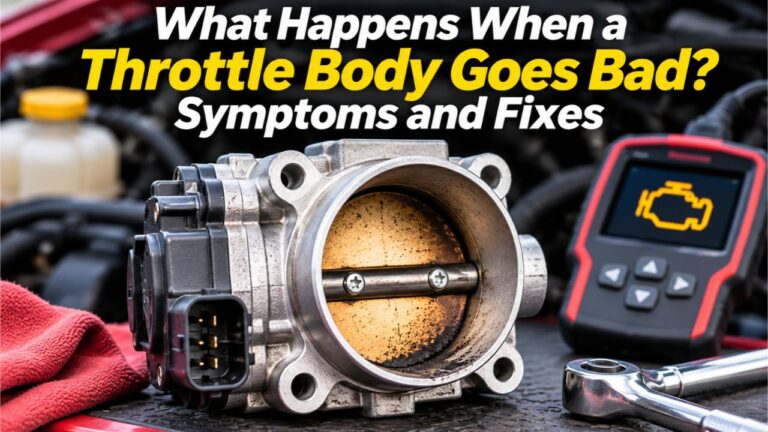
The throttle body sensor, commonly called the throttle position sensor (TPS), monitors how far the throttle plate opens. The engine computer uses this information to manage fuel delivery, ignition timing, and other engine functions. When the sensor sends inaccurate or interrupted signals, the computer may struggle to respond correctly to changing driving conditions.
The symptoms aren’t always obvious. Your car might accelerate normally one moment and hesitate the next. Some vehicles develop a high or unstable idle, while others suddenly limit engine power. These problems can resemble a dirty throttle body, a faulty accelerator pedal sensor, or even an ignition misfire.
Knowing the difference can save you from replacing expensive parts unnecessarily. This guide explains eight common symptoms, what causes sensor failure, how to test it, and when cleaning or replacement makes sense.
What Happens When a Throttle Body Sensor Fails?
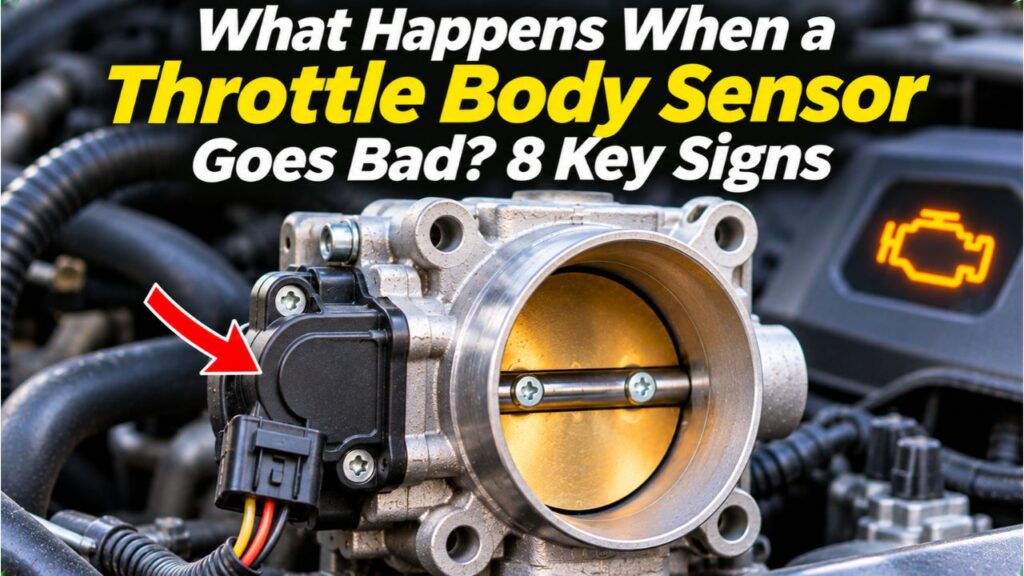
When a throttle body sensor fails, the engine control module (ECM) may receive incorrect, missing, or inconsistent throttle position signals. This can disrupt engine airflow and fuel management, causing hesitation, stalling, or unstable RPM. On electronic throttle systems, the computer may limit engine power when sensor readings disagree.
The TPS normally reports the position of the throttle plate, which controls airflow into a gasoline engine.
On many older vehicles, the sensor sits on a throttle shaft operated by an accelerator cable.
Modern electronic throttle bodies often contain two position sensors built into the assembly. The engine computer compares their signals to check whether the throttle is moving correctly.
For example, suppose the throttle plate is nearly closed, but one sensor reports that it’s wide open.
The computer may identify that mismatch as a fault and restrict throttle operation.
The operating principles of throttle position sensors explain how the sensor converts throttle angle into an electrical signal used for engine management.
A failing sensor doesn’t necessarily mean the throttle plate itself is damaged. That’s an important distinction during diagnosis.
8 Common Symptoms of a Bad Throttle Body Sensor
A bad throttle position sensor commonly causes delayed acceleration, rough idle, engine stalling, reduced power, RPM fluctuations, and dashboard warnings. Some vehicles also develop hard starting or higher fuel consumption. The symptoms depend on how the sensor fails and how the engine computer responds to incorrect signals.
| Symptom | What you may notice | Possible sensor-related cause |
| Delayed acceleration | Hesitation after pressing the gas pedal | Incorrect throttle position signal |
| Rough idle | Engine shakes or runs unevenly | Unstable position feedback |
| Engine stalling | Engine shuts off at stops | Incorrect idle airflow control |
| Reduced engine power | Vehicle accelerates very slowly | Protective throttle control mode |
| RPM fluctuations | Engine speed rises and falls | Erratic sensor readings |
| Check engine light | Warning light appears | Sensor circuit or correlation fault |
| Hard starting | Engine struggles to start or stay running | Incorrect throttle information |
| Poor fuel economy | Gas consumption increases | Engine operation becomes less efficient |
1. Delayed Acceleration or Hesitation
One of the clearest warning signs is hesitation when you press the accelerator.
The TPS tells the engine computer how far the throttle plate has opened. An incorrect signal can interfere with the computer’s response.
For example, you press the gas pedal to accelerate from a stop sign, but the engine pauses before gaining speed.
The problem may be intermittent, especially when the sensor has worn internal contacts.
Fuel delivery problems and accelerator pedal sensor faults can cause similar hesitation.
2. Rough or Unstable Idle
A failing TPS can contribute to rough idling because the engine computer may receive inaccurate throttle position information.
At idle, small changes in airflow affect engine speed.
If the sensor signal becomes unstable, the engine may struggle to maintain a steady idle under certain conditions.
You might notice the steering wheel vibrating while sitting at a traffic light.
A dirty throttle plate, vacuum leak, or worn spark plug can produce the same symptom, so rough idle alone isn’t proof of sensor failure.
3. Engine Stalling at Stops
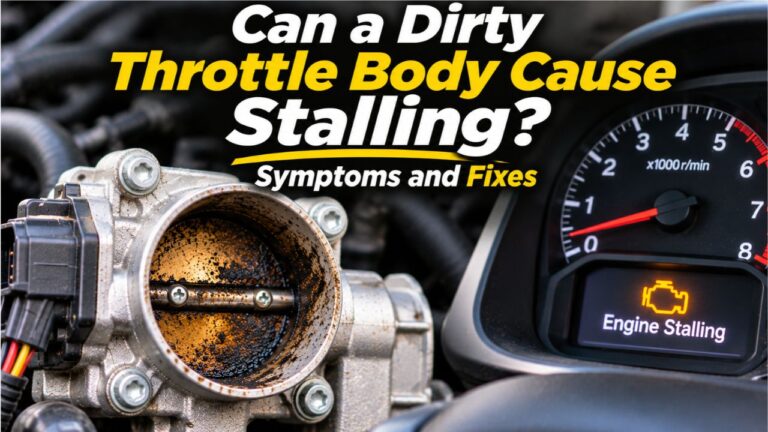
A faulty throttle position signal may contribute to stalling when the engine returns to idle.
As you slow down, the engine management system must maintain enough airflow and fuel for stable combustion.
Incorrect throttle information can interfere with that process.
For instance, your car may run normally on the highway but stall when you stop at an intersection.
Repeated stalling is a red flag.
If the engine shuts off unexpectedly in traffic, avoid further driving until the problem is diagnosed.
4. Reduced Engine Power or Limp Mode
Modern vehicles may enter reduced-power mode when the computer detects an unsafe or unreliable throttle position signal.
This protective state is often called limp mode.
The computer limits available engine power rather than allowing normal throttle operation.
For example, you press the accelerator halfway, but the vehicle barely accelerates. A reduced-power warning may also appear on the dashboard.
The response varies by manufacturer.
Some systems limit throttle opening, while others restrict engine speed or use additional protective measures.
5. RPM Fluctuations and Engine Surging
A damaged TPS may cause the engine speed to rise and fall unexpectedly.
This behavior is commonly called engine surging.
A worn sensor can sometimes produce inconsistent signals as the throttle shaft moves through certain positions.
You might notice the tachometer needle moving up and down while maintaining a steady accelerator position.
The engine may feel as if it’s repeatedly gaining and losing power.
Still, surging can also result from intake air leaks, fuel system faults, or other engine control problems.
6. Check Engine Light or Throttle Warning
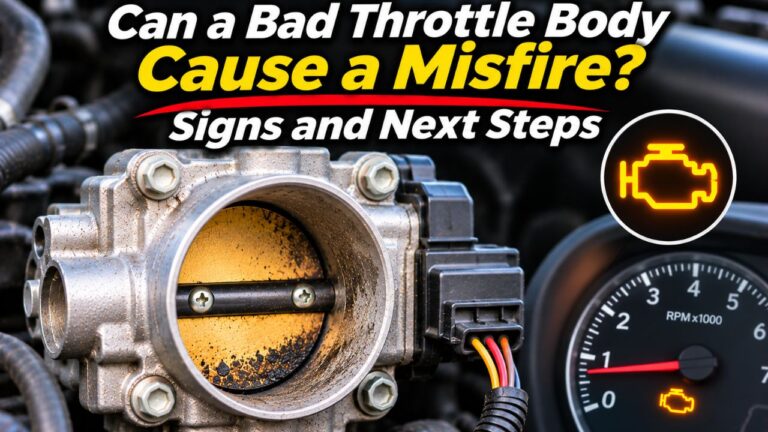
A faulty throttle body sensor can activate the check engine light when the engine computer detects an electrical or performance problem.
Some vehicles also display a separate electronic throttle control warning.
Common fault codes involve sensor voltage, signal range, or disagreement between redundant sensors.
For example, a P2135 code indicates that the computer detected a correlation problem involving throttle or accelerator position signals.
That doesn’t automatically mean the throttle body sensor itself is defective.
A damaged connector, wiring fault, or another sensor may be responsible.
7. Hard Starting or Starting Then Stalling
A bad TPS can sometimes contribute to difficult starting or an engine that stalls shortly after starting.
The computer uses throttle information as part of its engine management strategy.
Incorrect signals can interfere with starting or idle control on certain vehicles.
For example, the engine may start normally when cold but struggle to remain running after a warm restart.
These symptoms are less specific than acceleration or throttle control faults.
Battery problems, fuel pressure issues, and other sensors should also be considered.
8. Increased Fuel Consumption
A faulty throttle position sensor can contribute to increased fuel consumption when incorrect information affects engine operation.
The computer uses several sensor inputs to determine fueling and engine load.
An inaccurate TPS signal may affect those calculations on some systems.
You might notice that your usual commute requires more gasoline than before.
Poor fuel economy alone isn’t enough to identify a bad sensor.
Driving habits, tire pressure, fuel system problems, and ignition faults can also increase consumption.
Why Does a Throttle Position Sensor Go Bad?
Throttle position sensors commonly fail because of internal contact wear, moisture contamination, damaged wiring, corrosion, or physical damage. Older potentiometer-style sensors contain moving electrical contacts that can wear over time. Modern contactless sensors avoid some mechanical wear but can still develop electronic or connection faults.
Common causes include:
- Internal contact wear: Repeated throttle movement damages the sensing surface in older designs.
- Moisture intrusion: Water can cause corrosion or electrical faults.
- Loose connectors: Poor terminal contact interrupts sensor signals.
- Damaged wiring: Broken or shorted wires interfere with voltage readings.
- Heat and vibration: Repeated exposure can weaken connections and electronic components.
- Internal electronic failure: Sensor circuits may stop producing accurate position information.
Consider an older vehicle that hesitates at nearly the same accelerator position every time.
A worn spot inside a traditional TPS may cause an interrupted signal at that particular throttle angle.
The sensor might work at idle and full throttle but fail somewhere between.
That’s why checking the signal through its operating range can be more useful than measuring it at one fixed position.
What Trouble Codes Can a Bad Throttle Body Sensor Cause?
A faulty throttle body sensor may trigger diagnostic trouble codes related to throttle position voltage, circuit performance, or disagreement between sensor signals. Common examples include P0120 through P0123 and P2135. These codes identify the circuit or behavior that needs testing, but they don’t prove the sensor requires replacement.
| Trouble code | General meaning |
| P0120 | Throttle or pedal position sensor A circuit malfunction |
| P0121 | Throttle or pedal position sensor A range/performance problem |
| P0122 | Throttle or pedal position sensor A circuit low input |
| P0123 | Throttle or pedal position sensor A circuit high input |
| P0221 | Throttle or pedal position sensor B range/performance problem |
| P2135 | Throttle or pedal position sensor A/B correlation problem |
For example, P0122 may appear when a monitored sensor signal remains below its expected range.
Possible causes include a faulty sensor, damaged signal wire, poor reference voltage, or an electrical short.
A code reader can narrow down the problem, but further testing is needed.
Don’t clear the codes before recording them. Freeze-frame data, when available, may help identify the operating conditions when the fault occurred.
How Do You Check if the Throttle Body Sensor Is Bad?
Start by scanning for trouble codes and inspecting the sensor’s electrical connector. Then use live throttle position data or manufacturer-approved voltage tests to check signal behavior. A faulty sensor may produce readings that jump, drop out, or disagree with another position signal, but wiring problems must be ruled out first.
Step 1: Check the Connector and Wiring
Turn the ignition OFF and allow the engine to cool.
Locate the throttle body and inspect its electrical connector.
Look for corrosion, loose terminals, damaged insulation, or broken locking tabs.
A poor connection can create an intermittent signal that resembles sensor failure.
Step 2: Read the Diagnostic Codes
Connect an OBD-II scanner.
Record stored and pending trouble codes before clearing anything.
Pay attention to throttle position circuit and sensor correlation codes.
A fault involving one signal should guide which circuit receives further testing.
Step 3: Examine Throttle Position Live Data
Use a scanner that supports throttle position readings.
On a compatible vehicle, follow the factory procedure for checking sensor response as throttle position changes.
A healthy sensor should report values that behave according to its specified operating pattern.
Be careful when comparing accelerator pedal position with actual throttle position.
Electronic throttle systems don’t always move the throttle plate in direct proportion to pedal travel.
Step 4: Check Sensor Voltage if Required
Some traditional TPS designs use a reference supply of approximately 5 volts and a changing signal voltage.
A technician may measure the reference voltage, ground, and signal circuit with a digital multimeter.
The correct readings depend on the vehicle.
On certain sensors, moving the throttle gradually should produce a smooth signal change.
A sudden voltage drop or interruption may indicate a worn sensing element.
Never force an electronic throttle plate open or apply battery voltage to an unidentified sensor terminal.
Step 5: Confirm the Fault
If signal readings are incorrect, check the wiring and electrical supply before condemning the sensor.
The recommended checks for accelerator pedal position sensors also help distinguish pedal-sensor faults from throttle body sensor problems.
If the circuit tests correctly but the sensor output remains faulty, replacement may be necessary.
Bad Throttle Body Sensor vs. Dirty Throttle Body
A bad throttle position sensor reports incorrect electrical information, while a dirty throttle body has deposits that may interfere with airflow or throttle plate movement. Both can cause hesitation, unstable idle, or stalling. Cleaning can help with contamination, but it cannot repair a sensor with damaged internal electronics.
| Feature | Bad TPS | Dirty throttle body |
| Main problem | Incorrect electrical position signal | Carbon or oily residue |
| Common symptom | Hesitation or warning light | Rough idle or stalling |
| Sensor-related codes | More likely | Not always present |
| Visible deposits | Not required | Often present |
| Cleaning helps | Usually not | Sometimes |
| Typical repair | Sensor or assembly replacement | Approved cleaning procedure |
Here’s a practical example.
If the throttle bore has heavy deposits but sensor readings remain correct, cleaning may be worthwhile.
If the throttle is clean but one position signal repeatedly drops out, electrical diagnosis makes more sense.
Don’t get sidetracked by cleaning when the actual problem is a broken connector or failed sensor.
Can You Drive With a Bad Throttle Body Sensor?
Driving with a faulty throttle position sensor can be unsafe when the engine stalls, loses power suddenly, or responds unpredictably to the accelerator. Some minor faults may allow normal driving temporarily, but electronic throttle problems can worsen without warning. The severity of the symptoms should guide your next action.
Use this practical guide:
| Vehicle behavior | Recommended action |
| Check engine light, normal acceleration | Arrange diagnosis promptly |
| Occasional hesitation | Avoid unnecessary driving and investigate |
| Reduced engine power | Pull over safely and arrange assistance |
| Repeated stalling | Stop driving and seek repair |
| Unexpected acceleration or RPM changes | Stop safely and arrange towing |
If the vehicle accelerates unexpectedly, apply firm, steady braking and shift into Neutral when safe. Steer to a safe location and shut the engine off after stopping.
Don’t attempt repeated road tests when the accelerator response is unreliable.
A qualified automotive technician can diagnose the throttle control system without exposing you to unnecessary traffic risks.
Should You Replace the Sensor or the Entire Throttle Body?
Replace only the throttle position sensor when the manufacturer provides it as a separate serviceable component and testing confirms failure. Many modern electronic throttle bodies have integrated sensors that require replacing the complete assembly. Cleaning is appropriate only when deposits are causing the problem and the manufacturer permits the procedure.
Older cable-operated throttle bodies often have a small removable TPS mounted on the throttle shaft.
Modern electronic throttle bodies commonly combine the actuator motor, position sensors, and throttle plate inside one housing.
The electronic throttle body repair and service guidance explains how electrical connections, actuator faults, and relearn procedures affect diagnosis and replacement.
Before ordering parts, check:
- Whether the TPS is sold separately for your vehicle.
- Whether the sensor or complete assembly has failed testing.
- Whether the electrical connector needs repair.
- Whether the throttle plate has excessive deposits.
- Whether replacement requires adjustment or an electronic relearn.
Some vehicles require a throttle or idle relearn after sensor or throttle body service.
This procedure allows the engine computer to establish the correct operating settings.
Skipping a required relearn can contribute to high idle or stalling.
Don’t replace the complete throttle body until the actual fault and service requirements are confirmed.
Frequently Asked Questions
Can a Bad Throttle Body Sensor Cause a Car to Stall?
Yes. A faulty TPS can contribute to stalling when incorrect position information affects engine airflow and idle management. The engine may shut off while slowing down or stopping. Intake leaks, ignition problems, and fuel delivery faults can cause similar symptoms, so diagnostic testing is needed before replacing the sensor.
Can a Bad Throttle Position Sensor Cause a Car Not to Start?
Yes, on certain vehicles a severe throttle position sensor fault can interfere with starting or cause the engine to stall immediately. Still, a complete no-start is less specific than hesitation or throttle-related warnings. Battery condition, fuel delivery, crankshaft sensors, and other engine controls should also be checked.
Will a Bad Throttle Body Sensor Trigger the Check Engine Light?
A faulty TPS can trigger the check engine light when the computer detects abnormal voltage, circuit performance, or disagreement between sensor signals. Common codes include P0121, P0122, and P2135. A warning light doesn’t prove sensor failure because damaged wiring, poor connections, or another control fault may be responsible.
Can Cleaning a Throttle Body Fix a Bad TPS?
Cleaning may help when carbon deposits interfere with throttle plate movement or airflow. It won’t repair worn sensor contacts, damaged electronics, or a broken signal circuit. If diagnostic tests confirm internal TPS failure, replace the serviceable sensor or complete throttle body according to the manufacturer’s instructions.
What Happens if You Unplug the Throttle Position Sensor?
Unplugging a TPS can interrupt throttle position information and trigger fault codes or reduced-power operation. The response varies by vehicle. Modern electronic throttle systems may restrict acceleration as a protective measure. Don’t disconnect the sensor with the engine running or use unplugging it as an improvised diagnostic test.
How Long Can You Drive With a Bad Throttle Body Sensor?
There is no reliable safe mileage limit for a failing TPS. Some faults cause only occasional hesitation, while others trigger reduced power or unpredictable engine behavior. If the vehicle stalls, loses acceleration, or responds incorrectly to pedal input, stop driving and arrange diagnosis rather than risking another failure in traffic.
Fix the Sensor Fault Before It Affects Your Driving
A bad throttle body sensor can disrupt engine performance by sending incorrect throttle position information to the engine computer. Hesitation, rough idle, stalling, RPM fluctuations, and reduced power are common warning signs.
Some vehicles also activate the check engine light or enter a protective operating mode when throttle position signals become unreliable.
But these symptoms don’t automatically mean the sensor needs replacement. Dirty throttle plates, loose electrical connectors, damaged wiring, and accelerator pedal sensor faults can produce similar problems.
Start by reading the trouble codes and inspecting the throttle body connections. Then check sensor data using the vehicle’s approved diagnostic procedure.
If the sensor is confirmed faulty, determine whether it can be replaced separately or requires a complete throttle body assembly.
Your next step is to confirm the electrical fault before buying parts. Proper diagnosis can restore reliable throttle response and prevent unnecessary repairs.