Can I Drive With EVAP Purge Valve Disconnected? Safety Guide
If you have unplugged an EVAP purge valve for testing or discovered that its electrical connector or vapor hose is disconnected, you may wonder whether the vehicle is still safe to drive.
So, can I drive with EVAP purge valve disconnected? In many cases, the engine will still run and the vehicle may remain driveable for a short period. However, you should not treat a disconnected purge valve as a permanent solution. Depending on whether the electrical connector, vapor hose, or both are disconnected, the vehicle may develop a check engine light, rough running, fuel-vapor leaks, reduced fuel economy, or EVAP-related diagnostic trouble codes.
The purge valve is part of the evaporative emissions control system, or EVAP system. Its job is to control when stored fuel vapors from the charcoal canister are allowed into the engine to be burned.
A disconnected valve prevents this system from operating normally. In some cases, disconnecting the valve can temporarily make an engine run better if the valve was stuck open, but that is useful as a diagnostic clue—not as a proper repair.
Can I Drive With EVAP Purge Valve Disconnected?
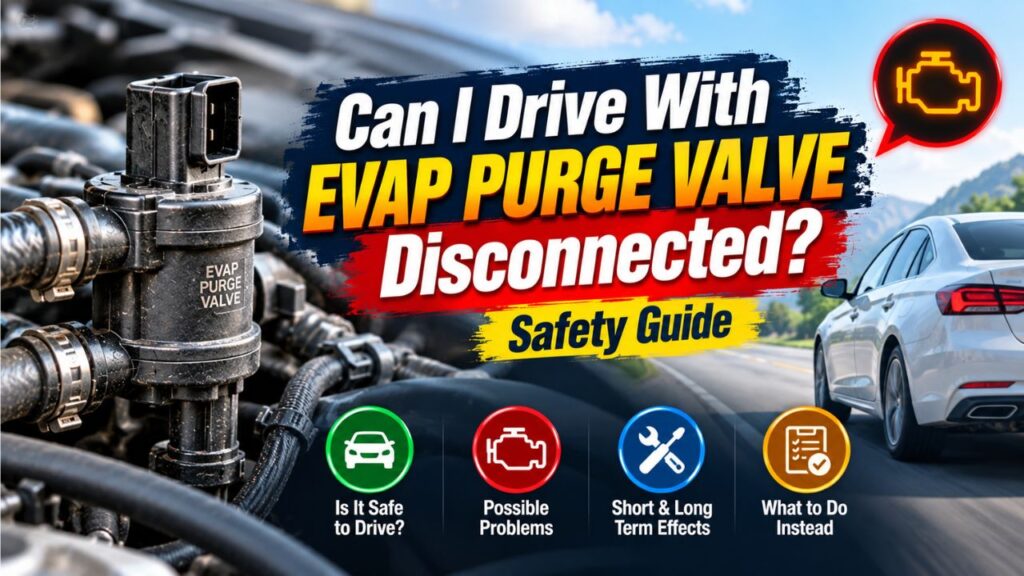
Yes, you can often drive with the EVAP purge valve disconnected for a short distance, especially if only the electrical connector has been unplugged and the vapor hoses remain properly connected.
However, the vehicle’s EVAP system will no longer operate as designed, and the engine computer will usually detect the fault.
You may experience:
- Check engine light
- EVAP trouble codes
- Increased fuel-vapor emissions
- Failed emissions inspection
- Possible fuel smell
- Rough idle in some situations
- Changes in fuel economy
- Hard starting after refueling
- Other drivability problems depending on why the valve was disconnected
If a vapor hose is disconnected and left open, the situation is more concerning because it can create an uncontrolled vacuum or vapor leak.
The safest approach is to reconnect or repair the purge valve as soon as practical.
What Is the EVAP Purge Valve?
The EVAP purge valve, also called a purge solenoid or canister purge valve, is an electronically controlled valve in the vehicle’s evaporative emissions system.
Gasoline naturally produces vapors inside the fuel tank.
Rather than allowing those hydrocarbons to escape into the atmosphere, the EVAP system stores them in a charcoal canister.
At appropriate times, the engine control module opens the purge valve.
Engine vacuum then draws the stored fuel vapors from the charcoal canister into the intake manifold, where they are burned during normal combustion.
The purge valve therefore acts like a controlled doorway between the EVAP vapor storage system and the engine.
What Does “Disconnected” Mean?
A purge valve can be disconnected in more than one way, and the consequences are different.
Electrical Connector Disconnected
If the electrical connector is unplugged but both vapor hoses remain attached, the engine computer loses control of the purge valve.
Most purge valves are designed to remain normally closed when they are not energized, although exact operation can vary by vehicle.
In this situation, the car may run relatively normally, but EVAP purging will not occur correctly.
The engine computer will usually recognize the electrical fault and store a diagnostic trouble code.
Vapor Hose Disconnected
If one of the purge valve hoses is disconnected, you may have a much larger problem.
A disconnected hose on the intake side can create a vacuum leak.
This can cause:
- Rough idle
- Lean air-fuel mixture
- High or unstable idle
- Misfires
- Stalling
- Check engine light
A disconnected hose on the charcoal-canister side may also allow fuel vapors to escape.
Valve Completely Removed
Driving with the valve completely removed while hoses remain open is generally not recommended.
The system must be sealed or connected correctly for the engine and EVAP system to operate as designed.
What Happens If You Unplug the Purge Valve Electrically?
When the electrical connector is removed, the powertrain control module can no longer command the valve.
The computer usually detects an open electrical circuit.
A check engine light may appear immediately or after the vehicle completes certain diagnostic checks.
Possible diagnostic trouble codes can relate to:
- Purge valve circuit faults
- EVAP purge flow problems
- Incorrect purge operation
- General EVAP system faults
The exact code depends on the vehicle.
The engine may still run because the purge valve is not required to keep the engine physically running under most operating conditions.
However, emissions control will no longer function normally.
Will the Car Run With the Purge Valve Unplugged?
Usually, yes.
A vehicle can often start and run with the purge valve electrical connector unplugged.
The engine control system still manages:
- Fuel injection
- Ignition
- Throttle operation
- Airflow measurement
- Other essential engine functions
The purge system is primarily responsible for controlling fuel vapors.
However, “the engine runs” does not mean the condition should be ignored indefinitely.
A stored fault can also interfere with EVAP monitoring and make it harder to detect other emissions problems.
Can Disconnecting a Bad Purge Valve Make the Car Run Better?
Yes, sometimes.
If a purge valve is stuck open, it may continuously allow vapor and air into the intake manifold when it should be closed.
That can behave somewhat like a vacuum leak.
Possible symptoms of a stuck-open purge valve include:
- Rough idle
- Difficult starting after refueling
- Stalling
- Lean mixture symptoms
- Misfires
- Unstable idle
If unplugging or isolating the purge valve causes those symptoms to improve, that may suggest the purge system is involved.
However, this is only a diagnostic clue.
Disconnecting the valve is not a permanent repair.
Why a Stuck-Open Purge Valve Can Cause Problems
At idle or during engine starting, the amount of air entering the engine needs to be tightly controlled.
If the purge valve is stuck open, the intake manifold can pull vapor—and sometimes unwanted air—through the EVAP system.
The engine computer may not expect that additional flow.
This can disturb the air-fuel ratio.
Depending on the failure, the engine may run:
- Lean
- Rich
- Rough
- Unstable
One particularly common complaint associated with an improperly flowing purge valve is difficult starting after filling the fuel tank.
Why Hard Starting Can Happen After Refueling
Refueling can produce a large amount of fuel vapor.
The charcoal canister stores those vapors.
If the purge valve is stuck open, excessive vapor may be drawn into the intake manifold while the engine is being started.
This can make the mixture excessively rich.
As a result, the engine may:
- Crank longer than usual
- Start and stumble
- Require throttle input
- Stall immediately after starting
If disconnecting or blocking purge flow improves a repeatable hard-start-after-refueling problem, the purge valve deserves further testing.
Will Disconnecting the Purge Valve Cause a Check Engine Light?
Most likely, yes.
Modern vehicles monitor the purge circuit and EVAP system.
An unplugged electrical connector creates a condition that the engine control module can often detect.
A check engine light may appear along with an EVAP-related code.
If the valve is reconnected later, the warning may not disappear immediately.
The computer may need to complete several successful drive cycles, or the code may need to be cleared after the repair.
Do not clear codes before diagnosis if you still need freeze-frame data or other stored information to identify the original problem.
Can a Disconnected Purge Valve Cause a Vacuum Leak?
It depends on what is disconnected.
If you unplug only the electrical connector, the electrical disconnection itself does not create a vacuum leak.
If a vacuum or vapor hose is removed and the intake-side connection remains open, then yes, you may create a significant vacuum leak.
This can affect engine operation immediately.
Symptoms may include:
- Hissing noise
- Rough idle
- Higher-than-normal idle
- Lean trouble codes
- Misfires
- Stalling
Never intentionally leave an intake vacuum port open while driving.
Can a Disconnected Purge Valve Cause a Fuel Smell?
Yes, especially if a vapor line is disconnected.
The EVAP system is designed to contain gasoline vapors.
Opening a vapor line can allow those vapors to escape around the engine bay or elsewhere under the vehicle.
If you smell strong gasoline fumes, do not assume it is harmless.
Check for:
- Disconnected EVAP hoses
- Damaged vapor lines
- Loose fuel cap
- Fuel leaks
- Saturated charcoal canister
A strong liquid-fuel smell or visible fuel leak requires prompt attention.
Is a Disconnected Purge Valve a Fire Hazard?
An unplugged electrical connector alone does not normally create a fuel leak.
However, leaving vapor lines disconnected can release flammable gasoline vapors.
The EVAP system should remain properly sealed.
If you smell a strong gasoline odor, see liquid fuel, or suspect a damaged fuel line, avoid driving until the source is identified.
The distinction matters: an EVAP vapor problem is not automatically the same as a liquid fuel leak, but gasoline vapor is still flammable.
Will Fuel Economy Get Worse?
It can.
A properly operating purge system allows stored fuel vapor to be burned in the engine rather than released.
When the system is disabled, that vapor-recovery process no longer works as intended.
A disconnected hose that causes an intake leak can also alter fuel trims and engine operation.
However, the effect on miles per gallon varies considerably.
A noticeable drop in fuel economy may also have unrelated causes.
Can a Disconnected Purge Valve Cause a Misfire?
Potentially, especially if the disconnection creates an intake leak.
A large vacuum leak can make the mixture too lean at idle or low engine speeds.
This may cause unstable combustion and misfire symptoms.
A malfunctioning purge valve itself can also contribute to misfires if it allows excessive vapor or airflow into the intake manifold.
However, a misfire has many possible causes, including:
- Spark plugs
- Ignition coils
- Fuel injectors
- Compression problems
- Vacuum leaks
- Fuel-pressure problems
Do not replace a purge valve solely because the engine is misfiring.
Can a Disconnected Purge Valve Cause Stalling?
Yes, under certain conditions.
If an open purge hose creates a significant vacuum leak, the engine may struggle to maintain the correct mixture at idle.
A stuck-open purge valve can sometimes have a similar effect.
Stalling is more likely when:
- The engine is idling
- The engine is starting
- The vehicle has just been refueled
- Purge flow is excessive
If the engine repeatedly stalls or runs unpredictably, driving should be avoided until the problem is diagnosed.
Can a Purge Valve Cause a No-Start Condition?
A purge valve failure is not one of the most common causes of a complete no-start, but a severely stuck-open valve can contribute to hard starting.
After refueling, excessive gasoline vapor entering the intake can make the mixture too rich.
The engine may crank for an extended period before starting.
If the vehicle does not start at all, other systems should also be checked, including:
- Battery condition
- Starter operation
- Fuel pressure
- Ignition spark
- Crankshaft position signal
- Engine compression
Do not assume every no-start problem is caused by the EVAP system.
How Far Can You Drive With the Purge Valve Disconnected?
There is no universal safe mileage.
A short diagnostic drive with only the electrical connector disconnected may be possible if the engine runs normally and all vapor hoses remain properly connected.
Driving for days or weeks that way is not a good repair strategy.
The longer the system remains disabled, the longer you may have:
- Check engine light
- Incomplete EVAP operation
- Increased vapor emissions
- Emissions inspection problems
- Potential drivability symptoms
If a hose is disconnected, the vehicle should generally be repaired much sooner because of the possibility of a vacuum or vapor leak.
Is It Okay to Drive to a Repair Shop?
If only the purge valve electrical connector is unplugged, all hoses are intact, there is no strong fuel smell, and the engine runs normally, driving a short distance to a repair facility is generally reasonable.
Do not continue driving if you experience:
- Strong gasoline odor
- Visible fuel leakage
- Severe rough idle
- Repeated stalling
- Major loss of engine power
- Flashing check engine light
A flashing check engine light usually indicates an active misfire severe enough to risk damaging the catalytic converter and should not be ignored.
Can You Leave the Purge Valve Disconnected Permanently?
No, that is not recommended.
The EVAP system is part of the vehicle’s emissions-control equipment.
Leaving the purge valve permanently disconnected can:
- Keep the check engine light on
- Prevent normal purge operation
- Cause emissions-test failure
- Increase hydrocarbon emissions
- Hide other new engine faults behind an existing warning light
Repair the underlying problem instead.
Will the Vehicle Pass an Emissions Test?
A vehicle with an unplugged purge valve is unlikely to pass an emissions inspection that checks the onboard diagnostic system.
The check engine light may be illuminated, and the EVAP monitor may show a fault or remain incomplete.
Requirements vary by state and inspection program, but an active emissions-related fault generally creates problems for OBD-based testing.
Simply clearing the code immediately before inspection does not solve the underlying issue because emissions monitors need time to complete again.
Should You Disconnect a Bad Purge Valve to Diagnose It?
Disconnecting the electrical connector can sometimes be part of diagnosis, but it is not sufficient by itself to prove the valve is bad.
Proper diagnosis may involve checking:
- Electrical resistance where specified
- Power and ground/control circuit
- Whether the valve seals when commanded closed
- Whether it opens when energized
- Vacuum flow
- EVAP trouble codes
- Fuel-trim changes
A purge valve can fail mechanically even when its electrical coil still tests normally.
For example, it can be electrically functional but physically stuck open.
How Can You Test Whether the Purge Valve Is Stuck Open?
A common basic test involves checking whether air or vacuum passes through the valve when it should be closed.
On many vehicles, an unpowered purge valve should remain closed.
If it freely passes air while disconnected from electrical power, it may be leaking internally.
However, purge valve design varies, so use vehicle-specific service specifications before interpreting the result.
A scan tool can provide additional information by allowing a technician to command the valve and observe engine response.
Purge Valve Disconnected vs Purge Valve Stuck Open
These two conditions can produce very different symptoms.
| Condition | Typical Effect |
| Electrical connector disconnected | Purge control disabled; check engine light likely |
| Valve stuck closed | Fuel vapors are not purged normally |
| Valve stuck open | Unwanted vapor/air may enter intake |
| Intake-side hose disconnected | Vacuum leak possible |
| Canister-side hose disconnected | Fuel vapor may escape |
A vehicle may run better with the electrical connector disconnected if an electronically controlled problem was commanding excessive purge, but mechanically stuck-open valves may continue leaking even when unplugged.
That distinction is important.
Can Unplugging the Valve Close a Stuck-Open Purge Valve?
No, not necessarily.
If the valve is mechanically stuck open, removing electrical power does not guarantee that it will close.
The internal valve may remain physically jammed.
This is why a proper leak or vacuum test can be more useful than simply unplugging the electrical connector.
What Should You Do If the Purge Valve Is Bad?
The correct fix is usually to replace the faulty purge valve after confirming the diagnosis.
A typical repair involves:
- Turn off the engine.
- Locate the purge valve.
- Disconnect the electrical connector.
- Release the EVAP hoses carefully.
- Remove the mounting fastener or clip.
- Install the correct replacement valve.
- Reconnect the hoses and electrical connector.
- Verify that all connections are secure.
- Clear codes only after diagnosis and repair if appropriate.
- Confirm normal operation.
Exact procedures vary by vehicle.
Some purge valves are mounted in the engine bay and are easy to reach. Others are less accessible.
Can You Temporarily Block the Purge Line?
Blocking a purge line may sometimes be used during controlled diagnostic testing, but it should not be treated as a normal driving repair.
Incorrectly plugging EVAP hoses can interfere with:
- Tank venting
- Pressure management
- EVAP diagnostics
Do not permanently block or bypass the EVAP system.
If temporary isolation is needed for diagnosis, use the correct service procedure for the specific vehicle.
How Urgent Is a Disconnected Purge Valve?
The urgency depends on the symptoms.
Lower Urgency
The vehicle may be reasonably safe for a short drive if:
- Only the electrical connector is disconnected
- All hoses remain attached
- Engine runs normally
- There is no fuel smell
- No severe warning symptoms are present
Higher Urgency
Repair it immediately if:
- A hose is open
- Strong fuel smell is present
- Engine stalls
- Vehicle runs extremely rough
- Fuel is visibly leaking
- Check engine light is flashing
The actual problem matters more than the purge valve name alone.
Common Mistakes to Avoid
Do not assume that unplugging a purge valve fixes it simply because the engine runs better.
Improvement after disconnection is useful diagnostic information, but the root cause still needs confirmation.
Also avoid:
- Leaving vacuum ports open
- Plugging EVAP hoses permanently
- Ignoring a strong gasoline smell
- Replacing the charcoal canister without diagnosis
- Clearing codes before recording them
- Assuming every EVAP code means the purge valve is bad
A loose fuel cap, vent valve, cracked vapor line, wiring problem, or leaking canister can produce EVAP-related faults as well.
FAQs About Can I Drive With EVAP Purge Valve Disconnected
Will my car still run if I unplug the purge valve?
Usually, yes. Many vehicles will continue running with the purge valve electrical connector unplugged.
However, the check engine light will likely appear and the EVAP system will not function correctly.
Can I drive with the purge valve hose disconnected?
It is not recommended.
A disconnected intake-side purge hose can create a vacuum leak, while another open EVAP hose can allow gasoline vapors to escape.
Reconnect the hose before normal driving.
Will unplugging the purge valve stop a rough idle?
It might if incorrect purge operation is contributing to the problem, but this depends on the failure.
A mechanically stuck-open valve can continue leaking even after the electrical connector is unplugged.
Can driving with a disconnected purge valve damage the engine?
A disconnected electrical connector alone usually does not immediately damage the engine.
However, a major vacuum leak, persistent misfire, or severely incorrect air-fuel mixture can create additional problems if ignored.
Why does my car run better when the purge valve is disconnected?
The purge system may have been allowing too much vapor or airflow into the intake.
This can happen with a stuck-open valve or an incorrect purge command. Further testing is needed to determine the exact cause.
Will disconnecting the purge valve stop a hard start after fueling?
It may change the symptom if purge flow is responsible, particularly with a stuck-open purge valve.
However, disconnecting the electrical connector will not necessarily close a valve that is mechanically jammed open.
Is the EVAP purge valve normally open or closed?
Many automotive purge valves are normally closed when not energized, but you should verify the design for your specific vehicle before using that assumption for diagnosis.
Can I bypass the EVAP purge valve?
Permanently bypassing the purge valve is not recommended. The EVAP system relies on controlled purge flow and proper sealing to manage fuel vapors and meet emissions requirements.
Conclusion
So, can I drive with EVAP purge valve disconnected? In many vehicles, a short drive may be possible if only the electrical connector is unplugged, the vapor hoses remain properly connected, the engine runs normally, and there is no strong fuel smell.
However, a disconnected purge valve should be considered a temporary diagnostic condition, not a permanent fix. Leaving it disconnected can trigger a check engine light, disable normal EVAP purge operation, increase emissions, and cause inspection problems.
If disconnecting the valve makes rough idle, stalling, or hard starting improve, test the purge valve and its related hoses properly. Repairing the actual fault will restore normal EVAP operation and prevent a temporary workaround from becoming a longer-term problem.