Can a PCV Valve Be Cleaned? When to Clean or Replace It
Yes, some traditional removable PCV valves can be cleaned if they are only lightly contaminated, but replacement is usually the better choice when the valve is clogged, damaged, sticking, or causing engine symptoms.
If you are wondering can a PCV valve be cleaned, the answer depends largely on the type of PCV system your engine uses. Older vehicles often have a small, inexpensive mechanical PCV valve that can be removed from the valve cover or hose. Cleaning may temporarily restore movement if the valve contains light oil deposits. Many newer engines, however, use diaphragms, oil separators, or PCV passages integrated into the valve cover, and these assemblies may not be designed for cleaning or individual repair.
Knowing when to replace a PCV valve is more important than trying to save a valve that has already deteriorated. A failing PCV system can contribute to rough idle, vacuum leaks, increased crankcase pressure, oil leaks, sludge, oil consumption, and check engine lights.
There is also no universal answer to how often should you replace a PCV valve. Some manufacturers specify a maintenance interval, while others recommend inspection or replacement only when a fault develops. The vehicle’s maintenance schedule should therefore take priority over a generic mileage rule.
Can a PCV Valve Be Cleaned or Should It Be Replaced?
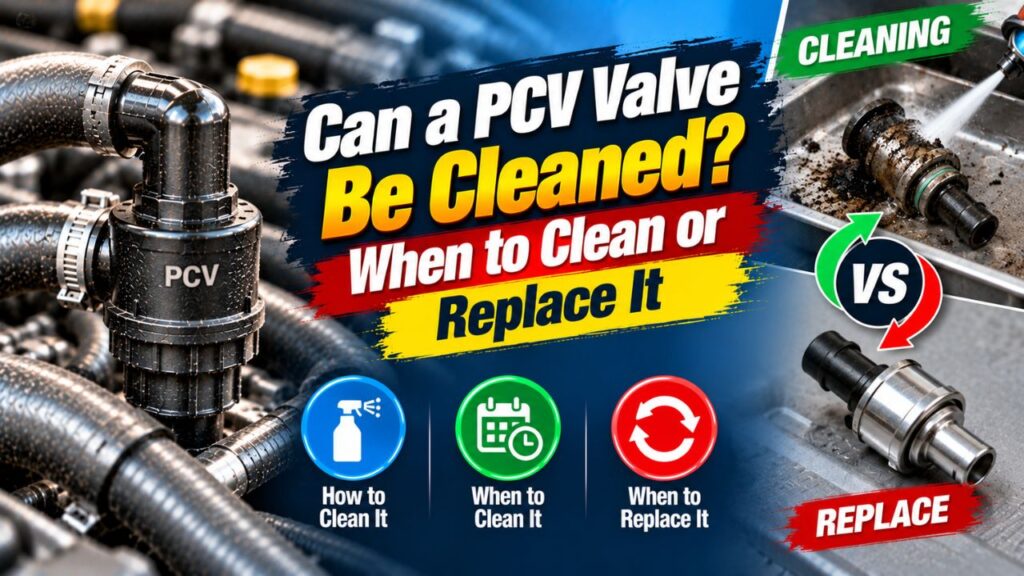
A traditional removable PCV valve can sometimes be cleaned, but cleaning is generally most appropriate when the valve is structurally sound and has only minor deposits.
Replacement is usually preferable if the valve is sticking, heavily clogged, cracked, worn internally, or inexpensive enough that cleaning provides little practical benefit.
The positive crankcase ventilation system, or PCV system, continuously handles oil vapor, combustion blow-by gases, and moisture. Over time, these contaminants can create varnish and deposits inside the valve and associated hoses.
Cleaning can remove deposits. It cannot repair mechanical wear, a torn diaphragm, damaged plastic, weak internal components, or a failed seal.
That distinction is the key to deciding whether cleaning is worthwhile.
What Does a PCV Valve Do?
The PCV system removes blow-by gases from the engine crankcase and routes them back into the intake system.
During combustion, a small amount of gas escapes past the piston rings. This is called blow-by. Those gases can contain fuel vapor, moisture, combustion byproducts, and oil mist.
Without adequate crankcase ventilation, those contaminants can contribute to pressure buildup and oil degradation.
The PCV valve regulates the flow of crankcase gases according to engine operating conditions.
When the system works correctly, it helps control:
- Crankcase pressure
- Oil vapor
- Moisture accumulation
- Emissions
A malfunctioning valve can disrupt both crankcase ventilation and engine airflow.
What Causes a PCV Valve to Get Dirty?
Oil vapor and combustion contaminants are constantly passing through the PCV system.
Over time, deposits can develop inside the valve.
The buildup may be worse when an engine experiences:
- Extended oil-change intervals
- Frequent short trips
- Sludge formation
- Excessive blow-by
- Poor-quality or incorrect engine oil
- High oil consumption
Short trips can be especially hard on the PCV system because the engine may not remain hot long enough to evaporate accumulated moisture.
The resulting mixture of oil vapor, moisture, and combustion residue can create sticky deposits.
What Does a Dirty PCV Valve Look Like?
A dirty PCV valve may show dark oily deposits around its openings.
When removed, you may see:
- Thick oil residue
- Brown or black varnish
- Sludge
- Carbon-like deposits
- Restricted openings
However, appearance alone does not determine whether the valve is functioning correctly.
A valve can look relatively clean but have an internal mechanical problem.
Likewise, a valve that looks oily is not automatically defective because some oil vapor naturally passes through the PCV system.
How to Clean a Traditional PCV Valve
If the vehicle uses a simple removable mechanical PCV valve and the manufacturer does not prohibit cleaning, the basic process is straightforward.
First, let the engine cool and locate the PCV valve according to the vehicle’s service information. Carefully remove the valve from its grommet, hose, or fitting.
Inspect the valve before cleaning. If the body is cracked, fittings are broken, or the internal mechanism appears damaged, replace it instead.
Use a cleaning product compatible with the valve materials and follow the cleaner manufacturer’s directions. Remove oil and varnish from the internal passage without damaging plastic or rubber components.
Allow the valve to dry completely before reinstalling it.
Do not reinstall a valve that still sticks, remains restricted, or shows physical damage.
Should You Use Carburetor Cleaner on a PCV Valve?
Some traditional all-metal or solvent-resistant PCV valves may tolerate certain automotive cleaners, but you should not assume every PCV valve is compatible with carburetor cleaner.
Modern valves may contain:
- Plastic
- Rubber
- Diaphragms
- Seals
Strong solvents can damage these materials.
Check the service information for the vehicle and the cleaner’s compatibility instructions.
When in doubt, replacement is generally safer than exposing an unknown PCV assembly to aggressive chemicals.
Can You Clean a PCV Valve With Brake Cleaner?
The same caution applies.
Brake cleaner is a strong solvent and formulations vary.
It may damage certain plastics, rubber parts, coatings, or diaphragms.
For an inexpensive PCV valve, the small savings from cleaning usually do not justify the risk of damaging the component with an unsuitable solvent.
Can You Clean an Integrated PCV System?
Sometimes external passages or hoses can be serviced, but many modern integrated PCV assemblies are not designed to be cleaned as separate valves.
Modern engines may incorporate the PCV system into the:
- Valve cover
- Oil separator
- Intake manifold
- Internal engine passages
A failed diaphragm or internal valve may require replacing the complete valve-cover or separator assembly.
Trying to flush solvents into an integrated system can damage seals or send contaminants into the intake.
Follow the manufacturer-specific repair procedure.
Does Cleaning a PCV Valve Actually Work?
It can, but only under the right conditions.
Cleaning may help if a mechanical valve is simply sticking because of light deposits.
For example, if varnish restricts an otherwise healthy valve, removing the deposit may restore normal movement.
Cleaning will not fix:
- Torn diaphragms
- Broken springs
- Worn internal valves
- Cracked housings
- Damaged hose connections
- Failed seals
If the valve is old and inexpensive, replacement is often more reliable than cleaning.
Is It Better to Clean or Replace a PCV Valve?
For most inexpensive traditional PCV valves, replacement is usually the more practical option once a genuine fault is suspected.
A new valve gives you known internal condition, whereas a cleaned old valve may still have wear that cannot be seen.
Cleaning makes more sense when:
- The valve is difficult to obtain.
- The manufacturer allows cleaning.
- Deposits are light.
- The valve has no physical damage.
- You are cleaning it as part of inspection rather than trying to repair a known internal failure.
Replacement makes more sense when symptoms are present or the valve repeatedly becomes restricted.
When to Replace a PCV Valve
A PCV valve should be replaced when it is no longer regulating crankcase airflow correctly or when it has physical damage that cannot be cleaned away.
Signs that replacement may be appropriate include rough idle, unusual crankcase pressure, oil leaks, whistling noises, excessive oil consumption, or a check engine light associated with a PCV-related vacuum problem.
You should also consider replacement if the valve is:
- Cracked
- Stuck
- Heavily clogged
- Internally damaged
- Part of a failed diaphragm assembly
The entire PCV system should be inspected before assuming the valve itself is responsible.
How Often Should You Replace a PCV Valve?
There is no universal replacement interval that applies to every vehicle.
Some older maintenance schedules specify periodic PCV valve replacement, while many newer vehicles do not list a routine replacement interval at all.
The safest approach is to follow the vehicle manufacturer’s maintenance schedule.
If no interval is given, inspect the system when:
- Performing major scheduled maintenance
- Diagnosing an oil leak
- Investigating a vacuum leak
- Dealing with abnormal oil consumption
- Troubleshooting rough idle or fuel-trim problems
A PCV valve may last a very long time in one engine and clog relatively quickly in another.
Engine design, oil condition, driving habits, and blow-by all affect service life.
Is There a Typical PCV Valve Replacement Mileage?
You may see generic recommendations suggesting replacement at various mileage intervals, but these should not override the vehicle manufacturer’s specifications.
PCV system designs differ too much for a universal mileage number to be reliable.
A simple mechanical valve on an older engine may have a scheduled replacement interval.
A modern integrated diaphragm system may be considered a replace-on-failure component.
Using the maintenance schedule for your exact vehicle is more accurate than following a blanket mileage rule.
Should You Replace the PCV Valve During a Tune-Up?
Sometimes, but not automatically.
On older vehicles where PCV replacement is listed as routine maintenance, replacing it during a tune-up may make sense.
On a modern engine with an integrated PCV system, there may be no reason to replace an expensive valve-cover assembly unless diagnosis shows a fault.
A tune-up should follow the maintenance needs of the specific engine rather than automatically replacing every traditional service item.
Symptoms That Suggest the PCV Valve Needs Replacement
PCV failure can produce different symptoms depending on whether airflow becomes excessive or restricted.
A valve stuck open may behave like a vacuum leak. You might notice rough idle, hissing, lean fuel trims, misfires, or a check engine light.
A clogged or stuck-closed valve can allow crankcase pressure to rise. This may contribute to oil leaks, oil being forced past seals, sludge, or pressure at the oil-fill opening.
Some failures can also increase oil consumption by allowing too much oil mist into the intake.
Because these symptoms overlap with other engine problems, diagnosis should confirm the PCV system before replacement.
Can a Bad PCV Valve Cause Oil Leaks?
Yes.
A restricted PCV valve can prevent blow-by gases from leaving the crankcase properly.
Pressure can then build and push oil through weak sealing points.
That may lead to leaks at:
- Valve-cover gaskets
- Crankshaft seals
- Camshaft seals
- Other engine gaskets
If an engine suddenly develops several oil leaks, checking crankcase ventilation is worthwhile.
Replacing seals without correcting excessive crankcase pressure may allow the leaks to return.
Can a Bad PCV Valve Cause Oil Consumption?
Yes.
A PCV system that allows excessive vacuum can pull additional oil mist into the intake.
The engine may then burn that oil.
You might notice oil residue in the intake, a falling oil level, or blue smoke in more severe cases.
However, increased oil consumption can also come from worn piston rings, valve seals, turbocharger problems, and other causes.
Can a Dirty PCV Valve Cause Rough Idle?
Yes, particularly if the valve is stuck open or fails to regulate airflow correctly.
A PCV valve connected to intake vacuum can allow unmetered air into the engine.
This may create a lean condition that is most noticeable at idle.
The engine may:
- Shake
- Surge
- Idle too high
- Nearly stall
A cracked PCV hose can cause almost identical symptoms, which is why the hoses should always be inspected too.
What If the PCV Valve Keeps Getting Clogged?
Repeated PCV clogging may indicate a larger engine or maintenance issue.
Possible contributors include:
- Sludge
- Excessive blow-by
- Long oil-change intervals
- Incorrect oil
- Heavy short-trip use
- Blocked ventilation passages
Replacing the valve repeatedly without investigating the cause may only provide temporary relief.
If heavy sludge is present, the engine’s overall condition and maintenance history should be evaluated.
Should You Replace PCV Hoses at the Same Time?
Not automatically, but inspect them carefully.
PCV hoses are exposed to oil vapor and engine heat.
Over time, they can become:
- Brittle
- Cracked
- Collapsed
- Soft
- Clogged
A leaking hose can create vacuum problems even with a perfectly good valve.
A blocked hose can cause crankcase pressure even after the PCV valve is replaced.
Replace damaged or restricted hoses as needed.
What About the PCV Grommet?
Traditional PCV valves often fit into a rubber grommet in the valve cover.
The grommet can harden and crack with age.
A damaged grommet may create:
- Vacuum leaks
- Oil seepage
- Loose PCV valve fit
If the valve is being replaced, inspect the grommet and replace it if it is brittle or damaged.
Can a PCV Valve Be Tested Before Replacement?
Yes, but no single test works for every design.
Older mechanical valves may be checked for free movement and proper vacuum behavior.
Some people shake a traditional valve and listen for a rattle. A lack of movement may indicate clogging, but a valve that rattles is not automatically good.
Modern diaphragm-style PCV systems require different diagnostic procedures.
Diagnosis may involve:
- Checking crankcase vacuum
- Inspecting fuel trims
- Listening for whistle or hissing
- Smoke testing for leaks
- Inspecting the diaphragm
Use the procedure appropriate for the engine.
Can Removing the Oil Cap Help Diagnose a PCV Problem?
Sometimes.
With the engine idling, the behavior of the oil-fill cap can provide clues about crankcase vacuum.
A failed PCV diaphragm on some engines can create unusually strong vacuum, making the oil cap difficult to remove.
A blocked system may create positive crankcase pressure instead.
However, some vacuum is normal on many engines.
Oil-cap behavior should be treated as a diagnostic clue, not a universal pass-or-fail test.
Can You Drive With a Dirty or Bad PCV Valve?
A vehicle may continue running, but ignoring a PCV problem can lead to more expensive issues.
Depending on the failure, continued driving may contribute to:
- Oil leaks
- Sludge
- Misfires
- Increased oil consumption
- Intake contamination
- Catalytic converter damage from severe misfires or oil burning
If the engine is running badly, leaking substantial oil, or showing a flashing check engine light, diagnose the problem promptly.
How to Help a PCV Valve Last Longer
The best way to protect the PCV system is to keep the engine internally clean.
Use the correct engine oil and change it according to the manufacturer’s schedule.
Avoid repeatedly extending oil-change intervals far beyond specification.
Proper maintenance helps reduce sludge and varnish that can clog PCV passages.
If the vehicle is driven mostly on very short trips, regular maintenance becomes particularly important because moisture may accumulate more easily inside the engine.
Common Mistakes When Servicing a PCV Valve
One common mistake is cleaning a valve that has actually failed mechanically. Removing deposits cannot repair worn or broken internal parts.
Another mistake is replacing only the valve while ignoring cracked or clogged hoses.
Using strong solvents on plastic or diaphragm-style components can also damage the PCV system.
Finally, do not assume every engine has a small removable valve. On many modern engines, the PCV components are integrated into a much larger assembly.
FAQs About Can a PCV Valve Be Cleaned
Can a PCV valve be cleaned and reused?
Yes, some traditional removable PCV valves can be cleaned and reused if they are only lightly contaminated and still function correctly.
If the valve is damaged, badly clogged, worn, or inexpensive to replace, installing a new one is usually more reliable.
When should a PCV valve be replaced?
Replace it when it is stuck, damaged, heavily restricted, causing improper crankcase vacuum or pressure, or producing confirmed PCV-related engine symptoms.
Follow any replacement interval specified by the vehicle manufacturer.
How often should you replace a PCV valve?
There is no universal replacement interval.
Check the maintenance schedule for your exact vehicle. If no interval is specified, replace the valve when inspection or diagnosis shows that it is no longer functioning correctly.
Can a PCV valve last 100,000 miles?
It may on some vehicles, while another design may need attention much sooner.
Mileage alone does not determine PCV condition. Engine design, oil maintenance, blow-by, and driving conditions all matter.
Can cleaning a PCV valve fix a check engine light?
Only if the check engine light is genuinely caused by a dirty PCV valve and cleaning restores correct airflow.
A check engine light can have many other causes, so diagnostic trouble codes and proper testing should guide the repair.
Should I clean or replace a clogged PCV valve?
Replacement is usually the better choice for a heavily clogged traditional valve, particularly when the part is inexpensive.
Cleaning is more reasonable for minor deposits when the valve is otherwise in excellent condition.
Can a PCV valve fail even if it looks clean?
Yes.
Internal mechanical wear, diaphragm damage, or incorrect flow can occur without obvious external contamination.
Appearance alone cannot confirm proper operation.
Do modern PCV valves need regular replacement?
Some do not have a scheduled replacement interval.
Many modern PCV systems are integrated into valve covers or oil-separator assemblies and are replaced when a diagnosed failure occurs.
Conclusion
The overall verdict on can a PCV valve be cleaned is that cleaning can help a simple removable valve when light oil or varnish deposits are the only problem, but it should not be treated as a repair for a worn, damaged, or failed PCV component. For inexpensive traditional valves, replacement is often more reliable than trying to restore an old one.
As for when to replace a PCV valve, replace it when testing shows incorrect operation, when it is cracked or heavily clogged, or when a confirmed PCV fault is causing rough idle, vacuum problems, excessive crankcase pressure, oil leaks, or abnormal oil consumption.
There is no universal answer to how often should you replace a PCV valve. Some vehicles have a scheduled interval, while others use PCV systems that are serviced only when a problem develops. The best approach is to follow the maintenance schedule for your exact vehicle, inspect the complete PCV system when symptoms appear, and replace damaged hoses or integrated components along with the valve when necessary.