What Is an Oxygen Sensor in a Car? How It Works and Why It Matters
An oxygen sensor is an exhaust-system sensor that measures oxygen in the exhaust gases so the engine computer can adjust the air-fuel mixture and monitor catalytic-converter performance.
If you drive a modern gasoline-powered vehicle, there is a very good chance it has more than one oxygen sensor working every time the engine runs. These small sensors play a major role in how efficiently the engine burns fuel, how much pollution comes from the exhaust, and how the vehicle’s onboard computer determines whether the catalytic converter is working properly.
Understanding what is an oxygen sensor in a car also helps explain several other common automotive questions, including what an oxygen sensor does, how it works, why it is important, and where it is located. An oxygen sensor does not directly measure how much fuel enters the engine. Instead, it examines the exhaust after combustion and reports whether the exhaust contains more or less oxygen than expected.
The engine control module, commonly called the ECM or PCM, uses that information to make rapid adjustments to fuel delivery. On vehicles with multiple sensors, the computer can also compare readings before and after the catalytic converter to evaluate emissions performance.
A failing oxygen sensor can contribute to poor fuel economy, rough running, increased emissions, and a check engine light, but oxygen-sensor trouble codes do not always mean the sensor itself is defective. Exhaust leaks, wiring problems, fuel-system faults, vacuum leaks, and engine problems can sometimes create similar readings.
This pillar guide explains oxygen sensors from the ground up, including their purpose, operating principle, location, different types, upstream versus downstream sensors, common symptoms, diagnostic trouble codes, testing, replacement considerations, and maintenance.
What Is an Oxygen Sensor in a Car?
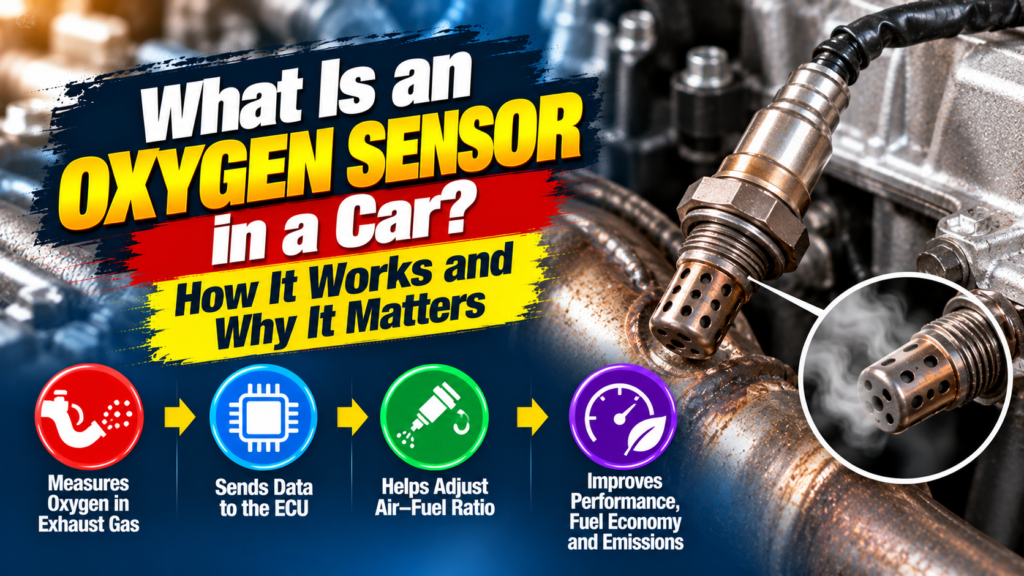
An oxygen sensor in a car is an electronic sensor installed in the exhaust system that measures the amount of oxygen remaining in the exhaust gases after combustion.
It is often called an:
O2 sensor, lambda sensor, or oxygen-sensing sensor.
The sensor sends an electrical signal to the vehicle’s engine computer. The computer uses that signal to determine whether the engine is operating with an air-fuel mixture that is relatively rich or lean.
A rich mixture contains more fuel relative to air.
A lean mixture contains more air relative to fuel.
The engine computer constantly makes small corrections to fuel-injector operation based partly on oxygen-sensor feedback.
Modern vehicles often have multiple oxygen sensors because different sensors perform different jobs.
What Does an Oxygen Sensor Do?
The main job of an oxygen sensor is to tell the engine computer what happened during combustion by measuring oxygen left in the exhaust.
The computer then uses this feedback to help control the air-fuel ratio.
If the exhaust indicates too much oxygen, the mixture may be too lean. The computer may respond by adding more fuel.
If very little oxygen remains in the exhaust, the mixture may be relatively rich. The computer may reduce fuel delivery.
This correction process can happen continuously while the engine is running.
On many modern vehicles, oxygen sensors also help the computer determine whether the catalytic converter is storing and processing oxygen properly.
So the oxygen-sensor system generally has two major purposes:
Fuel control and emissions monitoring.
Why Does the Engine Need Oxygen-Sensor Feedback?
An engine needs the correct relationship between air and fuel to operate efficiently.
For gasoline engines, the chemically ideal mixture for complete combustion of conventional gasoline is often described as approximately 14.7 parts air to 1 part fuel by mass.
This is called the stoichiometric air-fuel ratio.
Real engines do not stay at exactly 14.7:1 under every condition. During cold starting, acceleration, high load, and other operating situations, the computer may intentionally command richer or leaner mixtures.
However, during normal closed-loop operation, the oxygen sensors allow the computer to make fine corrections around the target mixture.
Without accurate feedback, the computer would have to rely more heavily on predetermined fuel maps and other sensors.
How Does an Oxygen Sensor Work?
An oxygen sensor works by comparing oxygen conditions in the exhaust with a reference or by directly measuring exhaust oxygen through an electrochemical sensing element.
The exact operating principle depends on the type of sensor.
Traditional oxygen sensors commonly use a zirconia ceramic element.
When the sensing element reaches its operating temperature, it produces a voltage related to the difference in oxygen concentration between the exhaust gas and a reference environment.
The engine computer interprets that signal as an indication of mixture condition.
What Happens When the Mixture Is Rich?
A rich mixture leaves relatively little oxygen in the exhaust because more oxygen has been consumed during combustion.
A traditional narrowband zirconia sensor responds by producing a relatively high signal voltage.
What Happens When the Mixture Is Lean?
A lean mixture contains more oxygen than needed for the available fuel.
More oxygen remains in the exhaust, and a traditional narrowband sensor produces a lower voltage.
The ECM watches the signal and repeatedly adjusts injector pulse width.
This feedback loop allows the engine-management system to keep combustion near its desired target.
What Is Closed-Loop Fuel Control?
When the engine computer actively uses oxygen-sensor feedback to adjust fuel delivery, the system is operating in closed loop.
During closed-loop operation, the computer monitors the oxygen-sensor signal and continuously modifies fuel delivery.
The process can be simplified as:
Engine burns air and fuel → exhaust reaches oxygen sensor → sensor reports oxygen level → ECM adjusts injector operation → mixture changes → sensor measures the new result.
This cycle repeats many times.
What Is Open Loop?
During open-loop operation, the computer does not rely primarily on oxygen-sensor feedback.
Open loop may occur during:
Cold startup
Certain high-load conditions
Specific fault conditions
Periods when the sensors have not yet reached operating temperature
The ECM instead uses programmed fuel maps and information from other sensors.
Once conditions are correct, the system normally transitions into closed loop.
Why Oxygen Sensors Need to Get Hot
Traditional oxygen sensors work properly only at elevated temperature.
Older sensors depended mostly on exhaust heat to reach operating temperature.
Modern sensors commonly contain an internal heater circuit that brings the sensing element up to temperature more quickly.
This allows closed-loop fuel control to begin sooner after startup.
A faster transition to closed loop can help reduce:
Fuel consumption during warm-up
Cold-start emissions
Time spent operating without full oxygen-sensor feedback
Heater failure can therefore trigger a diagnostic trouble code even if the sensing element itself is still capable of measuring oxygen.
What Is a Heated Oxygen Sensor?
A heated oxygen sensor, often abbreviated HO2S, contains an electrical heating element inside the sensor.
The heater receives battery voltage or controlled power from the vehicle electrical system.
Its purpose is not to make the exhaust hotter.
Instead, it heats the sensor’s internal sensing element so the sensor can operate accurately sooner and remain at an appropriate temperature during low-exhaust-flow conditions.
A heater-related trouble code can result from:
A failed heating element
Open wiring
Shorted wiring
Blown fuse
Connector damage
ECM control-circuit problem
Diagnosis should therefore include the electrical circuit rather than immediately replacing the sensor.
What Is a Narrowband Oxygen Sensor?
A narrowband O2 sensor is designed mainly to tell the computer whether the mixture is richer or leaner than a narrow point around stoichiometric combustion.
It does not provide highly precise air-fuel-ratio information across a broad range.
Instead, its signal changes sharply as the mixture crosses the stoichiometric point.
On a typical zirconia narrowband sensor, the signal may fluctuate approximately between:
0.1 volt on the lean side and 0.9 volt on the rich side.
Exact values depend on design and conditions.
During normal closed-loop operation, an upstream narrowband sensor may switch rapidly between lower and higher voltage as the ECM continually corrects mixture.
What Is a Wideband Oxygen Sensor?
A wideband oxygen sensor, also called an air-fuel ratio sensor on some vehicles, can measure mixture over a wider range with much greater precision.
Wideband sensors are common on many modern vehicles.
They allow more accurate fuel control under conditions such as:
Lean operation
Rich operation
Cold startup
Acceleration
Turbocharged operation
Emissions control
Unlike a traditional narrowband sensor, a wideband sensor should not always be diagnosed by simply looking for a voltage switching between 0.1 and 0.9 volts.
Its electrical behavior and scan-tool data depend on the manufacturer and control strategy.
Narrowband vs. Wideband Oxygen Sensors
| Feature | Narrowband O2 Sensor | Wideband O2 / Air-Fuel Sensor |
| Primary function | Rich/lean switching near stoichiometric | Measures mixture over a wider range |
| Accuracy | Good near stoichiometric point | Higher across broader conditions |
| Common on | Older and some modern vehicles | Many newer vehicles |
| Diagnostic behavior | Often switches high/low voltage | Manufacturer-specific current or voltage behavior |
| Fuel-control precision | Lower | Higher |
| Testing method | Relatively straightforward | Often requires scan data or manufacturer procedure |
The sensors may look similar externally, but they are not necessarily interchangeable.
Where Is the Oxygen Sensor Located?
The oxygen sensor is located in the exhaust system, usually threaded directly into the exhaust manifold, exhaust pipe, catalytic converter area, or another section of the exhaust stream.
Its exact location depends on:
Engine configuration
Number of cylinders
Number of catalytic converters
Exhaust layout
Model year
Vehicle emissions system
A vehicle may have two, three, four, or even more oxygen sensors.
Where Is the Upstream Oxygen Sensor Located?
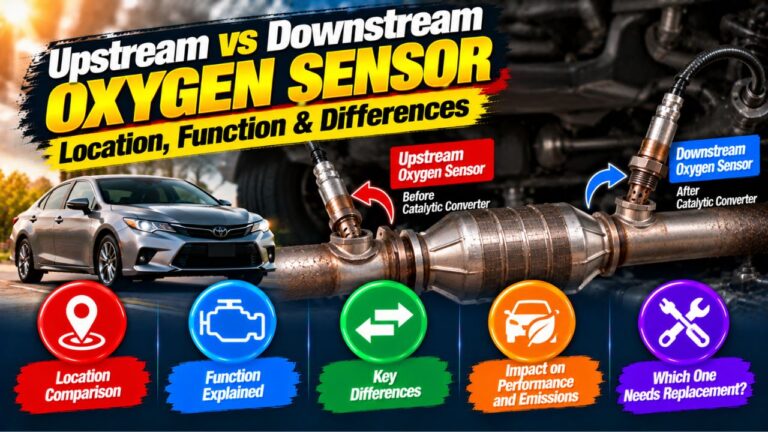
The upstream oxygen sensor is positioned before the catalytic converter.
It is usually located:
In the exhaust manifold
Near the exhaust manifold outlet
In the exhaust pipe before the catalytic converter
Because it samples exhaust directly from the engine before catalytic treatment, it is primarily used for fuel control.
It may also be called:
Sensor 1
Pre-catalyst sensor
Front O2 sensor
Air-fuel ratio sensor
Where Is the Downstream Oxygen Sensor Located?
The downstream oxygen sensor is installed after the catalytic converter.
It is primarily used to monitor catalytic-converter performance.
It may also be called:
Sensor 2
Rear O2 sensor
Post-catalyst sensor
Post-cat oxygen sensor
The downstream sensor allows the ECM to compare exhaust conditions before and after the converter.
Upstream vs. Downstream Oxygen Sensor
Although both may measure oxygen, they often have different jobs.
Upstream Sensor
The upstream sensor plays a major role in adjusting fuel mixture.
Its data affects:
Injector pulse width
Short-term fuel trim
Long-term fuel trim
Combustion efficiency
Emissions
A failing upstream sensor can therefore have a noticeable effect on drivability and fuel economy.
Downstream Sensor
The downstream sensor mainly monitors whether the catalytic converter is functioning correctly.
On many vehicles, the computer compares upstream and downstream sensor activity.
A healthy catalytic converter smooths out changes in exhaust oxygen.
If the downstream sensor begins behaving too much like the upstream sensor, the ECM may conclude that catalytic efficiency has fallen.
This can contribute to codes such as P0420 or P0430, although those codes do not automatically prove the catalytic converter is bad.
What Do Bank 1 and Bank 2 Mean?
On engines with two cylinder banks, diagnostic information may identify sensors by bank.
Bank 1 is the side of the engine containing cylinder number 1.
Bank 2 is the opposite side.
This matters on V6, V8, and other engines with two banks.
For example:
Bank 1 Sensor 1 usually means the upstream sensor on the cylinder-number-1 side.
Bank 1 Sensor 2 usually means the downstream sensor on Bank 1.
Bank 2 Sensor 1 means the upstream sensor on Bank 2.
Bank 2 Sensor 2 means the downstream sensor on Bank 2.
Do not assume Bank 1 is always the driver side or passenger side. That varies by engine.
How Many Oxygen Sensors Does a Car Have?
The number varies significantly.
Older vehicles may have only one oxygen sensor.
Many modern four-cylinder vehicles use two:
One upstream sensor
One downstream sensor
V-type engines may use four:
Bank 1 Sensor 1
Bank 1 Sensor 2
Bank 2 Sensor 1
Bank 2 Sensor 2
Vehicles with multiple catalytic converters or more complex emissions systems can use additional sensors.
The best way to determine how many your car has is to check vehicle-specific service information.
Is an Oxygen Sensor Important?
Yes. An oxygen sensor is very important to modern engine management and emissions control.
The upstream sensor helps the ECM maintain an appropriate air-fuel ratio.
The downstream sensor helps verify catalytic-converter performance.
Together, oxygen sensors can influence:
Fuel economy
Engine performance
Exhaust emissions
Catalytic-converter protection
Diagnostic monitoring
Check engine light operation
A vehicle may continue to run with a failed sensor, but that does not mean the sensor is unimportant.
How Oxygen Sensors Affect Fuel Economy
A faulty upstream oxygen sensor can report incorrect mixture information.
If the ECM receives a signal suggesting the mixture is lean when it is not, the computer may add unnecessary fuel.
This can reduce miles per gallon.
A sensor that responds slowly may also prevent the fuel-control system from making corrections as accurately as designed.
However, poor fuel economy can have many causes.
A bad O2 sensor should be confirmed through diagnosis rather than replaced based on fuel consumption alone.
How Oxygen Sensors Affect Emissions
Fuel mixture has a major effect on exhaust emissions.
A mixture that is too rich can increase:
Hydrocarbon emissions
Carbon monoxide
Fuel consumption
Catalytic-converter temperature
A mixture that is too lean can increase:
Nitrogen oxide formation under certain conditions
Misfire risk
Combustion instability
Oxygen sensors help the ECM maintain conditions that allow the three-way catalytic converter to reduce harmful exhaust pollutants efficiently.
How the Oxygen Sensor Works With the Catalytic Converter
The catalytic converter needs the exhaust mixture to remain within an appropriate operating range.
During normal operation, the ECM constantly adjusts fuel delivery around the desired air-fuel ratio.
The upstream O2 sensor reports changes before the catalytic converter.
The converter stores and releases oxygen while chemically converting pollutants.
The downstream sensor then measures the exhaust after treatment.
If the converter is working well, downstream oxygen changes should normally be more stable than the rapid upstream switching seen with a narrowband system.
If upstream and downstream patterns become too similar, the ECM may determine that converter oxygen-storage capacity has decreased.
How Oxygen Sensors Work With Fuel Trims
One of the most useful ways to understand oxygen-sensor operation is through fuel trim.
Fuel trim shows how much the computer is correcting fuel delivery away from its base calculation.
Short-Term Fuel Trim
Short-term fuel trim, or STFT, changes quickly.
If oxygen-sensor feedback indicates the engine is lean, STFT may move positive as the computer adds fuel.
If the engine appears rich, STFT may move negative as the computer removes fuel.
Long-Term Fuel Trim
Long-term fuel trim, or LTFT, represents learned correction over a longer period.
If the computer repeatedly needs to add fuel, positive LTFT can develop.
If it repeatedly needs to remove fuel, LTFT may become negative.
Abnormal fuel trims can help diagnose:
Vacuum leaks
Fuel-delivery problems
MAF sensor issues
Exhaust leaks
Oxygen-sensor problems
They should be interpreted together with other scan data.
What Happens When an Oxygen Sensor Goes Bad?
An O2 sensor may fail electrically, mechanically, or chemically.
Common failure modes include:
Slow response
Sensor contamination
Heater failure
Open circuit
Short circuit
Damaged wiring
Damaged connector
Internal sensing-element failure
A sensor can also become inaccurate without failing completely.
This can make diagnosis more difficult because the sensor may still produce a signal.
Symptoms of a Bad Oxygen Sensor
A failed oxygen sensor can cause several symptoms, although not every failure produces noticeable drivability problems.
Common signs include:
A check engine light
Reduced fuel economy
Rough idle
Poor acceleration
Engine hesitation
Failed emissions test
Strong exhaust odor
Rich or lean operation
Some downstream-sensor failures may cause little or no noticeable change in how the vehicle drives because the downstream sensor’s primary job is catalyst monitoring.
Can a Bad Oxygen Sensor Cause a Rough Idle?
Yes, particularly if an upstream sensor provides incorrect information that causes poor fuel correction.
However, rough idle has many possible causes, including:
Vacuum leaks
Dirty throttle body
Ignition problems
Fuel injector issues
Low compression
MAF sensor problems
PCV problems
Do not assume the O2 sensor is responsible without testing.
Can a Bad Oxygen Sensor Cause a Misfire?
It can contribute indirectly.
If incorrect oxygen-sensor feedback causes the mixture to become excessively rich or lean, combustion can become unstable.
However, ignition coils, spark plugs, injectors, vacuum leaks, compression problems, and mechanical faults are generally more direct causes of cylinder-specific misfires.
A misfire can also fool the oxygen sensor because unburned oxygen may enter the exhaust.
This is one reason diagnosis must consider cause and effect carefully.
Can a Bad Oxygen Sensor Cause Poor Acceleration?
Potentially.
A faulty upstream sensor can influence fuel delivery enough to produce hesitation or reduced engine response.
However, the ECM often stops relying heavily on O2 feedback during certain high-load conditions.
Poor acceleration can also result from:
Fuel-pressure problems
Restricted exhaust
Ignition faults
Dirty MAF sensor
Throttle problems
Transmission issues
So acceleration problems alone are not enough to diagnose an O2 sensor.
Can a Bad Oxygen Sensor Increase Fuel Consumption?
Yes.
A sensor that causes the ECM to command more fuel than necessary can reduce fuel economy.
You may notice:
More frequent fuel stops
Lower MPG
Strong fuel smell
Dark exhaust deposits
However, the degree of fuel-economy loss varies.
A downstream sensor failure may have much less effect on fuel consumption than a faulty upstream sensor.
Can a Bad O2 Sensor Damage the Catalytic Converter?
Potentially, especially if the failure causes prolonged rich operation.
A rich mixture can send excess fuel into the exhaust.
The catalytic converter may burn that fuel, causing very high internal temperatures.
Over time, excessive heat can damage the catalytic substrate.
However, ignition misfires and fuel-system problems are often even more serious threats to the converter.
A flashing check engine light can indicate a catalyst-damaging misfire and should be addressed promptly.
Common Oxygen Sensor Trouble Codes
Oxygen-sensor-related diagnostic trouble codes commonly fall into several categories.
P0130–P0135
These generally relate to Bank 1 Sensor 1 signal or heater problems, depending on the exact code.
P0136–P0141
These commonly relate to Bank 1 Sensor 2.
P0150–P0155
These commonly relate to Bank 2 Sensor 1.
P0156–P0161
These commonly relate to Bank 2 Sensor 2.
Other codes may describe:
Slow response
No activity
Signal stuck rich
Signal stuck lean
Heater resistance
Circuit voltage
Air-fuel ratio sensor performance
Exact definitions should always be checked for the specific vehicle.
Does an Oxygen Sensor Code Mean the Sensor Is Bad?
No.
This is one of the most important diagnostic points.
A code mentioning an oxygen sensor does not automatically mean the sensor itself has failed.
For example, a sensor may report a lean condition because the engine actually is running lean.
Possible causes include:
Vacuum leak
Low fuel pressure
Dirty fuel injector
Unmetered intake air
Exhaust leak ahead of the sensor
MAF sensor problem
A sensor heater code might instead result from:
Damaged wiring
Corroded connector
Blown fuse
Poor ground
ECM driver problem
The trouble code tells you which condition the computer detected. It does not always identify the failed component.
Can an Exhaust Leak Cause an O2 Sensor Code?
Yes.
An exhaust leak before or near an upstream oxygen sensor can draw outside air into the exhaust stream.
That extra oxygen may make the sensor report a lean condition even when combustion itself is normal.
The ECM may then add fuel unnecessarily.
This can lead to:
Fuel-trim problems
Lean codes
Poor fuel economy
Incorrect sensor diagnosis
Inspect exhaust leaks before replacing an oxygen sensor solely because its reading looks lean.
Can a Vacuum Leak Affect the Oxygen Sensor?
Yes.
A vacuum leak allows unmetered air into the engine.
The mixture becomes leaner because the ECM initially does not account for that extra air.
The oxygen sensor correctly detects additional oxygen in the exhaust.
The sensor is therefore doing its job even though scan data may appear abnormal.
Replacing the sensor would not fix the vacuum leak.
Can a Bad Fuel Injector Make an O2 Sensor Look Bad?
Yes.
A clogged injector can create a lean condition.
A leaking injector can create a rich condition.
The oxygen sensor reports what it sees in the exhaust.
If diagnosis focuses only on the sensor signal without considering fuel delivery, the wrong part may be replaced.
What Contaminates an Oxygen Sensor?
O2 sensor performance can be affected by contamination.
Possible contaminants include:
Engine oil
Coolant
Silicone compounds
Certain sealants
Fuel additives
Carbon deposits
A sensor contaminated by an engine that burns oil or coolant may fail again if the underlying engine problem is not corrected.
How Long Do Oxygen Sensors Last?
There is no universal lifespan.
Older unheated sensors may have shorter expected service lives than newer heated sensors.
Modern sensors can often last well over 100,000 miles, but operating conditions have a major influence.
Factors that can shorten life include:
Oil burning
Coolant contamination
Rich operation
Misfires
Excessive heat
Physical impact
Wiring damage
Road salt and corrosion
Follow the vehicle manufacturer’s maintenance schedule if a replacement interval is specified.
Do Oxygen Sensors Need Routine Cleaning?
Generally, no.
Oxygen sensors are not normally considered routine-cleaning components.
Spraying solvents onto the sensing element can damage or contaminate it.
If a sensor is heavily contaminated because the engine burns oil or coolant, cleaning it may not restore accurate operation.
The proper solution is usually to repair the underlying problem and replace the sensor if diagnosis confirms it is faulty.
Can You Test an Oxygen Sensor?
Yes, but the proper method depends on whether the vehicle uses a narrowband sensor, wideband sensor, or air-fuel ratio sensor.
Useful diagnostic tools may include:
OBD-II scan tool
Digital multimeter
Oscilloscope
Manufacturer service information
Smoke machine for intake-leak diagnosis
Exhaust-analysis equipment
Scan-tool live data is often one of the easiest ways to begin.
How to Check a Narrowband O2 Sensor With Scan Data
When a warmed-up engine is in closed loop, a healthy upstream narrowband sensor will typically respond quickly to changes in mixture.
The signal may switch repeatedly between relatively lean and rich values.
A sensor that remains fixed, responds very slowly, or behaves implausibly deserves further diagnosis.
However, before condemning it, check for:
Engine temperature
Closed-loop status
Exhaust leaks
Vacuum leaks
Fuel pressure
Wiring problems
A truly lean or rich engine can make a good sensor appear stuck.
Why Wideband O2 Sensors Require Different Testing
Wideband sensors do not behave like traditional narrowband sensors.
Some systems represent mixture through pump current.
Others convert that information into manufacturer-specific scan-tool data.
You may see:
Lambda
Equivalence ratio
Air-fuel ratio
Sensor current
Commanded versus actual mixture
For this reason, testing a wideband sensor by expecting 0.1–0.9 volt switching can produce an incorrect diagnosis.
Use the correct service procedure.
What Is Lambda?
Lambda is a ratio used to describe air-fuel mixture relative to the chemically ideal mixture.
A lambda value of:
1.00 means approximately stoichiometric.
Less than 1.00 generally represents a richer mixture.
Greater than 1.00 generally represents a leaner mixture.
Wideband oxygen sensors are often described as lambda sensors because they can measure mixture across a broader operating range.
Can You Drive With a Bad Oxygen Sensor?
A vehicle can often continue running with a failed oxygen sensor, but prolonged driving is not ideal.
Depending on the failure, you may experience:
Poor fuel economy
Higher emissions
Poor drivability
Reduced performance
Possible catalyst damage
A failed downstream sensor may have less immediate effect on engine operation, but the check engine light can prevent the vehicle from passing an emissions inspection in areas where OBD readiness and stored codes are checked.
Prompt diagnosis is the better approach.
What Happens if You Ignore a Bad O2 Sensor?
Ignoring a confirmed faulty sensor can lead to greater operating costs and additional problems.
For example, an incorrect upstream signal could cause the engine to consume extra fuel.
Long-term rich operation may increase deposits and catalyst temperature.
A sensor fault can also hide other engine-management problems because the check engine light remains illuminated.
Once the light is always on, you may not notice when another fault develops.
How Much Does Oxygen Sensor Replacement Cost?
Cost varies considerably by vehicle.
The final price depends on:
Sensor type
Sensor location
Number of sensors
Parts quality
Labor access
Rust and corrosion
Some sensors are easily accessible from under the vehicle.
Others may be located in tight areas near the firewall, exhaust manifold, turbocharger, or catalytic converter.
Wideband air-fuel sensors can also cost more than basic narrowband sensors.
Vehicle-specific pricing is therefore more useful than a single nationwide number.
Can You Replace an Oxygen Sensor Yourself?
Many DIYers can replace an accessible oxygen sensor, but some installations can be difficult.
The sensor threads into a hot exhaust component and may become heavily corroded over time.
Typical replacement involves:
Disconnecting the electrical connector
Removing the sensor with an oxygen-sensor socket or wrench
Inspecting the threads
Installing the correct replacement sensor
Routing the wiring away from hot or moving components
However, exact torque, anti-seize guidance, and connector routing vary by manufacturer.
Many new sensors already have the correct thread coating applied.
Do not automatically add anti-seize compound unless the sensor or vehicle manufacturer recommends it.
Why Oxygen Sensors Can Be Hard to Remove
Oxygen sensors operate in a very hot exhaust environment.
Years of heating cycles, moisture, road salt, and corrosion can cause the threads to seize.
Using excessive force can damage:
Exhaust manifold threads
Sensor bung
Catalytic converter
Exhaust pipe
A badly seized sensor may require professional removal.
Never work on an extremely hot exhaust system.
OEM vs. Universal Oxygen Sensors
Replacement sensors may be sold as:
Direct-fit sensors
OEM sensors
Universal sensors
Direct-Fit Sensor
A direct-fit sensor typically includes the correct connector and wire length.
This reduces installation errors.
Universal Sensor
A universal sensor may require wiring or splicing.
Incorrect connections can create signal, heater, or ground problems.
For many DIY repairs, a high-quality direct-fit sensor designed for the exact vehicle is the safer and simpler option.
Should You Replace All Oxygen Sensors at Once?
Not necessarily.
If one sensor fails, the others do not automatically need replacement.
However, if several sensors are the same age and one has failed after very high mileage, inspecting the others may be reasonable.
Replace sensors based on:
Diagnostic results
Manufacturer maintenance schedule
Age and mileage
Condition
Do not replace four expensive sensors simply because one code appeared.
Can You Replace Only the Upstream O2 Sensor?
Yes, if diagnosis confirms only the upstream sensor is faulty.
Likewise, you can replace only a defective downstream sensor.
The important part is identifying the correct:
Bank
Sensor number
Connector
Sensor type
Installing the wrong sensor or replacing the wrong bank will not solve the original problem.
Can a Bad Oxygen Sensor Prevent a Car From Starting?
Usually not by itself.
During initial cranking and cold startup, the ECM commonly operates in open loop and does not depend heavily on oxygen-sensor feedback.
A failed O2 sensor therefore normally causes problems after the engine is running rather than preventing startup entirely.
A no-start condition is more likely related to:
Fuel delivery
Ignition
Crankshaft or camshaft sensor
Battery or starter
Security system
Engine mechanical problem
An unusual electrical short in an O2 circuit could potentially create broader problems, but that is not the typical failure mode.
Can a Bad O2 Sensor Cause Black Smoke?
Potentially.
If the sensor causes the ECM to command an excessively rich mixture, black exhaust smoke may occur.
However, black smoke more commonly indicates a significant rich-running problem such as:
Leaking injector
Excessive fuel pressure
MAF sensor error
Temperature-sensor fault
Fuel-control problem
O2 sensor readings should be evaluated alongside fuel trims and other scan data.
Can a Bad Oxygen Sensor Cause a Gas Smell?
Yes, indirectly.
If a faulty upstream sensor contributes to rich operation, the exhaust can smell strongly of fuel.
A fuel smell can also indicate a dangerous liquid fuel leak.
If raw gasoline odor is present around the vehicle, especially under the hood or near the fuel tank, inspect for leaks rather than assuming the oxygen sensor is responsible.
Can an Oxygen Sensor Affect Engine Power?
It can, particularly if incorrect feedback causes poor fuel mixture.
You may notice:
Hesitation
Sluggish response
Reduced efficiency
Rough operation
However, major power loss often points to something more significant than an O2 sensor alone, such as:
Clogged catalytic converter
Fuel-pressure problem
Ignition fault
Turbocharger problem
Airflow restriction
Engine mechanical issue
Does an Oxygen Sensor Measure Exhaust Temperature?
No.
An O2 sensor measures oxygen-related conditions, not exhaust temperature directly.
Some vehicles have separate exhaust gas temperature sensors for temperature monitoring.
Although oxygen sensors require heat to operate, they are not temperature sensors.
Does an Oxygen Sensor Measure Fuel?
No.
The O2 sensor does not directly measure gasoline or fuel flow.
It measures oxygen in the exhaust.
The ECM uses that information along with data from sensors such as the MAF or MAP sensor to infer whether combustion is rich or lean.
Oxygen Sensor vs. MAF Sensor
The mass airflow sensor and oxygen sensor work at different points in the combustion process.
The MAF sensor measures incoming air before combustion.
The oxygen sensor measures the result in the exhaust afterward.
A simplified relationship is:
MAF sensor → tells ECM how much air entered
O2 sensor → tells ECM how combustion turned out
Both can strongly affect fuel-control diagnosis.
Oxygen Sensor vs. Catalytic Converter
An oxygen sensor and catalytic converter are completely different components.
The oxygen sensor measures exhaust oxygen.
The catalytic converter chemically converts harmful pollutants into less harmful gases.
The sensors help the ECM manage and monitor the system, but they do not perform the catalytic conversion themselves.
Common Oxygen Sensor Diagnosis Mistakes
One of the biggest mistakes is replacing a sensor solely because its name appears in a trouble-code description.
A second common mistake is ignoring exhaust leaks. Fresh air entering near the sensor can create misleading lean readings.
Another mistake is diagnosing a wideband sensor using narrowband voltage expectations.
It is also easy to confuse sensor position. Bank 1 Sensor 2 is not interchangeable with Bank 1 Sensor 1 simply because both are oxygen sensors.
Finally, replacing an O2 sensor without addressing an oil-burning, coolant-burning, or rich-running engine can result in the replacement sensor becoming contaminated again.
How to Help Oxygen Sensors Last Longer
Oxygen sensors generally do not require direct maintenance, but maintaining the engine can help extend their life.
Fix persistent misfires promptly because raw fuel can overheat the catalytic converter and contaminate the exhaust system.
Repair oil consumption and coolant leaks when possible.
Use the fuel and engine oil recommended by the vehicle manufacturer.
Avoid applying unapproved silicone sealants or chemicals where their vapors could reach the exhaust.
Keep wiring and connectors secured away from heat and road damage.
The goal is not to service the O2 sensor itself but to maintain conditions that allow it to operate normally.
When Should You Replace an Oxygen Sensor?
Replace an oxygen sensor when diagnosis confirms that it is:
Electrically failed
Responding too slowly
Producing implausible data
Open or shorted internally
Unable to heat properly because its internal heater has failed
Contaminated beyond reliable operation
Do not replace a sensor simply because the vehicle has high mileage unless the manufacturer specifies a scheduled interval or testing shows degraded performance.
Is an Oxygen Sensor Important for Emissions Testing?
Yes.
A faulty oxygen sensor can illuminate the check engine light and prevent the vehicle from passing an OBD-based emissions inspection.
The computer also performs readiness monitors that evaluate emissions-related systems.
Simply clearing the code immediately before inspection may not help because the readiness monitors can reset to incomplete.
The underlying fault should be repaired, and the vehicle must usually complete the appropriate drive cycle before monitors become ready again.
FAQs About What Is an Oxygen Sensor in a Car
What Does an Oxygen Sensor Do in a Car?
An oxygen sensor measures oxygen in the exhaust and sends that information to the engine computer.
The ECM uses the signal to help adjust fuel delivery and, depending on sensor location, monitor catalytic-converter performance.
How Does an Oxygen Sensor Work?
A traditional oxygen sensor uses a heated ceramic sensing element that reacts to differences in oxygen concentration.
It produces an electrical signal that changes according to whether exhaust conditions indicate a richer or leaner mixture.
Wideband sensors use a more advanced design that can measure air-fuel conditions across a wider range.
Is an Oxygen Sensor Important?
Yes.
Oxygen sensors play an important role in fuel economy, emissions, engine operation, and catalytic-converter monitoring.
A failed sensor may not immediately stop the vehicle from running, but it can increase fuel consumption and emissions or cause drivability problems.
Where Is the Oxygen Sensor Located?
The oxygen sensor is threaded into the exhaust system.
Upstream sensors are located before the catalytic converter, usually in or near the exhaust manifold.
Downstream sensors are located after the catalytic converter.
How Many Oxygen Sensors Does a Car Have?
The number varies.
Many four-cylinder cars have two sensors, while V6 and V8 engines often have four.
Vehicles with more complex exhaust systems can use additional sensors.
What Is Bank 1 Sensor 1?
Bank 1 Sensor 1 is generally the upstream oxygen or air-fuel ratio sensor on the side of the engine containing cylinder number 1.
It is located before the catalytic converter.
What Is Bank 1 Sensor 2?
Bank 1 Sensor 2 is generally the downstream oxygen sensor on Bank 1.
It is positioned after the catalytic converter and primarily helps monitor converter performance.
Can I Drive With a Bad Oxygen Sensor?
Usually for a short period, but prolonged driving is not recommended.
A bad upstream sensor can reduce fuel economy and create poor fuel control, while any oxygen-sensor fault can keep the check engine light illuminated and affect emissions-system monitoring.
Can a Bad O2 Sensor Cause Poor Gas Mileage?
Yes.
Incorrect upstream sensor feedback can cause the engine computer to add more fuel than necessary.
Fuel economy may decrease as a result.
Can a Bad Oxygen Sensor Cause the Check Engine Light?
Yes.
Oxygen-sensor signal, heater, response, or circuit problems commonly trigger the check engine light and store diagnostic trouble codes.
Can You Clean an Oxygen Sensor Instead of Replacing It?
Cleaning is generally not considered a reliable repair.
Solvents and chemicals can damage the sensor, and contamination often indicates another engine problem that must be repaired.
If testing confirms the sensor has failed, replacement is normally appropriate.
Is an O2 Sensor the Same as an Air-Fuel Ratio Sensor?
They serve a similar overall purpose, but they are not always the same technology.
A traditional narrowband O2 sensor mainly indicates rich or lean conditions around stoichiometric mixture.
A wideband air-fuel ratio sensor can provide much more precise mixture information over a wider range.
Conclusion
Understanding what is an oxygen sensor in a car comes down to one central idea: it is the exhaust-system feedback device that tells the engine computer how much oxygen remains after combustion. That information allows the ECM to correct fuel delivery and helps modern vehicles control emissions efficiently.
The upstream oxygen sensor is particularly important for air-fuel-ratio control, while downstream sensors are primarily used to monitor catalytic-converter performance. Depending on the vehicle, the system may use traditional narrowband O2 sensors, more precise wideband air-fuel ratio sensors, or a combination of different sensor designs.
The overall verdict is that oxygen sensors are essential parts of modern engine management, but they should not be replaced just because a trouble code mentions them. A good sensor can report a real lean or rich condition caused by a vacuum leak, exhaust leak, fuel problem, or another engine fault. Proper diagnosis should consider sensor data, fuel trims, wiring, exhaust integrity, and engine condition together.
If an oxygen sensor is confirmed to be slow, electrically faulty, contaminated, or unable to heat properly, replacing it with the correct direct-fit sensor can restore accurate fuel feedback, help improve fuel economy, reduce emissions, and allow the engine-management system to operate as designed.