When to Replace an Oxygen Sensor and How Often to Change It
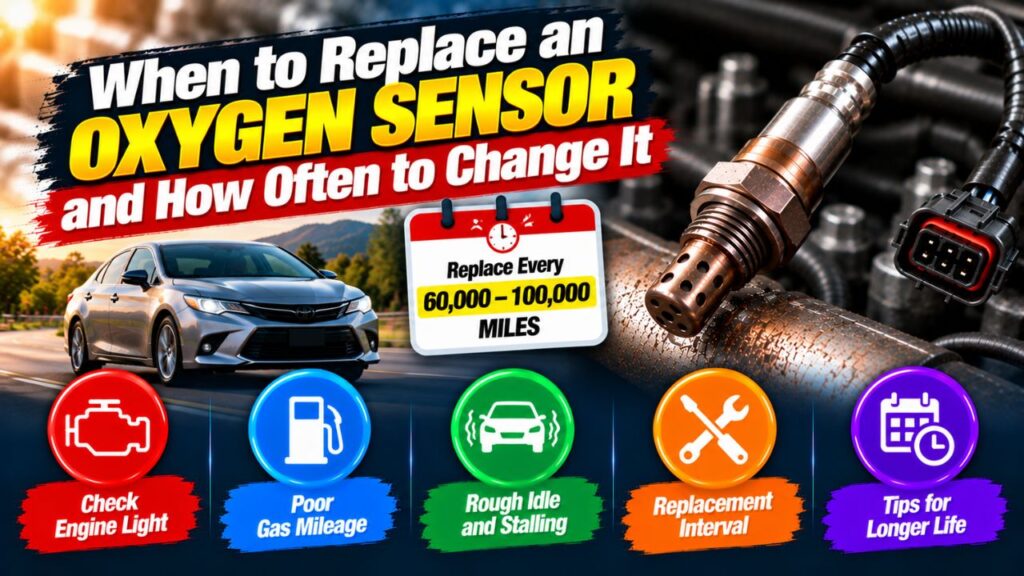
Replace an oxygen sensor when testing confirms it is slow, contaminated, electrically failed, physically damaged, or no longer providing accurate data. Most modern O2 sensors do not need automatic replacement at a fixed interval, although many can last roughly 60,000 to 100,000 miles or more.
If you are wondering when to replace an oxygen sensor, the best answer is not simply “every 100,000 miles.” Oxygen sensors age, but their actual service life depends on engine condition, sensor design, exhaust temperature, contamination, and how the vehicle is driven.
Some sensors fail relatively early because an engine burns oil, runs excessively rich, misfires, or leaks coolant into the combustion chamber. Others remain accurate well beyond 100,000 miles. That is why replacing oxygen sensors strictly according to mileage can waste money if the sensors are still working properly.
At the same time, ignoring a failed upstream sensor can affect fuel economy, emissions, drivability, and catalytic-converter health. The right approach is to combine mileage, symptoms, trouble codes, scan-tool data, and vehicle manufacturer recommendations before deciding whether replacement is actually necessary.
This guide explains how often should you replace an oxygen sensor, what symptoms matter, how upstream and downstream sensors differ, what can shorten sensor life, and how to determine whether an O2 sensor needs replacement.
When to Replace an Oxygen Sensor
You should replace an oxygen sensor when diagnosis shows that the sensor itself is faulty, not simply because a check engine light mentions an oxygen-sensor circuit.
Replacement is appropriate when the sensor has a confirmed problem such as a failed heater, slow response, damaged wiring at the sensor, contamination, physical damage, or a signal that remains outside normal operating behavior despite the rest of the engine and exhaust system being in good condition.
A sensor should also be replaced if the vehicle manufacturer lists a specific scheduled replacement interval and the sensor has reached that mileage.
For many modern vehicles, however, there is no routine O2-sensor replacement interval.
How Often Should You Replace an Oxygen Sensor?
There is no universal replacement schedule.
Older unheated oxygen sensors generally had shorter service lives, while modern heated sensors are commonly capable of lasting around 60,000 to 100,000 miles or considerably longer.
Some vehicles can retain original oxygen sensors beyond 150,000 miles.
The practical rule is:
Do not replace a modern oxygen sensor only because it has reached a certain mileage unless the vehicle manufacturer recommends it or testing shows that the sensor has deteriorated.
Mileage is useful as a clue, but it should not be treated as the diagnosis.
Why Oxygen Sensors Eventually Wear Out
An oxygen sensor sits directly in the exhaust stream and works in an extremely harsh environment.
During thousands of heating and cooling cycles, it is exposed to hot exhaust gases, combustion byproducts, moisture, fuel residue, and contaminants.
Over time, the sensing element may become slower or less accurate.
An aging sensor may still produce a signal, but its response can become sluggish enough to affect fuel control.
The internal heater can also fail independently of the sensing element.
What Does an Oxygen Sensor Do?
An oxygen sensor, commonly called an O2 sensor, measures oxygen content in the exhaust.
The engine computer uses that information to determine whether combustion is running relatively rich or lean.
The upstream oxygen sensor, located before the catalytic converter, is especially important because its feedback helps the computer adjust fuel delivery.
The downstream oxygen sensor, located after the catalytic converter, is used mainly to monitor catalytic-converter efficiency.
Because these sensors have different jobs, a failed upstream sensor may affect the way the engine runs more noticeably than a failed downstream sensor.
Upstream vs. Downstream Sensor Replacement
It is important to know which sensor has actually failed.
Upstream Oxygen Sensor
The upstream sensor has a direct role in fuel-mixture control.
A failing upstream sensor may contribute to poor fuel economy, unstable fuel trims, hesitation, rough running, or increased emissions.
Because it is exposed directly to combustion gases, it can also suffer contamination from oil, fuel, or coolant.
Downstream Oxygen Sensor
The downstream sensor monitors exhaust after it passes through the catalytic converter.
A failed downstream sensor commonly causes a check engine light or emissions-monitoring problem, but it usually has less direct influence on fuel control than the upstream sensor.
Do not replace both sensors automatically because one fails.
Should You Replace Oxygen Sensors at 60,000 Miles?
Not automatically.
Some older vehicles may have service recommendations near this range, but many modern vehicles do not require scheduled replacement at 60,000 miles.
If the sensor is operating correctly and the manufacturer does not specify replacement, there is no strong reason to remove a good sensor solely because of mileage.
However, at higher mileage, sensor performance becomes more worth evaluating if you notice fuel-economy changes, emissions problems, or relevant trouble codes.
Should You Replace an O2 Sensor at 100,000 Miles?
Again, not automatically.
One hundred thousand miles is commonly mentioned as a rough lifespan estimate for modern heated oxygen sensors, but it is not a mandatory replacement mileage for every vehicle.
A sensor may still be operating perfectly at 100,000 miles.
Another may have failed at 50,000 miles because the engine was burning oil.
Condition matters more than the odometer alone.
Can an Oxygen Sensor Last 150,000 Miles or More?
Yes.
It is entirely possible for an O2 sensor to last 150,000 miles, 200,000 miles, or even longer if the engine runs cleanly and the sensor remains uncontaminated.
High mileage alone does not prove that the sensor is bad.
However, an older sensor may respond more slowly than a new one even if it has not completely failed.
If drivability or emissions problems appear, scan-tool testing becomes useful.
Signs It May Be Time to Replace an Oxygen Sensor
A failing oxygen sensor can produce several symptoms, but none of them alone proves that the sensor is defective.
Common signs include:
- Check engine light
- Poor fuel economy
- Rough idle
- Hesitation
- Failed emissions test
- Rich or lean trouble codes
- Slow sensor response on a scan tool
A downstream sensor failure may cause fewer noticeable driving symptoms than an upstream failure.
Check Engine Light and O2 Sensor Replacement
A check engine light is one of the most common reasons people replace oxygen sensors, but this is also where misdiagnosis happens frequently.
For example, a code may indicate:
- O2 sensor circuit fault
- Sensor heater fault
- Slow response
- Signal stuck rich
- Signal stuck lean
The code tells you what the computer detected. It does not always tell you which part caused the problem.
A lean O2 reading could actually be caused by:
- Vacuum leak
- Exhaust leak
- Weak fuel pump
- Dirty injector
- Intake leak
A rich reading could come from:
- Leaking injector
- Excess fuel pressure
- Misfire
- Faulty airflow measurement
Always diagnose the underlying condition before replacing the sensor.
When a Slow Oxygen Sensor Should Be Replaced
An oxygen sensor does not have to be completely dead to be bad.
A slow-response sensor may still switch between rich and lean, but not quickly enough for proper fuel control.
This can affect:
- Fuel economy
- Emissions
- Engine response
A scan tool can help identify sluggish switching on traditional narrowband upstream sensors.
Wideband or air-fuel ratio sensors work differently and should be evaluated using the manufacturer’s diagnostic method rather than ordinary narrowband voltage expectations.
When an O2 Sensor Heater Failure Requires Replacement
Modern sensors include an internal heater so the sensor reaches operating temperature quickly.
If the heater fails, the sensor may take much longer to become active after startup.
A heater-related trouble code may result.
Before replacing the sensor, check:
- Heater circuit fuse
- Wiring
- Connector
- Power and ground
If the wiring is good and the heater inside the sensor has failed, sensor replacement is appropriate.
Replace a Sensor if It Is Physically Damaged
An oxygen sensor should be replaced if it has obvious physical damage.
Damage may include:
- Broken connector
- Melted wire insulation
- Cracked sensor body
- Impact damage
- Damaged threads
O2 sensors and their wiring are exposed under the vehicle and near extremely hot exhaust components, so physical damage is possible during exhaust repairs or from road debris.
Replace a Sensor if It Is Contaminated
Contamination can permanently damage the sensing element.
Common contaminants include:
- Engine oil
- Coolant
- Excessive fuel residue
- Silicone compounds
- Lead contamination
If the sensor is heavily contaminated, cleaning is generally not considered a reliable repair.
Replace the sensor after correcting the cause of the contamination.
Otherwise, the replacement sensor may fail again.
Oil Burning and Oxygen Sensor Life
Oil consumption can shorten O2 sensor life significantly.
Oil entering the combustion chamber leaves deposits in the exhaust system.
Those deposits can coat the oxygen sensor and interfere with its ability to measure exhaust oxygen accurately.
If your vehicle is burning oil and repeatedly damaging oxygen sensors, replacing sensors alone will not solve the underlying problem.
Investigate issues such as piston-ring wear, valve-seal wear, turbocharger problems, or PCV-system faults.
Coolant Contamination and Oxygen Sensors
Coolant entering a cylinder can also damage O2 sensors.
Possible causes include:
- Head gasket leak
- Cracked cylinder head
- Internal engine leak
If an oxygen sensor fails together with unexplained coolant loss, white exhaust smoke, or overheating, diagnose the engine before installing another sensor.
Rich Running Can Shorten Sensor Life
An excessively rich air-fuel mixture produces carbon and fuel residue.
That contamination can coat the sensing element and also overheat the catalytic converter.
If a sensor fails because the engine was running rich, replacing only the sensor may result in repeated failure.
The rich condition must also be corrected.
Misfires Can Damage O2 Sensors
A severe misfire allows unburned fuel and excess oxygen to enter the exhaust.
This can create abnormal exhaust conditions and very high catalytic-converter temperatures.
Persistent misfires can damage:
- Oxygen sensors
- Catalytic converter
- Other exhaust components
A flashing check engine light often indicates a severe misfire that should be addressed promptly.
Exhaust Leaks Can Mimic a Bad O2 Sensor
Before replacing an upstream oxygen sensor for a lean reading, inspect the exhaust system.
An exhaust leak can draw outside air into the exhaust stream.
The additional oxygen may cause the sensor to report a lean condition even though the sensor is functioning normally.
Possible leak points include:
- Exhaust manifold
- Manifold gasket
- Flange connection
- Flex pipe
- Sensor bung
Fixing the exhaust leak may restore normal sensor readings without replacing the sensor.
How to Test Before Replacement
A proper diagnosis may use a scan tool, digital multimeter, wiring diagram, and service information.
A scan tool can display sensor behavior in real time.
For a traditional narrowband upstream sensor, technicians often look at:
- Switching activity
- Response speed
- Rich/lean behavior
For a wideband sensor, diagnosis may involve:
- Air-fuel ratio data
- Pump current
- Manufacturer-specific parameters
The exact test should match the sensor type.
Fuel Trims Can Help With Diagnosis
Short-term fuel trim (STFT) and long-term fuel trim (LTFT) show how much the engine computer is adjusting fuel delivery.
Large positive fuel trims suggest the computer is adding fuel.
Large negative trims suggest it is removing fuel.
These numbers can help determine whether an O2-sensor code reflects an actual mixture problem rather than a bad sensor.
For example, high positive fuel trims combined with a vacuum leak may indicate the oxygen sensor is correctly reporting a lean condition.
Should You Replace Both O2 Sensors at the Same Time?
Usually no.
Oxygen sensors do not need to be replaced in axle-style pairs the way some suspension or brake components do.
If Bank 1 Sensor 1 is bad and the other sensors test normally, replacing only Bank 1 Sensor 1 is generally appropriate.
Replacing multiple sensors may make sense if several high-mileage sensors have confirmed slow response or similar failures, but it should be based on testing.
Should You Replace All Four Oxygen Sensors?
Not unless they all need replacement.
Many V6 and V8 vehicles have four sensors:
- Bank 1 Sensor 1
- Bank 1 Sensor 2
- Bank 2 Sensor 1
- Bank 2 Sensor 2
Replacing all four simply because one sets a code can become expensive and unnecessary.
Diagnose the sensor identified by the code first.
How to Identify Bank 1 and Bank 2
Bank 1 is the side of the engine containing cylinder No. 1.
Bank 2 is the opposite bank on engines with two cylinder banks.
Sensor numbering generally works like this:
Sensor 1 = upstream of the catalytic converter
Sensor 2 = downstream of the catalytic converter
Some exhaust systems are more complicated, so verify the layout for the exact vehicle.
Can You Replace an Oxygen Sensor Too Early?
Yes, in the sense that you may spend money replacing a perfectly functional component.
An O2 sensor is not usually improved just because it is newer.
If the existing sensor responds correctly and meets the vehicle’s diagnostic criteria, replacement may provide no noticeable benefit.
Preventive replacement can make sense when specifically recommended by the manufacturer, but random replacement is not an effective diagnostic strategy.
Can You Wait to Replace a Bad Oxygen Sensor?
That depends on the failure.
A downstream monitoring sensor fault may not immediately affect drivability, but it can still keep the check engine light on and may cause an emissions-test failure.
A bad upstream sensor is generally more important because it can affect fuel control.
Delaying replacement of a confirmed upstream sensor can contribute to:
- Poor fuel economy
- Incorrect fuel mixture
- Higher emissions
- Catalytic-converter stress
Repair confirmed faults rather than ignoring them for long periods.
Is It Safe to Drive With a Bad Oxygen Sensor?
The vehicle may still run, but that does not mean the problem should be ignored.
If the sensor failure causes or accompanies rich operation or severe misfire, continued driving can overheat the catalytic converter.
Stop driving and diagnose the vehicle promptly if the check engine light is flashing, the engine is running extremely rough, or there is a strong fuel smell.
Can You Clean an Oxygen Sensor Instead of Replacing It?
Cleaning is generally not a dependable repair.
The sensing element is delicate and may be damaged by harsh solvents.
Products such as brake cleaner or carburetor cleaner should not be treated as O2-sensor restoration methods.
If contamination has permanently affected the sensor, replacement is the appropriate solution.
More importantly, fix the engine problem that caused the contamination.
How Much Does Sensor Age Matter?
Age matters, but it should be considered together with mileage and operating condition.
A 15-year-old sensor with relatively low mileage has still experienced:
- Heat cycles
- Corrosion
- Moisture
- Wiring aging
At the same time, a newer high-mileage sensor may have accumulated far more operating hours.
There is no exact age at which every oxygen sensor should automatically be replaced.
Should You Replace Oxygen Sensors Before an Emissions Test?
Not unless testing indicates a problem.
Replacing functioning sensors before an emissions inspection usually provides no benefit.
If the vehicle has:
- Check engine light
- O2-sensor code
- Fuel-trim problem
- Catalyst-monitor issue
diagnose those issues before inspection.
After repairs, the vehicle may need sufficient drive cycles for readiness monitors to complete.
Common Mistakes When Deciding When to Replace an Oxygen Sensor
One of the biggest mistakes is replacing an O2 sensor merely because a trouble code contains the words “oxygen sensor.” Codes describe a detected condition, not always the root cause.
Another mistake is replacing all sensors when only one has failed.
It is also common to overlook exhaust leaks, wiring faults, vacuum leaks, and fuel problems that can make a perfectly good sensor appear defective.
Finally, do not ignore the cause of contamination. If engine oil or coolant ruined the first sensor, the replacement may suffer the same fate unless the engine problem is repaired.
FAQs About When to Replace an Oxygen Sensor
How often should you replace an oxygen sensor?
Many modern oxygen sensors can last 60,000 to 100,000 miles or more, but there is no universal replacement interval.
Follow the vehicle manufacturer’s maintenance schedule and replace the sensor when diagnosis confirms deterioration or failure.
Do oxygen sensors need to be replaced at 100,000 miles?
Not necessarily.
A sensor may still work correctly beyond 100,000 miles. Replace it based on manufacturer recommendations or confirmed performance problems.
Should I replace an O2 sensor if there is no check engine light?
Usually not unless testing shows the sensor is slow or inaccurate, or the manufacturer lists a scheduled replacement interval.
Can a bad oxygen sensor cause poor gas mileage?
Yes.
A failing upstream sensor can contribute to incorrect fuel adjustments and reduced fuel economy.
Should both upstream and downstream sensors be replaced together?
No.
Replace only the sensor or sensors that are confirmed faulty unless there is another specific reason to replace multiple units.
How do I know if an oxygen sensor is slow?
A scan tool can reveal sensor response behavior.
Traditional narrowband upstream sensors should respond quickly to mixture changes once the engine is warm. Wideband sensors require a different diagnostic approach.
Can an oxygen sensor fail without a code?
Yes.
A sensor may become sluggish before it deteriorates enough to trigger a diagnostic trouble code.
What happens if you never replace a bad O2 sensor?
A failed upstream sensor can contribute to poor fuel economy, increased emissions, drivability problems, and catalytic-converter stress. A failed downstream sensor can prevent proper catalyst monitoring and keep the check engine light on.
Conclusion
If you are deciding when to replace an oxygen sensor, the best rule is to replace it when testing confirms the sensor is no longer performing correctly, when it has suffered physical or chemical damage, or when the vehicle manufacturer specifies a scheduled replacement interval.
As for how often should you replace an oxygen sensor, there is no universal mileage that applies to every vehicle. Modern heated O2 sensors commonly last around 60,000 to 100,000 miles or more, and many continue operating well beyond that range. Mileage should therefore be treated as a guideline, not an automatic replacement trigger.
The most practical approach is to consider the complete picture: check engine codes, sensor response, heater operation, fuel trims, wiring, exhaust leaks, engine condition, oil consumption, coolant loss, and manufacturer recommendations. A code that mentions an oxygen sensor does not automatically mean the sensor itself is defective.
The final verdict is simple: do not replace oxygen sensors blindly by mileage, but do not ignore a sensor that has been properly diagnosed as slow, contaminated, damaged, or electrically failed. Correct diagnosis protects your fuel economy, emissions performance, catalytic converter, and repair budget while preventing unnecessary parts replacement.