What Is a Catalytic Converter? How It Works and Why Cars Need It
A catalytic converter is an emissions-control device installed in a vehicle’s exhaust system. It uses catalyst-coated internal material to change harmful combustion gases into less harmful substances before they leave the tailpipe. Gasoline vehicles commonly use converters that reduce carbon monoxide, unburned hydrocarbons, and nitrogen oxides.
The converter does not work like a conventional filter that simply catches exhaust. Instead, chemical reactions occur as hot gases pass across catalyst materials inside its honeycomb-like core.
For anyone asking what is a catalytic converter, think of it as a chemical treatment chamber positioned in the exhaust stream. The engine produces combustion gases, the converter processes several harmful compounds, and the cleaned exhaust continues toward the muffler and tailpipe.
Catalytic converters became widespread on U.S. passenger cars during the 1975 model year as manufacturers responded to stricter federal emissions standards. Modern versions work with electronic fuel injection, oxygen sensors, and the engine computer to control exhaust emissions far more precisely.
The EPA has reported that modern passenger vehicles emit roughly 99% less of several common pollutants than vehicles built in the 1960s. Catalytic converters are one of the major technologies behind that reduction.
Understanding what the converter does also makes it easier to recognize why misfires, excessive fuel, oil burning, coolant leaks, and physical damage can shorten its life.
What Does a Catalytic Converter Do?
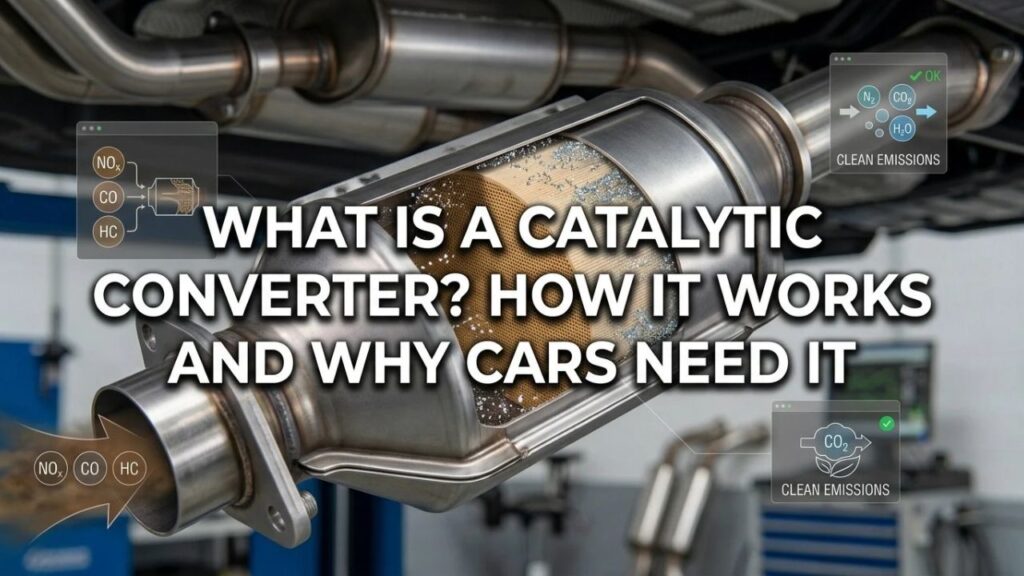
A catalytic converter changes several harmful exhaust pollutants into less harmful compounds through chemical reactions.
It operates after combustion has already taken place inside the engine.
It Reduces Carbon Monoxide
Carbon monoxide, or CO, forms when fuel does not burn completely.
It is a toxic gas that can interfere with the body’s ability to carry oxygen.
Inside the converter, carbon monoxide is oxidized primarily into carbon dioxide.
It Reduces Unburned Hydrocarbons
Hydrocarbons are fuel molecules that pass through the engine without fully burning.
They contribute to air pollution and ground-level ozone formation.
The converter oxidizes many hydrocarbons into:
- Carbon dioxide
- Water vapor
It Reduces Nitrogen Oxides
High combustion temperatures can cause nitrogen and oxygen in the intake air to react and create nitrogen oxides, commonly written as NOx.
Modern three-way catalytic converters reduce NOx primarily into:
- Nitrogen
- Oxygen
This reaction occurs alongside the oxidation of carbon monoxide and hydrocarbons.
Key Takeaway: A catalytic converter chemically changes carbon monoxide, hydrocarbons, and nitrogen oxides into less harmful exhaust products before they leave the tailpipe.
How Does a Catalytic Converter Work?
The process depends on heat, exhaust flow, catalyst materials, and accurate air-fuel control.
Exhaust Enters the Converter
After combustion, exhaust gases leave the cylinders through the exhaust valves.
They then pass through parts such as:
- Exhaust manifold
- Turbocharger on applicable engines
- Exhaust piping
- Catalytic converter
The exact arrangement varies by vehicle.
Some engines place a converter very close to the exhaust manifold so it heats quickly after startup.
Exhaust Passes Through a Honeycomb Core
Inside the converter is a substrate containing thousands of small passages.
The substrate may be made from ceramic or metallic material.
The honeycomb structure creates a very large surface area without completely blocking exhaust flow.
Catalyst Materials Cover the Internal Surface
The honeycomb is coated with materials that support the chemical reactions.
Common precious-metal catalysts include:
- Platinum
- Palladium
- Rhodium
These metals participate in reactions without being consumed in the same way as ordinary fuel.
Heat Activates the Reactions
A catalytic converter works poorly when completely cold.
As exhaust temperature rises, the catalyst reaches a range where its reactions become much more active.
This is why emissions can be higher during the first moments after a cold start.
Modern vehicles often place converters closer to the engine to reduce warm-up time.
Oxygen Sensors Help Control the Process
Gasoline engines commonly have an oxygen or air-fuel sensor before the converter.
The engine computer uses that sensor to make fuel corrections.
Many vehicles also use another oxygen sensor after the converter.
The downstream sensor helps the computer evaluate catalyst performance.
Key Takeaway: Hot exhaust flows through a catalyst-coated honeycomb, where chemical reactions reduce pollutants while oxygen sensors and the ECU help maintain the conditions needed for proper catalyst operation.
Where Is the Catalytic Converter Located?
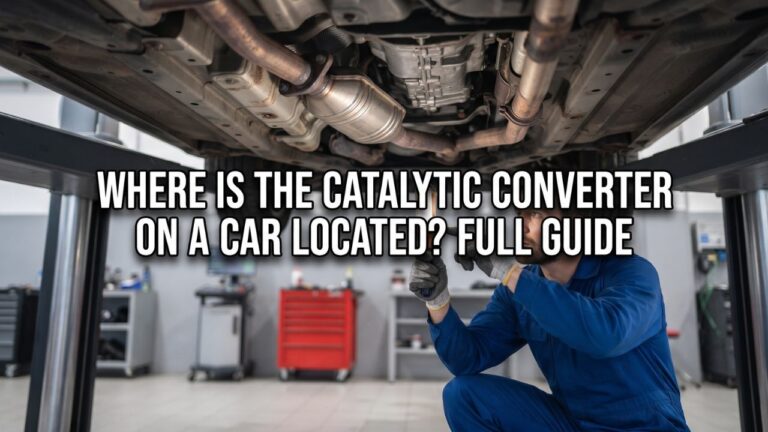
The converter is located somewhere in the exhaust system between the engine and tailpipe.
The exact position depends on the vehicle.
Close-Coupled Catalytic Converter
Many modern vehicles place at least one converter close to the exhaust manifold.
This design helps the converter heat rapidly after startup.
It may be:
- Attached directly to the exhaust manifold
- Integrated into the manifold
- Positioned just below the engine
Underbody Catalytic Converter
Another converter may sit farther underneath the vehicle.
It is typically found along the exhaust pipe before the muffler.
Vehicles Can Have More Than One Converter
Some vehicles use:
- One converter
- Two converters
- Several small converters
- Separate converters for each cylinder bank
V6 and V8 engines often have different exhaust paths for each cylinder bank, so multiple converters are common.
Key Takeaway: Catalytic converters sit in the exhaust system between the engine and tailpipe, with modern vehicles often using one near the engine and sometimes additional converters farther downstream.
What Is Inside a Catalytic Converter?
The outside looks like a metal exhaust canister, but most of the important parts are hidden inside.
Stainless-Steel Housing
The outer shell protects the catalyst from:
- Road debris
- Moisture
- Exhaust pressure
- Physical damage
It also connects the converter to the exhaust system.
Honeycomb Substrate
Inside the housing is a structure containing many tiny channels.
The substrate is often made from ceramic material.
Its job is to provide a large surface for exhaust gases to contact while allowing those gases to continue flowing.
Washcoat
A porous coating called a washcoat covers the substrate.
It increases usable surface area and helps distribute catalyst materials.
Platinum
Platinum can promote oxidation reactions involving carbon monoxide and hydrocarbons.
Palladium
Palladium also plays a major role in oxidation reactions and is widely used in gasoline catalytic converters.
Rhodium
Rhodium is especially useful for reducing nitrogen oxides.
It is one of the reasons modern three-way converters can treat several pollutants at once.
Key Takeaway: Inside a converter are a metal housing, honeycomb substrate, washcoat, and catalyst materials such as platinum, palladium, and rhodium.
What Are the Different Types of Catalytic Converters?
Converter designs have changed as emissions regulations and engine technology have developed.
Two-Way Catalytic Converter
Early gasoline catalytic converters were primarily oxidation catalysts.
They reduced:
- Carbon monoxide
- Hydrocarbons
They are often called two-way converters.
Three-Way Catalytic Converter
Modern gasoline vehicles commonly use three-way catalyst technology.
A three-way converter treats:
- Carbon monoxide
- Hydrocarbons
- Nitrogen oxides
It relies heavily on accurate control of the air-fuel mixture.
Diesel Oxidation Catalyst
Diesel engines commonly use a diesel oxidation catalyst, or DOC.
It primarily oxidizes:
- Carbon monoxide
- Hydrocarbons
Modern diesel vehicles may also have separate emissions components such as:
- Diesel particulate filter
- SCR catalyst
- Diesel exhaust fluid system
These parts perform different jobs even though they are installed within the same exhaust-aftertreatment system.
Key Takeaway: Gasoline vehicles commonly use three-way converters, while diesel engines may use oxidation catalysts along with DPF and SCR systems.
Why Do Cars Need Catalytic Converters?
Internal-combustion engines produce pollutants as fuel burns.
Without exhaust treatment, those compounds would leave the tailpipe in much larger quantities.
They Reduce Harmful Tailpipe Emissions
The converter lowers the amount of several pollutants released into the surrounding air.
That includes gases linked to:
- Smog
- Ground-level ozone
- Respiratory irritation
- Carbon monoxide exposure
They Help Vehicles Meet Emissions Standards
New vehicles sold in the United States must meet applicable emissions requirements.
The catalytic converter forms part of the certified emissions-control system on gasoline vehicles.
They Work With Other Emissions Components
A converter does not control emissions alone.
Modern systems can also include:
- Oxygen sensors
- EGR systems
- EVAP systems
- PCV systems
- Electronic fuel injection
- Engine management software
Each part handles a different aspect of emissions control.
Key Takeaway: Cars need catalytic converters to reduce harmful exhaust pollutants and meet emissions standards as part of a larger engine-management and emissions-control system.
When Did Cars Start Using Catalytic Converters?
Catalytic converters became widespread in the United States during the 1975 model year.
The Clean Air Act of 1970 established much stricter emissions targets for new automobiles.
Automakers needed better ways to reduce pollutants, and catalytic technology became a major solution.
Unleaded Gasoline Was Important
Older gasoline commonly contained lead compounds.
Lead could contaminate catalyst surfaces and prevent converters from functioning properly.
The growth of converter-equipped vehicles therefore occurred alongside the move toward unleaded gasoline.
Early Converters Were Simpler
Many early units were oxidation catalysts designed mainly to reduce:
- Hydrocarbons
- Carbon monoxide
Three-Way Converters Came Later
As oxygen sensors and electronic fuel controls improved, three-way converters became common.
These converters could also reduce nitrogen oxides while controlling hydrocarbons and carbon monoxide.
Key Takeaway: Catalytic converters became widespread on U.S. cars beginning with the 1975 model year, followed later by more advanced three-way catalyst systems.
Does Every Car Have a Catalytic Converter?
No.
Vehicle design and power source determine if one is needed.
Gasoline Cars
Modern gasoline vehicles generally use one or more catalytic converters.
Hybrid Cars
Hybrid vehicles that contain a gasoline engine still produce combustion exhaust.
They therefore use catalytic converters.
Plug-In Hybrids
Plug-in hybrids also contain combustion engines, so they typically need catalytic converters when the engine operates.
Battery-Electric Vehicles
Fully electric vehicles do not burn gasoline or diesel.
They have no combustion exhaust system and therefore do not need a conventional catalytic converter.
Examples include battery-electric models from Tesla and many other manufacturers.
Older Vehicles
Some vehicles built before widespread catalyst adoption were manufactured without catalytic converters.
Their emissions equipment depends on model year and original certification.
Key Takeaway: Gasoline vehicles and hybrids generally have catalytic converters, while fully electric vehicles do not because they produce no combustion exhaust.
Does a Catalytic Converter Reduce Engine Power?
A healthy converter is designed to allow adequate exhaust flow while controlling emissions.
It should not create a noticeable power problem when operating correctly.
A Clogged Converter Can Reduce Power
If the internal honeycomb melts or becomes blocked, exhaust flow is restricted.
Symptoms may include:
- Weak acceleration
- Trouble reaching high RPM
- Poor hill climbing
- Rough running
- Stalling
The problem comes from abnormal restriction, not from normal catalyst operation.
High-Flow Converters Exist
Performance exhaust systems sometimes use converters designed for increased flow.
The vehicle still needs to meet applicable emissions requirements.
Removing a required catalytic converter is not the same as installing a properly certified replacement.
How Long Does a Catalytic Converter Last?
There is no fixed replacement interval for most vehicles.
A converter may last well beyond 100,000 miles and often remains functional for much of the vehicle’s service life.
Its lifespan depends heavily on engine condition.
Conditions That Shorten Converter Life
Common causes include:
- Persistent misfire
- Rich air-fuel mixture
- Oil burning
- Coolant entering the cylinders
- Physical impact
- Severe overheating
The converter is often damaged by another problem rather than simply wearing out on its own.
What Causes a Catalytic Converter to Fail?
Converter failure can be chemical, structural, or related to restricted exhaust flow.
Misfires
A misfire can allow unburned fuel into the exhaust.
That fuel may burn inside the converter and create intense heat.
The internal substrate can eventually melt.
Rich Fuel Mixture
Excessive fuel delivery can create similar overheating.
Possible causes include:
- Leaking injector
- Fuel-pressure problem
- Ignition failure
- Incorrect sensor readings
Oil Burning
Engine oil passing into the combustion chambers can coat or contaminate catalyst surfaces.
Coolant Leaks
Coolant entering the cylinders can also contaminate the converter.
Physical Impact
Road debris, curbs, or collisions can crack the substrate.
Broken pieces may begin rattling or obstruct exhaust flow.
Key Takeaway: Misfires, rich fueling, oil consumption, coolant contamination, extreme heat, and physical damage are major causes of catalytic converter failure.
What Are the Symptoms of a Bad Catalytic Converter?
The symptoms depend on the type of failure.
A converter with poor chemical efficiency may cause little change in drivability.
A clogged or broken converter can cause much stronger symptoms.
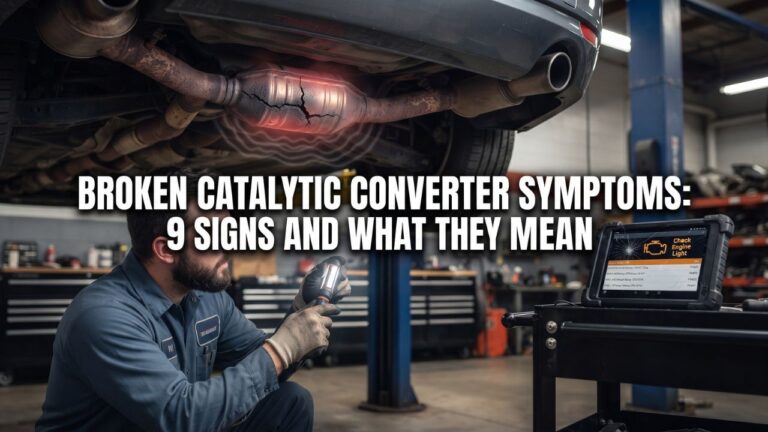
Check Engine Light
Common catalyst-related codes include:
- P0420
- P0430
These codes generally indicate catalyst efficiency below the expected threshold.
They do not prove the converter is clogged.
Loss of Power
A blocked converter can create exhaust backpressure.
Power loss often becomes more noticeable at higher RPM.
Slow Acceleration
The vehicle may feel sluggish or unable to respond normally when the accelerator is pressed.
Rough Idle or Stalling
A severe restriction can affect normal cylinder breathing enough to create unstable engine operation.
Rattling
Broken ceramic material inside the housing may produce a metallic rattle.
Sulfur-Like Odor
Some exhaust faults can produce a sulfur or rotten-egg-like smell.
This odor alone does not prove the converter is defective.
Key Takeaway: A bad converter may cause catalyst codes, power loss, sluggish acceleration, rough running, stalling, or rattling, but the symptoms vary according to the failure type.
What Do P0420 and P0430 Mean?
These are common catalyst-related diagnostic trouble codes.
P0420
P0420 generally means:
Catalyst System Efficiency Below Threshold — Bank 1.
P0430
P0430 generally means:
Catalyst System Efficiency Below Threshold — Bank 2.
Bank 2 applies only to engines that have more than one cylinder bank.
These Codes Do Not Automatically Mean the Converter Is Clogged
The engine computer evaluates catalyst operation using sensor data.
A converter may have poor chemical efficiency while still flowing exhaust normally.
Other problems can also influence catalyst-monitor results, including:
- Exhaust leaks
- Misfires
- Fuel-mixture problems
- Sensor faults
Diagnosis should come before replacement.
Key Takeaway: P0420 and P0430 point toward catalyst-efficiency problems, but neither code proves that the converter is physically clogged.
Can You Drive With a Bad Catalytic Converter?
It depends on the failure.
A vehicle with a steady catalyst-efficiency code and normal drivability may remain operable while diagnosis is arranged.
Driving becomes more concerning when the vehicle develops:
- Severe power loss
- Flashing check engine light
- Repeated stalling
- Heavy misfire
- Smoke
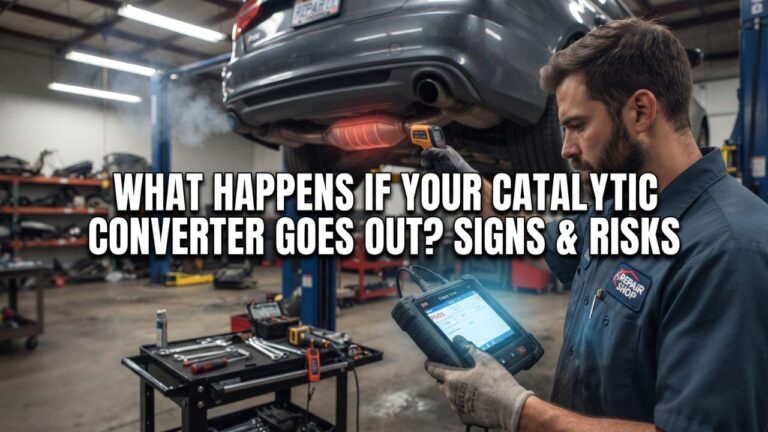
- Glowing converter
- Exhaust fumes in the cabin
A severely clogged converter can eventually make the vehicle unsafe to drive in normal traffic.
Can a Catalytic Converter Be Cleaned?
A physically healthy converter with minor deposits is different from a converter whose internal substrate has melted or collapsed.
Chemical cleaning cannot rebuild damaged ceramic material.
A converter with:
- Melted honeycomb
- Broken substrate
- Collapsed passages
- Major internal restriction
generally needs replacement.
The engine problem that caused the damage should be repaired first.
How Much Does a Catalytic Converter Cost to Replace?
Replacement cost varies widely.
Major factors include:
- Vehicle make and model
- Engine
- Number of converters
- OEM versus aftermarket part
- Converter location
- Labor required
- Emissions certification
- State requirements
Some vehicles use converters integrated into the exhaust manifold, making parts and labor more expensive.
Before paying for an early failure, check the vehicle’s emissions warranty. On qualifying U.S. light-duty vehicles, the catalytic converter is generally among major emissions components covered for 8 years or 80,000 miles under federal requirements.
Why Are Catalytic Converters Stolen?
Converters contain small amounts of valuable precious metals.
Depending on the converter design, those metals can include:
- Platinum
- Palladium
- Rhodium
Some vehicles also place the converter where it is relatively easy to reach from underneath.
Converter theft can leave the vehicle with:
- Very loud exhaust
- Check engine light
- Cut oxygen-sensor wiring
- Exhaust fumes
- Missing exhaust sections
The vehicle should be repaired with the correct emissions-compliant replacement.
Is It Illegal to Remove a Catalytic Converter?
Required emissions equipment generally cannot legally be removed or defeated for normal road use in the United States.
A vehicle originally certified with a catalytic converter should be repaired with a suitable replacement if the converter fails.
Hollowing out the converter or installing a straight pipe is not a proper repair for a street-driven vehicle.
Conclusion
So, what is a catalytic converter? It is an exhaust emissions-control device that uses catalyst materials to convert several harmful combustion pollutants into less harmful compounds before the exhaust leaves the vehicle.
The converter contains a honeycomb substrate coated with materials such as platinum, palladium, and rhodium. Hot exhaust passes through thousands of small channels where chemical reactions reduce carbon monoxide, hydrocarbons, and nitrogen oxides.
A healthy catalytic converter normally requires no routine replacement. Engine misfires, excessive fuel, oil burning, coolant contamination, overheating, and physical damage are the problems most likely to shorten its service life.
If a vehicle develops catalyst codes, rattling, severe power loss, overheating, or poor acceleration, diagnose the engine and exhaust system before replacing the converter. Fixing the underlying cause protects the replacement from failing again.
FAQs About What a Catalytic Converter Is
What is a catalytic converter in simple terms?
A catalytic converter is a part of the exhaust system that chemically changes harmful engine pollutants into less harmful gases before they leave the tailpipe.
What is the main purpose of a catalytic converter?
Its main purpose is to reduce harmful exhaust emissions. Modern gasoline converters treat carbon monoxide, unburned hydrocarbons, and nitrogen oxides.
What is inside a catalytic converter?
Most contain a honeycomb-like ceramic or metallic substrate, a washcoat, and catalyst materials that can include platinum, palladium, and rhodium. The honeycomb provides a large surface area for exhaust reactions.
Does a catalytic converter filter exhaust?
Not in the same way as an ordinary physical filter. A gasoline catalytic converter primarily promotes chemical reactions. A diesel particulate filter is the component specifically designed to trap particulate matter in many modern diesel systems.
Do electric cars have catalytic converters?
Fully battery-electric vehicles do not because they have no combustion engine or conventional exhaust system. Hybrids and plug-in hybrids still use converters because their gasoline engines produce exhaust.
How do I know if my catalytic converter is bad?
Possible signs include P0420 or P0430, rattling, sluggish acceleration, loss of high-RPM power, rough running, stalling, or abnormal converter heat. Testing is needed because several other faults can produce similar symptoms.
Can a car run without a catalytic converter?
A gasoline engine may physically run without one, but a vehicle designed with a converter can become very loud, trigger warning lights, produce excessive emissions, and violate emissions requirements if the converter is removed.
How long should a catalytic converter last?
Many converters last more than 100,000 miles and some remain functional for most of the vehicle’s life. Misfires, rich running, oil burning, coolant leaks, overheating, and impact damage can cause much earlier failure.