What Does a Bad Catalytic Converter Sound Like? Rattle & Noise
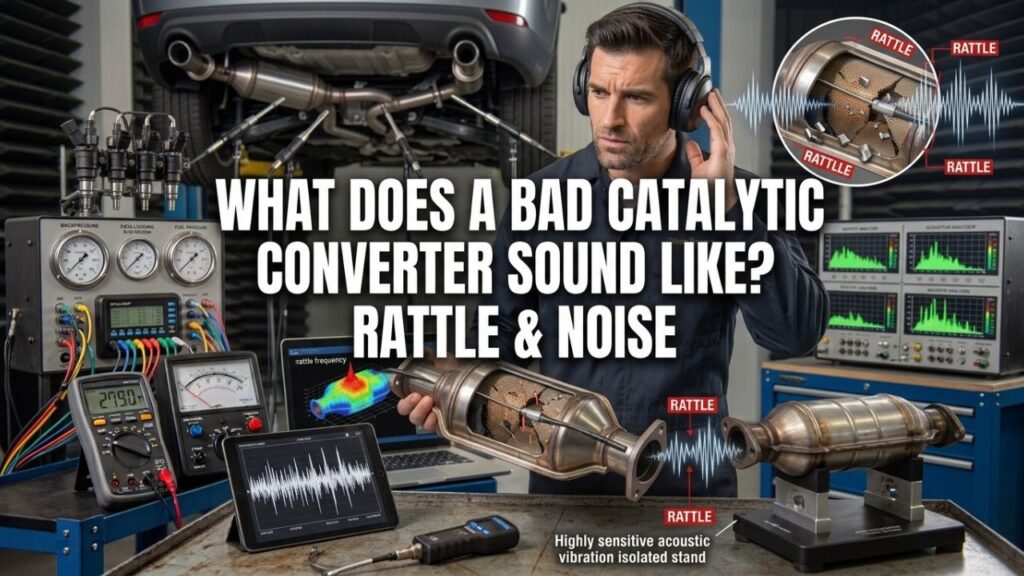
A failing catalytic converter most often makes a metallic rattle from underneath the vehicle when its internal honeycomb breaks apart. You may hear it at startup, idle, or during acceleration. A loose heat shield can create a similar tinny rattle, while a clogged converter may cause unusual exhaust noise along with weak acceleration rather than a distinct sound.
Sound matters because converter problems do not all fail in the same way. A broken internal substrate can rattle inside the housing, a rusty heat shield can buzz against the shell, and an exhaust leak near the converter can create a louder ticking, puffing, or roaring noise.
The useful clue is how the sound behaves. A rattle that changes with engine RPM points toward a loose or broken component, while noise paired with power loss, hard starting, or poor acceleration raises more concern about exhaust restriction.
For U.S. vehicles, the EPA classifies the catalytic converter as a specified major emissions-control component. On qualifying light-duty vehicles, federal emissions warranty coverage for the converter extends to 8 years or 80,000 miles, subject to the warranty requirements.
If you are asking what does a bad catalytic converter sound like, listen mainly for a metallic rattle, clattering from beneath the car, or a new exhaust noise near the converter. Keep in mind that a converter can also fail chemically and set a P0420 or P0430 code without making any unusual sound.
A loose heat shield, cracked exhaust pipe, bad muffler, broken hanger, or internal muffler damage can sound much like converter trouble. The best diagnosis combines the sound with engine performance, fault codes, a physical inspection, and exhaust-flow checks.
The sections below explain each common sound, what causes it, how to separate converter noise from other exhaust problems, and when the vehicle should be inspected.
What Does a Bad Catalytic Converter Sound Like?
A bad catalytic converter does not have one universal sound. The noise depends on what has failed inside or around the converter.
The most characteristic sound is a metallic rattle or clatter coming from the converter area. Walker notes that cracked substrate or damaged internal matting can leave loose components inside the converter housing, which can be detected during inspection.
Metallic Rattling or Clattering
Inside many catalytic converters is a ceramic honeycomb coated with catalyst material. The honeycomb needs to remain secured inside the metal shell.
Heat damage, impact, age, contamination, or repeated thermal stress can crack that structure. Pieces may then move inside the housing.
The result can sound like:
- Small stones shaking inside a metal can
- A light metallic clatter
- A buzzing rattle
- A loose object vibrating under the floor
Firestone also identifies a broken converter core as a source of rattling or clattering from the exhaust area.
The sound may be strongest during cold startup, idle changes, acceleration, or when engine RPM passes through a certain range.
Tinny Buzz From the Heat Shield
A rattling sound near the converter does not always mean the catalyst itself has broken.
Converters operate at high temperatures, so manufacturers install metal heat shields around or near them. Corrosion, a broken weld, a bent shield, or a missing fastener can let the shield vibrate.
A loose shield often makes a thin, tinny buzz rather than the heavier sound of loose material inside the converter.
The noise may appear at one narrow RPM range and disappear when engine speed changes. AutoZone describes loose heat-shield noise as a tinny rattle that can be noticeable during startup or acceleration.
Louder Exhaust or Roaring Noise
A converter with a cracked shell, broken flange, failed weld, or nearby exhaust leak may make the exhaust noticeably louder.
You may hear:
- A low roar
- Puffing
- Ticking
- A sharp exhaust beat
- A sound similar to a leaking muffler
This type of noise usually points toward an exhaust leak around the converter rather than poor catalyst chemistry alone.
A leak can also allow exhaust gases into areas where they do not belong, so it should not be ignored.
Key Takeaway: Metallic rattling is the classic converter sound, but a tinny heat-shield buzz or loud exhaust leak can sound very similar and needs separate inspection.
What Does a Clogged Catalytic Converter Sound Like?
A clogged converter may make surprisingly little noise.
The main symptom is often restricted engine breathing, which shows up as poor acceleration, reduced power, or difficulty reaching higher RPM.
AutoZone lists rattling or metallic noises among possible clogged-converter symptoms, but restriction can also exist without a clear converter-specific sound.
Hissing or Restricted Exhaust Noise
A severe restriction may alter the sound of exhaust leaving the engine.
You might notice a strained, muted, or unusual hissing quality during acceleration. This sound alone does not prove the converter is clogged because exhaust leaks, intake leaks, turbo plumbing, and other faults can make similar noises.
The stronger clue is hissing or strained exhaust combined with power loss.
If the engine revs normally at idle but struggles badly under load, exhaust backpressure deserves attention.
Engine Sounds Strained Under Acceleration
A restricted converter can make the engine sound as if it is working harder without producing matching acceleration.
The exhaust may seem muffled or choked, and the engine can feel unwilling to rev freely.
Walker states that excessive backpressure ahead of the converter can indicate converter restriction. Its diagnostic guidance also notes that backpressure needs to be checked as part of converter diagnosis rather than judging the component from one symptom.
Severe Restriction May Cause Stalling
If enough of the internal honeycomb melts or collapses, exhaust flow can become heavily restricted.
The vehicle may:
- Start and then stall
- Lose power as RPM rises
- Struggle on hills
- Refuse to accelerate normally
- Become difficult to restart
At this stage, sound becomes less useful than the performance symptoms.
Key Takeaway: A clogged converter may sound muted, strained, or slightly hissy, but loss of power and exhaust restriction are stronger clues than noise alone.
Why Does a Bad Catalytic Converter Rattle?
Converter rattling usually means something has become physically loose.
The most common source is the internal substrate, though the converter shell and surrounding heat shield can create similar sounds.
Broken Honeycomb Material
The catalyst substrate contains many small exhaust passages.
If that structure cracks, pieces can move inside the housing as the engine vibrates. AutoZone lists a broken substrate as a common reason for rattling underneath the vehicle.
Damage can follow years of heat cycling, physical impact, or severe overheating.
Converter Overheating
Misfires and rich air-fuel mixtures can send unburned fuel into the exhaust.
That fuel may burn inside the converter and raise internal temperature enough to damage or melt the substrate.
Walker states that temperatures above about 1,600°F may damage catalyst material, while still higher temperatures can destroy the substrate or its supporting mat.
Once the structure cracks or melts unevenly, loose pieces can begin rattling.
Road Impact
Catalytic converters sit under the vehicle where road debris, curbs, rocks, and other objects can strike the exhaust.
A hard impact may dent the shell or crack the internal ceramic without creating an obvious exhaust leak.
If rattling begins shortly after the vehicle bottoms out or hits debris, physical damage should be considered.
Corrosion and Broken Heat Shields
Rust can weaken the outer shell, mounting points, welds, brackets, and heat shields.
A loose shield may sound almost identical to internal converter damage from the driver’s seat.
That is why replacing the converter based only on a rattle is risky.
Key Takeaway: Converter rattles usually come from broken internal substrate, overheating damage, impact, or loose surrounding metal such as a heat shield.
When Does a Bad Catalytic Converter Rattle the Most?
The timing of the noise can narrow down the cause.
Listen for patterns rather than focusing only on volume.
Rattle at Startup
A broken substrate or loose heat shield may rattle most strongly during startup because engine vibration changes quickly as the engine catches and settles into idle.
Cold exhaust parts can also have slightly different clearances than hot parts.
If the noise fades as the vehicle warms, that does not rule out a converter or shield problem.
Rattle at Idle
A loose internal piece may vibrate while the engine idles.
The sound can stop when RPM changes because the exhaust system moves through a different vibration frequency.
A heat shield is also very likely to buzz at a particular idle speed.
Rattle During Acceleration
Acceleration increases exhaust flow and engine movement.
Loose substrate pieces may move more, and damaged exhaust mounts or shields can vibrate against nearby components.
If rattling under acceleration appears together with sluggish power, a damaged or restricted converter becomes more suspicious.
Rattle When Revving in Park
A rattle that follows RPM can help locate the general area, but repeatedly revving an engine is not a substitute for inspection.
Have someone listen from a safe position outside the vehicle while the car is stationary, parking brake applied, and transmission in Park.
Do not crawl under a running vehicle supported only by a jack.
Key Takeaway: Startup, idle, and acceleration can each trigger converter-related rattles, and the RPM pattern can help separate vibration noises from constant exhaust leaks.
Bad Catalytic Converter Sound vs Loose Heat Shield
These two problems are commonly confused because both occur in almost the same location.
| Clue | Broken Converter Substrate | Loose Heat Shield |
| Sound | Metallic clatter or internal rattle | Thin buzz or tinny vibration |
| Location | Inside converter shell | Outside converter or exhaust |
| Changes with RPM | Often | Often |
| Power loss | Possible if restriction develops | Usually no |
| Check-engine light | Possible | Usually no |
| P0420/P0430 | Possible | Not normally caused by shield alone |
| Exhaust restriction | Possible | No |
| Repair | Converter diagnosis/replacement | Shield fastening or replacement |
A heat shield problem is often much cheaper to fix than a converter.
I recommend checking the shield and nearby exhaust brackets before assuming an internal converter failure, especially when the vehicle runs normally and no catalyst-related code is stored.
Bad Catalytic Converter Sound vs Exhaust Leak
An exhaust leak usually creates a different sound from loose converter material.
Leaks near the engine can produce a sharp tick or puff that speeds up with RPM. Larger leaks can make the exhaust sound deep, rough, or much louder than normal.
A converter rattle sounds more like loose material shaking inside metal.
The two can exist together. Corrosion around the converter flange or shell may create both an exhaust leak and loose metal.
Walker notes that cracked seams, leaking flex joints, and damaged exhaust sections can produce excessive exhaust noise.
If exhaust fumes can be smelled inside the cabin, have the system inspected promptly. Carbon monoxide in exhaust is hazardous.
Can a Bad Catalytic Converter Make No Noise?
Yes.
A converter can stop cleaning exhaust correctly while remaining mechanically intact and unrestricted.
In that case, the first sign may simply be:
- Check-engine light
- P0420 code
- P0430 code
- Failed emissions inspection
The converter does not need to rattle to be bad.
Its catalyst coating can degrade or become contaminated while the honeycomb stays firmly mounted.
This is why listening tests alone cannot confirm converter condition.
Other Symptoms to Check Along With the Sound
Noise becomes more useful when paired with other converter symptoms.
Check-Engine Light
Catalyst-efficiency codes such as P0420 and P0430 may appear when onboard monitoring detects poor converter operation.
Those codes do not prove the converter is physically broken or clogged. Oxygen-sensor problems, exhaust leaks, misfires, and fuel-control faults can also affect catalyst-monitor readings.
Poor Acceleration
A restricted converter can block exhaust flow and make acceleration noticeably weaker.
This symptom carries more weight if the power loss grows worse as engine RPM rises.
Rotten-Egg Smell
A sulfur-like smell can appear with exhaust or catalyst problems.
It may also indicate a rich-running engine or another combustion issue feeding abnormal exhaust into the converter.
Reduced Gas Mileage
Restriction can force the engine to work harder and increase throttle demand.
A rich mixture or misfire that damaged the converter can also lower fuel economy before the converter itself becomes restricted.
Excessive Heat
A converter running abnormally hot may be dealing with excess fuel or another upstream engine problem.
Do not touch the exhaust system while it is hot. Catalytic converters operate at temperatures capable of causing serious burns.
Key Takeaway: Converter noise becomes more meaningful when it appears with catalyst codes, weak acceleration, sulfur odor, poor fuel economy, or abnormal heat.
How to Check a Catalytic Converter Noise
Start with basic checks before replacing parts.
1. Identify Where the Sound Comes From
Listen near the center or front portion of the exhaust system, depending on converter location.
Some vehicles have more than one converter, including units mounted close to the exhaust manifold.
Do not assume every under-car rattle comes from the converter.
2. Check the Heat Shields
With the exhaust completely cool and the vehicle safely supported, inspect converter shields for corrosion, missing fasteners, bent edges, or contact with the exhaust.
A shield that moves easily by hand may explain the noise.
Do not remove heat shields simply to eliminate a rattle. They protect nearby components and the vehicle body from exhaust heat.
3. Scan for Diagnostic Codes
Connect an OBD-II scan tool and check stored, pending, and permanent codes.
P0420 or P0430 can support a catalyst diagnosis, but also look for misfire, fuel-trim, oxygen-sensor, and air-fuel sensor codes.
Those other faults may explain why the converter failed.
4. Check for Exhaust Restriction
A technician can perform an exhaust backpressure test through an appropriate test port.
Walker states that excessive pressure ahead of the converter points toward converter restriction, while excessive pressure farther downstream can indicate another exhaust blockage.
This is much stronger evidence than sound alone.
5. Inspect for Physical Damage
Look for dents, crushed areas, corrosion, broken welds, damaged flanges, or evidence that the vehicle struck something.
A damaged converter shell can be a clue that the internal substrate was also affected.
Key Takeaway: Locate the sound, inspect shields and exhaust joints, scan for codes, and test exhaust flow before deciding the converter needs replacement.
Should You Keep Driving With a Rattling Catalytic Converter?
A slight rattle does not always mean the car will stop immediately, but it should be inspected.
If the internal substrate is broken, pieces may eventually shift and block exhaust flow. That can turn a noise problem into severe power loss.
Reduce unnecessary driving and arrange diagnosis sooner if the rattle comes with:
- Major acceleration loss
- Engine stalling
- Flashing check-engine light
- Strong misfire
- Excessive heat
- Burning smell
- Difficulty starting
- Glowing exhaust components
A flashing check-engine light commonly signals a severe misfire that can send unburned fuel into the converter. Continued driving under that condition can cause rapid catalyst damage.
Do You Need to Replace a Converter That Rattles?
If the converter’s internal substrate has broken apart, replacement is normally required.
There is no practical repair that reliably restores shattered ceramic material inside a sealed converter housing.
If the noise comes only from a loose external heat shield, the converter itself may still be usable. The shield may need proper fastening or replacement based on its condition.
Before installing a new converter, find out what damaged the old one.
Walker identifies engine misfires, fuel-mixture problems, oil contamination, coolant contamination, overheating, and physical damage among common converter failure causes.
Skipping that diagnosis can lead to another converter failure.
Conclusion
For what does a bad catalytic converter sound like, the sound most strongly associated with physical converter damage is a metallic rattle or clatter from underneath the vehicle. Broken pieces of the internal honeycomb can move inside the converter shell as the engine vibrates.
A thin buzzing noise may come from a loose heat shield instead. A cracked exhaust connection can create ticking, puffing, or roaring, while a clogged converter may cause little unusual noise and show itself mainly through poor acceleration or high exhaust backpressure.
I would not replace a converter from sound alone. Check the heat shield, exhaust joints, diagnostic codes, engine operation, and backpressure first.
If the converter rattles and the vehicle is also losing power, stalling, overheating the exhaust, or misfiring badly, have the system inspected promptly. Those added symptoms make internal damage or restriction much more likely.
FAQs About Bad Catalytic Converter Sounds
Does a bad catalytic converter make a rattling noise?
Yes. A metallic rattle is one of the more recognizable signs of physical converter damage. The ceramic honeycomb inside can crack and break into pieces that move within the metal housing. A loose heat shield can create a very similar noise, so the converter should be inspected before replacement.
What does a clogged catalytic converter sound like?
A clogged converter may not make a distinct sound. Some vehicles develop rattling, a strained exhaust note, or unusual hissing while accelerating. Loss of power, difficulty revving, stalling, and excessive exhaust backpressure are stronger signs of blockage than sound by itself.
Why does my catalytic converter rattle when I accelerate?
Acceleration increases exhaust flow and changes engine vibration, which can make broken substrate pieces or a loose heat shield move more strongly. If the rattle also comes with weak acceleration, check for internal converter damage and exhaust restriction.
Can a bad catalytic converter sound like rocks in a can?
Yes. Loose pieces of broken ceramic substrate can produce a sound similar to small stones shaking inside a metal container. That sound often changes with RPM or vehicle vibration.
Can a loose catalytic converter heat shield sound the same?
Yes. A loose heat shield can make a tinny buzzing or rattling sound from the same area. If the engine runs normally and no catalyst code is present, inspecting the shield is a sensible first step before assuming the converter core has failed.
Will a bad catalytic converter make the exhaust louder?
It can if the converter shell, flange, pipe, or nearby joint develops a leak. Broken internal substrate can also change exhaust tone. A catalyst that has only lost emissions-cleaning ability may produce no change in exhaust volume.
Can a catalytic converter be bad without making any sound?
Yes. Catalyst material can lose emissions-cleaning ability without the internal honeycomb becoming loose. The vehicle may set P0420 or P0430, fail an emissions test, or show other converter symptoms while remaining completely quiet.
Is a rattling catalytic converter safe to drive with?
A short trip may still be possible if the vehicle runs normally, but the noise should be diagnosed. Broken substrate can shift and restrict exhaust flow. Stop driving and seek service if the vehicle develops severe power loss, stalling, a flashing check-engine light, abnormal exhaust heat, or strong misfiring.